

Exact Sciences: Revolutionizing Colorectal Cancer Screening Through Non-Invasive Stool DNA Testing

Exact Sciences
Cancer Detection Device Developer
In the past two years,Exact Sciences, which built its foundation on early colorectal cancer screening, has frequently captured public attention, generating significant buzz.
Its flagship product, Cologuard, continues to see robust sales growth.On February 11 this year, Exact Sciences announced its financial results for the fourth quarter of 2019: revenue reached $257 million (approximately RMB 1.82 billion), a year-on-year increase of 107%.Last year, Exact Sciences also went into a frenzy of mergers, acquisitions, and investment-driven expansion:Acquired oncology genetic testing company Genomic Health for a total of $2.8 billion (approximately RMB 19.8 billion), and invested heavily in the emerging early-screening startup Thrive Earlier Detection to position itself in new early-screening methodologies.
Back in the day, Exact Sciences was a fledgling company that faced significant hurdles on its path to early cancer screening. Its flagship colorectal cancer early-screening product, PreGen-Plus, which took years of dedicated effort to develop, failed to secure FDA marketing approval, leaving the company’s stock price mired in a prolonged slump. Today, however, Exact Sciences not only boasts a soaring stock price but has also emerged as a powerful financial force, frequently acquiring and investing in other enterprises.As of April 30, 2020, the company’s total market capitalization reached $11.984 billion.
How did Exact Sciences execute its turnaround strategy? What is the impact of the company’s research products? As a veteran in the field of early cancer screening, Exact Sciences’ growth trajectory mirrors that of countless peer companies, offering valuable lessons for the industry. Below, we examine the company’s history to understand its primary research directions and product technologies.
Exact Sciences, founded in 1995 and headquartered in Madison, Wisconsin, USA, is a molecular diagnostics company focused on non-invasive colorectal cancer screening. It went public on the NASDAQ in January 2001. The company’s flagship product, Cologuard, was co-developed by Exact Sciences and the Mayo Clinic. It screens for colorectal cancer by qualitatively detecting DNA markers associated with colorectal neoplasia and the presence of occult hemoglobin in human stool.
The company leverages molecular biology techniques for the early diagnosis of colorectal cancer, and its stool-based DNA technology has been incorporated into the colorectal cancer screening guidelines issued by the American Cancer Society and the U.S. Multi-Society Task Force on Colorectal Cancer.
Kevin Conroy is the Chairman and Chief Executive Officer of Exact Sciences.,He holds a J.D. from the University of Michigan Law School. Kevin joined the company in 2009 and is primarily responsible for collaborating with the Board of Directors and investors, overseeing corporate strategy, fostering a culture of collaboration and innovation, and allocating company resources appropriately to maximize value.
Prior to this, Kevin served as President and Chief Executive Officer of Third Wave Technologies, and as Chief Operating Officer of a venture capital-backed technology company; he also worked as an intellectual property consultant for GE Healthcare and as an intellectual property litigator at McDermott Will & Emery.
Colorectal cancer has long been characterized by high incidence and mortality rates, resulting in substantial healthcare costs.According to data from the Global Cancer Report, the incidence of colorectal cancer has consistently ranked among the top three, while its mortality rate has long held the second position. In the United States, colorectal cancer is the second leading cause of cancer-related deaths. The National Cancer Institute (NCI) estimates that annual expenditures for the treatment of colorectal cancer exceed $14 billion.
Early screening for colorectal cancer can provide favorable conditions for the treatment of patients, but the numerous drawbacks of traditional early screening technologies are the primary reason why most people do not undergo screening.
Traditional early screening techniques for colorectal cancer primarily include fecal occult blood testing and colonoscopy.Although the fecal occult blood test (FOBT) is relatively simple and rapid, it requires annual testing, resulting in an annual compliance rate of only 31%–53% among screened individuals. Furthermore, FOBT demonstrates poor performance in detecting a range of precancerous lesions; up to 95% of sessile serrated adenomas may be missed, yet these adenomas carry a 30% risk of progressing to colorectal cancer. Moreover, most health systems and medical groups lack the infrastructure and resources necessary to implement FOBT effectively.
Although colonoscopy offers high sensitivity, it is an invasive screening procedure associated with surgical risks and complications, making it difficult for individuals in poor physical condition to tolerate. Prior to the examination, patients must undergo bowel preparation (by taking laxatives in advance), which can cause significant physical discomfort. Furthermore, this procedure is subject to notable operator-dependent variability: the adenoma detection rate varies nearly tenfold among different endoscopists, while the detection rate for sessile serrated polyps, which are more likely to progress to colorectal cancer, varies nearly twentyfold.
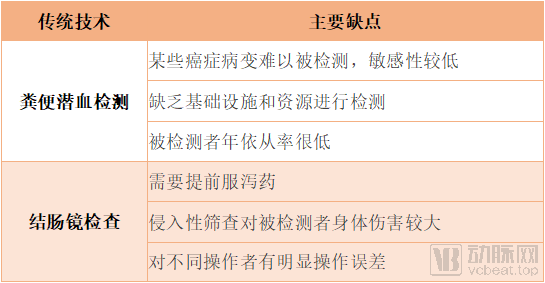
Disadvantages of Traditional Early Screening Technologies
Source:Exact Sciences Prospectus
To provide the public with more effective and convenient colorectal cancer testing technologies, Exact Sciences has established non-invasive colorectal cancer screening as its strategic direction.
The main development history of Exact Sciences can be divided into three stages: the exploratory phase, the growth phase, and the stabilization phase.
Since its founding in 1995, Exact Sciences has collaborated closely with leading researchers from academic institutions such as the Mayo Clinic to jointly evaluate technologies and colorectal cancer screening tests, launch its core product PreGen-Plus, and conduct three blinded clinical studies.The sensitivities of PreGen-Plus in three clinical studies were 91%, 72%, and 78%, respectively, which are higher than those of traditional detection methods such as FOBT (25%-30%) and flexible sigmoidoscopy (approximately 48%); its specificity reached 95%-100%, comparable to or even better than that of FOBT and flexible sigmoidoscopy.
In 2001, Exact Sciences established a partnership with Laboratory Corporation of America (LabCorp) in research and development and sales to promote the commercialization of PreGen-Plus.
Within a few years, an unexpected situation arose. In 2007, the FDA issued a warning letter to Exact Sciences regarding its PreGen-Plus technology, stating that PreGen-Plus was a Class III medical device and required premarket approval (PMA) from the FDA prior to commercialization, along with scientific evaluation to ensure its safety and effectiveness. However, due to technological immaturity, PreGen-Plus failed to pass the evaluation and ultimately did not receive FDA marketing approval.
PreGen-Plus was restricted from commercial sales. The partnership between Exact Sciences and LabCorp also ended with the failure of PreGen-Plus. On June 1, 2008, LabCorp halted research on PreGen-Plus.
This led to Exact Sciences, although listed on NASDAQ as early as 2001, maintaining a consistently low stock price due to the delayed FDA approval for its core product, PreGen-Plus.
However, at this stage, apart from Exact Sciences, no major molecular diagnostics company has developed a stool DNA-based colorectal cancer screening technology.
The failure of PreGen-Plus did not halt Exact Sciences’ progress. After the setback, the company quickly regained its footing, brushed off the dust, and pressed on, choosing to redevelop a new sDNA-based colorectal cancer screening technology:Cologuard。
To facilitate the successful development of Cologuard,Over the following two years, Exact Sciences successively established strategic partnerships with multiple pharmaceutical institutions and companies, including Genzyme, Hologic, and MDx Health S.A., and restructured its management team to significantly enhance the company’s managerial and operational capabilities.
The conduct of the DeeP-C study laid a solid foundation for Cologuard’s eventual FDA marketing approval.DeeP-C is a pivotal clinical trial conducted by Exact Sciences for colorectal cancer. In the study, participant samples were first tested using Cologuard, and then participants simultaneously underwent fecal immunochemical testing (FIT) and colonoscopy to evaluate the sensitivity and specificity of Cologuard.
On March 19, 2014, the results of the DeeP-C pivotal clinical study were published in The New England Journal of Medicine: Cologuard demonstrated high levels of both sensitivity and specificity.
The successful implementation of DeeP-C provided a critical clinical trial foundation for the subsequent FDA marketing approval of Cologuard. Since then, Exact Sciences has finally emerged from its hardships into a period of stable upward growth.
On August 11, 2014, the U.S. Food and Drug Administration (FDA) officially approved Cologuard for marketing at a price of $599, making it the first and only approved stool DNA-based screening test for colorectal cancer. In October of the same year, the Centers for Medicare & Medicaid Services (CMS) formally authorized nationwide coverage of Cologuard under Medicare.
Since then, Exact Sciences has made significant efforts to promote the inclusion of Cologuard in medical guidelines.Currently, Cologuard has been successfully incorporated into multiple cancer medical guidelines, such as the American Cancer Society (ACS) guidelines and the Healthcare Effectiveness Data and Information Set (HEDIS).
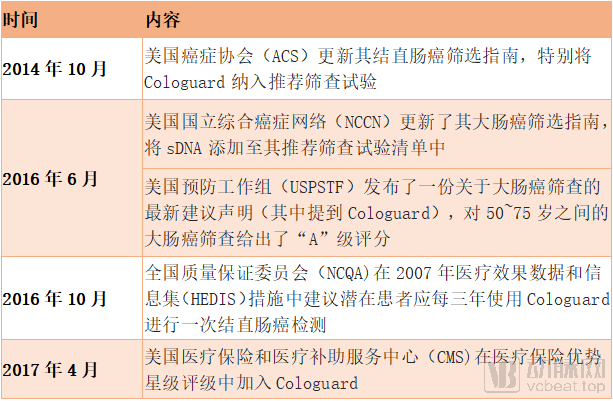
Cologuard has been progressively incorporated into the colorectal cancer screening guidelines and quality measures of various healthcare organizations.
Source: Company Annual Report
In 2016, Exact Sciences’ Cologuard molecular testing technology received the Prix Galien Award for Best Medical Technology Product.
The success of Cologuard has inspired Exact Sciences and the Mayo Clinic to deepen their collaboration, laying the foundation for the development of next-generation cancer screening technologies.On February 6, 2015, Exact Sciences and the Mayo Clinic announced a five-year extension and expansion of their collaboration, aiming to jointly develop screening, monitoring, and diagnostic tests beyond colorectal cancer to address other cancers such as lung and liver cancer.
With the core product now available, Exact Sciences’ next focus is on how to deliver it to end users.On August 22, 2018, Exact Sciences announced a collaboration agreement with Pfizer through 2021 to jointly promote the sales of Cologuard.
Through collaboration, Exact Sciences successfully integrated its Cologuard technology with Pfizer’s sales expertise and resources, rapidly expanding the Cologuard sales force. By broadening sales channels, this partnership significantly enhanced Cologuard’s marketing effectiveness, thereby increasing its product coverage and brand awareness.
In addition,Exact Sciences also promotes Cologuard by hosting or sponsoring sports events or activities (primarily in golf and football) to increase its brand awareness and visibility.In 2017 and 2018, Exact Sciences partnered with professional golfer Jerry Kelly to promote Cologuard and hosted the inaugural Cologuard Classic (a PGA Tour Champions event) in Tucson, Arizona.
Inclusion in national medical insurance, collaboration with Pfizer, and hosting popular events have all significantly boosted Cologuard sales.Exact Sciences’ sales revenue has climbed year by year, reaching $450 million in 2018.In February this year, it announced its financial results for the fourth quarter of 2019: revenue reached $257 million, a year-on-year increase of 107%.To meet the growing demand for Cologuard testing, Exact Sciences has been continuously expanding its laboratory capacity.
Although blood-based cancer screening technologies remain the dominant trend at present, with news such as Epigenomics AG’s blood-based colorectal cancer screening test receiving FDA approval and GRAIL’s blood-based assays rapidly gaining traction emerging from time to time, these developments serve as reminders that competition in the colorectal cancer screening market involving Exact Sciences remains intense.
As the only FDA-approved non-invasive colorectal cancer screening test based on stool DNA on the market, Cologuard is confident that its product offers superior sensitivity and testing experience compared to other products and services.
Long-term collaboration with the Mayo Clinic has enabled Exact Sciences to accumulate extensive R&D experience, successfully developing five innovative technologies that have not only overcome technical barriers but also further established new ones.
Compared with traditional colorectal cancer screening technologies, stool DNA-based colorectal cancer screening technology faces three major technical challenges:
1. The amount of human-derived DNA in feces is extremely low, making extraction highly challenging;
2. Frequent gene mutations in colorectal cancer cells make detection challenging;
3. It is difficult to identify biomarkers with high specificity and sensitivity for colorectal cancer.
In response, Exact Sciences has developed five innovative technologies to overcome these technical barriers:
1. Fecal DNA Isolation Technology: Stool DNA isolation technology represents a major breakthrough in the development of multi-target stool DNA tests and serves as the foundation for developing non-invasive colorectal cancer screening assays;
2. DNA Stabilization Technology: Compared with the previous-generation PreGen-Plus, Exact Sciences has successfully developed an advanced DNA stabilization buffer, a critical step in creating reliable at-home screening kits that provides better protection for fecal DNA during transportation;
3. DNA Biomarker Detection Technology: Exact Sciences has developed its proprietary QuARTS technology (Quantitative Allele-specific Real-time Target and Signal Amplification), which can effectively amplify and quantify two independent methylated DNA markers (NDRG4 and BMP3) as well as seven different KRAS gene point mutations;
4.Hemoglobin Biomarker Detection and Stabilization Technologies: The samples collected using this technology can withstand long-term transportation. Exact Sciences has improved traditional hemoglobin biomarker testing by incorporating additives into a stabilization buffer, thereby enhancing its stability;
5. Mathematical Algorithms: Accurately translates biological information into actionable, specific insights.
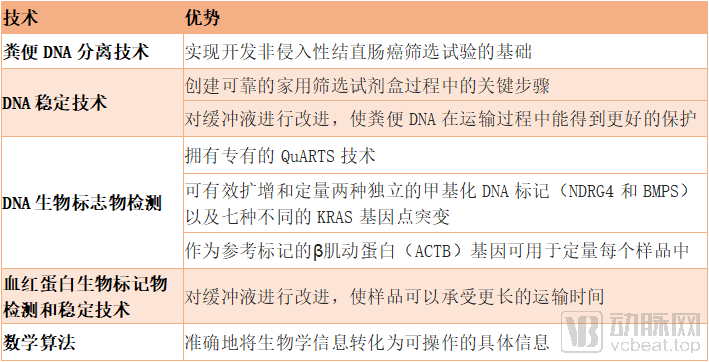
Source: Public informationSupporting Cologuard’s Innovative Technology
Compared with traditional early screening technologies for colorectal cancer, Cologuard has significant advantages.It demonstrates higher screening sensitivity for colorectal cancer patients at all stages compared to FIT (a type of fecal immunochemical test): Cologuard achieves a detection sensitivity of up to 92%, whereas FIT stands at only 74%. Compared with colonoscopy, Cologuard’s non-invasive nature significantly reduces patient discomfort during the examination and avoids the risks associated with invasive procedures, making it more readily accepted by the public.
Cologuard requires no bowel preparation or anesthesia; users can collect samples at home and mail them to Exact Sciences’ laboratory for testing, offering great convenience.
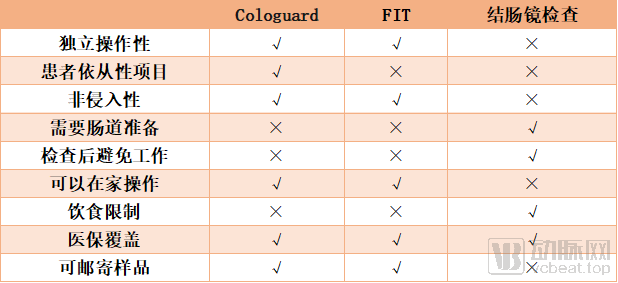
Source: Public InformationCologuard、FITandColonoscopyComprehensive Comparison of
Cologuard technology successfully overcomes the limitations of traditional screening methods, improving the patient screening experience.In this light, the successful development of Exact Sciences is indeed to be expected.
According to the company’s annual report, Exact Sciences reported operating revenue of $454 million in 2018, a year-on-year increase of 70.86%, but incurred a substantial loss of $175 million. This appears to be a common characteristic of the in vitro diagnostics industry and has not affected the company’s high market valuation. As of April 12, 2019, Exact Sciences’ total market capitalization stood at $11.935 billion; four months later, on August 13, it reached $15.685 billion, with a price-to-sales ratio (TTM) of 21.66x.
It is both an enterprise and capital.How will Exact Sciences leverage its strengths to continue transforming the field of early cancer screening? Time will tell.