

Ready Responders Files for IPO Following $48M Series B and Fourfold User Growth During Pandemic

Ready Responders
Healthcare Service Provider

GV
Google's Investment Fund

Deerfield
Investment Advisory Firm
Recently, VCBeat learned that healthcare service providersReady Responders Secures $48 Million in Series B Funding Led by Deerfield Management and Google Ventures.
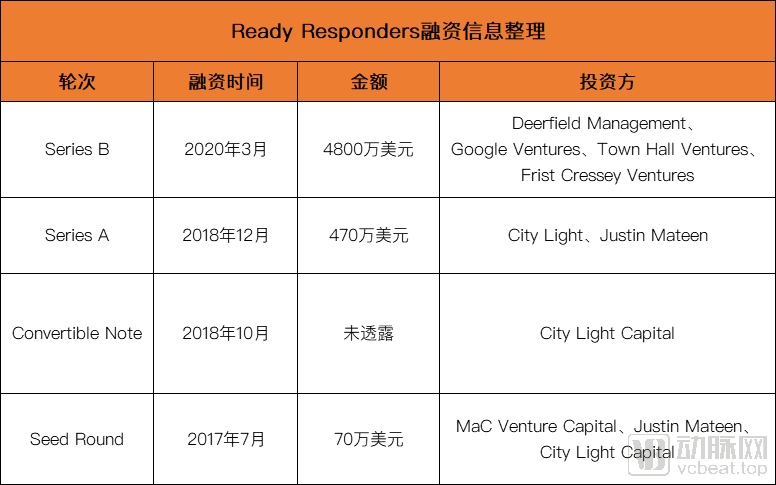
Ready Responders' Funding History
It is reported that Ready Responders has invested the funds from this financing round into epidemic prevention and control efforts.
Ready Responders was founded in 2016, with its headquarters located in New Orleans, Louisiana, USA.
The company leverages mobile internet technology to connect community-based healthcare professionals, providing patients with safe and affordable home-based medical services.
Their professional team of caregivers, EMTs, and nurses connects with patients through the company’s telemedicine and other technologies, enabling patients to consult with medical professionals and receive diagnosis and treatment without leaving home. These healthcare providers serve as their responders.
The company not only meets patients’ physical health needs but also addresses their mental and social well-being. Its service offerings include emergency care, transitional care post-discharge, and community-based care. The company is committed to bridging quality gaps in healthcare through its services.
Ready Responders is registered with the Louisiana Secretary of State. It has a Chief Medical Officer who oversees the physician network to ensure its continuous availability.
The company’s services have been included in U.S. Medicare and Medicaid, as well as in many other insurance programs., open from 8:00 AM to midnight, with no holidays off.
According to the company's data statistics, their patientsPatient satisfaction score exceeded 95%。
In January this year, Ready Responders also announced a partnership with REMSA. REMSA is an emergency medical services provider based in Reno, Nevada, and has been providing ground and air ambulance services across the region for more than three decades.
Victoria Sale, the company's senior vice president, added,Ready Responders has reduced non-acute visits in the emergency departments of the New Orleans health system by 70%. Furthermore, among frequent users, emergency department visit rates have decreased by more than 65%.
Evidence suggests that shifting to value-based healthcare reimbursement, such as directing patients to primary care rather than emergency departments through programs like Ready Responders, can save $560 million annually.
In a study of 5,570 patients in Houston, researchers utilized telemedicine, social services, and alternative transportation options to redirect patients away from emergency departments and toward primary care settings whenever possible. As a result, ambulance transports of emergency patients to the emergency department decreased by 56%, and emergency response efficiency improved by 44 minutes.
Ready Responders has three co-founders: Justin Dangel, Benjamin Swig, and Shlomo Ventura Leon, with Justin Dangel also serving as Chief Executive Officer.
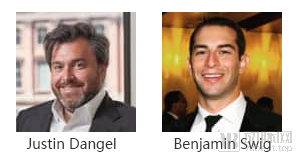
Justin Dangel graduated from Duke University in the United States with a Bachelor’s degree in Political Science. He is also the co-founder of Firefly Health.
At the end of 2007, Justin Dangel founded Goji, an online insurance brokerage firm (formerly known as Consumers United), which was named one of the “Top 10 Fastest-Growing Companies in the Insurance Industry” by Inc. magazine in 2012.
Previously, Justin Dangel was also the founder and CEO of Voter.com, and served as an analyst at Hambros Advanced Technology Trust in London.
Benjamin Swig, another co-founder and former Chief Operating Officer of the company, resigned in February 2019 after serving for two and a half years. He previously held administrative and clinical roles at New Orleans Emergency Medical Services and served as Acting Director of the U.S. Public Health Service Training Program within the Office of the Surgeon General.
Benjamin Swig has diverse professional expertise and broad interests. He graduated from Trinity College with a Bachelor of Arts degree. He also attended Tulane University, where he earned a Master of Public Health from the School of Public Health and Tropical Medicine and an Executive Master of Business Administration from the Freeman School of Business.
Furthermore, Benjamin Swig became a Nationally Registered EMT in 2001 and a Nationally Registered Paramedic in 2013. He has worked across various companies and in diverse roles, with each position offering him unique experience, fresh perspectives, valuable lessons, and distinct challenges to overcome—making every journey an unforgettable one.
In 2016, Benjamin Swig left New Orleans and co-founded Ready Responders with two other individuals. After his departure, he established the private real estate investment operator Swig Company in San Francisco, California.
The final founder, Shlomo Ventura Leon, holds an MBA from the University of Haifa. In addition to Ready Responders, he founded CyberTraits and has served in roles such as Senior Advisor for Strategy & Business Development.
Ready Responders started in New Orleans, USA, and has expanded to Nevada, Maryland, Washington, D.C., and other regions. Justin Dangel stated that they would soon launch services in New York City and plan to expand into California.
Justin Dangel describes his company’s services as akin to old-fashioned house calls by physicians. After a patient places a call, care providers are dispatched to the client’s home. Prior to this, clients can use an iPad to describe their symptoms to a nurse or physician.
As the novel coronavirus pandemic spread globally, Ready Responders, a provider of telemedicine services, has been continuously contributing its efforts to epidemic prevention and control.
Ready Responders can respond to a wide range of public health emergencies and, like hospitals or healthcare professionals, adhere to strict protocols to prevent viral transmission. The company actively follows CDC guidelines related to the virus and continuously conducts training as the situation evolves to protect its patients and healthcare workers.
According to the real-time global coronavirus outbreak tracking map provided by Microsoft Bing, as of April 24,The global cumulative number of confirmed coronavirus cases has exceeded 2.7 million, with the United States reporting 890,000 infections, ranking first worldwide.
During the coronavirus pandemic, the United States faced a significant shortage of testing methods and tools; according to a report by Oxford University’s *Our World in Data*, the per capita number of tests in the U.S. was 40 times lower than that in South Korea.
As of March 16, the FDA had approved six diagnostic test kits for market release, all of which were nucleic acid tests. In contrast, China had approved 19 diagnostic test products, encompassing two major categories: nucleic acid tests and antibody tests.
At the MassChallenge Innovation Summit, Margaret Bourdeaux, Research Director at Harvard Medical School, stated that testing and tracking viral infections, as well as isolating those exposed to the virus and infected individuals, are key to controlling the disease.
“During this crisis, the number of patients and medical records in hospitals has reached a historic high,” said Dr. Olan Soremekun, Chief Medical Officer of Ready Responders. “We need to make every effort to conserve essential resources for critically ill patients, reduce viral transmission, and alleviate the shortage of medical resources.”
To address the severe pandemic and improve the current situation, Ready Responders has also launched home coronavirus test kits and at-home testing services. Although test results take 2–5 days to return, the testing process itself requires only 15 seconds. The company announced plans to provide in-home care and viral testing for patients to alleviate the burden on hospitals.
Ready Responders operates under the guidance of the CDC, with its paramedics donning full personal protective equipment (PPE) to conduct testing in patients’ homes, while also enabling video consultations with healthcare providers. Currently, the availability of this testing service is steadily increasing. Justin Dangel stated, “The average number of patients contacting us daily has increased approximately fourfold.”
Dr. Olan Soremekun stated that individuals need to self-isolate at home and maintain physical distance from others as much as possible. Furthermore, to reduce transmission and ensure appropriate care for infected individuals, people must undergo viral testing as early as possible. Additionally, viral testing can help curb the spread of the virus and screen healthcare workers who may be infected but remain asymptomatic, thereby identifying those who should self-isolate.
“When patients are willing to accept care services from Ready Responders, they can contact us through our app or by phone,” said Dr. Olan Sormekun. “After that, we will use our telehealth capabilities to screen patients’ symptoms and dispatch appropriate medical professionals to their homes. Upon arrival, the dispatched personnel will assess the patient according to proper protocols and conduct FDA-approved coronavirus testing if necessary.”
Currently, it is not a simple matter for suspected patients worldwide to undergo coronavirus testing; results typically take at least several days, and may even be delayed further.
In addition to the issue of “slow” testing, many countries also face the challenge of “difficult” access to testing. Due to limited medical resources, several countries, including the United Kingdom and Sweden, have ceased viral testing for mild cases and suspected patients, instead reserving these resources for healthcare workers and those with severe or critical conditions.
Amid the severe situation, the FDA invoked the Emergency Use Authorization (EUA) framework and updated it during the crisis, relaxing standards to accelerate the end of the pandemic.
But this has also allowed some startups to spot loopholes to exploit. In mid-March, many companies announced the launch of rapid and convenient at-home coronavirus self-test kits; however, these fraudulent test kits were not authorized (of course, Ready Responders’ home testing and services are not included in this category). The FDA issued a warning to consumers, after which most of these test kits were withdrawn.
Nevertheless, many countries, including the United States, have biotechnology and pharmaceutical companies developing compliant and convenient coronavirus testing reagents and self-testing kits. Many companies in the digital health sector have identified significant market opportunities in viral testing.
“The FDA warns against using unauthorized home test kits for consumer self-testing,” said Olan Sormekun. “Ready Responders uses only FDA-authorized test kits, which have proven to be both safe and accurate. Furthermore, our team consists of well-trained professionals who follow proper procedures to ensure accurate results, rather than having consumers perform the tests themselves.”
Not only in the United States, but also in China, there have been false claims that “home coronavirus test kits can detect the virus in just 15 minutes.” The National Medical Products Administration (NMPA) has debunked this rumor, clarifying that there are currently no home self-test versions of COVID-19 test kits available.
Although the market path for home-based viral testing is fraught with challenges, it nonetheless underscores the demand and potential within this sector. If R&D in this field can yield more positive results in the near term, it would deliver substantial value to the nation, society, families, and individuals alike.