

HLT's AI-Driven Drug Development Breakthrough Featured in Nature Amid IPO Filing
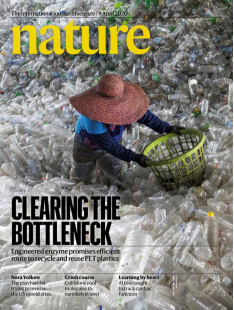
As the COVID-19 pandemic continues to spread globally, countries are racing to find ways to contain the disease. As a well-known domestic medical artificial intelligence technology company, Happy Life Technology (HLT) has been closely monitoring the development of the epidemic. Recently, it was featured in one of the world’s oldest and most prestigious scientific journals.*Nature* published an article titled “Artificial Intelligence Facilitates New Drug Development, Significantly Enhancing R&D Speed and Precision”, introduces HLT’s achievements in the field of artificial intelligence, as well as how it leverages AI technologies to help researchers improve the quality and efficiency of clinical trials. The original article is provided below.
Medical Artificial Intelligence (AI) Significantly Enhances the Efficiency and Precision of Clinical Trial Management
As the global outbreak of COVID-19 continues to spread, countries are racing to find ways to contain the disease. Some researchers are leveraging artificial intelligence (AI) technologies to accelerate the search for treatments, with the aim of identifying effective therapeutic drugs as soon as possible. Inspired by the process developed by Flinders University in Australia for creating an influenza vaccine—the world’s first drug designed entirely by AI—these researchers are devoting their efforts to using AI in the search for a coronavirus vaccine.
The drug development process is highly complex, risky, and protracted. According to data from the Tufts Center for the Study of Drug Development, the average cost of developing a new drug is $2.6 billion, and the average time from development to market approval is 12 years. Improving the efficiency of new drug development is an urgent global challenge.
With the emergence and application of artificial intelligence (AI) technologies, the pharmaceutical industry is poised for revolutionary changes in identifying drug targets and accelerating clinical trials. An increasing number of large pharmaceutical companies are placing significant emphasis on AI technologies to overcome various obstacles by enhancing the quality and efficiency of clinical trials.
AI-Assisted Clinical Trials for Ophthalmic Drugs
In China, several well-known medical companies in the industry have achieved substantial results by leveraging artificial intelligence technologies. Their success is continuously narrowing the gap between China and global leaders in the same field. Last October, Heber Bio, a renowned Chinese biopharmaceutical company, announced the successful completion of Phase II clinical trials for its innovative biologic agent HBM9036 (Tanfanercept). The trial investigated the safety and efficacy of HBM9036 eye drops in patients with moderate-to-severe dry eye disease in China. With the assistance of AI, the duration of the Phase II study was significantly shortened.
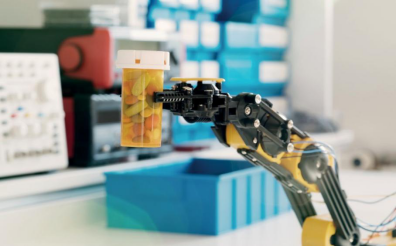
Image credit: WLADIMIR BULGAR/Science Photo Library/Getty Images
More than 300 million people worldwide suffer from dry eye disease, but due to the lack of safe and effective anti-inflammatory medications, only about one-fifth of patients receive treatment.
Xie Lixin, Academician of the Chinese Academy of Engineering and Honorary Director of the Shandong Eye Institute, stated, “Although the incidence of dry eye disease continues to rise, previous treatments have typically focused on symptom relief, with strategies targeting the underlying disease mechanisms being very limited.”
During the trial, Harbour BioMed collaborated with its strategic partner, Happy Life Technology (HLT), a Chinese medical AI company, to develop precise profiles of diagnostic and treatment behaviors based on a collaborative network of ophthalmology experts. Leveraging disease models built on an AI-assisted platform, they conducted multi-dimensional patient flow analysis to accurately identify potential patient populations and target hospitals. Building on this foundation, and incorporating patient adherence analysis, they formulated precise recruitment and enrollment plans.
Coordinated by physicians from the medical network, this single-center trial enrolled 100 eligible subjects within 39 days, with 98 of them completing all protocol-specified visits. Chen Xiaoxiang, Chief Product Development Officer at Harbour BioMed, stated that AI-assisted clinical research significantly accelerated patient enrollment and processing, reducing the duration of clinical trials by 60%.
“We are committed to leveraging various new technologies to accelerate clinical R&D,” said Chen Xiaoxiang. “Artificial intelligence is driving the drug development process and pioneering a new development model for the pharmaceutical industry, an innovation that will benefit the entire healthcare sector.”
These trial results, together with the clinical trial outcomes from HanAll, the collaborative development partner of Harbour BioMed for HBM9036, have laid the foundation for conducting Phase III clinical trials of this drug in China. Harbour BioMed expects to initiate the Phase III clinical trials in 2020.
The application of intelligent technologies holds significant importance for pioneering innovation. Academician Xie Lixin stated, “I hope that intelligent clinical trials will benefit more fields in the future.” HLT has leveraged artificial intelligence technology to help multiple Chinese medical institutions establish medical AI platforms and develop various disease models. These disease models support multi-center trials, enhance the research management capabilities of study sites, and have received widespread industry acclaim, particularly in the area of clinical trial management.
“This marks the arrival of the era of intelligent clinical trials,” said Mr. Xu Jiming, Co-Founder of HLT. “As artificial intelligence matures, it is ushering in a new era of drug development that is more reliable, higher in quality, and more efficient.”
Optimizing Clinical Trial Management
Peking University Cancer Hospital is exploring and practicing intelligent clinical trials and has established the “Innovation Base for Intelligent Clinical Trials” in collaboration with HLT.
Shen Lin, Vice President of Peking University Cancer Hospital, stated that artificial intelligence (AI) technology has had a significant impact on the clinical research process. It not only alleviates various challenges in data collection, tracking, monitoring, and imaging data evaluation but also enhances the quality and efficiency of research. Professor Shen noted that the hospital is currently leveraging HLT’s AI technology to explore intelligent quality control and data management in four key areas: patient recruitment, intelligent alerts for adverse events, intelligent alerts for protocol deviations, and reminders for underreported concomitant medications.
Efforts are currently underway to address long-standing issues and challenges, including clinical trial data management—such as traceability of records, protocol deviations, investigational product management processes, and safety documentation—as well as quality control audits in clinical trials. These challenges may stem from various factors, such as insufficient staffing, increased management costs and reduced efficiency due to higher levels of data hierarchy, and the inability to cover all data points.
Professor Shen Lin highlighted the optimized data management provided by HLT’s intelligent system, stating, “The advantages of artificial intelligence in enhancing the quality of clinical trials have been fully demonstrated in our experiments.” For instance, one algorithm showed that underreporting of adverse drug reactions in trials was significantly lower compared to manual processing.
Furthermore, enhanced monitoring during the trial can eliminate the need for post-trial inspections, thereby further improving trial efficiency.
Automated form-filling via eSource can reduce data entry errors by clinical research coordinators, shorten trial duration, and improve data quality. Professor Shen Lin stated, “I personally believe that there is a substantial demand for artificial intelligence technologies in clinical trials, with significant potential for future development.”
Since the outbreak of COVID-19, HLT has also launched a remote monitoring system to facilitate online coordination among various participants in clinical trials. Mr. Xu Jiming stated, “Artificial intelligence technology plays a critical role in ensuring effective monitoring of clinical trials.”
Compared with traditional treatment approaches, greater emphasis is now placed on real-world data when formulating personalized treatment plans. The National Medical Products Administration of China recently released the first guideline on the use of real-world evidence in drug development. This underscores the need to leverage tools such as artificial intelligence to enhance data quality.
“If artificial intelligence becomes the main force in new drug development, it will be able to reduce the medication burden on patients and provide them with more high-quality drugs. ‘I am optimistic about the future development of AI in this field,’ said Mr. Xu Jiming.”
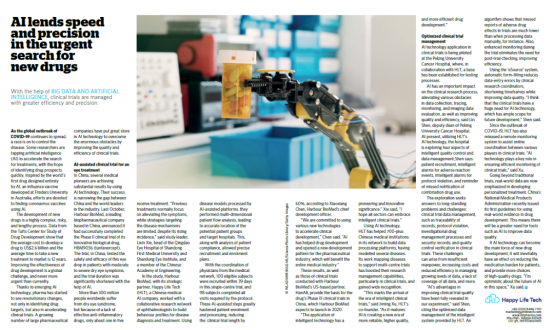
Screenshot source: Nature