

QingCloud Files for STAR Market IPO, Offering Full-Stack Cloud Solutions for Healthcare and Beyond
Lin Yuan, Vice President of Operations at QingCloud, has always felt that the phone call came through at just the right moment.
On April 7, 2020, QingCloud submitted its prospectus to the STAR Market, seeking to raise RMB 1.188 billion for upgrades to its cloud computing products, research and development of full-domain cloud technologies, construction of integrated cloud-network infrastructure, and replenishment of working capital.
At this point, QingCloud had just celebrated its eighth anniversary, more than eight years after Lin Yuan received the “partnership offer” call from Huang Yunsong, CEO of QingCloud.
QingCloud, founded in April 2012, is a platform-level hybrid cloud ICT vendor and service provider with comprehensive cloud computing capabilities. It is committed to delivering autonomous, controllable, neutral, reliable, high-performance, and flexibly developable cloud computing products and services to enterprise users. Its products and services are widely applied across numerous industries, including healthcare, fintech, and education.
QingCloud’s core business is divided into two major segments: cloud products and cloud services:
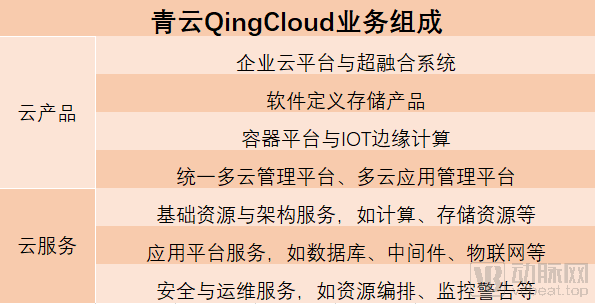
The prospectus reveals that QingCloud’s basic resource and infrastructure services have accounted for over 83% of the revenue in its cloud services segment for three consecutive years. The cloud services segment, dominated by public cloud offerings, registered a compound annual growth rate (CAGR) of 6.96% in operating revenue from 2017 to 2019. Meanwhile, QingCloud’s cloud products segment, primarily focused on hybrid and private cloud deployments, surpassed public cloud in both revenue and gross profit margin. The cloud products business contributed more than 65% of QingCloud’s total revenue.
“Allure and Peril Coexist in ‘Cloud Computing’.” The White Paper on the Development of China’s Cloud Computing Industry, released by the Development Research Center of the State Council, indicates that the industry scale was projected to exceed RMB 100 billion in 2019, reaching RMB 129.07 billion. By 2021, the size of the cloud computing industry is expected to surpass RMB 200 billion. Relevant data published by the China Academy of Information and Communications Technology (CAICT) further corroborates this trend, suggesting that the growth rate of China’s cloud computing market is poised to remain above 30%, continuing to outpace the global average.
However, cloud computing is also a capital-intensive industry, requiring companies to be prepared for substantial long-term investments with no short-term profitability. Leveraging their deep financial resources, tech giants have aggressively expanded and thrived in the cloud computing market. QingCloud, which was determined from its inception to serve the enterprise-level cloud services market, has managed to break through financial constraints and stand out without the backing of such giants. How did it achieve this? We may gain some insights by examining QingCloud’s development journey.
The story of QingCloud began at IBM.
Founded in 1911, IBM is the world’s largest information technology and business solutions company, with 460,000 employees worldwide. When Lin Yuan was still an intern, Huang Yunsong had already been working at IBM for many years as a core employee.
Around 2010, Huang Yunsong devoted his full attention to SmartCloud, the cloud computing project he founded. It was IBM’s only key initiative worldwide at the time to be founded by a Chinese national. Given IBM’s intricate and interdependent business operations, where even a minor change could have far-reaching repercussions, cloud infrastructure development required a gradual and meticulous approach. Huang Yunsong, however, believed that cloud computing must be built from the ground up; only with a solid foundation could the structure remain steadfast and enduring.
The future business architecture of QingCloud may have already taken shape in Huang Yunsong’s mind.
While Huang Yunsong was engaged in fierce debates over the SmartCloud project, Gan Quan, then at Baidu, was plotting his third entrepreneurial venture; meanwhile, Lin Yuan, an employee at Tencent, was burning the midnight oil as a diligent “code monkey.” At that time, they were still one catalyst away from becoming the “Three Musketeers.”
In 2012, Amazon Web Services (AWS), the undisputed leader in cloud computing, had already taken shape. Intrigued by its potential, Huang Yunsong and Gan Quan, a serial entrepreneur, quickly joined forces to establish their own company, aiming to “let the cloud system evolve according to their own vision.”
Huang Yunsong excelled in storage and networking, while Gan Quan specialized in robot scheduling systems; what was missing was a middle-end platform. At 1 a.m., Huang Yunsong called Lin Yuan. Upon hearing his vigorous response, Huang dismissed his earlier concern that “Lin Yuan is too young” and blurted out, “You’re the one.” With this, the “Three Musketeers” of QingCloud were finally united.
In April 2012, QingCloud was established in a residential apartment in Beiyuan with a monthly rent of RMB 8,500. Eight years later, QingCloud has completed six rounds of financing and is making a final push for an IPO on the STAR Market.
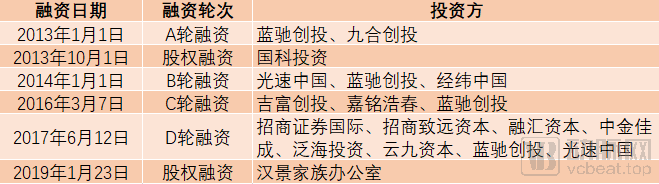
Source: Arterial Orange Database; Chart by VCBeat
Alibaba established its “cloud computing” and “big data” strategies in 2008 and launched cloud services the following year, becoming the first domestic provider of cloud services. Not to be outdone, Tencent entered the cloud market in 2010 as an early participant, benefiting from first-mover advantages. However, in China’s cloud computing market, QingCloud is also regarded as one of the first batches of cloud computing startups.
“If you are only slightly better than the tech giants, you will have no chance.” This statement, made by Huang Yunsong at the inception of QingCloud, has now become the guiding principle for QingCloud’s differentiated competitive strategy. In facing off against industry giants, QingCloud has avoided direct confrontation, instead carving out a unique path—one that is “difficult to tread but leads to long-term success.”
Leveling Up from SDN 1.0 to 3.0
In July 2013, QingCloud launched its public cloud service. This public cloud is built upon its proprietary Software-Defined Storage (SDS) and Software-Defined Networking (SDN). Notably, QingCloud was the first company in China to implement SDN on a public cloud platform.
Decoupling is the core tenet of SDN. To address the issues arising from the tight physical coupling of technology and hardware in traditional networks, QingCloud has adopted a product strategy centered on decoupling the various functions of its cloud platform.
If the various modules in software are likened to building blocks, decoupling means making each module as independent as possible, allowing it to be combined, split, or replaced with any other module. In simple terms, it involves eliminating the dependencies between modules.
QingCloud’s cloud product business involves decoupling core technologies to achieve productization, resulting in marketable software and hyper-converged appliances deeply integrated with hardware. SDN 1.0 is suitable for small-scale network architectures; however, it becomes inadequate as the scale increases.
In 2016, QingCloud SDN 2.0 was launched, addressing performance bottlenecks associated with scaling and providing a distributed multi-node load balancer to enhance business performance. On July 27, 2018, at the Cloud Insight Conference 2018, QingCloud unveiled SDN 3.0, featuring a hybrid SDN controller that manages both software-defined and hardware-based networks, thereby meeting the needs of private cloud users for unified management of cloud-based software networks and existing hardware networks.
From Public Cloud to Private Cloud
Cloud computing is a sector that severely tests an enterprise’s endurance and financial strength. Without substantial resilience and deep capital reserves, small and medium-sized enterprises (SMEs) will find it difficult to sustain their operations. In 2014, faced with an intensely competitive price war in the public cloud market, QingCloud opted for an indirect strategy by entering the private cloud sector.
For a cloud service provider, the transition between public and private clouds is far from simple. At this juncture, the value of QingCloud’s initial “heavy investment” in independently developing its Software-Defined Networking (SDN) technology has begun to materialize. Thanks to its “perfect” underlying codebase, QingCloud can support both public and private clouds with a single unified system. Lin Yuan once likened QingCloud’s system to a high-speed train: each carriage can be detached and reconfigured, yet the train continues to operate smoothly.
Starting with the financial sector, QingCloud gained recognition from Bank of China and China Merchants Bank in early 2015 by building private cloud platforms for them. Soon after, QingCloud began expanding into other industries, including healthcare. To further promote the adoption of cloud computing in key sectors, QingCloud collaborated with numerous benchmark clients to develop solutions such as hybrid clouds for medical consortia.
In the healthcare sector, QingCloud has launched four tailored solutions: a hybrid cloud model for medical consortia across hospitals of all levels, a hybrid cloud model for large Grade A tertiary hospitals, a public cloud model for cloud-based hospitals, and a cloud storage model for medical imaging clouds.
After eight years of development, QingCloud has established comprehensive capabilities in delivering full-spectrum cloud products and services:
Full Stack: At the Technical Level,QingCloud has independently developed an integrated cloud-network technology architecture spanning intelligent WAN, IaaS, and PaaS, delivering comprehensive ICT service capabilities.
During the pandemic, leveraging QingCloud’s IaaS and PaaS technological enablement and support, Huake Ruantong collaborated to launch the National Public Service Platform for the Floating Population and a Big Data Management Platform for Epidemic Control. These platforms provided local governments, industrial parks, enterprises, schools, and other stakeholders with scientifically grounded epidemic information, data aggregation services, and targeted policy implementation support, thereby fully advancing the execution of various epidemic prevention and control measures.
It is worth noting that the National Public Service Platform for the Migrant Population is the only national-level public service platform in China dedicated to this demographic. The platform encompasses 16 administrative modules across 15 departments, including healthcare, employment, education, and household registration (hukou). By integrating big data, cloud computing, and artificial intelligence technologies, it empowers local governments to enhance comprehensive management and support evidence-based decision-making regarding the migrant population.
Full State: In terms of delivery format,By leveraging a unified technical architecture, we have established two standardized business modules: cloud products and cloud services. These modules meet customer requirements for private cloud, public cloud, and hybrid cloud deployments, while delivering comprehensive industry-specific cloud computing solutions tailored to multiple sectors.
To address medication access challenges for isolated patients with chronic diseases during the epidemic prevention and control period and enable “contactless medication pickup,” QingCloud partnered with Dingji Weiye to jointly launch a medication dispensing solution for chronic diseases during the pandemic. Leveraging QingCloud’s cloud service platform, Dingji Weiye rapidly established an “Electronic Prescription Sharing System and Smart Pharmacy,” facilitating remote prescribing via mobile diagnosis and treatment, medical insurance settlement, two-way referrals, remote consultations, and internet-based healthcare services.
In July 2013, the QingCloud public cloud platform was officially launched, offering capabilities such as second-level resource provisioning and 100% Layer 2 isolation. Leveraging the QingCloud public cloud platform, the AiYide Cloud Health System connects family doctors at community hospitals with residents, enabling communities to monitor individuals under home quarantine and promptly detect any anomalies.
QingCloud has also partnered with iYide to launch the Smart Cloud Hospital Epidemic Prevention Assistant solution. By building five functional modules on QingCloud’s public cloud—namely, cloud nursing, cloud infusion, cloud health management, cloud ward rounds, and cloud imaging—the solution integrates hospital HIS, LIS, and PACS systems, thereby facilitating efficient nursing and diagnostic operations throughout the epidemic period.
Full-Spectrum: In terms of the depth of service scenarios,QingCloudWe are actively working to build an integrated service capability that combines cloud, network, edge, and endpoint resources, enabling broader data interconnectivity.
Since its inception, QingCloud has prioritized the cultivation of corporate culture. “Competitive spirit, human-centric management, and encouragement of innovation” are the three key pillars of QingCloud’s corporate culture. As a technology-driven enterprise, QingCloud has placed significant emphasis on foundational R&D capabilities since its establishment, implementing technical incentive policies to motivate employees to enhance their independent research and development competencies.
In 2019, QingCloud was recognized by CCW Research as a market competitiveness leader in China’s private cloud sector. QingCloud’s mission is to facilitate digital transformation for enterprises and industries; looking ahead, it strives to become the cornerstone of the digital world. In 2019, QingCloud pioneered the launch of its public cloud services in the Jakarta region of Indonesia, officially commencing its global expansion strategy.