

BioLingus Files IPO Prospectus to Revolutionize Chronic Disease Treatment with Sublingual Biologic Therapies

BioLingus
Pharmaceutical R&D Developer
For patients with chronic diseases, the burden of repeated treatments—weekly or even daily—has become unbearable, and injectable drug therapies further exacerbate their physical and psychological suffering. Taking diabetes as an example, patients not only require regular insulin injections but also face the inconvenience of refrigerating unused insulin. “I believed I could change this status quo, and in fact, we truly achieved it,” said Thomas Ko, Chief Technology Officer (CTO) of BioLingus.
BioLingus is a biopharmaceutical company headquartered in Switzerland, with branches in Australia, mainland China, and the Hong Kong Special Administrative Region. The company’s core technology represents the culmination of years of accumulated expertise by its founders, enabling the sublingual delivery of peptide- and protein-based therapeutics for the treatment of chronic diseases, thereby offering an alternative to traditional injectable medications. Leveraging its innovative technology and R&D-driven product portfolio, BioLingus has emerged as a pioneer in the development of non-invasive biologics and was recognized in 2018 as one of Europe’s top biotechnology companies. Currently, BioLingus is developing a range of sublingual drugs for indications including diabetes and inflammatory conditions.
BioLingus has achieved its current success thanks to an elite management team that ensures the company maintains a competitive edge in both technology and business. Within this team, Chief Technology Officer (CTO) Thomas Ko, as one of the founders, plays a pivotal role.
Thomas was born into a prominent pharmaceutical family in Hong Kong, with both his grandfather and father engaged in drug research, development, and manufacturing. Thus, it is not surprising that despite his affluent upbringing, Thomas’s childhood was not filled with various toys, but rather with glassware and tablet presses. At the age of 15, he left home alone to study in Australia, attending Essendon High School. As a stranger in a foreign land with no relatives or friends nearby, Thomas overcame numerous linguistic and lifestyle challenges, eventually gaining admission to the Victorian College of Pharmacy (which became part of Monash University in 1990).
After graduation, he was selected into the Victorian hospital system and became the first male pharmacist to serve at the Royal Children’s Hospital in Melbourne. However, perhaps driven by his family DNA, his passion for physical chemistry and drug development ultimately led him to leave this stable and respectable position, ushering in a new chapter in pharmaceutical R&D. It was during this new career phase that Thomas achieved remarkable success.
He is not only an inventor but also an entrepreneur. Since 1971, Thomas has developed more than 200 products and successfully commercialized them. For instance, a spray-on antibacterial bandage he developed was sold to a U.S. pharmaceutical company in the late 1970s. In the early 1980s, Thomas further developed Detach, an oral biologic medication for preventing diarrhea in pigs, poultry, and international travelers. He later licensed Detach to Ciba-Geigy, which was subsequently acquired by Novartis. In the early 1990s, Thomas also developed Immulin, a sublingual interferon lozenge for the treatment of chronic hepatitis B and C, and successfully introduced it into the Chinese market. Later, Vital Biotech Limited, the company he founded, was listed on the Hong Kong Stock Exchange (HKEX) in 2003.
Time moved on to 2004, marking another turning point in Thomas’s life. His father was diagnosed with advanced bladder cancer, and in order to stay by his side, Thomas resolutely decided to sell off his equity stakes. During that period, Thomas frequently engaged in heartfelt conversations with his father, discussing life and medicine. One day, they explored whether natural methods could be used to enhance the immune system. “We discovered that if inflammation could be halted, the progression of cancer would also slow down,” Thomas recalled. It was precisely this dialogue between father and son that reignited Thomas’s drive for research and development, prompting him to leave his semi-retired life behind.
In 2012, Thomas and Swiss entrepreneur Yves Decadt crossed paths by chance. They later met for the first time in Zurich to discuss the feasibility of bringing Thomas’s vision to life. With mutual recognition and appreciation, and after reaching consensus among multiple parties, BioLingus was officially established in Switzerland in 2014. Yves Decadt, also a founding shareholder, serves as the company’s Chief Executive Officer (CEO). Prior to this, Yves spent 18 years at Johnson & Johnson, holding various positions across multiple countries, and subsequently served in executive/CEO roles at several small and mid-sized biotechnology/medical technology companies. Yves holds a Master’s degree in Bioengineering and an MBA in Industrial Business Administration (both from Ghent University in Belgium), as well as a Master’s degree in Pharmacology and Pharmaceutical Medicine (from the Faculty of Medicine at the Université Libre de Bruxelles). Beyond his academic achievements, Yves has received numerous awards as CEO of BioLingus, including the European CEO Award, the Red Herring Award, the Global Entrepreneurship Award, and the VBInsight Top 20 Award, among others.
Moreover, another Swiss shareholder of the company, Dr. Didier Coquoz, is an experienced clinician and serial entrepreneur. With over 25 years of professional experience in North America and Europe, he currently serves as Chief Development Officer (CDO) at BioLingus. In addition, BioLingus has recruited the renowned Australian immunologist Dr. Ken Pang. Dr. Pang’s publications have frequently appeared in top-tier journals such as Science, Immunity, Genome Research, and Molecular Psychiatry, accumulating more than 9,000 citations. Recently, Dr. Guy Vergnault, a world-class expert in drug development, has also joined the company, making BioLingus’ senior leadership team truly exceptional.
BioLingus’s achievements are naturally attributable to the advanced management capabilities and business operational philosophies of its senior leadership team; however, the company’s core driving force lies in its technological breakthroughs, honed through years of accumulated expertise.
In the early years, a study conducted by Monash University found that even when administered via injection, proteins do not enter the bloodstream but instead enter the lymphatic system, ultimately reaching various organs throughout the body.
BioLingus employs bioengineering techniques to mimic the stable states of peptides and proteins found in nature. “In nature, plant seeds contain unstable substances such as proteins and DNA, yet they can remain stable for extended periods in natural environments, and even in extreme conditions,” said Thomas. Mimicking the survival mechanisms of plant seeds in nature was Thomas’s initial technical vision for BioLingus.
To ensure the stability of biomacromolecules, BioLingus has developed its proprietary CSSR technology (Cytokine Stabilization and Sustained-Release Technology). This approach addresses formulation, manufacturing processes, and encapsulation equipment. Currently, most injectable proteins on the market are sold as lyophilized products, with the majority requiring refrigerated storage. Furthermore, the company has developed its patented SEED technology, which stabilizes biomolecules over extended periods. Studies have demonstrated that an interferon-alpha CSSR formulation developed using SEED technology can be stored stably at room temperature for up to 42 months.
Moreover, BioLingus has independently developed OPUS (Oral Peptide Utility System) and SLIT (Sublingual Immunotherapy) technologies, as well as a patented encapsulation device that integrates spray drying and spray cooling. Leveraging these technologies and equipment, BioLingus has won multiple innovation awards in Europe and the United States, and its technologies have secured patent coverage in the United States, Europe, China, Japan, and other regions.
BioLingus currently possesses multiple core product lines based on OPUS and SLIT technologies. These include sublingual liraglutide for the treatment of type 2 diabetes and obesity; sublingual exenatide for type 2 diabetes; sublingual insulin+ for the treatment of advanced type 2 diabetes; and sublingual interleukin-2 (IL-2) for the prevention of type 1 diabetes. Notably, sublingual IL-2 exhibits anti-inflammatory properties and can be used to treat various autoimmune diseases, including rheumatoid arthritis, psoriasis, and lupus. Furthermore, the company has developed sublingual interferon, which enhances the human body’s immune response against diverse viruses.
OPUS and SLIT constitute the two core platform technologies of BioLingus. The relationship between these two technologies is akin to that between electric vehicles and gasoline-powered cars. As members of the same category of transportation, both can carry passengers from point A to point B; however, their mechanical designs are fundamentally different. On the surface, OPUS and SLIT technologies may appear similar, but they actually belong to two distinct fields. OPUS is designed for peptides with molecular weights smaller than those of proteins. While BioLingus’s sublingual formulations using OPUS require higher doses than injections, SLIT requires only 1/100 of the injectable dose. OPUS is applied to drugs treating metabolic disorders such as diabetes and obesity, whereas SLIT targets immune dysfunction-related diseases (such as chronic inflammation and cancer), placing them in entirely different therapeutic areas. Consequently, BioLingus has established separate companies to independently develop technologies and pharmaceuticals for diabetes and immune dysfunction disorders.
Unlike traditional injectable protein drugs and oral medications administered via the gastrointestinal tract, BioLingus’s sublingual formulations are typically available as tablets or drops, offering patients greater convenience in both administration and storage. Furthermore, BioLingus’s protein stabilization technology reduces costs associated with cold-chain logistics and pharmaceutical manufacturing. In terms of efficacy, sublingual delivery avoids proteolytic degradation in the intestine and bypasses hepatic first-pass metabolism, thereby prolonging drug action and extending the dosing interval.
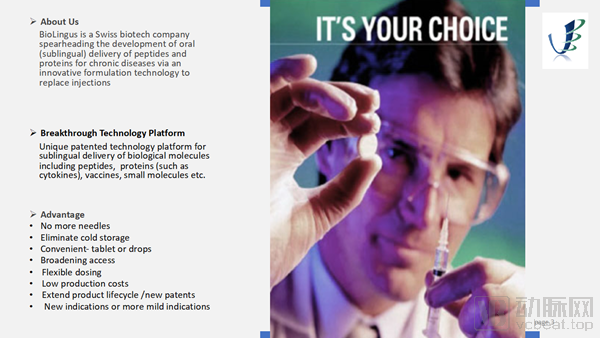
In February 2019, BioLingus entered into a collaboration with WuXi AppTec’s subsidiary, STA Pharmaceuticals, whereby the latter was authorized to engage in co-marketing with BioLingus for technology promotion. Meanwhile, BioLingus is also seeking global partners to advance the commercialization of its core drug portfolio in the Americas, Europe, the Middle East, and the Asia-Pacific region, including China.
Currently, BioLingus is focusing on the development of three non-invasive drugs for type 2 diabetes and obesity: sublingual liraglutide, sublingual exenatide, and sublingual insulin+. Recently, BioLingus secured a committed €31 million in Series B financing, which will be used to advance the clinical research of OPUS.