

Zeen Health Submits IPO Prospectus: Pioneering AI-Powered CBT-I Therapy to Transform China's $40B Sleep Economy
In this fast-paced era, “insomnia” is tightening its grip like a net, becoming a lingering “nightmare” for many.
According to statistics from the World Health Organization (WHO), 27% of the global population experiences sleep problems, meaning at least one in four people “sleeps poorly.” The China Sleep Index Report indicates that 38.2% of people in China suffer from sleep issues, which is 11.2 percentage points higher than the global average. More than 300 million Chinese people are troubled by insomnia; from 2013 to 2018, the average daily sleep duration for Chinese individuals dropped from 8.8 hours to 6.5 hours. “Sleep deprivation and insomnia” have become defining ailments of this era.
In fact, people spend one-third of their lives sleeping. The quality of sleep directly affects a person's health and performance in academics and career, and can cause significant distress and psychological burden.
How to Effectively Treat “Insomnia”? Zheng’an (Beijing) Technology Co., Ltd. (hereinafter referred to as “Zheng’an Tech”) has launched an AI-powered CBT-I therapy, bringing hope to hundreds of millions of insomnia patients. “CBT-I, or Cognitive Behavioral Therapy for Insomnia, is an effective non-pharmacological intervention for insomnia. By leveraging AI technology, we provide intelligent and efficient treatment to help patients overcome the distress of insomnia as soon as possible,” said Liu Xiaogang, founder of Zheng’an Tech.
In the United States, the prevalence of insomnia is as high as 32%–50%, and the annual output value of the “sleep economy” has reached tens of billions of US dollars. According to the “Research Report on Market Analysis and Investment Prospects of China’s Sleep Medical Market (2018–2023)” released by Bosi Data, the market size of China’s sleep improvement industry was approximately RMB 279.7 billion in 2017. Of this total, sleep health supplements accounted for RMB 12.8 billion; sleep medications, RMB 13.4 billion; sleep devices and products, RMB 250 billion; and sleep services, RMB 3.5 billion.
“In fact, compared with foreign countries, we started relatively late, and the solutions to sleep problems are more focused on the stage of aiding sleep rather than treatment,” Liu Xiaogang pointed out.
He pointed out that the main pain points in China are as follows: First, there is low awareness. This lack of awareness manifests in two aspects. On the hospital side, sleep medicine is poorly recognized, with many hospitals assigning sleep-related issues directly to departments such as pulmonology and neurology, resulting in a poor patient experience. On the patient side, awareness of sleep treatment is also low; when facing problems like insomnia, individuals typically resort to taking sleeping pills or purchasing sleep-aid products rather than seeking professional medical treatment.
Secondly, there are flaws in the clinical treatment pathways. Treatment is generally divided into two categories: Cognitive Behavioral Therapy for Insomnia (CBT-I) and pharmacological therapy. CBT-I is recommended as the first-line treatment for insomnia by the American College of Physicians and the European Sleep Research Society. It is currently the most effective treatment for insomnia and is also the most commonly used method for self-management of the condition. CBT-I improves sleep by correcting inappropriate beliefs and attitudes toward sleep as well as maladaptive behavioral habits. Its core components include sleep hygiene education, relaxation training, cognitive therapy, stimulus control, and sleep restriction therapy.
Pharmacological treatment currently relies primarily on non-benzodiazepine agents, which are more effective than benzodiazepines in addressing difficulty falling asleep, difficulty maintaining sleep, and early morning awakening. However, this approach has limitations, including the inability to achieve a radical cure, relapse upon discontinuation, and side effects such as memory impairment, reduced deep sleep, and dependence or addiction. Compared with pharmacotherapy, Cognitive Behavioral Therapy for Insomnia (CBT-I) offers distinct advantages and is gradually being implemented in China; nevertheless, its widespread adoption remains limited due to the prolonged treatment duration and scarce medical resources.
Furthermore, there is a scarcity of sleep medicine specialists, with only approximately 5,000 qualified physicians in China. “Our research found that among more than 100 tertiary hospitals in Beijing, only nine offer outpatient clinics for Cognitive Behavioral Therapy for Insomnia (CBT-I), and the number of specialists engaged in sleep treatment is extremely limited,” pointed out Liu Xiaogang.
Finally, most sleep products on the market remain at the “sleep aid” stage and lack therapeutic properties. For instance, there are currently a series of online software products targeting sleep issues that only address mild cases, while hardware devices offer merely monitoring functions, failing to resolve chronic insomnia.
With the growing population of insomnia patients and the rise of the sleep economy, sleep medicine has gradually gained clinical recognition. In June 2019, the Chinese Medical Doctor Association released the “Catalogue of Specialties for Standardized Residency Training (2019 Edition),” formally including sleep medicine in the training catalog and establishing it as an independent discipline in China.
How Can Technology Empower and Improve Treatment for Insomnia Patients?
With 16 years of experience in internet product design and management, Liu Xiaogang formerly served as Senior Product Director for Huami Technology’s medical health division. He previously held design management roles at Kingsoft Cloud and Tencent, where he led teams to establish Huami’s medical health business and implemented the company’s “cloud-chip” strategy. Leveraging his robust technical background and deep insights into the healthcare industry, Liu recognized the significant opportunities within the sleep sector. In August 2019, he founded Zheng’an Technology, dedicated to developing AI-driven CBT-I (Cognitive Behavioral Therapy for Insomnia) treatment pathways.
Its AI-powered CBT-I product, “Ru Mian Asleep,” leverages vast amounts of sleep and behavioral data from individuals with insomnia to create an Artificial Intelligence Cognitive Behavioral Therapy for Insomnia (AI CBT-I) system. This system develops personalized sleep improvement plans tailored to each individual’s unique factors. Backed by a professional medical team, it provides online sleep coaching and counseling services anytime and anywhere, ensuring that everyone has access to their own personal sleep therapist.
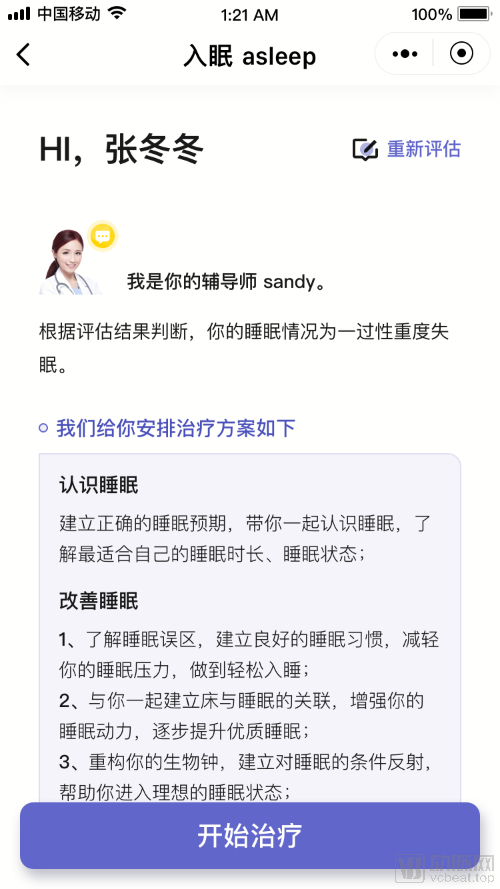
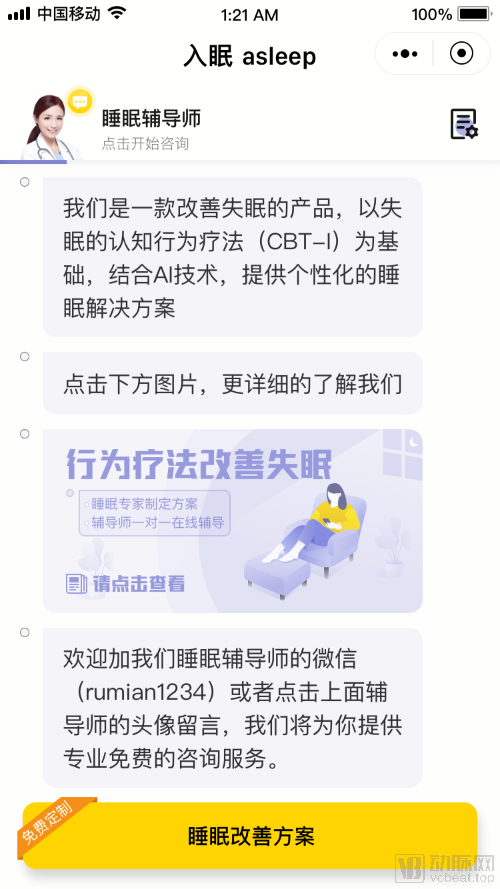
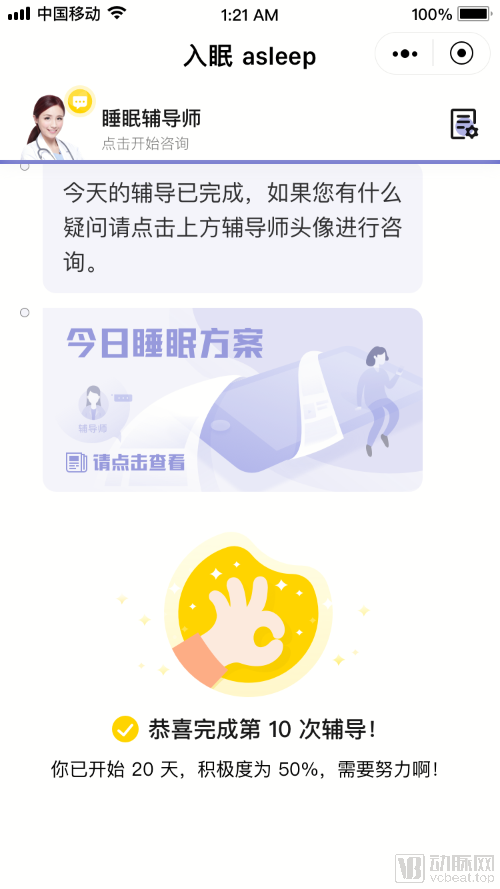
(Product Illustration)
So, what dilemmas of traditional CBT-I have been addressed by the integration of AI? What are the differences between AI-driven CBT-I and traditional CBT-I?
Liu Xiaogang introduced that traditional CBT-I involves weekly sessions, costs several thousand yuan, relies on therapists with limited experience and inadequate training, requires manual recording of patient data, is cumbersome, and results in low adherence.
AI-driven CBT-I involves daily interactions, with no restrictions on location or duration, allowing patients to receive treatment anytime and anywhere. Priced at only a few hundred yuan, it delivers standardized therapeutic quality comparable to that of senior therapists. Furthermore, it can be integrated with smart wearable devices to accurately and unobtrusively monitor patient data.
“We are currently building our framework across four key areas. First is content delivery: through our official WeChat account, we provide users with educational materials on sleep health and help establish correct perceptions of sleep. Second is our digital products: our mini-program incorporates core components of Cognitive Behavioral Therapy for Insomnia (CBT-I), specifically relaxation therapies such as mindfulness meditation, sleep-aid audio tracks, breathing exercises, and progressive muscle relaxation training. Third, we will launch a range of sleep-supportive ancillary products. Fourth, we will collaborate with smart wearable device manufacturers to create a closed-loop ecosystem for sleep treatment,” said Liu Xiaogang.
This system unfolds across four key dimensions—sleep assessment, treatment planning, sleep coaching, and rehabilitation management—to fully realize efficient, intelligent insomnia therapy.
He stated that the first version of the product has been completed and is currently undergoing testing. In parallel, collaborations with several hospitals are underway, with the next phase aiming to enter clinical trials to more authoritatively validate the system.
Transferring traditional offline treatments to an online platform is no easy feat. This requires not only technological breakthroughs but also the integration of parallel medical processes. Liu Xiaogang told VCBeat that Zheng'an Technology is currently undergoing angel-round financing, with a target of RMB 5 million. The funds will be used to further enhance AI capabilities in the next stage, establish technical barriers, optimize treatment protocols in clinical collaboration with hospitals, and accelerate the realization of a closed-loop treatment system.