

Precision Gaoxin Submits IPO Prospectus: Powering China's National Hypertension Specialty Medical Consortium with a Precision Chronic Disease Management Platform
According to the "Report on Cardiovascular Diseases in China 2018,"The prevalence of cardiovascular disease in China continues to rise, with an estimated 290 million affected individuals. Among them, 245 million have hypertension. The prevalence of hypertension among adults aged 18 and above is 27.9%, and the case fatality rate is also high. However, the awareness, treatment, and control rates are only 51.6%, 45.8%, and 16.8%, respectively.
The field of chronic disease management is fraught with challenges. Although efforts to establish chronic disease service systems began early, the outcomes of such management have been less than satisfactory.
However, with the development of internet platforms, the potential of the chronic disease management market continues to grow. On the other hand, national policies have provided clear support, such as the “Opinions of the State Council on Implementing the Healthy China Action” (2019), the “Medium- and Long-Term Plan for Chronic Disease Prevention and Control in China (2017–2025),” and the “Opinions of the General Office of the State Council on Promoting the Development of ‘Internet + Healthcare’.”
In this context, Beijing Jingzhun Gaoxin Health Management Co., Ltd. (hereinafter referred to as “Jingzhun Gaoxin”), dedicated to the health management of chronic diseases, was established in March 2016.
Wang Leyang, Director and CEO of Jingzhun Gaoxin, told VCBeat that hypertension is one of the leading causes of cardiovascular disease-related mortality in China. Elevated blood pressure can lead to coronary heart disease and heart failure. Furthermore, hypertension may cause damage to target organs associated with the vascular system across various bodily systems, thereby inducing systemic atherosclerotic vascular disease, which ultimately results in cardiac disease and death.
Currently, the treatment of cardiovascular diseases in China largely relies on “blocking” approaches, with an increasing number of stent placements and bypass surgeries. However, such interventional treatments have limited capacity and impose a substantial economic burden. “If we can effectively manage patients’ blood pressure, we can reduce the risk of hypertension-related events, thereby decreasing the need for surgical interventions.”
Treatment costs in the field of chronic diseases show a polarized disparity.Wang Leyang stated that data shows the daily treatment costs for chronic diseases such as hypertension are relatively low when the conditions are well-controlled. In particular, under the “4+7” policy, annual medication expenses can be kept at around RMB 200. However, if these chronic conditions progress to myocardial infarction, intracranial hemorrhage, or cerebral infarction, the resulting economic burden will increase significantly.
Wang Leyang also stated in the interview that with the successive introduction of medical insurance-related policies in recent years, “cost containment” has become a keyword for the entire industry. Data from the China Cardiovascular Disease Report (2016) shows that annual direct medical expenditures for hypertension in China reached RMB 300 billion, accounting for approximately 7% of total health expenditure. From the perspective of the entire chronic disease sector, according to statistical data released by the National Health Commission in 2017, expenditures on chronic diseases amounted to RMB 3,244.15 billion, representing 70% of the nation’s total health spending. Given the substantial scale of expenditures in this area, cost containment is highly necessary.
Precision Hypertension’s chronic disease management service is dedicated to controlling patients’ health conditions, ensuring medication adherence, stabilizing blood pressure levels, reducing complications, and thereby lowering subsequent high medical costs. Achieving this goal means that the service system not only possesses intrinsic economic value but also generates profound positive impacts for the nation, society, families, and individuals. This is the direction toward which the Precision Hypertension team strives.
In April 2017, the General Office of the State Council issued the “Guiding Opinions on Promoting the Construction and Development of Medical Consortia.”
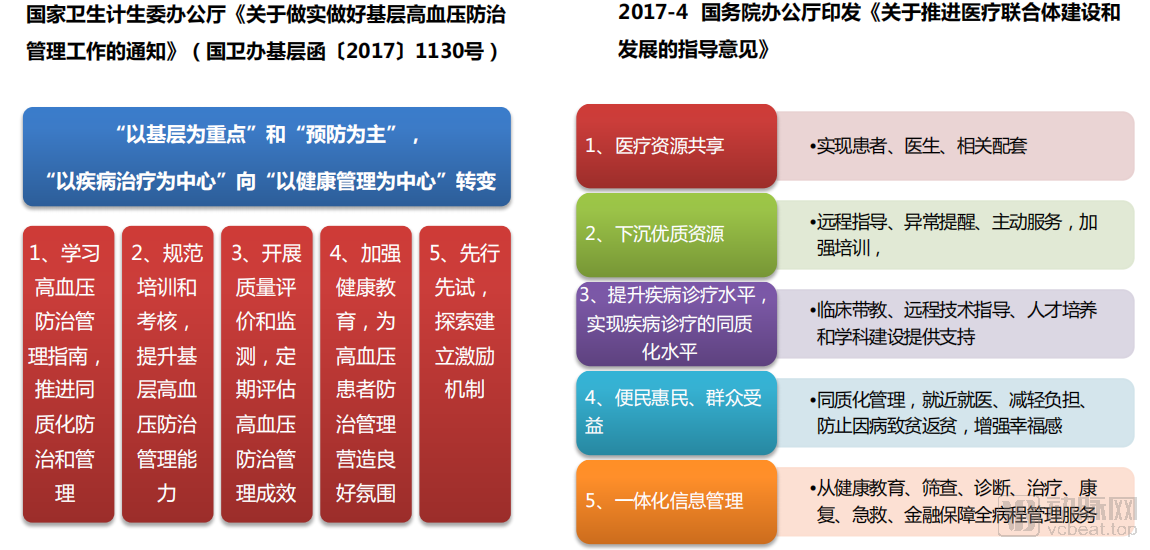 Relevant Policy Requirements
With the continuous implementation and advancement of tiered diagnosis and treatment, the construction of medical consortia in China has been comprehensively rolled out. Under the guidance of the National Health Commission, the “National Center for Cardiovascular Diseases Hypertension Specialty Medical Consortium,” led by the National Center for Cardiovascular Diseases and Fuwai Hospital, Chinese Academy of Medical Sciences, was established on November 25, 2017, becoming the first national-level team to pioneer chronic disease prevention and control.
Having demonstrated its information service capabilities through verification in multiple national-level cardiovascular research projects, the “Hypertension Doctor” App, developed by Jingzhun Gaoxin Institute, has become the official collaborative platform of the National Center for Cardiovascular Diseases’ Hypertension Specialty Medical Consortium.
In fact, Jingzhun Gaoxin began preparing to enter the vast market of chronic disease management as early as 2015. Leveraging its experience in software services and adopting an internet-based cloud service model, Jingzhun Gaoxin participated in multiple national-level cardiovascular research projects in its early stages, assisting in the development of platforms for both scientific research and daily management. This marked the initial form of Jingzhun Gaoxin and provided valuable experience and foundation for its subsequent development.
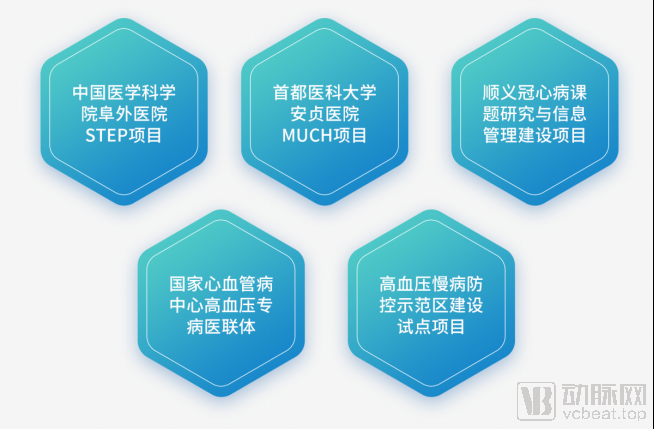
Projects Undertaken by Jingzhun Gaoxin Institute
Over the years, Precision Hypertension Heart has undertaken the construction of platforms for multiple research projects and studies, managing tens of thousands of hypertensive patients within these scientific initiatives. Aligning with the National Health Commission’s directive of “prioritizing hypertension management and implementing coordinated care for the ‘three highs’ (hypertension, hyperglycemia, and hyperlipidemia),” the company has pioneered chronic disease management models and industrial integration, with hypertension as the entry point. In supporting various scientific research projects and the Hypertension-Specialized Medical Consortium of the National Center for Cardiovascular Diseases, Precision Hypertension Heart has established a specialized, scalable, and highly empowering collaborative platform for precision chronic disease management, serving providers across the healthcare delivery system.
Jingzhun Gaoxin’s hypertension chronic disease prevention and control system—comprising the physician-facing app “Hypertension Doctor,” the patient-facing app “Gaoxin Health,” official WeChat accounts, and related management platform matrices—is an intelligent cloud-based hypertension management service platform specifically designed for healthcare providers at all levels and patients with hypertension.
In 2019, to actively implement the Outline of the “Healthy China 2030” Plan and to carry out the requirements set forth in the Letter from the Bureau of Disease Prevention and Control of the National Health Commission on Approving the Establishment of the National Comprehensive Prevention and Control Demonstration Zone Project for Hypertension as a Chronic Disease, the Notice on Doing a Good Job in the 2018 National Basic Public Health Service Projects, and the Administrative Measures for the Construction of National Comprehensive Prevention and Control Demonstration Zones for Chronic Diseases, the initiative to establish regional comprehensive prevention and control demonstration zones for hypertension as a chronic disease was launched. The nationwide development of “National Comprehensive Prevention and Control Demonstration Zones for Hypertension as a Chronic Disease” aims to improve the management, treatment, and control rates of hypertension, prevent cardiovascular and cerebrovascular events, reduce medical costs, and alleviate the societal burden.
Leveraging its prior experience in providing health management services within the cardiovascular field, Jingzhun Gaoxin’s affiliated platform has also become the operational support platform for the “National Hypertension Chronic Disease Prevention and Control Demonstration Zone” initiative under the Bureau of Disease Prevention and Control of the National Health Commission.
In addition to daily blood pressure management functions, the company’s platform also offers services including telemedicine, AI-driven chronic disease management, specialized Traditional Chinese Medicine (TCM) diagnosis and treatment, and psychological support. It integrates online consultation services, follow-up visits for chronic diseases, and medication delivery, thereby providing an optimal pathway for convenient online services for chronic disease patients, as well as comprehensive solutions for regional chronic disease prevention and control.
Currently, within the platformThe platform serves 43 provincial-level centers, 225 municipal-level centers, and 1,170 county-level hospital sub-centers, with the number of medical consortium member units reaching 7,030. There are over 30,000 healthcare professionals participating on the platform, among whom cardiovascular specialists account for approximately two-thirds.
According to Wang Leyang, Jingzhun Gaoxin’s current business model is primarily expanded around the regional chronic disease management market, basically adopting a B2G2C approach, while also offering paid membership services directly to consumers (B2C).
The "precision" management model for chronic diseases with high precision can be divided into two aspects:
1. “Jing” (Precision)—A refined, whole-course management model for chronic diseases;
2. “Precise”—A Regional Chronic Disease Prevention and Control Management Model Characterized by “Precision”
According to the introduction, the precision-oriented chronic disease prevention and control system offers six key values and advantages:
I.Closed-Loop Management Across the Full Lifecycle, designed around the core indicators of comprehensive prevention and control, effectively improving the rate of blood pressure control compliance.
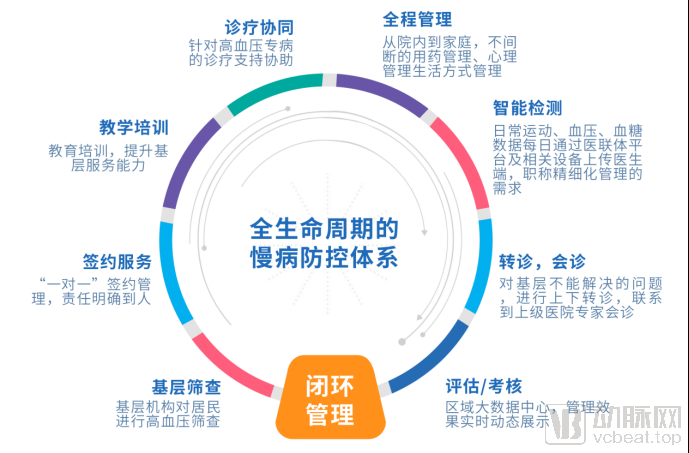
Closed-Loop Management of the Chronic Disease Prevention and Control System for Hypertension
II.Professional and Stable Hypertension Management Platform Support Capabilities。
> National-Level STEP Project Research Support Platform;
> National Clinical Research Center for Cardiovascular Diseases Hypertension Specialized Disease Medical Consortium Business Collaboration Platform;
> National Demonstration Zone for Hypertension and Chronic Disease Prevention and Control: Business Support Platform.
III.Online Medical Consultation, establish seamless doctor-patient communication channels through mobile apps/official accounts, easily manage more patients, and improve the level of information technology construction and management efficiency in the region.
4.Continuous Blood Pressure Management:
1. Utilize advanced smart IoT wearable devices, with data instantly uploaded to the management platform;
2. Home blood pressure monitoring and 24-hour ambulatory blood pressure monitoring;
3. It is particularly suitable for the characteristics of Asian hypertensive patients, who have a higher prevalence of masked hypertension, morning blood pressure surge, and nocturnal hypertension.
5.Collaborative Diagnosis and Treatment to Enhance the Quality of Prevention and Control. Effectively integrate guidance from the specialist team of the Hypertension Specialized Medical Consortium under the National Center for Cardiovascular Diseases to support contracted physicians in managing hypertensive patients, thereby enhancing the capabilities of primary care providers; establish a coordinated online-offline health management system featuring bidirectional referrals, remote consultations, and vertical integration between upper- and lower-level institutions, to achieve shared and optimally allocated regional medical resources.
VI.Building a Regional Big Data Center for Comprehensive Blood Pressure, providing real-time visualization of the achievement status of core indicators for hypertension prevention and control within the region. The data is authentic, rapid, continuous, and traceable, enabling timely identification and resolution of issues, thereby effectively enhancing the overall effectiveness of comprehensive prevention and control.
In the current landscape of chronic disease management, overall outcomes remain suboptimal. Primary care facilities face insufficient screening and service capabilities, with 8% lacking essential medications, and there is a general absence of sustainable, long-term management models. Unlike other platforms, Jingzhun Gaoxin distinguishes itself through its superior management efficacy.
Regarding the management model, Jingzhun Gaoxin assisted the National Center for Cardiovascular Diseases in applying certain models from the STEP study to practical management. Within this research framework,Blood pressure management control rate reached 90.6%。
In terms of technology and security, first, they uphold their authority, professionalism, and standardization within their specialized field. According to Wang Leyang, given the unique nature of health and population data, their interface standards and security frameworks comply with the requirements of Level 3 of the Classified Protection of Cybersecurity (MLPS 2.0). “Our platform operates at the same level as tertiary hospitals.”
Second, both medical consortia and demonstration zones are characterized by large service populations and diverse healthcare needs. Therefore, on the technical platform, Jingzhun Gaoxin has facilitated collaboration among healthcare providers at various levels and across different institutions, effectively addressing key bottlenecks in this process.Established a long-term, replicable model. Specifically addressing collaboration with the public health system, Wang Leyang explained, “For the institutions we serve, if there is a need for high-precision cardiac care services to be rapidly integrated into the public health service system, we have standardized interfaces and service integration mechanisms in place.”
Third, individual circumstances vary from person to person. In terms of personal services, there is a need for personalized care. Wang Leyang stated that they would strive to address each individual’s unique needs as comprehensively as possible, providing patients with precise, full-cycle services.
Although some explorations have been made in the field of chronic disease management, Jingzhun Gaoxin has remained a relatively low-profile team. Currently, Jingzhun Gaoxin has only received angel investment and has not yet introduced other investors. However, the company has recently formulated financing plans and developed a clearer vision for its future.
In terms of near-term objectives, Jingzhun Gaoxin is implementing chronic disease prevention and control systems across ten regions.
In terms of long-term development strategy, Jingzhun Gaoxin is committed to becoming a provider of professional solutions for chronic disease prevention and control in various regions, serving as a robust complement to the public health service system, and fostering an organic integration between government and market forces in the field of chronic disease management.
Furthermore, the demand for health services varies among the general public, and there is an expectation to achieve secondary conversion of end-users. Wang Leyang stated that they would also effectively integrate services designated as “Premium,” including premium suppliers. Within the overall service model framework, if there are service products or content at different tiers, the company will make them available to users, allowing them to make choices based on their individual needs, financial capacity, and affordability, thereby realizing on-demand services. Health service products differ from other commodities in that they require in-depth assessments conducted by professionals to provide optimal recommendations. This solution will be designed for users by Jingzhun Gaoxin.
Finally, in terms of service products, they also aim to optimize the user experience and enhance its engagement.
Wang Leyang told VCBeat, “Many internet products, including games, boast tremendous user stickiness. In contrast, while everyone recognizes the benefits of health management, many people may feel that achieving good health requires sacrificing comfort and user experience. We believe, however, that a balance can be struck. Therefore, we are continuously enhancing our product’s ease of use and user engagement, which remains our ongoing objective.”
Another widespread challenge in the chronic disease management industry is that many users are elderly. “It is commonly believed that older adults face inherent barriers when using mobile applications or the internet. Therefore, we aim to simplify our existing products as much as possible,” said Wang Leyang. “We also hope to provide a highly user-friendly platform that enables the elderly population, along with the broader group of service recipients, to quickly integrate into this system.”
Meanwhile, Wang Leyang also stated, “Everyone is the primary person responsible for their own health. We hope to engage as many people as possible in effective management services, working together to address the challenge of chronic diseases. In this process, we must ensure that no patient with a chronic disease is left behind.”