

AI-Powered Ultrasound: Unlocking a High-Potential, Late-Blooming Segment in Medical Imaging Amid 2 Billion Annual Diagnoses
In the field of AI medical imaging, the niche segment of AI-powered ultrasound has received far less attention than AI-enhanced CT imaging, remaining relatively under the radar. However, in early 2020, the FDA approved the first AI-assisted ultrasound diagnostic software from Caption Health, marking a major breakthrough for the AI ultrasound sector and granting it commercial viability, which has subsequently drawn greater attention to this field.
In China, the field of AI-powered ultrasound is less crowded than the AI+CT sector, with only a few startups involved. However, the annual number of ultrasound examinations in China is approximately 2 billion, far exceeding the 200 million CT scans performed each year.
In terms of population coverage, AI ultrasound holds greater market potential. Regarding product forms, unlike the AI+CT sector, which has seen product homogenization, AI ultrasound can empower both high-end ultrasound systems and handheld devices, offering a diverse range of product formats.
Although AI-powered ultrasound represents a major subfield within the broader domain of AI in medical imaging, it possesses numerous distinct characteristics. Unlike other AI applications in medical imaging, which primarily focus on image analysis,AI application in ultrasound requires a two-step approach to address two issues: first, assisting in the acquisition of correct images; second, aiding in the accurate analysis of ultrasound images.
It is evident that the path ahead for AI in ultrasound is fraught with challenges. For AI, how can ultrasound leverage AI’s capabilities to expand into broader medical scenarios beyond the confines of the ultrasound department? What technical barriers will AI encounter in its application to ultrasound? VCBeat has conducted a comprehensive review.
Ultrasound is likely one of the fastest, safest, and more affordable medical diagnostic tools available to licensed physicians. While there are 50 million doctors worldwide, only 2% of them have mastered the skills required for ultrasound scanning.
Ultrasound should be an accessible diagnostic tool, but in reality, its application is not readily available.
According to statistics from the China Association of Medical Equipment, as of 2018, the installed base of ultrasound systems in China was approximately 190,000 units. In comparison, the installed bases for other modalities were significantly lower: approximately 55,000 units for digital radiography (DR), 22,000 units for computed tomography (CT), 20,000 units for endoscopes, and 9,255 units for magnetic resonance imaging (MRI). While the overall number of ultrasound systems in China is not low, their distribution across hospitals of different tiers is uneven. As of the end of April 2018, 2,427 tertiary hospitals possessed a total of 24,270 color Doppler ultrasound systems, averaging 10 units per hospital. In contrast, secondary and primary hospitals averaged only 5 and 1 unit(s) per hospital, respectively, indicating a significant disparity.
Ultrasound itself features advantages such as being radiation-free and allowing for repeatable diagnostics. With technological advancements, ultrasound devices are becoming increasingly affordable and compact. However, only by lowering the threshold for ultrasound usage can it become a truly inclusive and portable diagnostic tool.
Unlike radiologists, who diagnose based on static images, sonographers must acquire dynamic images from multiple planes for real-time diagnosis. Both the acquisition and interpretation of ultrasound images are highly dependent on the physician’s experience.
AI integrated into ultrasound diagnostics can assist in addressing two key issues: first, how to better acquire images; and second, how to better analyze them.
To complete image acquisition and analysis within a short timeframe, AI follows a three-step process. Taking Caption AI, the first FDA-approved AI-assisted medical imaging acquisition system, as an example, Caption AI initially leverages AI to guide physicians in image capture. Through real-time AI guidance, even non-specialist physicians can acquire ultrasound images.
The second step involves using algorithms to identify the optimal images. The high variability of ultrasound images poses a significant challenge for AI-based imaging diagnosis. Caption AI’s algorithm can select the best frames from video sequences and quantify image quality, thereby enhancing the reliability of AI-assisted ultrasound image acquisition and diagnosis.
The third step is image analysis. Traditionally, interpreting and analyzing ultrasound images required sonographers with years of specialized training. However, Caption Health utilizes deep learning algorithms to automatically measure ejection fraction, aiding clinicians in assessing patient conditions.
Although the FDA has currently approved the Caption Health product for market launch, its use is limited to cardiac disease screening in adults. During the FDA’s in-depth review of Caption Guidance, the agency evaluated data from two independent studies.
The first study involved 50 trained sonographers performing diagnostic scans on patients, with one group not using computer-aided diagnosis (CAD) software and the other using it. The results demonstrated that even inexperienced sonographers could acquire high-quality images.
Another study involved training eight registered nurses, who were not ultrasound experts, to use the Caption Guidance software and tasked them with acquiring echocardiographic images. The quality of the acquired images was then assessed by five cardiologists. The results demonstrated that the Caption Guidance software enabled registered nurses to obtain echocardiographic images and videos of diagnostic quality.
For ultrasound, AI makes its use simpler and more accessible. For AI, ultrasound provides an ideal scenario to demonstrate its capabilities.
Zhu Ruixing, Investment Director at SoftBank China, told VCBeat that due to the unique characteristics of AI products, sectors with economies of scale are more likely to create value opportunities for AI. Compared with CT and MRI, ultrasound examinations have a higher annual volume of procedures and established fee schedules. Therefore, AI-assisted diagnosis in the field of ultrasound holds significant commercialization prospects.
The integration of AI and ultrasound is emerging as a rising star in the field of AI-based medical imaging. Beyond enhancing diagnostic accuracy, AI in ultrasound imaging can perform automated image quality assessment, image standardization, image segmentation, automatic measurements, and computer-aided diagnosis.
However, in China, the two entirely different medical scenarios presented by large hospitals and primary care facilities have determined that AI applications in ultrasound cannot be addressed through a one-size-fits-all solution, but rather have evolved along two completely distinct pathways.
One approach involves integrating AI into traditional ultrasound departments, enhancing the intelligence of large-scale ultrasound systems. This technology transforms ultrasound devices from mere imaging products into intelligent terminals that integrate data acquisition, management, and analysis with deep learning capabilities.
Taking GE Health as an example, as a leading giant in the ultrasound industry, GE Health and Siemens together account for more than 50% of China's ultrasound market.
In 2019, GE launched the LOGIQ™ E20, equipped with the cSound+™ image generator, in the Chinese market. This system achieves a 48-fold increase in cache speed and a tenfold breakthrough in computing power, providing technical support for big data capture and analysis as well as holographic domain imaging. In terms of AI-assisted intelligent recognition, the digital engine leverages image perception to enable tissue and organ structure identification, intelligent lesion segmentation, and intelligent measurements. This helps physicians eliminate tedious and complex image optimization and measurement tasks, allowing them to focus on clinical diagnosis and treatment. Regarding applicable conditions, GE’s AI-assisted intelligent recognition covers whole-body imaging and is primarily used in clinical fields such as interventional procedures, thyroid and breast imaging, musculoskeletal imaging, pediatrics, and cardiology, supporting clinicians in achieving precise diagnoses.
In other departments, AI-powered ultrasound goes beyond diagnosis to assist with real-time guidance and surgical assessment. In specialties such as anesthesiology, emergency medicine, and intensive care units (ICU), ultrasound primarily helps physicians make more accurate assessments, improve the efficiency of diagnosing and treating life-threatening emergencies, and more effectively monitor and regulate basic life functions while providing protection and support for vital organs.
Taking the Department of Anesthesiology as an example, the application of point-of-care (POC) ultrasound in this specialty primarily focuses on ultrasound-guided vascular access, nerve blocks, and intraoperative transesophageal echocardiography (TEE), with the aim of enhancing the safety of anesthetic procedures and the accuracy of organ function assessment. This differs from diagnostic ultrasound examinations used for disease diagnosis. The role of artificial intelligence (AI) in this context includes facilitating trauma assessment, image registration/fusion, system quality assurance, scanning assistance, and Doppler noise suppression.
Of course, for large-scale medical equipment, AI currently serves more as a complementary enhancement; however, it is foreseeable that its role will become increasingly important in the future.
Zhu Ruixing stated, “From a hardware perspective, for manufacturers such as GE and Siemens, the iteration speed of hardware is not as fast as that of software. Breakthroughs in software and algorithms are likely to become the mainstream in the future.”
For Philips, another major player in the ultrasound market, 60% of its global R&D personnel are now focused on software and AI. However, this does not mean that it is transforming into a software company. Philips’ medical devices themselves are highly digitalized and generate vast amounts of data. The key lies in how to interconnect and integrate this data.
Another pathway lies within primary care settings. Outside of large hospitals, China’s healthcare system comprises nearly 900,000 primary care institutions. Among the three key segments—medical treatment, pharmaceuticals, and diagnostics—the critical area requiring increased investment to resolve structural contradictions in healthcare is diagnostics. Leveraging the portability of handheld ultrasound devices, empowering primary care with ultrasound technology represents a viable approach.
Zhu Ruixing pointed out, “It is impossible to train a primary-care physician into a specialized sonographer. Since the competencies of primary-care physicians cannot be equated with those of physicians at tertiary Grade A hospitals, empowerment at the primary care level relies on medical devices. Equipping primary-care physicians with simple and easy-to-use devices makes it feasible to improve diagnostic and treatment efficiency in a short period and to establish a tiered diagnosis and treatment system.”
Companies targeting the primary healthcare market are mainly startups. As new variables in the ultrasound market, they primarily apply AI ultrasound technology to handheld ultrasound devices. Empowered by AI software, these solutions enable more primary healthcare institutions to utilize ultrasound diagnostic equipment, achieving a breakthrough from zero to one. Their target audience consists largely of physicians with limited knowledge of ultrasound.
Taking Shanghai Soundwise Technology (Soundwise) as an example, as an ecosystem partner of Sontu, a handheld ultrasound manufacturer, Soundwise leverages AI algorithms to automatically select optimal clips from acquired ultrasound images, provide intelligent guidance for users without ultrasound experience, and offer diagnostic recommendations based on the images. This simplifies ultrasound-based diagnosis and image acquisition, eliminating the need for extensive training periods to achieve proficiency.
Traditionally, ultrasound diagnosis has relied on specialized physicians to visually identify anatomical structures in images. AI, through intelligent recognition, enables the use of ultrasound beyond just professionally trained doctors, achieving automatic identification of optimal images and assisting in diagnosis.
For AI-powered handheld ultrasound, different application scenarios present distinct implementation challenges.
For clinical department applications, many physicians in these departments have not previously used ultrasound equipment, and their needs are relatively fragmented. Therefore, the adoption of artificial intelligence requires a certain period of market education.
However, in departments such as interventional radiology and cardiology, some clinicians also possess certain experience in ultrasound diagnosis and treatment, making the implementation of handheld ultrasound devices in these departments relatively straightforward.
For grassroots levels, market education is even more challenging.
As a pioneer in China focusing on AI-powered ultrasound, Zhang Zhuo, CEO of Deepwise, stated that the needs of primary healthcare are not simply a scaled-down version of those in tertiary hospitals. Primary healthcare has entirely different functional and scenario-based requirements for ultrasound equipment.
“For village doctors, it is not feasible to undergo a lengthy learning curve. Moreover, given their brief examination workflows, the product’s scanning time must be controlled within a few minutes. Therefore, it is critically important for AI-powered ultrasound solutions to achieve genuine intelligence and streamline operational processes. Currently, most AI-ultrasound products on the market still fall short of enabling individuals with only nursing-level expertise to quickly master their use.”
According to incomplete statistics compiled by VCBeat, there are currently 16 AI ultrasound-related companies registered both domestically and internationally. In terms of disease coverage, while conventional ultrasound diagnosis is widely utilized across various clinical departments, AI-powered ultrasound diagnosis primarily focuses on a range of conditions, including breast cancer diagnosis, prenatal screening, thyroid disorders, and cardiovascular diseases.
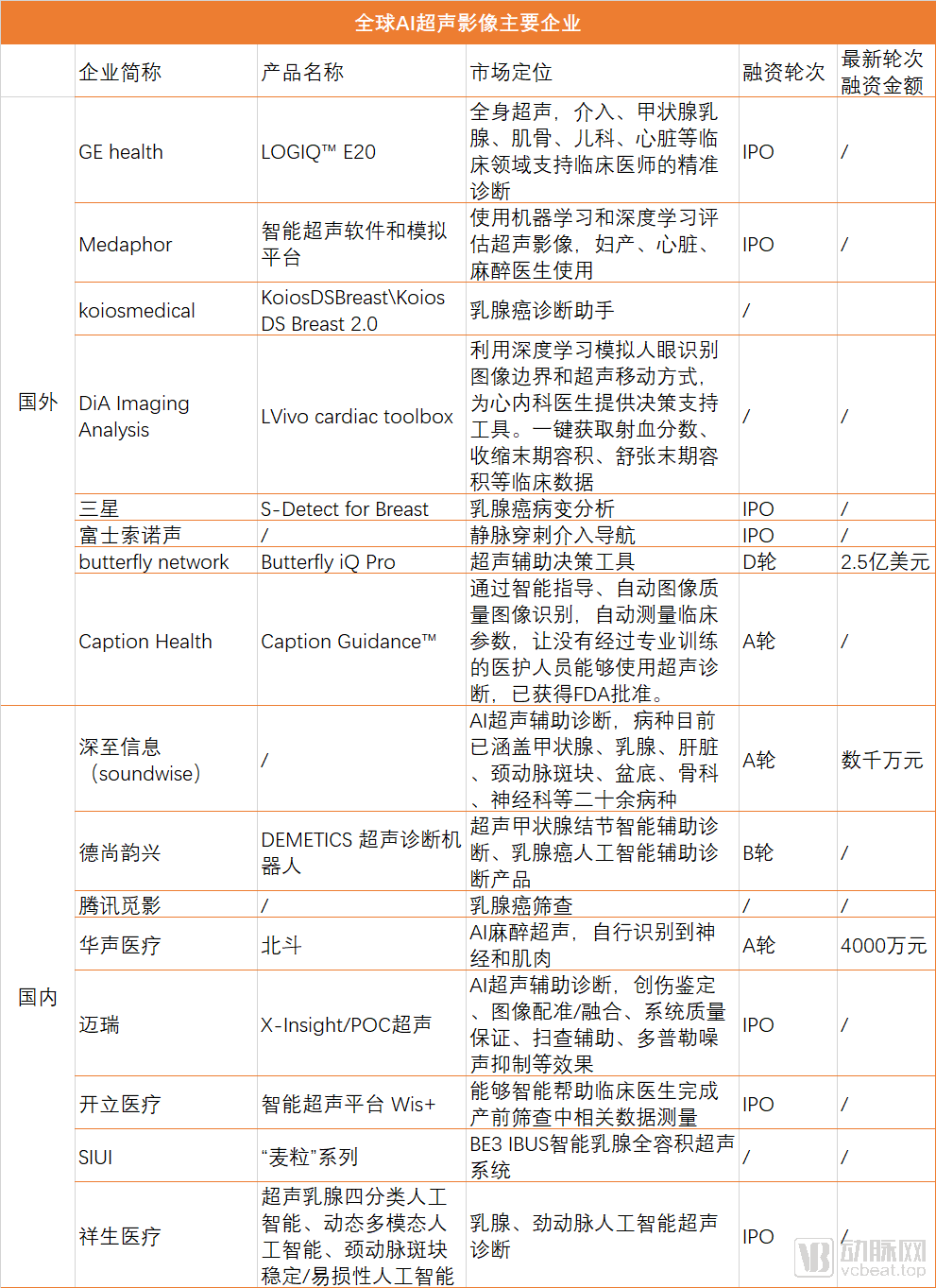
*Companies not included in this table may also contact VCBeat for further discussion.
As can be seen from the main application scenarios in the table, although the AI ultrasound sector features strong positioning by industry giants as well as the presence of startups, the differing application scenarios mean that they do not constitute direct competition.
Compared with AI+CT imaging, the AI ultrasound sector is not crowded. Why has AI+ultrasound been a late-blooming track in AI imaging? A major reason is that AI+ultrasound poses greater technical challenges.
According to Yan Yeen, Executive President of Deshang Yunxing, the main technical challenges of applying AI to ultrasound can be divided into three major parts.
The primary objective is to achieve real-time diagnosis. Unlike the static images produced by CT and MRI, ultrasound generates dynamic, real-time imagery. The key challenge in ultrasound examination lies in the necessity of performing image acquisition and interpretation simultaneously. This is primarily because, for imaging modalities such as CT, MRI, and X-ray, image acquisition is performed by technologists while interpretation is conducted by radiologists, thereby eliminating the need for real-time synchronization. In contrast, ultrasound requires concurrent acquisition and interpretation, which poses greater challenges for computer-aided diagnosis, particularly in terms of algorithms and computational power.
Secondly, in terms of data, ultrasound imaging data is relatively more difficult to acquire than CT data, due to the established practices for browsing, processing, and storing ultrasound images.
“Why did numerous AI pulmonary nodule companies emerge at the dawn of the AI medical imaging boom? Because, relatively speaking, pulmonary nodule imaging data is easier to acquire.”
In addition to the limited scale of the database, ultrasound images suffer from low standardization, as their clarity depends on the sonographer’s scanning technique and the specific equipment model. Therefore, a highly specialized expert team is required to clean and analyze these data.
The third point is the limitation of algorithmic frameworks. “It is crucial to have a proprietary algorithmic framework. Currently, the vast majority of companies rely on open-source algorithms, particularly in the field of ultrasound, where very few enterprises possess their own proprietary algorithms. Unlike other radiology AI applications, ultrasound AI is heavily dependent on independently developed algorithmic frameworks, which are closely correlated with the accuracy and real-time performance of analytical products.”
He cited an example, noting that excessively lengthy algorithms can lead to slow processing speeds. Given the real-time nature of ultrasound imaging, which generates dozens of frames per second—and in some cardiac imaging applications, over a hundred frames per second—robust algorithms are essential to handle such large volumes of data. As one of the earliest companies in China to develop AI-powered ultrasound products, Deshang Yunxing has already launched AI solutions for thyroid, breast, pelvic floor, liver, and carotid artery ultrasound. Thanks to its fully independent intellectual property rights in algorithmic frameworks, all of Deshang Yunxing’s ultrasound AI products demonstrate superior adaptability and performance.
In addition to the three points mentioned above, if AI is to be integrated into handheld ultrasound devices, the issue of computational power limitations must also be addressed. The hardware constraints of handheld ultrasound devices and the limitations in image clarity pose greater challenges for deploying AI software. Handheld ultrasound devices are significantly smaller than traditional ultrasound systems, which places substantial demands on AI computational capabilities.
Zhu Ruixing stated, “AI ultrasound is a systematic engineering endeavor; it is not simply a matter of companies being able to perform diagnostic recognition once they possess an algorithm. For instance, if the platform is a handheld ultrasound device, onboard chips and GPUs are required to assist with computation, necessitating comprehensive consideration of algorithm design, integrated circuit (IC) design, chip selection, and power consumption.”
Companies must not only develop a highly precise model for analyzing ultrasound videos, but also ensure that the model can operate effectively under the limited resources of Android tablet and smartphone platforms.
In the field of AI-powered ultrasound, regulatory approval is an inevitable major hurdle. Caption Health’s FDA clearance has effectively cleared the path for most companies that continue to invest in R&D for AI-based ultrasound technologies.
Zhu Ruixing stated that the FDA’s approval progress represents a significant positive development for China: “I began focusing on the field of AI-enhanced ultrasound relatively early. Previously, this sector remained in a dormant phase. With the FDA’s approval of AI-assisted diagnostic software for ultrasound, the industry may be poised for rapid growth. In 2016, when the AI medical imaging sector garnered the most attention, it coincided with the FDA’s approval of the first AI-assisted diagnostic software.”
Dr. Robert Ochs, Deputy Director of the Office of In Vitro Diagnostics and Radiological Health at the FDA’s Center for Devices and Radiological Health, stated during the approval of Caption Health’s AI-assisted software for adult cardiac ultrasound examinations that the significance of allowing this AI-powered ultrasound diagnostic software to enter the market extends beyond its use by ultrasound specialists. The broader future application of AI in ultrasound lies in enabling general healthcare providers—such as nurses in family clinics—to utilize ultrasound technology, thereby helping us detect diseases earlier and more accurately.
In the evolution of ultrasound technology, both hardware and software capabilities are crucial for handheld ultrasound devices. Currently, AI systems in ultrasound present a higher barrier to entry. This is akin to the smartphone industry in China, where numerous manufacturers can produce hardware, but few can develop operating systems. In a market with increasingly homogeneous hardware, the ability to develop robust AI software largely determines the application potential of handheld ultrasound hardware.
Meanwhile, in primary care settings, ultrasound devices are more affordable than large-scale equipment such as CT scanners. Therefore, AI-powered ultrasound solutions may be more suitable for widespread adoption compared to AI applications reliant on large imaging modalities like CT. However, a significant challenge remains for general practitioners in primary healthcare: how to truly streamline workflows into intelligent, user-friendly processes. With the empowerment of AI software, ultrasound is increasingly becoming a “visual stethoscope.”