

RDMD Secures $14 Million Series A Funding to Build Real-World Data Platform Accelerating Rare Disease Drug Development
Lux Capital
Investment Institutions in the Fields of Physical and Life Sciences

Village Global
Early-Stage Venture Capital Firms
Maveron
Venture Capital Firm Focused on Early-Stage Startups

Garuda
Angel Fund

Spark Capital
Venture Capital Firms
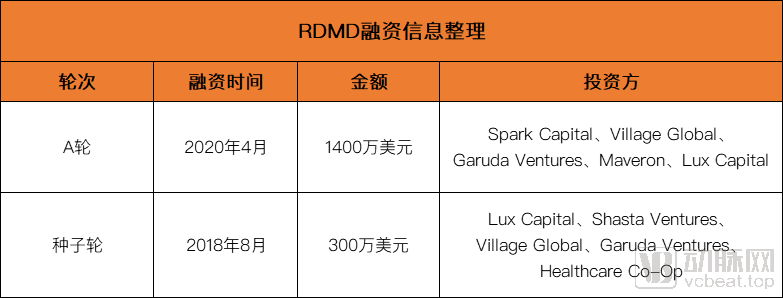
Recently, VCBeat learned that a data technology company specializing in rare disease research and drug developmentRDMD Completes $14 Million Series A Financing Round. The round was led by Spark Capital, with participation from existing seed investors Village Global, Garuda Ventures, and Lux Capital, as well as new investor Maveron.
Furthermore, the company simultaneously announced a five-year partnership with Belgian pharmaceutical manufacturer UCB to research rare neurodegenerative diseases.UCB will leverage RDMD’s real-world data to advance its drug development efforts for this class of rare diseases.
RDMD is a startup founded in November 2017, headquartered in San Francisco, California, USA. The two founders are Nancy Yu and Onno Faber; the former also serves as Chief Executive Officer, while the latter serves as Chairman of the Board.

“Four years ago, I began experiencing hearing loss in my left ear, which doctors attributed to an infection. After countless unsuccessful treatments, a specialist finally decided to perform an MRI scan. I was ultimately diagnosed with a rare genetic disorder—neurofibromatosis type 2 (NF2)—which has an incidence rate of only one in 30,000. This experience changed my life,” said Onno Faber.
At the age of 16, during his high school years, Onno Faber founded his first technology company, ii studio. Since then, he has also founded or managed several other companies, including Hoppakay and Tapstack.
After learning that he had NF2 and that no effective treatments were available, Onno Faber leveraged his technical expertise to organize a Silicon Valley “hackathon” in 2017, which attracted 150 hackers. The RDMD team, led by Nancy Yu, stood out in the competition and subsequently raised $3 million in seed funding to establish a health database for rare diseases.
“I want to know if we can combine a powerful data and analytics platform with patient data to gain insights into rare diseases,” said Onno Faber. “I have always been a tech entrepreneur. Now, I am applying the knowledge I have gained throughout my career to building RDMD. We are committed to helping patients with rare diseases and accelerating the development of treatments for rare diseases.”
Nancy Yu previously worked at the genetic testing company 23andMe for two years and served as an advisor to Livongo. Under her leadership, RDMD developed an FDA-cleared technology platform capable of generating robust clinical evidence, thereby accelerating rare disease research and drug development. This platform empowers patients and their families to easily contribute to rare disease research anytime and anywhere, transforming them from passive observers into active participants.
Nancy Yu once stated,There are currently more than 7,000 rare diseases worldwide, and this number continues to rise; approximately one in ten people globally may be affected by a rare disease. However, fewer than 5% of these patients receive treatment with therapies approved by the U.S. Food and Drug Administration (FDA).
Rare disease research faces numerous challenges due to the scarcity of resources available to researchers. Valuable data is dispersed across hospitals nationwide, and collecting this information demands considerable time and effort, yet there is insufficient funding to support such endeavors. Furthermore, patients are often unaware that their health information is being utilized.
RDMD aims to enable patients to safely provide anonymized information from their health records to accelerate drug development. Patients can decide for themselves whether to contribute their health information.
“Unlike more common diseases that benefit from abundant resources, rare diseases lack a foundational data infrastructure, which prevents many treatment programs from being implemented,” said Adam Goulburn, General Partner at Lux Capital, in a statement. “RDMD is an organization dedicated to addressing the challenges of rare diseases, with the goal of creating fertile ground for treatment initiatives.”
RDMD’s platform extracts and analyzes data from electronic health records (EHRs) to conduct rapid retrospective studies and generate new real-world data. As the data are sourced directly from medical records, they are sufficiently reliable. According to the company, these data are de-identified, stored in RDMD’s proprietary database, compliant with regulatory requirements, and accessible to biopharmaceutical partners or research teams.
Furthermore, the company offers an EHR application designed for patients. In addition to helping patients manage their personal health records, it enables users to share health information with their caregivers and, with consent, release anonymized data to researchers studying rare diseases.
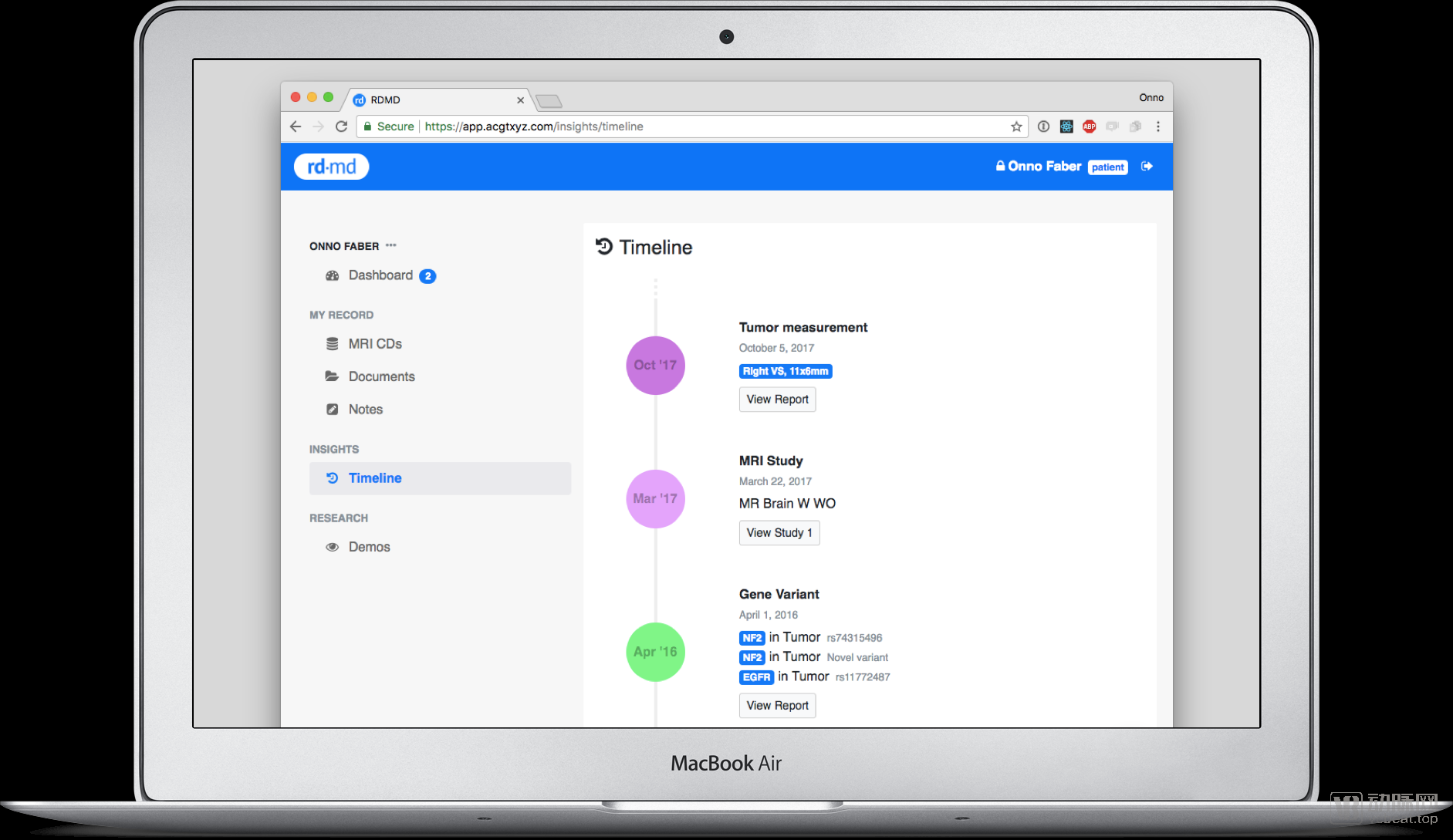
RDMD Patient Health Records
Nancy Yu stated: “Typically, collecting data on such rare diseases over several years would cost millions of dollars. In contrast, our dataset requires significantly less time and cost.”
One of the biggest challenges in developing new drugs and therapies for rare diseases is how to obtain sufficient information to identify the right treatment approaches. To address this issue, RDMD uses AI to analyze data from medical records and uncover commonalities among rare disease cases. The company then sells this data to pharmaceutical companies to support their development of new treatments.
This 15-person startup initially focused on neurofibromatosis. Now,They have established communities for 12 diseases and plan to expand this number to 30 within one year.
Currently, RDMD’s disease portfolio covers Neurofibromatosis Type 2 (NF2), Immune Thrombocytopenia (ITP), Progressive Supranuclear Palsy (PSP), Chronic Inflammatory Demyelinating Polyneuropathy (CIDP), Myasthenia Gravis (MG), GM1 Gangliosidosis (GM1), Inclusion Body Myositis (IBM), Sanfilippo Syndrome (MPS III), Thymidine Kinase 2 Deficiency (TK2d), Hunter Syndrome (MPS II), Wilson Disease, and CDKL5 Deficiency Disorder.
The company has established partnerships with patient advocacy groups and physician associations related to the aforementioned diseases, including the Children’s Tumor Foundation, Cure GM1 Foundation, Cure IBM, Cure Sanfilippo Foundation, International Foundation for CDKL5 Research, Myositis Support and Understanding Association, National Tay-Sachs & Allied Diseases Association, NF2 Biosolutions, and the PSP & CBD Foundation.
According to company statistics, it has more than 1,000 users and can access patient medical information from over 1,500 hospitals through these users. RDMD has also expanded its platform to Canada and plans to expand into Europe in the near future.
“We still need to learn more about rare diseases, including Sanfilippo syndrome, the condition my daughter Eliza has. RDMD has collected over 7,000 medical records from hospitals across the United States and Canada for our Sanfilippo community,” said Dr. Cara O’Neill, Chief Scientific Officer of the Cure Sanfilippo Foundation. “The best part is that patients don’t have to pick up the phone to call hospitals; RDMD handles all the behind-the-scenes work off-site.”
According to publicly available information from RDMD, they intend to use the funds from their Series A financing for:
1. Expand to cover 20 additional rare diseases;
2. Conduct targeted research for each new scenario to help researchers better understand the natural history of each disease, thereby enabling the design of improved clinical trials;
3. Provide participants in each rare disease community with improved research experiences and research insights;
4. Expand partnerships with patient organizations and academic societies to establish a regulatory-grade evidence platform;
5. Develop commercial partnerships with new and existing biopharmaceutical clients;
6. Further expand the capabilities of international platforms;
7. Expand the team;
8. Ensure the continuity of the research plan throughout the coronavirus pandemic and beyond.
In 2018, CNBC released its annual list of the 100 most promising startups to watch, and RDMD was included. The company was also nominated as a 2020 TEDMED Hive Innovator and was listed by Forbes magazine as one of the 10 latest examples of powerful innovation in the healthcare sector.
Although RDMD’s EHR data-focused clinical research methodology is unique, its model is reminiscent of the one designed by Flatiron Health for oncology. The latter was founded by Nat Turner and Zach Weinberg in 2012 and was acquired by Roche in early 2020 for up to $1.9 billion.
There are other similar data model organizations, such as the PatientsLikeMe patient community in Cambridge, Massachusetts.
Rare diseases, also known as “orphan diseases,” are treated with medications referred to as “orphan drugs.” In 1983, the United States enacted the Orphan Drug Act of 1983, which aims to incentivize pharmaceutical and medical device companies to develop new therapies for patients with rare diseases.
The FDA’s incentives for the development of drugs for rare diseases include Orphan Drug Designation, the Priority Review Voucher Program for pediatric rare disease treatments, and grant programs supporting clinical trials for rare disease therapies. Although the number of patients with any given rare disease is relatively small, the aggregate patient population is substantial—it is estimated that nearly 30 million people in the United States alone are affected by rare diseases.
In a 2019 study, C. Rees and colleagues, members of the U.S. National Academy of Sciences, reported on the completion and publication status of 659 rare disease clinical trials registered on ClinicalTrials.gov between January 2010 and December 2012. The results showed that by December 2014, 199 trials (30.2%) had been terminated, largely due to insufficient patient enrollment. Furthermore, among the completed clinical trials, more than half (306 trials, 66.5%) remained unpublished within two years, and nearly one-third (142 trials, 31.5%) were still unpublished after four years. In many cases, publication was contingent upon sample size and statistical significance.
Since 2016, the FDA’s Office of Orphan Products Development (OOPD) has collaborated with the National Center for Advancing Translational Sciences (NCATS) on its “Therapeutics for Rare and Neglected Diseases” program, providing funding for rare disease clinical trials and natural history studies through the “Orphan Products Grants Program.” In addition, the Patient-Centered Outcomes Research Institute (PCORI) established a Special Advisory Panel on Rare Diseases, which has to date conducted 28 patient-centered comparative effectiveness studies focused on the treatment and management of rare diseases.
Many countries abroad maintain rare disease registries and related information, such as the Genetic and Rare Diseases Information Center (GARD) in the United States and Orphanet in the European Union. In China, however, there has been a persistent lack of epidemiological data on rare diseases, which seriously hinders efforts in clinical care, scientific research, and health policy formulation.
China also faces several challenges in the treatment of rare diseases, such as the urgent need to establish a regulatory framework for orphan drugs, insufficient nationwide epidemiological survey data, the pressing requirement for unified utilization and management of premium medical resources, and the need to address patients’ medical insurance coverage and quality of life.
However, we have already begun to take action.
In December 2016, the Rare Disease Branch of the Chinese Research Hospital Association was established in Beijing, and the National Key R&D Program for Rare Disease Research was simultaneously launched. In 2017, the National Rare Disease Registry System (NRDRS) was officially launched. To date, 121 diseases have been included in the first batch of the National List of Rare Diseases.
In 2018, the first big-data research paper on China’s first national list of rare diseases was published: “Analysis of the Current Status of 121 Rare Diseases Based on Over 15 Million Hospitalization Cases in China.”
This study is commendable for three reasons:
1. Extensive Data: Based on a database of over 15 million real inpatient medical records;
2. Interdisciplinary: It applies multidisciplinary principles from clinical medicine, healthcare administration, statistics, medical record management, mathematics, and computer technology;
III. First Report: This is the first study in China related to the National First Batch of Rare Diseases Catalogue. It has yielded valuable real-world data on the geographical distribution, disease-type distribution, hospitalization status, and initial and follow-up visit patterns of 121 rare diseases in tertiary Grade A hospitals across China in recent years.
We believe that better solutions for rare diseases are on the horizon.