

Alnylam Pharmaceuticals Secures $2 Billion Strategic Financing with Blackstone to Advance RNAi Therapeutics

Blackstone Life Sciences
Life Sciences Fund

GSO Capital Partners
Asset Management Company
Alnylam Pharmaceuticals
RNA Interference (RNAi) Innovative Drug Developer
Recently, VCBeat learned thatBlackstone Group and U.S. biotechnology company Alnylam Pharmaceuticals have reached a $2 billion strategic financing partnership to accelerate the development of RNA interference (RNAi) therapeutics."This financing round is one of the largest private financings in the history of biotechnology companies."
This transaction primarily includes the following:
A $1 billion contingent payment led by Blackstone Life Sciences, in exchange for 50% of Alnylam’s royalties and other rights;
The largest tranche of $750 million in the first-lien mortgage loan led by GSO (Blackstone’s global credit investment platform);
Blackstone Life Sciences provides $150 million in funding to support the development of Alnylam’s cardiometabolic programs, vutrisiran and ALN-AGT;
The remaining $100 million will be used to purchase common shares of Alnylam.
The massive splash created by a $2 billion investment inevitably sparks curiosity: What exactly is RNAi technology? What impact has it had on the current medical landscape? And at what stage is Alnylam’s research, prompting Blackstone to place such a significant bet?
RNA interference (RNAi) is a natural cellular process of gene silencing, representing one of the most promising and rapidly evolving fields in contemporary biology and drug development. Its discovery, hailed as “a major scientific breakthrough that occurs once every decade or so,” was awarded the 2006 Nobel Prize in Physiology or Medicine. Alnylam Pharmaceuticals is a pioneer in this cutting-edge scientific technology.
Alnylam Pharmaceuticals, Inc. was founded in 2002 and is headquartered in Cambridge, Massachusetts, with more than 1,300 employees worldwide. Alnylam’s commercial RNAi therapeutic products include ONPATTRO®, which has been approved in the United States, the European Union, Canada, Japan, Brazil, and other countries, as well as GIVLAARI®, which has been approved in the United States and the European Union.
Dr. John Maraganore is the Chief Executive Officer and a Director of Alnylam. He earned his master’s and doctoral degrees in Biochemistry and Molecular Biology from the University of Chicago early in his career. Maraganore has been with Alnylam since its inception.
Prior to joining Alnylam, Maraganore served as Senior Vice President of Strategic Product Development at Millennium Pharmaceuticals, where he was primarily responsible for the franchise covering oncology, cardiovascular, metabolic, and inflammatory disease products. He also previously held the positions of Director of Molecular Biology and Director of Marketing and Business Development at Biogen, where he invented and led the discovery and development of the injectable drug ANGIOMAX® (bivalirudin).
The scientific advisors and founders of Alnylam Pharmaceuticals are even more remarkable.These eight individuals are preeminent global scientists in the fields of RNAi research and medical research, all of whom are heavyweight figures:
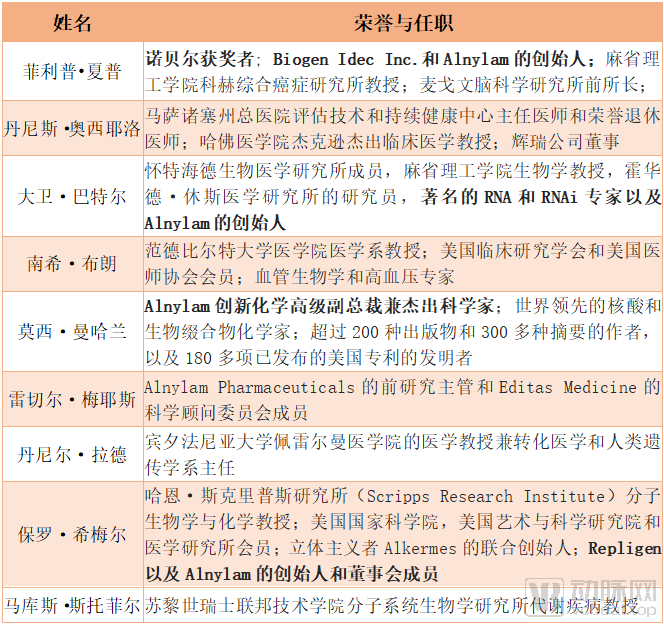
Alnylam Pharmaceuticals Scientific Advisory Board Profile
Source: Alnylam Pharmaceuticals Official Website
However, a heavyweight team does not seem to be the complete answer to the problem. Capital represents real financial commitment, and a prestigious reputation can serve as an added advantage, but it is the ultimate outcomes of technical research that truly matter. The label of “a major scientific breakthrough occurring roughly once every decade” propelled RNA interference (RNAi) into the spotlight, while the destiny of “enduring countless trials before being entrusted with a great mission” also fell upon Alnylam. In the early stages of research, Alnylam frequently kept investors awake at night.
On September 13, 2010, news from Alnylam Pharmaceuticals in the United States that its new cancer drug had cured 19 patients with advanced-stage disease caused a sensation. Alnylam claimed to have discovered a novel drug capable of curing all cancers. This announcement sparked intense public discussion: Was this the beginning of humanity’s conquest of cancer?
However, the good times were short-lived. On May 30, 2012, Alnylam announced the failure of the Phase IIb clinical trial for ALN-RSV01. Within a few months, Alnylam’s stock price plummeted by nearly 30%. Nevertheless, this setback did not discourage Alnylam. On June 7, the company initiated the Phase II clinical trial for ALN-TTR02. On July 15, Alnylam actively entered into a collaboration with China’s Shifang Pharmaceutical to develop ALN-VSP, an RNA interference therapeutic for the treatment of liver cancer.
On July 15, 2013, Alnylam announced positive Phase I clinical data for ALN-TTRsc, an RNAi-targeted therapy for ATTR amyloidosis. On August 23, Alnylam received orphan drug designation from the U.S. Food and Drug Administration (FDA) for two of its investigational hemophilia drugs, ALN-AT3.
Everything appears to be trending positively. Drawn by the broad development prospects, pharmaceutical giants such as Sanofi and Roche have either partnered with or invested in Alnylam Pharmaceuticals, signaling a clear resurgence of interest in RNAi therapy research.
In August 2015, the novel RNAi therapy developed by Alnylam Pharmaceuticals was once considered potentially capable of outperforming the PCSK9 inhibitors launched by Amgen and Sanofi at the time. Alnylam’s new therapeutic candidate, ALN-PCSsc, was able to reduce patients’ LDL cholesterol levels by 64%–83%, whereas Phase III clinical trial data for Sanofi’s Praluent and Amgen’s Repatha showed reductions of 36%–59% and 60%, respectively. Moreover, ALN-PCSsc required only quarterly or even semi-annual injections, while Praluent and Repatha necessitated an average of 26 injections per year. Alnylam garnered significant attention, but setbacks soon emerged quietly.
On October 2, 2016, Alnylam was forced to halt its therapy ALN-AAT, developed for the treatment of alpha-1 antitrypsin deficiency, due to safety concerns. Upon the announcement, the company’s market capitalization plummeted by approximately $500 million on the same day. On October 7, the Phase III clinical trial of revusiran, a novel drug developed by the company for the treatment of hereditary ATTR amyloidosis, was again forced to terminate after reports emerged of an excessively high mortality rate among patients in the treatment arm. This led to a 41% plunge in Alnylam’s stock price, delivering another severe blow to RNAi therapies.
Fate continued to play its tricks. In September 2017, an unexpected patient death occurred in the clinical trial of fitusiran, Alnylam’s hemophilia therapy, once again thrusting the safety concerns of RNAi therapeutics into the spotlight. Although givosiran, developed for the treatment of acute hepatic porphyria (AHP), was progressing smoothly at the time, the setback with fitusiran still triggered widespread panic among investors.
A series of heavy blows has cast a shadow over RNAi therapy. Alnylam faces a critical choice: “continue” or “abandon.” If it chooses to abandon, all previous substantial investments will go down the drain, and it is likely that few others will dare to venture into this field again. By continuing its research, Alnylam would bear immense public pressure and still face the risk of failure. However, success would usher in a new chapter in human medical technology.
Perhaps it was an inevitable outcome of the healthcare transformation that Alnylam chose to forge ahead under a heavy burden.
On March 13, 2018, Alnylam’s novel rare disease drug lumasiran received FDA Breakthrough Therapy Designation, primarily for the treatment of Primary Hyperoxaluria Type 1 (PH1).
On August 11, 2018, the U.S. FDA announced the approval of Onpattro (patisiran), an RNAi therapeutic developed by Alnylam Pharmaceuticals, for infusion treatment in patients with peripheral neuropathy caused by hereditary transthyretin-mediated amyloidosis (hATTR). This marks the first therapy approved by the FDA for treating polyneuropathy caused by hATTR, as well as the first small interfering RNA (siRNA) drug approved by the agency.
hATTR affects approximately 50,000 people worldwide and is a rare, fatal genetic disease.This disease causes the abnormal deposition of protein fibers known as amyloid in internal organs and tissues, thereby interfering with their normal function. When these protein deposits occur in the peripheral nervous system, they can lead to loss of sensation, pain, or impaired mobility in the arms, legs, hands, and feet, while also affecting the function of the heart, kidneys, eyes, and gastrointestinal tract. Current treatment approaches primarily focus on symptom management, highlighting an urgent unmet medical need in this field.
Onpattro is a small interfering RNA (siRNA) therapy targeting transthyretin; such drugs work by silencing specific RNAs involved in disease pathogenesis.Onpattro encapsulates small interfering RNA (siRNA) within lipid nanoparticles, delivering the drug directly to the liver during infusion therapy to interfere with the production of RNA encoding abnormal forms of transthyretin (TTR). By inhibiting TTR production, Onpattro helps reduce the accumulation of amyloid deposits in peripheral nerves, alleviates patient symptoms, and facilitates better disease management.
“The need for treatments for hATTR polyneuropathy has long been recognized. This unique targeted therapy offers an innovative treatment option for these patients, directly addressing the underlying cause of the disease,” said Dr. Billy Dunn, Director of the Division of Neurology Products in the FDA’s Center for Drug Evaluation and Research.
Currently, Onpattro was approved in the United States on August 10, 2018, and in the European Union on August 30, 2018, becoming the first RNAi therapeutic to be marketed in the 20 years since the discovery of the RNA interference (RNAi) phenomenon. Subsequently, Onpattro has been successively approved and launched in countries including Germany, Japan, the United Kingdom, Canada, and Brazil for the treatment of hereditary transthyretin-mediated (hATTR) amyloidosis.
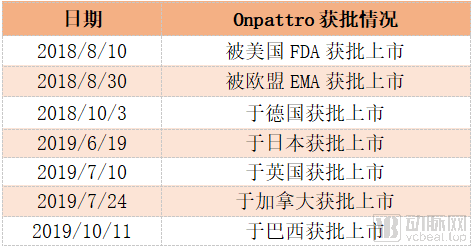
Current Approval Status of the RNAi Drug Onpattro
The industry is highly optimistic about the commercial prospects of Onpattro. Pharmaceutical market research firm EvaluatePharma predicts that Onpattro’s sales will reach $1.308 billion in 2024.
On November 21, 2019, Givlaari, another innovative drug from Alnylam, was approved by the U.S. FDA for the treatment of acute hepatic porphyria (AHP). On March 5, 2020, Givlaari received marketing approval in the European Union. It is the second RNAi therapeutic worldwide.
Acute Hepatic Porphyria (AHP) is a group of very rare genetic disorders, with long-term complications including chronic neuropathic pain, hypertension, chronic kidney disease, and liver disease.This disease comprises four subtypes, each caused by a genetic defect leading to a deficiency in one of the enzymes involved in the hepatic heme biosynthesis pathway. These defects result in the accumulation of neurotoxic heme intermediates, namely aminolevulinic acid (ALA) and porphobilinogen (PBG), with ALA considered the primary driver of acute attacks and persistent symptoms between episodes. Patients with acute hepatic porphyria (AHP) frequently suffer from chronic pain and debilitating, intolerable disease exacerbations, yet currently available treatment options remain limited.
Givlaari is a transformative drug for the treatment of acute hepatic porphyria.This medication treats acute hepatic porphyria (AHP) via subcutaneous RNA interference (RNAi) therapy targeting aminolevulinic acid synthase 1 (ALAS1). Administered once monthly, it sustains a significant reduction in induced hepatic ALAS1 levels, thereby lowering the neurotoxic heme intermediates aminolevulinic acid (ALA) and porphobilinogen (PBG) to normal ranges. By reducing the accumulation of these intermediates, Givlaari effectively prevents or reduces the occurrence of severe and life-threatening AHP attacks, controls chronic symptoms, and alleviates disease burden.
On April 16, 2020, the U.S. FDA granted Fast Track designation to Alnylam’s RNAi therapy vutrisiran for the treatment of polyneuropathy caused by hereditary transthyretin-mediated amyloidosis (hATTR) in adults.
Currently, Alnylam has two RNAi therapies under regulatory review: lumasiran for the treatment of primary hyperoxaluria type 1 (PH1), and inclisiran for the treatment of hypercholesterolemia. Both are expected to be approved for marketing this year.In addition, the company has six RNAi therapies in late-stage clinical development in its pipeline.
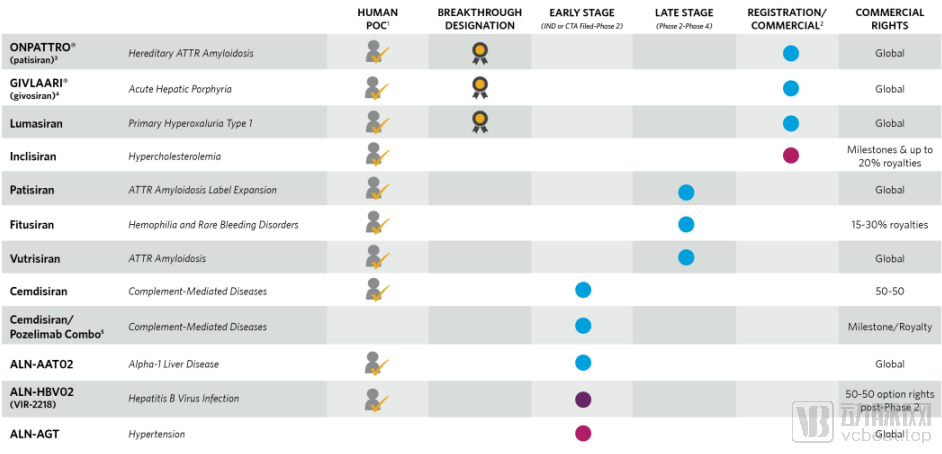
Alnylam PPharmaceuticals Product Pipeline
Image source: Alnylam Pharmaceuticals official website
Previously, TMC entered into a licensing and collaboration agreement with Alnylam, securing global development and commercialization rights for inclisiran. In November 2019, Novartis acquired TMC for $9.7 billion, thereby bringing inclisiran into its portfolio.
Currently, there are two cholesterol-lowering drugs on the market that target PCSK9, but they require administration every two weeks or once a month. Inclisiran is administered once every six months, requiring only two doses per year, which offers a significant advantage in terms of treatment convenience. The pharmaceutical market research firm EvaluatePharma predicts that the annual peak sales of inclisiran after its launch will reach $2.6 billion.
The successive launches of the RNAi therapeutics Onpattro and Givlaari signal the advent of an era of transformation in medical technology.Dr. Nicholas Galakatos, Global Head of Life Sciences at Blackstone, stated that Alnylam’s RNA interference technology represents one of the most promising and rapidly evolving fields in contemporary biology and drug development. This is the rationale behind Blackstone’s investment in Alnylam.