

Colorectal Cancer Early Screening Industry Heats Up: Blood, Stool, and AI Imaging Innovations Drive a RMB 100-Billion Market
In 2019, the latest national cancer statistics report released by the National Cancer Center indicated that in 2015, there were approximately 3.929 million new cases of malignant tumors and about 2.338 million cancer-related deaths nationwide. This translates to an average of more than 10,000 new diagnoses per day, or 7.5 people diagnosed with cancer every minute.
It is worth noting that the report shows that in 2015, the incidence rate of colorectal cancer in China was 9.88%, ranking third, only after lung cancer and liver cancer, and the mortality rate ranked fifth, which has become a major factor affecting the health of Chinese people and leading to death.
Colorectal cancer is a common malignant tumor originating in the colon or rectum. Its etiology is closely associated with lifestyle factors, genetics, and intestinal adenomas, and its incidence is increasingly skewed toward older age groups. In fact, early intervention can effectively reduce both the incidence and mortality rates of colorectal cancer. The progression from early-stage adenoma to colorectal cancer typically takes approximately ten years, and 90% of patients diagnosed at an early stage can be cured with effective treatment. The World Health Organization has explicitly recognized colorectal cancer as a malignancy for which screening and population-based census programs are valuable.
The “Expert Consensus on Early Diagnosis and Screening Strategies for Colorectal Tumors in China” recommends that the target population for colorectal cancer screening be individuals aged 40 to 74 years. According to the 2017 National Statistical Yearbook, the population in China within this age group is approximately 600 million; therefore, around 600 million people in China require early cancer screening.
The "Three-Year Action Plan for Cancer Prevention and Control in China (2015–2017)" states that the target early screening rate for colorectal cancer in key regions is 50%. We assume a 30% coverage rate of early cancer screening products among the high-risk population (180 million people), with annual screening. The price of early colorectal cancer screening products ranges from RMB 100 to RMB 2,000 (fecal occult blood test: ~RMB 20; colonoscopy: ~RMB 300; painless colonoscopy: ~RMB 600; DNA-based early colorectal cancer screening products: ~RMB 2,000). For calculation purposes, we use a price of RMB 600. Thus, the size of China’s early cancer screening market is calculated as 600 million × 30% × RMB 600 = RMB 108 billion.
Traditional methods for colorectal cancer screening include colonoscopy, fecal occult blood testing, CT colonography, digital rectal examination, and tumor marker testing. Colonoscopy is considered the "gold standard" for colorectal cancer detection due to its high accuracy; however, the procedure is cumbersome and painful. Fecal occult blood testing encompasses both the guaiac-based fecal occult blood test (gFOBT) and the fecal immunochemical test (FIT); while these techniques are non-invasive, they exhibit relatively low sensitivity. CT colonography offers high precision but is limited by its difficulty in detecting early-stage carcinogenesis and involves exposure to ionizing radiation. Digital rectal examination is simple and easy to perform, yet it often causes patient discomfort. Tumor marker testing can facilitate early tumor detection, but it is prone to false-positive results.
Overall, while traditional colorectal cancer screening methods have their respective advantages, they also suffer from various drawbacks that hinder the widespread adoption of early screening.
In recent years, the emergence of numerous new technologies and approaches—such as blood tests, stool tests, and AI-based medical imaging—has created new opportunities for the widespread adoption of early colorectal cancer screening.
Blood testing is a non-invasive diagnostic method that offers advantages such as ease of operation, high sensitivity, low cost, and rapid turnaround. By detecting circulating tumor DNA (ctDNA), circulating tumor cells (CTCs), or exosomes released by tumors into the bloodstream, it can determine the presence of tumor cells in the body and facilitate early cancer detection. Additionally, colorectal cancer can be screened for by analyzing abnormal DNA methylation, hemoglobin concentration, and gene mutations in stool samples.
Medical imaging is also a critical tool for early cancer screening. However, due to the high complexity of pathological changes, stringent requirements for lesion localization accuracy, and limitations in professional expertise, physicians may fail to detect early-stage carcinogenesis. By leveraging AI and image recognition technologies, doctors can improve their work efficiency and diagnostic capabilities, enabling the detection of early cancerous changes and making large-scale early screening feasible.
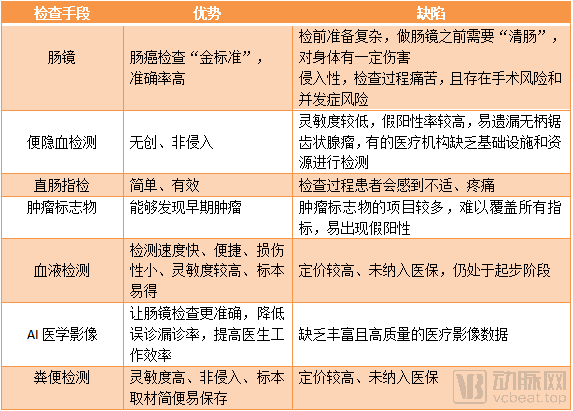
Pros and Cons of Various Colorectal Cancer Screening Methods
What Is the Current State of Colorectal Cancer Screening Technologies Based on Blood Tests, Stool Tests, and AI Medical Imaging in China? How Are Major Companies Strategizing? VCBeat Conducts a Panoramic Scan of the Early Screening Sector for Colorectal Cancer Based on Blood Tests, Stool Tests, and AI Medical Imaging to Help Readers Gain a Systematic and Comprehensive Understanding of This Field.
Policies and Guidelines Prioritize the Application of New Technologies to Advance Early Screening for Colorectal Cancer
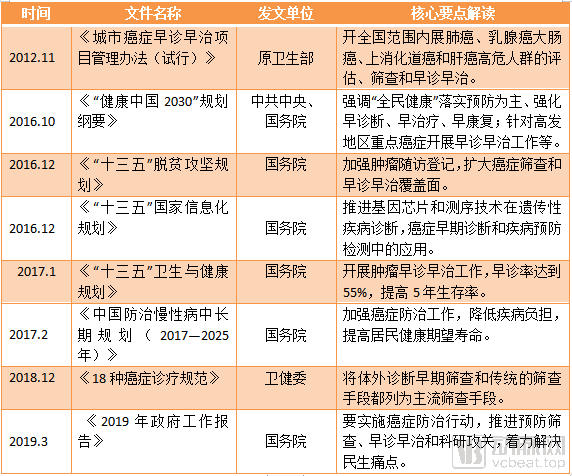
From a policy perspective, the government has become a significant force driving the development of early cancer screening, introducing multiple policies in succession to promote this field. In March 2019, the Government Work Report stated that “we should implement cancer prevention and control initiatives, advance preventive screening, early diagnosis and treatment, and key scientific research, with a focus on addressing critical public livelihood issues,” bringing unprecedented attention to early cancer screening.
Meanwhile, in the field of early screening for colorectal cancer, many local governments have already taken substantive actions.
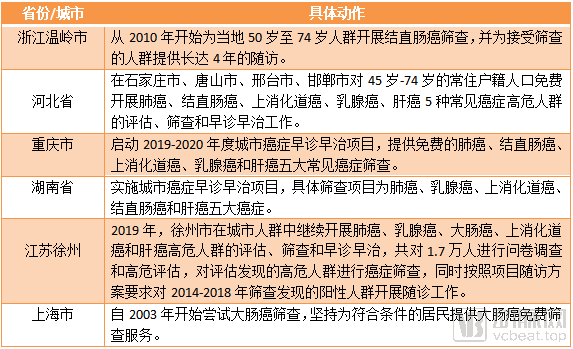
It is foreseeable that, driven by government initiatives, the market for early cancer screening—represented by colorectal cancer—will become the next major growth hotspot and continue to develop favorably.
According to China's colorectal cancer screening guidelines and expert consensus, fecal occult blood testing (FOBT) and colonoscopy are the standard methods for colorectal cancer screening. FOBT is non-invasive and convenient, while colonoscopy offers high accuracy. A positive FOBT result should be followed by a colonoscopy, thereby maximizing both diagnostic accuracy and procedural convenience.
With the advancement of genetic testing technologies, stool DNA testing and blood DNA testing have gained increasing attention and are gradually being incorporated into clinical guidelines and expert consensus statements. Meanwhile, colonoscopy, as the “gold standard” for colorectal cancer screening, continues to hold an irreplaceable role. In both guidelines and expert consensus documents, colonoscopy is recommended as the follow-up diagnostic procedure for individuals who test positive on initial screening.
Colorectal Cancer Early Screening Attracts Investor Interest: New Technologies and Methods Improve Patient Adherence
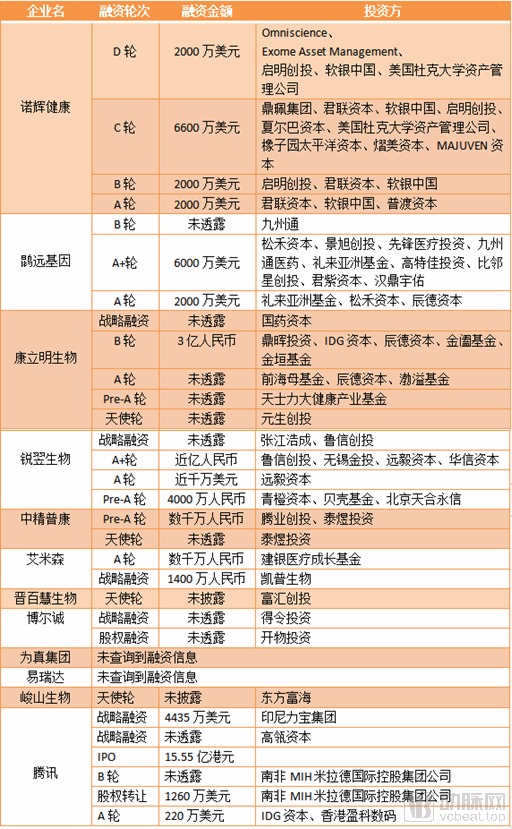
VCBeat has compiled the financing details of 12 companies that have entered the colorectal cancer early screening market.
In terms of funding amounts, most companies have raised funds in the range of thousands of RMB. Three companies—Kangliming Bio, New Horizon Health, and Genetron Health—have each secured over 100 million RMB in financing, indicating that the capital market recognizes the value of the colorectal cancer early screening market.
From the perspective of funding rounds, most companies are at Series A and Series B, indicating that the industry’s overall financing is still in its early stages, with substantial room for future growth. Tencent, as one of the leading players in AI-based medical imaging, is already publicly listed. It is expected that within five years, some companies specializing in early colorectal cancer screening based on liquid biopsy and methylation detection technologies will be among the first to go public.
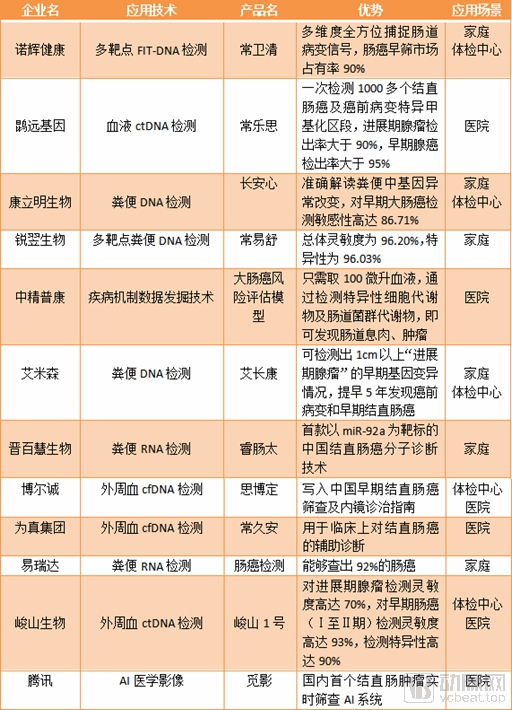
VCBeat has compiled information on the products of more than ten companies operating in the colorectal cancer early screening market. It is evident that colorectal cancer early screening products are primarily based on blood and stool analysis. Although these two testing methods serve only as preliminary screening tools and must be used in conjunction with colonoscopy, their advantages—such as convenience and high sensitivity—have significantly driven the development of the colorectal cancer early screening industry, gradually becoming a prevailing trend in the sector.
Blood Tests Drive Non-Invasive, Convenient Early Screening for Colorectal Cancer
Circulating tumor cells (CTCs), circulating tumor DNA (ctDNA) fragments, and exosomes are present in the blood even before specific symptoms manifest, thereby enabling early detection of colorectal cancer through blood-based testing.
As can be seen, many companies adopt the method of detecting circulating tumor DNA (ctDNA) fragments in blood, such as Genetron Health, Boercheng, and Junshan Bio. Circulating tumor DNA fragments refer to DNA segments carrying tumor information released by tumor cells and are a part of cell-free DNA (cfDNA) in plasma. ctDNA testing actually detects all cfDNA and then analyzes tumor-specific genetic variations from it. The detection of ctDNA requires high technical sensitivity. Currently, suitable technologies include digital PCR technology and NGS technology combined with single-molecule barcoding.
Exosomes are small membrane-bound vesicles secreted by most cells, characterized by a lipid bilayer structure and a diameter of approximately 40–100 nm. Studies have shown that tumor cells release exosomes in substantial quantities, and these exosomes are correlated with tumorigenesis, progression, metastasis, and drug resistance. Therefore, exosomes released by tumor cells into the bloodstream can be utilized to analyze tumor-related information by detecting specific proteins and non-coding RNAs contained within them.
Detection of circulating tumor cells for early screening of colorectal cancer has also garnered significant attention in recent years. Researchers at Chang Gung Memorial Hospital have found that detecting circulating tumor cells in blood can identify early-stage colorectal cancer with an accuracy of 84% to 88%.
Stool-Based Early Screening Technology for Colorectal Cancer Is Suitable for Home Screening
Both the intestines and tumors shed a large number of cells. By detecting components of shed tumor cells in feces, it is also possible to determine whether an individual has colorectal cancer.
Companies offering stool-based early screening for colorectal cancer all detect methylation mutations by extracting human-derived cells from fecal samples, although the specific genetic loci targeted vary among different companies.
New Horizon Health’s “Changweiqing” utilizes a multi-target FIT-DNA test that detects KRAS gene mutations, methylation, and hemoglobin, while analyzing 24 mutation sites across six target genes associated with colorectal cancer. This approach eliminates screening “blind spots” and enhances accuracy.
“Changyishu,” developed by RayBiotech, employs a multi-target fecal DNA testing technology to analyze SDC2 and SRFP2 methylation as well as hemoglobin in stool samples. This approach monitors the entire process of gene-regulated tumor cell proliferation, differentiation, adhesion, and migration, covering all stages of colorectal cancer development. It facilitates the early detection of precancerous lesions and colorectal cancer, thereby overcoming limitations such as the low sensitivity associated with single-gene methylation tests.
“ColonoClear,” a product under Kangliming Biotechnology, aids physicians in the early detection of intestinal tumors by accurately interpreting abnormal genetic alterations—specifically, human SDC2 gene methylation—in fecal samples. This approach holds promise for intercepting colorectal cancer at its early stages, thereby achieving the goals of prevention and curative treatment.
Moreover, stool-based colorectal cancer screening is simple to perform and suitable for home use. As shown in the table, all stool-based testing products can be used at home, thereby helping hospitals conserve medical resources.
Meanwhile, it is worth noting that New Horizon Health and RealBio Technology have adopted a multi-target detection approach. As colorectal cancer is a complex disease, multi-dimensional testing can enhance detection sensitivity.
AI Enhances the Accuracy of Colonoscopy
Colonoscopy can meet the diagnostic needs of nearly the entire colon. However, missed detections are common due to factors such as small or occult polyps, variability in lesions, or insufficient physician expertise. AI-based medical imaging products, trained on extensive datasets of colonic lesions with known outcomes—including features such as lesion size, shape, color, boundaries, and pathological results—can efficiently assist physicians during colonoscopy, significantly improving screening efficiency and accuracy.
Currently, the accuracy of AI-assisted colonoscopy screening remains a concern. Nevertheless, it is undeniable that AI can significantly reduce the missed diagnosis rate associated with visual inspection and provide physicians with reference insights regarding lesion characteristics. This technology holds substantial significance for the detection of early-stage colorectal tumors and for reducing the incidence of advanced-stage tumors, making it an inevitable trend in future development.
In the field of AI medical imaging, Tencent Miying is undoubtedly the most prominent product in China. In 2018, Tencent Miying launched the nation’s first real-time AI screening system for colorectal tumors.
Tencent Miying’s Colorectal Tumor Screening AI System leverages artificial intelligence technologies, such as image recognition and deep learning, integrated with digestive endoscopy to assist clinicians in real-time detection of colorectal polyps and immediate characterization of their nature. By analyzing 10 images per second, the system provides real-time alerts on conditions including non-adenomatous polyps, adenomatous polyps, and adenocarcinoma, thereby supporting clinicians in achieving more accurate and efficient diagnosis of colorectal tumors.
Based on large-scale, non-homologous, multi-center testing and statistical analysis, Tencent Miying achieves a real-time localization accuracy of 96.93% for colorectal polyps and a real-time diagnostic accuracy of 97.20% in differentiating adenocarcinoma.
In addition, Medtronic has developed the world’s first AI-assisted colonoscopy product for colorectal cancer diagnosis—GI Genius. Many research teams in China are also conducting related studies. For instance, Chinese scholars published the first randomized controlled trial (RCT) report in the field of colonoscopy and even AI-assisted image diagnosis, demonstrating that AI can assist endoscopists in detecting more colonic adenomas and polyps, thereby reducing missed diagnoses. Furthermore, Liu Xiaogang’s team from Sichuan Provincial People’s Hospital, in collaboration with researchers from Harvard Medical School, completed the world’s first prospective randomized controlled clinical trial on AI in this area. The trial found that AI increased the adenoma detection rate of colonoscopy by nearly 50%.
The colorectal cancer early screening market in Europe and the United States is relatively mature, with industry giants already emerging.
As early as the last century, European and American countries began to prioritize early screening for colorectal cancer. In the United States, authoritative organizations such as the American Cancer Society have continuously refined guidelines for colorectal cancer screening recommendations, fostering public awareness and habits regarding early screening. According to CDC data, the colorectal cancer screening rate in the U.S. reached 67.3% in 2016. In the United Kingdom, the government provides biennial at-home fecal immunochemical tests to the target population nationwide through its bowel cancer screening program. NHS data shows that between 2012 and 2015, the coverage rate of colorectal cancer screening among the UK’s target population exceeded 50%.
The early screening market in Europe and the United States has already reached a considerable scale, with leading companies emerging in colorectal cancer early screening based on liquid biopsy technology and AI-powered medical imaging.
Exact Sciences: Stool DNA-Based Early Screening Technology for Colorectal Cancer
Exact Sciences, founded in 1995 and headquartered in Madison, USA, is a molecular diagnostics company focused on non-invasive colorectal cancer screening. It was listed on the NASDAQ in January 2001. The company has collaborated with the Mayo Clinic to develop Cologuard, a multi-target stool FIT-DNA test for early detection of colorectal cancer.
Cologuard screens for colorectal cancer by qualitatively detecting DNA markers associated with the disease and measuring the concentration of fecal occult hemoglobin in human stool. It demonstrates a sensitivity of up to 92% and a specificity of 87% for colorectal cancer detection, while also achieving a 42% sensitivity for precancerous lesions. Furthermore, users can collect samples at home and mail them for testing.
In 2014, Cologuard received FDA approval. To date, it remains the only FDA-approved sDNA technology for colorectal cancer screening marketed in the United States, and has been included in insurance coverage and multiple clinical practice guidelines.
Epigenomics: Blood-Based DNA Early Screening Technology for Colorectal Cancer
Epigenomics, founded in Germany, specializes in blood-based Septin9 methylation testing technology for early cancer screening research. Its flagship product, EpiproColon, is a Septin9 gene methylation detection kit designed for non-invasive early detection of colorectal cancer. The test requires only a small blood sample to enable early detection of colorectal cancer and precancerous lesions (including polyps, adenomas, etc.). Compared with colonoscopy and fecal occult blood testing, this assay respects patient privacy, is safe and risk-free, eliminates the need for patients to handle stool samples, and is therefore more readily accepted by individuals. Clinical data show that EpiproColon detects 68% of cases.
Currently, the product has obtained approval from the CFDA, CE, and FDA. Meanwhile, it is also the first FDA-approved product for tumor screening based on ctDNA.
Medtronic: World’s First AI-Assisted Colonoscopy for Colorectal Cancer Diagnosis
Medtronic, founded in 1949, is a global leader in medical technology. To improve the diagnostic rate of gastrointestinal diseases, Medtronic launched the AI-assisted autonomous diagnostic system GI Genius Intelligent Endoscopy Module in 2019.
GI Genius Intelligent Endoscopy Module is the world’s first system to use artificial intelligence for detecting colorectal polyps. By learning from a large dataset of colonic lesion images with known outcomes—including lesion size, shape, color, boundaries, and pathological results—the system intelligently identifies colonic lesions, reduces the miss rate associated with visual inspection, and assists physicians in real-time detection of colonic polyps.