

Riding the Silver Wave: How International Institutions Can Better Localize in China's Evolving Elder Care Market
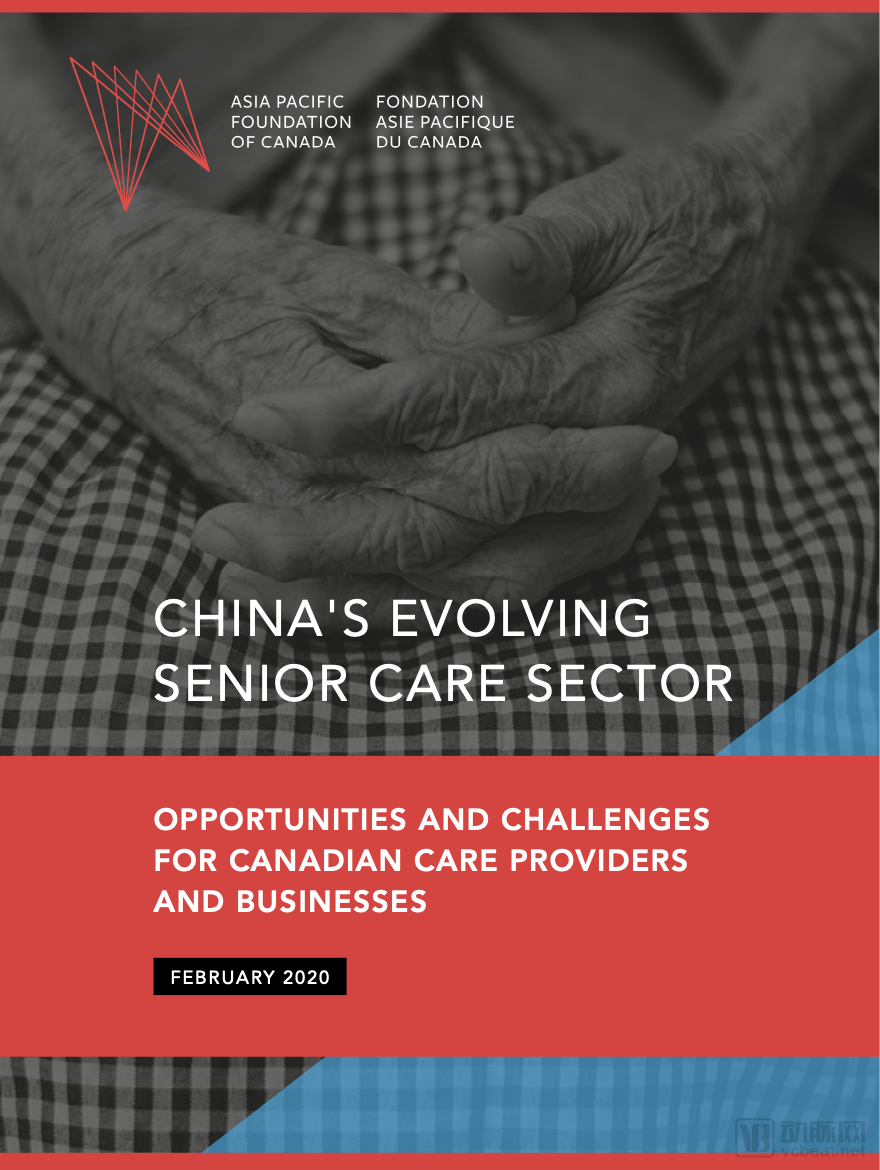
The "Report on Elderly Care in China" (hereinafter referred to as the "Report"), recently released by APF Canada, points out that China is facing the challenge of population aging, which brings huge market space to the elderly care industry. APF Canada is an independent non-governmental research institution dedicated to studying the relationship between Canada and Asia, promoting political, economic, and social dialogue and exchanges, and providing guidance and recommendations for Canadian companies expanding into the Asia-Pacific region.
“The Report” presents a set of data showing that in 2017, China’s population aged 60 and above reached 240 million, accounting for approximately 17% of the total population. This figure is projected to rise, with seniors expected to comprise 35% of China’s population by 2050. As population aging accelerates, the number of individuals suffering from chronic diseases continues to climb, placing significant pressure on the healthcare system.
To address the substantial demand for health and elderly care, Chinese regulators have introduced a series of policy measures in recent years to continuously reduce barriers to the private healthcare economy, encourage social participation, and meet the multi-level and diversified needs for elderly health services. However, due to a late start, the existing systems, standards, and regulations related to elderly health remain imperfect, and both the quantity and quality of service providers urgently need improvement.
In the face of the surging “silver wave,” how can China better achieve healthy aging? The Report suggests that introducing high-quality international elderly care services may become a new breakthrough. The Asia Pacific Foundation of Canada cites three typical cases of companies operating in China: the smart nursing service provider Buurtzorg, the asset-light care enterprise NICHII GAKKAN, and the health management organization Canadian Wellness Institute (CWI), offering reference for enterprises seeking to enter China’s elderly care market.
Against the backdrop of China’s “getting old before getting rich” societal context, traditional family-based elderly care generally suffers from insufficient caregiving capacity, while there is also a lack of supply of professional institutional elderly care services. In the realm of health and elderly care services, standards and regulations are relatively mature abroad, and China’s vast development prospects have attracted numerous foreign investors.
For example, Fortress and Watermark (Watermark Communities), the two largest senior care providers in the United States, have successively entered the Chinese market. ORPEA (Orpea), France’s largest senior care company, also opened a high-end nursing home in Nanjing in 2016, featuring 140 nursing beds and 111 rooms, to provide round-the-clock care and medical services to affluent individuals aged 80 and above.
Despite numerous attempts to launch health-focused elderly care projects, differing national conditions mean that the public still prefers home-based care, making it difficult for high-end institutional elderly care services to gain widespread adoption. Profitability remains the primary concern; for high-end elderly care institutions, the key metric is whether bed occupancy rates can cover both upfront capital expenditures and operational costs. However, after the aforementioned companies transplanted their asset-heavy nursing home business models into the Chinese market, low occupancy rates have thus far yielded no clear path to profitability.
Where exactly does the problem lie? In fact, for international enterprises with advanced care models, long-term care and medical services for disabled elderly individuals are regarded as rigid demands. Standardized, high-quality nursing services inevitably come with higher fees. However, China’s medical insurance system is still in its early stages of exploring long-term care coverage, which explains why high-end elderly care institutions in China can only serve a small fraction of the elderly population.
However, in the long run, China’s growing demand for elderly health management and rehabilitation services remains a blue-ocean market. In contrast to the sparse patronage at the aforementioned high-end senior care facilities, certain international organizations advocating the “health management + eldercare” model have successfully broken through their development bottlenecks in China, achieving expansion of service capabilities and maximizing value realization.
The Canada Asia Pacific Foundation noted in its *Report* that the integration of medical care and elderly care holds certain development potential in China’s senior care market, and cited three typical case studies of entities that have expanded in China through distinct nursing and health management models.
1. Buurtzorg: Opportunities in Home Care and Smart Care:
The first typical case comes from Buurtzorg, a Dutch company that, after entering China, has drawn significant attention from the elderly care industry by leveraging advanced nursing services powered by smart technology.
Buurtzorg employs 10,000 staff members and provides community care services in the Netherlands and globally, including in China and Japan. Buurtzorg’s service teams are small units composed of 10 to 12 nurses who exercise autonomy in their practice, allowing them to adapt care models to the specific needs of local residents rather than applying rigid, standardized protocols. These nurses primarily serve as health managers, emphasizing the importance of preventive care.
In the realm of smart nursing, Buurtzorg leverages the OMAHA IT nurse platform to record and analyze health management profiles, while also utilizing the platform to assess patient needs and the outcomes of health interventions, thereby integrating technology with care services. Currently, Buurtzorg is continuously collaborating with local Chinese companies and has already provided such community-based services to the elderly in cities including Shanghai, Suzhou, and Qingdao.
2. NICHII GAKKAN: Asset-Light Nursing Service Operations
Among Japan’s premium elderly care service providers, Nichii Gakkan, which operates 400 premium care facilities and 1,300 premium care service stations, has gained significant popularity since entering the Chinese market. The company provides care services to approximately 135,000 elderly individuals worldwide.
Nichii Gakkan first entered the Chinese market in 2014, leveraging its extensive experience and resources to establish joint ventures with domestic housekeeping companies for business collaboration, primarily providing home care services and caregiver training through an asset-light model.
In China, the development of institutions such as nursing homes and care stations is still in its early stages. There is a general lack of experience in providing care services for the elderly, and staff members often lack professional skills, making it difficult to deliver high-quality, standardized care. Against this backdrop, Nichii Gakkan has earned market trust by providing high-quality care services, thereby benefiting from the growing demand.
3. Canada Wellness Institute (CWI): Reshaping the Chronic Disease Management Model in China
Founded in 1996, the Canadian Wellness Institute (CWI) is the leading chronic disease prevention organization in North America. With unique expertise in health management systems, it has identified new opportunities amidst the gaps in China’s elderly care services market.
CWI has established a systematic lifestyle medicine service model covering the entire life cycle, achieving “all-age coverage” in elderly care services. Leveraging advanced medical fitness facilities and a professional team, CWI customizes personalized exercise plans for the entire population—including healthy individuals, those in sub-optimal health, and patients with chronic diseases—across five dimensions: exercise, nutrition, psychology, sleep, and health literacy. Through personalized, continuous intervention and management, the model aims to achieve optimal health outcomes.
Over the past two decades, CWI has saved the Canadian government hundreds of millions of Canadian dollars in healthcare expenditures by serving millions of diverse individuals and accumulating extensive experience in health management. In 2015, CWI partnered with a tertiary-level traditional Chinese medicine hospital in Shandong Province, China, to establish the country’s first health management center in Rizhao City. This initiative introduced innovative health management concepts to the Chinese market and facilitated the hospital’s transformation into an international medical and healthcare institution.
In 2018, CWI established a joint venture subsidiary with the Chinese health technology company Miao Health, named the Canada Wellness Institute (China) [hereinafter referred to as “CWI (China)”], to further strengthen its strategic localization in China. Together, they have developed an AIoT-based health management model, cultivated service capabilities aligned with international standards, and continuously expanded their business coverage in China.
Virtually all imported products undergo localized innovation upon entering China. Viewed along the timeline, the key to the successful implementation of the CWI model in China over the past two years lies in its cross-sector collaborations with More Health, which have given rise to various “CWI (China)+” models. In its Report, the Asia Pacific Foundation of Canada noted that the Chinese government has highly praised this development model.
Since its establishment in 2015, Miao Health has been committed to leveraging digital technologies such as the internet, big data, and AIoT to guide the public in shifting their health paradigm from a focus on “treatment” to one on “prevention.” By building a precision health management platform, integrating data connectivity across various health monitoring devices, and enabling multi-dimensional health data tracking, the company also employs gamified operational strategies to motivate users to proactively manage their health.
After establishing a strong online presence and accumulating a large user base, Miao Health leveraged the experience of its CWI offline health management centers to create an "online + offline" full-scenario intelligent health intervention solution. CWI (China) integrates Miao Health’s online management capabilities with digitally transformed offline health management services, evolving into a comprehensive institution that combines elderly care, chronic disease management, rehabilitation training, insurance coverage, and pharmaceutical services. Through this closed-loop model, it continues to expand into broader fields.
Over the past two years, CWI (China) has fostered cross-industry collaborations with hospitals, real estate developers, smart health cities, and insurance providers. Notable examples include the establishment of the China-Canada International Health Management Center in partnership with Taihe Hospital in Shiyan, Hubei Province; the development of the Hangzhou Bay Wellness Town in collaboration with Greenland Real Estate; and the joint construction of smart health cities in Hefei and Xingtai. These initiatives consistently demonstrate that CWI’s operational model in China has reached a high level of maturity.
Notably, on January 16 and 17, 2020, the CPIC-Canada Health Management Centers opened in Hangzhou and Zhengzhou, respectively. This move marks the deep integration of the CWI (China) model with the insurance industry. Leveraging AIoT-based, full-scenario intelligent health intervention solutions, it helps insurance customers meet multidimensional health needs—including health management, risk protection, and coordinated medical care—through both online and offline channels, thereby engaging in the entire service chain spanning pre-insurance, during-insurance, and post-insurance stages.
The emergence of the “health management + insurance” model signals that insurance institutions are extending their scope from mere underwriting to a comprehensive “pre- and post-insurance” service chain, offering new insights into how health insurance can be integrated with health management. In China, elderly individuals aged 60 and above with pre-existing conditions are largely unable to purchase insurance, leaving them to bear health risks on their own. However, through CWI (China)’s health assessments and chronic disease management services, elderly patients with chronic conditions can obtain customized insurance plans, thereby reducing their medical expenses.
Ms. Carrie, Global CEO of CWI, has stated that the proportion of seniors aged 65 and above in Canada is two to three times that in China. The majority of clients who receive interventions from CWI and pay for its services are elderly individuals, demonstrating high retention rates. Amidst a global surge in chronic diseases, although the Chinese market operates in a manner vastly different from the Canadian market, it still offers immense opportunities unmatched by any other country. In the future, CWI and Miao Health plan to join forces to open 100 new health management centers in China.
“The Report” also emphasizes that, in promoting the development of the healthy aging industry, China’s multiple policy incentives and market dividends have paved the way for foreign enterprises to enter the market; however, finding reliable partners in China is often a lengthy and complex process. The development of institutional elderly care in China faces significant challenges and a long road ahead, and CWI (China)’s model may offer valuable references and lessons for latecomers.