

Ganke Workroom Files IPO Prospectus: A Behavior-Based Approach to Healthcare-Associated Infection Control with 5,382 Hospitals Onboard
Those familiar with the hospital infection control market are certainly no strangers to infection control workrooms.
Unlike healthcare-associated infection (HAI) informatics companies that focus on patient data monitoring, early warning, and prevention and control of HAIs, GanKong Workspaces targets healthcare professionals, emphasizing cognitive assessment, behavioral observation, and role-based competency enhancement and collaboration facilitation. As a leading third-party service provider dedicated to improving the effectiveness of hospital infection prevention and control, it strives to become an “Expert in Refined Quality and Safety Services for Healthcare Institutions.”
Since January 21, when it began assisting the Infection Control Center of Xiangya Hospital in filming the video on prevention and control guidelines commissioned by the Medical Administration and Hospital Management Bureau of the National Health Commission for a nationwide televised conference held before the Spring Festival, the “Infection Control Workspace” has ended its “holiday that never began.”
On Chinese New Year’s Eve, Wu Hongman, founder of the infection control startup GanKong Workroom, saw her phone add more than 30 provincial-level WeChat service groups to the nearly 2,000 existing hospital service groups.
All-Staff Hospital Infection Control Training Group, Key Internal Area Risk Assessment Group, Anti-Epidemic Supply Allocation Group, Personal Protective Equipment (PPE) Identification Group, and the “Wuhan Together” Anti-Epidemic Expert Group. The membership of these groups included nearly all renowned hospital infection control experts in China, directors and dedicated personnel for infection prevention and control at medical institutions of all levels, project managers for hospital anti-epidemic command centers, and operational teams for infection control initiatives. Each group functioned as an emergency project command team.
Since the onset of the pandemic, an ad hoc communication mechanism has been established within the Infection Prevention and Control (IPC) workspace. Through various online groups, the IPC workspace has provided partner hospitals with extensive services in nosocomial infection education and training, development of emergency management checklists, and risk assessments for key areas such as pre-examination triage stations, fever clinics, and isolation wards in infectious disease departments. Additionally, it has disseminated the first edition of COVID-19 guidelines, COVID-19 prevention and control directives, and instructional videos on the proper donning and doffing of personal protective equipment (PPE), thereby meeting hospitals’ urgent response needs.
As of early March, the Infection Control Workspace provided consulting services to nearly 18,000 dedicated infection prevention and control (IPC) professionals. It rapidly launched 14 online training courses on COVID-19, facilitating multiple rounds of remote training and knowledge assessments for approximately 12,000 healthcare institutions. These institutions were under the jurisdiction of over 40 municipal and county-level quality control centers managed by three provincial hospital infection quality control centers outside Hubei Province (the epicenter of the outbreak), as well as more than 30 independent municipal and county-level hospital infection quality control centers. Its public welfare IPC education WeChat account, “IPC Little Spider,” published an average of eight articles per day, totaling more than 300 articles, with over 2 million cumulative readers and multiple articles exceeding 100,000 views each.
In addition, the Infection Control Workspace urgently launched an online personal protective equipment (PPE) inquiry platform, providing specifications and usage videos for PPE, as well as information on the allocation of anti-epidemic supplies. This platform has served nearly 1.4 million individuals in learning and training, accumulating close to 6.4 million visits. In mid-March, the platform further introduced comprehensive management checklists tailored to different departments for resumption-of-work inspections and infection control practices in medical institutions. It has been adopted by more than 4,000 medical institutions, generating risk assessment reports.
As mentioned earlier, Infection Control Workspace entered the infection prevention and control (IPC) market by focusing on enhancing healthcare professionals’ cognition and behavior, as well as fostering team collaboration. When asked about the rationale behind this strategic choice, Wu Hongman shared her insights from two perspectives:
First, the cause of hospital infection control requires the joint participation of patients, clinical medical staff, and hospital infection management personnel.Integrating knowledge with action in cognition and behavior is the key to effective clinical infection prevention and control. To excel in hospital infection management, healthcare institutions must not only establish detailed evaluation criteria and provide role-specific training and learning activities, but also foster efficient collaboration among medical staff, who should proactively conduct or accept supervisory inspections.
Second, from the perspective of governments and healthcare institutions, the overall enhancement of the region is also important.The quality of management varies across medical institutions at different levels, making it essential to implement standardized management and enhance capabilities from the perspectives of economic cost and professional management.
A collaborative mechanism of “joint problem-solving and issue identification” must be established between dedicated infection control personnel and clinical healthcare providers, shifting the focus of prevention and control from monitoring infections and diagnosing and treating them after occurrence to “how to standardize infection prevention and control (IPC) practices (measures) to reduce the incidence of infection.” This risk-prevention-oriented model enables multidimensional assessment of infection incidence, prevention, and control status, thereby fostering a more advanced management organizational system and a new framework of evaluation indicators to eliminate and mitigate infection risk factors.
Gankong Workroom was founded in Changsha in 2014 against this ideological backdrop.
Founder Wu Hongman earned her bachelor’s degree from the School of Nursing, Central South University. Since graduation, she has been engaged in the prevention and control of infectious diseases, patient care, and education at Xiangya Hospital of Central South University, accumulating ten years of clinical experience in infectious disease services. Ms. Wu also worked for over seven years at the Infection Control Center of Xiangya Hospital, primarily focusing on hospital infection risk assessment and prevention and control training. Meanwhile, she completed graduate-level coursework in epidemiology and health statistics at the School of Public Health, Central South University, during her spare time. Her extensive professional experience in hospitals, combined with her academic background, has enabled her to develop a unique perspective and methodology for hospital infection prevention and control.
The Department of Infectious Diseases at Xiangya Hospital of Central South University was established in 1954. As one of the earliest hospitals in China to establish a specialized infectious disease department, it has made significant contributions to the prevention, control, and research of infectious diseases, exerting substantial influence among its domestic peers. In 1989, Xiangya Hospital was designated by the former Ministry of Health as a national training base for hospital infection surveillance and management, positioning it at the forefront of hospital-acquired infection prevention and control in China.The establishment of the Infection Prevention and Control Workspace has also benefited from the robust development of these two departments at Xiangya Hospital.
First, Xiangya Hospital’s strong spirit of innovation has created a favorable environment for the establishment of the Infection Prevention and Control Workspace. The president of Xiangya Hospital and leadership at all levels come from clinical medical backgrounds; they are fully aware of the pain points and challenges in improving clinical quality and safety management, and are actively exploring solutions.
The hospital is also seeking various approaches to enhance the awareness and participation of medical staff at all levels in hospital quality and safety management, including incentive mechanisms for adverse event reporting and the designation of internal auditors within each department. The hospital has been continuously exploring advanced information technology solutions to help foster a culture of safety and demonstrates a high level of openness to adopting emerging innovations.
With the support of Professor Wu Anhua, Chair of the Hospital Infection Control Branch of the Chinese Preventive Medicine Association, Director of the National Training Base for Hospital Infection Surveillance and Management, and Head of the Infection Control Center at Xiangya Hospital of Central South University, Xiangya Hospital took the lead in adopting the Infection Control Workspace. Under the guidance of Xiangya Hospital’s infection control team, the product has undergone continuous improvement.
Furthermore, Ren Nan, Chairman of the Hospital Infection Control Branch of the Hunan Preventive Medicine Association and a renowned infection prevention and control (IPC) expert, serves as the Chief Medical Liaison Officer for IPC Workspace. Zheng Shouchang, an MBA-certified senior engineer and former Chief Architect at Zhuojian Technology, serves as the Chief Architect. Co-founder Wang Zhigang, with a background in clinical medicine and former Sales Director at Juding Medical, brings extensive expertise in medical informatics software sales. The core team comprises trusted mentors and friends, ensuring both the professionalism and synergy of the IPC Workspace team.
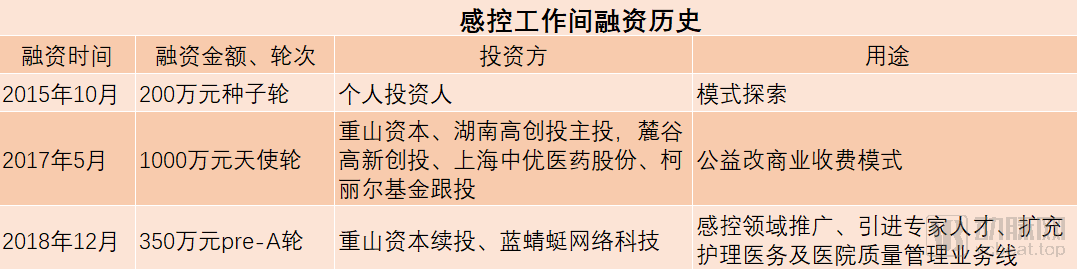
With unique insights into the industry and a clear understanding of its own development path and industry trends, the “small but specialized” infection control workspace gained investor favor shortly after its establishment. To date, the infection control workspace has completed three rounds of financing:
Under the GanKongGongZuoJian brand, there are currently several mobile internet application services in the professional field of hospital infection prevention and control, including the “Internet + Hospital Infection Prevention and Control” service platform “GanKongGongZuoJian,” the public welfare education WeChat official account for infection control operations “GanKong Xiao Zhizhu” (Infection Control Little Spider), and the live-streaming series for practical infection control knowledge sharing “GanKong Gongkaike” (Infection Control Open Class).
Among these, the Gankong Work Expert APP has been adopted by 5,382 medical institutions, providing customized hospital infection risk management, quality control, and training services to nearly 3,000 hospitals. It has delivered public welfare infection prevention and control training and examinations to 7.15 million healthcare professionals, generated 16 million hand hygiene observation tasks, and facilitated 1.85 million risk assessment and infection control supervision tasks.
At its inception, recognizing the necessity for self-assessment, self-improvement, and management report generation regarding hand hygiene across all hospital departments, GanKongGongZuoJian pioneered the launch of a specialized hand hygiene inspection tool in China, thereby promoting comprehensive staff training and the widespread adoption of management evaluation practices for hand hygiene in healthcare institutions.
From 2017 to 2019, the Infection Control Workspace assisted over a thousand hospitals at all levels in organizing hand hygiene competitions annually. In 2019, the National Healthcare-Associated Infection Surveillance Network utilized the Infection Control Workspace APP to complete nationwide hand hygiene training for healthcare workers, as well as data collection tasks related to hand hygiene observations and consumables management in eight key departments. Additionally, it produced the 20-episode series "Scenario-Based Instructional Videos on Hand Hygiene for Chinese Healthcare Workers."
It is worth mentioning that,In 2019, Gankong Workroom and relevant experts also assisted the WHO in conducting a survey on the hand hygiene management assessment framework across nearly 300 healthcare institutions.In 2020, the Infection Control Workspace also scheduled hand hygiene knowledge competitions for more than 3,100 medical institutions and convened nearly 10 domestic experts to deliver specialized lectures.
The hallmark of the Infection Control Workspace lies in its meticulous refinement and thorough development of this seemingly simple collaborative tool for observation and statistics. By continuously improving and updating its content, it enables fully online, quantitative management of healthcare professionals’ “implementation learning–process evaluation–continuous improvement” cycle, thereby meeting the management needs of hospitals and teams at various levels, and allowing for replication across other scenarios and content areas.
The Infection Control Workspace has compiled domestic and international guidelines and literature related to hand hygiene, and in collaboration with hospital infection control experts, developed them into video-based training modules. These resources help healthcare institutions rapidly implement hand hygiene training and assessment, while also facilitating online process improvement.
Subsequently, the Infection Control Workspace organized the construction and evaluation of infection prevention and control (IPC) across various departments. It provided tiered IPC training and operational drills for healthcare workers, and gradually accumulated a more comprehensive suite of services in areas such as on-site assessment and management of IPC measure implementation in specific scenarios, including puncture procedures, surgeries, infections with multidrug-resistant organisms, and care for patients using medical devices.
Throughout the service delivery process, the infection prevention and control (IPC) team has compiled extensive data and knowledge to guide healthcare professionals in integrating knowledge with practice. This approach has enabled hospitals at all levels to continuously improve internal management through practical application. The scientific rigor of IPC workspace products has been repeatedly validated, and the associated services have been progressively refined. Wu Hongman noted that this behavior- and process-based evaluation system is gradually gaining recognition and increasing attention from hospital administrators as a key performance indicator.
As previously mentioned, Wu Hongman emphasized the importance of homogeneous management across regions. In line with this, GanKongGongZuoJian has supported quality control centers designated by the health commissions of multiple provinces and municipalities. These centers conduct assessments of healthcare personnel’s infection prevention and control capabilities within regional medical institutions, evaluate organizational management and infection control quality standards, and provide training and supervision.
Meanwhile, leveraging the platform’s regional knowledge base, it also supports healthcare institutions in conducting self-inspections, self-directed learning, and self-training. The Infection Prevention and Control Workspace regularly updates and releases assessment frameworks and training courses. During the COVID-19 pandemic, the Infection Prevention and Control Workspace supported the Hubei Provincial Center for Healthcare-Associated Infection Quality Control in continuously providing online training on infection prevention and control knowledge to over 200,000 healthcare workers.
The positioning of the Infection Control Workspace is that of a service provider assisting clients in achieving success across various work scenarios, rather than merely a provider of software functionalities. Wu Hongman candidly stated that for an infection control workspace relying on service-based revenue, corporate management and survival face significant challenges; to maintain long-term competitiveness, it must continuously enhance service quality.
In the short term, Infection Control Workstation aims to expand its hospital coverage rate. Looking ahead, it hopes to enhance the overall quality and safety of medical care in healthcare institutions, while actively exploring diversified products and services to better serve a broader range of healthcare facilities.
To comprehensively expand its medical quality management business and upgrade to QOHSE assessment reporting and decision-making management services based on the lifecycle of healthcare institutions, Infection Control Workspace has launched its Series A financing plan.