

Zhimeng Biopharma Advances Innovative Therapies for Viral and Neurological Diseases with Lead HBV Drug in Late-Stage Clinical Trials
China is a country with a high prevalence of hepatitis B, home to approximately one-third of the world’s hepatitis B carriers. An article in The Lancet titled “Hepatitis B in China” states that 120 million people living in China are hepatitis B virus carriers.
From the virus’s perspective, the hepatitis B virus (HBV) is undoubtedly one of the most evolutionarily successful viruses in human history. Unlike Ebola virus, which has a high case-fatality rate that kills hosts rapidly and thereby interrupts transmission chains, HBV can remain latent in patients for prolonged periods and even cause asymptomatic infections, facilitating its widespread dissemination.
Throughout the lifetime of patients with hepatitis B, there is approximately a 20% to 30% probability of progression to liver cirrhosis or hepatocellular carcinoma. Among patients with liver cirrhosis and hepatocellular carcinoma worldwide, hepatitis B accounts for approximately 30% to 45% of cases; in China, these proportions are as high as 60% and 80%, respectively.
Currently, there are no drugs available that can achieve a complete functional cure for hepatitis B. First-line therapies on the market, represented by tenofovir disoproxil fumarate (TDF) and entecavir (ETV), generally require lifelong administration and fail to completely clear the hepatitis B surface antigen (HBsAg). Literature even indicates that 10% to 20% of patients receiving antiviral therapy with potent nucleos(t)ide analogues (NAs), such as ETV and TDF, still experience progression of fibrosis. Low levels of hepatitis B virus (HBV) persist in the bloodstream or liver tissue, making it difficult for patients to discontinue treatment and increasing the risk of drug resistance.
If we project 20 to 30 years into the future, China’s current hepatitis B virus carriers will gradually progress to chronic hepatitis B patients. It is reasonably estimated that the number of chronic hepatitis B patients in China will remain above 20 million, with annual medical expenditures exceeding RMB 200 billion, while existing hepatitis B drugs and vaccines will struggle to meet this substantial market demand.
In this broader context, the emergence of Shanghai Zhimeng Biopharma Inc. has brought hope for hepatitis B patients to completely break free from HBV. Addressing the three major challenges faced by hepatitis B patients—namely, high intra-body HBV viral load, elevated levels of hepatitis B surface antigen (HBsAg), and compromised immune function—Zhimeng Biopharma has developed a pipeline strategy with three corresponding approaches to tackle hepatitis B from multiple angles.
To address the issue of high HBV viral load in patients with hepatitis B, Shanghai Zhimeng Biopharma Inc. is developing a novel core inhibitor, a first-in-class pyrazole small molecule that effectively inhibits HBV replication in patients, reduces viral load, and improves the rate of functional cure for hepatitis B.
The nucleocapsid refers to the collective term for the viral protein capsid and the viral nucleic acid contained within its center. During the viral replication process, after HBV enters the cell, it first “sheds” its capsid to expose the genetic material for extensive replication, and then forms new nucleocapsids to achieve replication and dissemination.
The nucleocapsid inhibitor developed by Zhimeng Biopharma accelerates the formation of the HBV capsid, completing capsid assembly before the HBV genetic material is packaged into it. This results in the formation of “empty shells” lacking HBV genetic material, thereby inhibiting HBV replication in vivo.
This inhibitor demonstrates potent antiviral activity against various HBV mutants, including those resistant to other HBV core protein inhibitors under investigation. Shanghai Zhimeng Biopharma Inc. is currently conducting clinical trials. Dr. Chen Huanming, founder of Shanghai Zhimeng Biopharma, disclosed to VCBeat that two completed double-blind studies showed high systemic exposure in healthy volunteers following oral administration, surpassing other investigational drugs and demonstrating a superior safety profile.
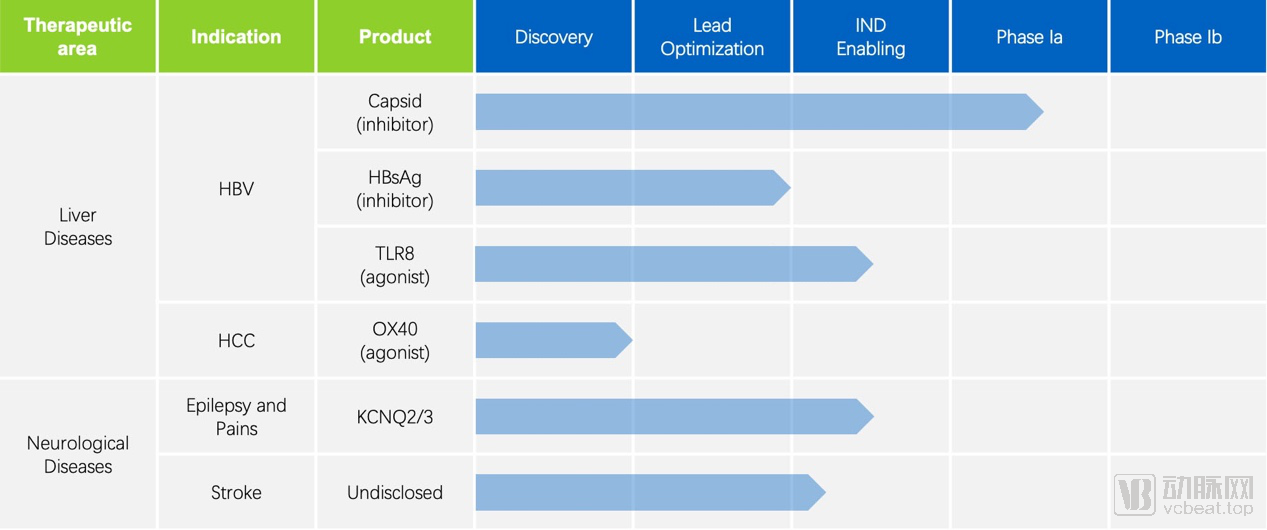
Zhimeng Biopharma’s Clinical Pipeline (Image sourced from the official website)
In addition to its most advanced clinical pipeline of nucleocapsid inhibitors, Shanghai Zhimeng Biopharma Inc. has also established pipelines targeting hepatitis B surface antigen (HBsAg) inhibition and the immune modulator TLR8, both of which have entered the preclinical research stage. The HBsAg release inhibitor pipeline primarily addresses the issue of elevated HBsAg levels in patients with hepatitis B. Seroclearance of HBsAg is defined as a “functional cure,” and HBsAg inhibitors can be used to reduce HBsAg levels in these patients.
TLR8 Agonist (TLR8 Pipeline) is a small-molecule immunomodulator that activates dendritic cells and natural killer cells, thereby enhancing human immunity. Its indications are not limited to hepatitis B; it is also widely used in cancer therapy. As a novel therapeutic strategy broadly applicable to the treatment of RNA viral infections, it represents Zhimeng Biopharma’s third approach to achieving a functional cure for hepatitis B.
Dr. Chen Huanming, the founder, stated that Zhimeng Biopharma’s three strategies for tackling hepatitis B focus on future-oriented combination therapies using novel approaches.
Dr. Chen Huanming, Founder of Zhimeng Biopharma, is an expert in the fields of drug discovery and medicinal chemistry. He has previously served as a senior R&D executive at several renowned pharmaceutical companies in China and the United States, successfully leading multiple new drug projects to market launch. Dr. Chen possesses extensive experience in new drug research, development, and management, along with strong capabilities in resource integration and commercialization.

Dr. Huanming Chen, Founder of Zhimeng Biopharma
After completing his postdoctoral research at the University of Maryland, Dr. Huanming Chen joined Valeant Pharmaceutical International, a globally renowned pharmaceutical company, where he engaged in the research and development of antiviral and neurological disease treatments. This experience laid the foundation for the R&D pipeline direction he would later establish at Zhimeng Biopharma. Throughout his career, Dr. Chen has led the discovery and development of preclinical and clinical candidates for more than 10 drugs targeting antiviral, anticancer, central nervous system, and inflammatory indications. He has co-authored 36 research papers and holds over 40 patents.
In addition to Dr. Chen Huanming, Dr. Zhang Zhijun, another co-founder of Zhimeng Biopharma, also boasts extensive experience in drug discovery and development. Prior to co-founding Zhimeng Biopharma, he served for over seven years as the Head of Virology Research at Sanofi’s Asia-Pacific R&D Center, where he led all antiviral research activities in the region. Dr. Zhang also previously held the position of Associate Professor at the University of Oklahoma Health Sciences Center (OKHSC), conducting preclinical and clinical studies on various antiviral and antibacterial products. He is the author of more than 20 scientific papers and holds numerous patents. Notably, Dr. Chen Huanming and Dr. Zhang Zhijun once worked simultaneously at Valeant Pharmaceutical International and collaborated on projects.
The founding team of Zhimeng Biopharma boasts extensive successful experience in new drug development. Notably, the anti-gout drug lesinurad was licensed to AstraZeneca for $1.26 billion and launched in 2015; a next-generation potassium channel opener for epilepsy treatment was licensed to GlaxoSmithKline for $150 million; and a MEK inhibitor for oncology was licensed to Bayer for $407 million.
Shanghai Zhimeng Biopharma Inc. has currently established a pipeline in the field of neurological disorders and is developing third-generation potassium channel (KCNQ2/3) openers for the treatment of neurological conditions, including epilepsy, pain, and depression. Among these, the program targeting epilepsy is advancing most rapidly and has progressed to the stage of investigational new drug (IND) application studies.
Epilepsy, commonly known as “goat horn wind” or “goat epilepsy,” is a chronic condition characterized by sudden, abnormal electrical discharges from brain neurons, leading to transient cerebral dysfunction. KCNQ2/3 channels play a crucial role in regulating the excitability of brain cells. Retigabine was the first FDA-approved neuronal KCNQ2/3 potassium channel opener, indicated for the treatment of refractory epilepsy in patients unresponsive to existing antiepileptic drugs. Due to concerns such as skin discoloration (including blue pigmentation) and the potential risk of vision loss, retigabine was withdrawn from the market in 2017.
In cell-based and animal studies, Shanghai Zhimeng Biopharma Inc.’s KCNQ2/3 potassium channel opener demonstrated greater potency than retigabine and exhibited significant efficacy across a broad range of epilepsy and pain animal models. Compared with retigabine, Zhimeng’s potassium channel opener offers several advantages: first, it enhances chemical stability, preventing pigment deposition; second, it improves metabolic stability, enabling a shift from three-times-daily to once-daily dosing; third, it increases blood-brain barrier permeability while reducing peripheral distribution, thereby improving safety; and finally, it boosts pharmacological activity, allowing for lower dosing.
It is reported that Shanghai Zhimeng Biopharma Inc. has completed its angel and Pre-A financing rounds, and has recently initiated its Series A fundraising. The proceeds will be primarily used to advance the Phase I clinical trials of its HBV core inhibitor, as well as to support IND-enabling studies for other pipeline projects.