

Qingdao Weisidun Launches Smart Bracing System for Scoliosis with Real-Time Monitoring via Mobile App
On Zhihu, a Q&A thread has garnered over one million views. The question was posted by a high school sophomore: “My life feels completely ruined because of scoliosis. What should I do?” It attracted 281 responses. Both the student’s personal journey and the respondents’ own experiences or observations highlight that scoliosis causes not only physical impairment but also psychological harm.
According to incomplete statistics from relevant institutions, there are over 5 million scoliosis patients in China, with approximately 300,000 new cases added each year. Beyond congenital causes, a significant number of cases result from poor postnatal lifestyle habits, such as hunching and incorrect sitting posture. Patients with scoliosis maintain a twisted spinal configuration (C-shaped or S-shaped), which generally results in shorter stature compared to peers and affects physical appearance. Furthermore, thoracic scoliosis can impair cardiopulmonary function, making patients more susceptible to colds and pneumonia, while lumbar scoliosis may cause gastrointestinal symptoms such as loss of appetite and indigestion.
Currently, the primary players in the scoliosis market are traditional orthotic brace manufacturers. When designing braces, orthotists rely on their past experience to determine pressure points and create molds by wrapping plaster casts around patients’ bodies. While this design process is relatively mature, it is heavily dependent on the orthotist’s expertise, resulting in high labor costs. Furthermore, the braces are made from thermoplastic materials such as polyethylene and polypropylene. These materials cannot be molded at low temperatures, and exposure to high temperatures during processing can compromise their mechanical strength.
To address these issues, Qingdao Wisdom Intelligent New Materials Co., Ltd. (hereinafter referred to as “Qingdao Wisdom”) has developed an intelligent spinal orthotic brace. Crafted from multifunctional shape-memory polymers and integrated with smart digital orthotic technology, the brace is lightweight, thin, and breathable. It features shape-memory capabilities, is biodegradable, and delivers effective orthotic correction.
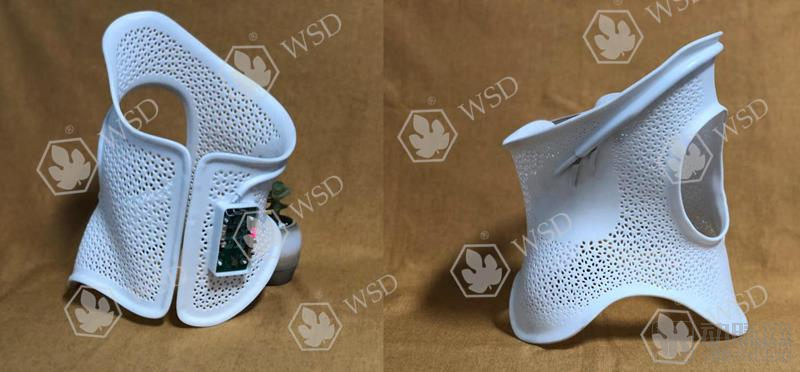
In March this year, a 16-year-old female patient was diagnosed with scoliosis during a medical consultation. Upon the recommendation of the Director of the Spinal Surgery Department at Qingdao Eastern Municipal Hospital, the patient and her family decided to pursue brace treatment and selected the solution provided by WSD Biomedical (Qingdao). The spinal orthotic brace used in this case was designed by Mr. Song Lizhi, Technical Director of WSD Biomedical (Qingdao) and Chief Orthotist specializing in scoliosis rehabilitation in Beijing, and was fabricated through carving at the WSD Biomedical Studio.
“Director Song Lizhi and our studio provided remote guidance on the positive mold via video call. On April 10, we fitted the patient with a brace at our studio in Qingdao WSD. Due to the impact of the COVID-19 pandemic, Director Song connected with us remotely from Beijing, and the telemedicine consultation lasted approximately 45 minutes,” Tan Lin, General Manager of Qingdao WSD, told VCBeat.
One week after bracing, X-rays taken at the hospital showed that the patient’s Cobb angle (the severity of scoliosis is primarily assessed by measuring the lateral curvature angle, with the Cobb angle method being the most commonly used measurement technique) had been corrected from an initial 30° to 6°, well within the controllable range.
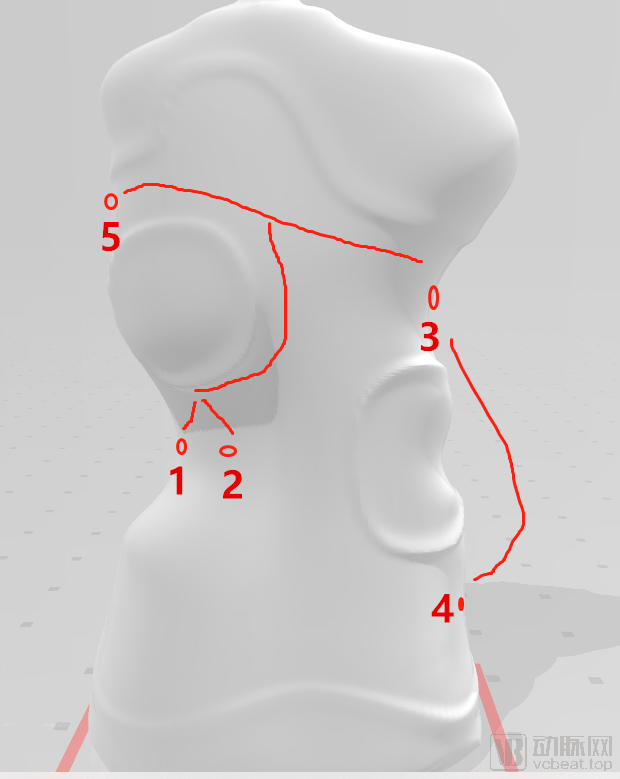
The superior efficacy of WSD Biomedical’s spinal orthotic braces is attributed to the meticulous attention to detail in their design. According to Tan Lin, a total of five sensors are embedded within the brace to detect pressure changes from multiple angles. As illustrated in the figure, in the primary force-application area, Sensor 1 monitors load during the supine position, while Sensor 2 monitors load across various postures, including sitting, standing, and lying down. In the three-point pressure system area, Sensor 3 monitors the load on the thoracic curve at the axilla, and Sensors 4 and 5 monitor load across various postures, including standing, upright positioning, and recumbency.
Furthermore, brace wear can be monitored via the app’s backend, enabling physicians, orthotists, and patients’ family members to track daily compliance, provide supervision, and offer treatment recommendations. This is reflected in seven key aspects: First, sensor-derived data enable the establishment of a high-precision monitoring system. Second, pressure magnitude, variations, and wear duration can be assessed in real time. Third, data support is provided to determine the appropriate corrective forces to be applied by the brace during treatment. Fourth, accurate data feedback to orthotists facilitates design optimization. Fifth, children’s wear time can be effectively monitored. Sixth, reliance on empirical experience in brace fabrication is eliminated, thereby making the manufacturing process data-driven and reproducible. Seventh, accumulated data—stratified by Cobb angle, age, curve pattern, and degree of correction—provide data-driven guidance for orthotists.
For a rehabilitation device, what business model should companies prioritize? Commercializing the device itself is the primary challenge to address. However, fostering greater data-driven engagement with users can not only enhance their experience but also strengthen user stickiness. “We are also working to build a database, leveraging the collected data for broader applications. For instance, the data accumulated on our platform can provide spine surgeons with a big-data platform. Given China’s scale, this data accumulation will represent a significant contribution to the international spinal medicine community,” said Tan Lin.
Regarding the team, General Manager Tan Lin possesses 16 years of study and management experience in the United States, offering a global perspective. The Chief Scientist, one of the company’s founders, is an expert with over three decades of international background in materials research, primarily dedicated to the application and commercialization of intelligent shape-memory materials and water-soluble polymeric materials in fields such as medicine. CTO Song Lizhi is a renowned specialist in scoliosis orthotic rehabilitation. He served as the Center Director of the Orthopedic Brace Department at the 306 Hospital of the People's Liberation Army in Beijing from 2012 to 2017. He obtained the National Rehabilitation Therapist Certificate in 2014, and in 2016, he received certification in the SEAS (Scientific Exercises Approach to Scoliosis) method for scoliosis physiotherapy and the SAA (Active Self-Correction) therapeutic exercise certification from Italy. He currently holds three patents for orthotic device designs.
In terms of market competition, the global orthopedic medical field does not have a large number of players, but each has its own specific focus. For example, OrthoPediatrics, based in Warsaw, Indiana, specializes in pediatric orthopedic devices. The company adheres to the philosophy that “children are not small adults,” meaning that device design must account for children’s smaller bone volume and greater curvature, while also carefully protecting their epiphyseal growth plates. Medicrea, a French biotechnology and medical device company, leverages 3D printing technology to develop and manufacture patient-specific titanium alloy implants. By integrating artificial intelligence and predictive modeling, it has created 3D-printed interbody fusion and spinal fixation systems, providing tool support for physicians treating conditions such as spinal deformities. Last year, U.S. company Zimmer Biomet Holdings announced that its Tether Vertebral Body Tethering System received FDA approval for the treatment of pediatric spinal deformities, including adolescent idiopathic scoliosis.
Looking ahead, WSD Biomedical (Qingdao) Co., Ltd. will continue to refine its spinal orthotic braces, pursue product iterations and new product development, and consider expanding into the sports rehabilitation sector, leveraging “intelligent digital simulation technology” to drive industry progress. Regarding financing, Tan Lin expressed willingness to engage with investment institutions and warmly welcomed relevant enterprises to visit the company for exchanges and discussions.