

Huazhi Micro-Innovation Completes Nearly RMB 100 Million Series B Funding Round; Its Neurosurgical Robot Deployed in Over 100 Hospitals

HOZ Medical
Medical Robotics R&D Company
VCBeat has learned that on April 30, 2020, Hua Chi Minimally Invasive, a developer of robotic systems for neurosurgery, announced the completion of its Series B financing round, raising nearly RMB 100 million. The round was led by SDIC Chuanghe, with Lenovo Ventures participating as a co-investor, and China Renaissance serving as the company’s long-term financial advisor.Following this round of financing, the company will continue to expand the market for its certified products, strengthen R&D efforts, upgrade its technological innovation platform, and accelerate the development of other product lines.
Hua Chi Minimally Invasive, founded in 2000, is a leading domestic developer and manufacturer of neurosurgical robotic systems, as well as an industrialization base for the Intelligent Robotics Theme under the National High-Tech Research and Development Program (863 Program). The company’s core product, the frameless stereotactic brain surgery system CAS-R-2, isThe First Medical Robot in China with Fully Independent Intellectual Property Rights, andThe First Domestically Produced Product to Enter the Chinese Market. This project has been awarded the Second Prize of the National Science and Technology Progress Award.
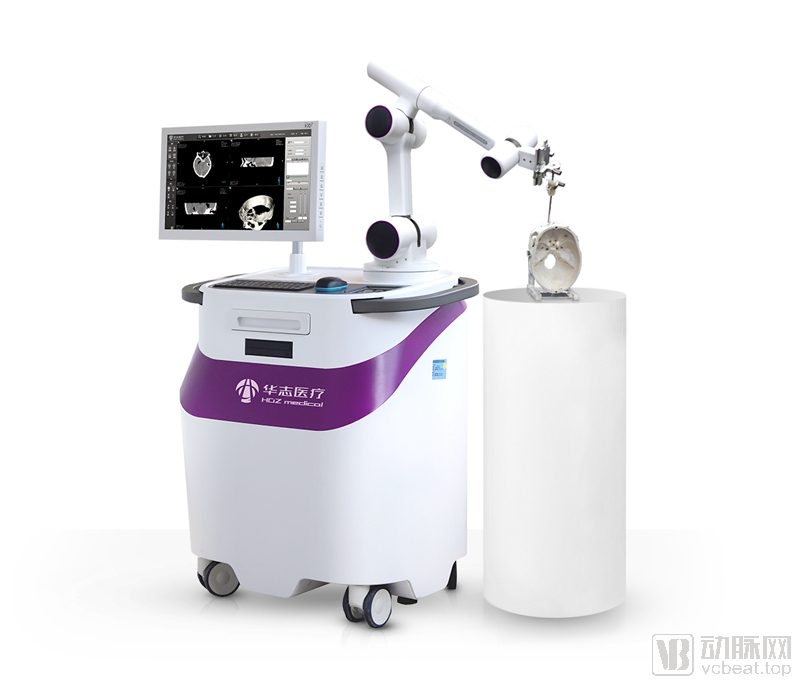
CAS-R-2 Frameless Stereotactic Neurosurgical System
Since its inception, Hua Chi Minimally Invasive has completed three rounds of financing. Previously, the company secured a RMB 50 million investment led by Tasly Capital and a Series A round amounting to tens of millions of RMB led by Tongsheng Capital.
Zhang Weigang, co-founder of Hua Chi Minimally Invasive, stated, “Craniotomy is a common treatment for neurosurgical diseases. Due to the significant trauma, high surgical risk, frequent complications, and slow postoperative recovery associated with craniotomy,”“Neurosurgeons, particularly those at primary-care institutions, have a strong demand for new technologies and products. The neurosurgical robot developed by Hua Chi Minimally Invasive precisely meets this need. This is a key reason why Hua Chi Minimally Invasive has repeatedly attracted investor interest.”
Neurosurgical Procedures Are Challenging; Surgical Robots Solve the Problem
Neurosurgery is widely recognized in the medical community as a highly specialized and advanced discipline, primarily focused on the treatment of traumatic brain injury, hemorrhagic stroke, brain tumor biopsy, intratumoral radiotherapy, epilepsy, Parkinson’s disease, and other related conditions. With China’s economic development and changes in lifestyle habits, the incidence of neurosurgical diseases has shown a significant upward trend.
Stroke and brain tumors are two categories of diseases that account for a high proportion of neurosurgical procedures. Taking stroke as an example, there are over 10 million prevalent cases of stroke in China, with more than 1 million new cases of hemorrhagic stroke added annually. According to data from the World Health Organization, the incidence rate of stroke in China is increasing at an annual rate of 8.7%. This indicates that the number of patients in China requiring neurosurgical intervention is substantial.
However, due to the lack of effective tools, neurosurgeons in China have long faced significant challenges in performing neurosurgical procedures. This is particularly true for physicians at primary care institutions, where craniotomy demands high levels of professional expertise. Only approximately 50% of primary hospitals are capable of performing craniotomies, leaving many patients unable to receive timely treatment. Furthermore, craniotomy is associated with several drawbacks, including large surgical trauma, a high incidence of postoperative complications, and prolonged patient recovery times. The emergence of surgical robots, which offer advantages such as stability, precision, and efficiency, has effectively addressed these limitations of traditional craniotomy.
According to Zhang Weigang, neurosurgical surgical robots have been under development in China for over two decades, yet market participants remain few and far between. Zhang noted that the technology entails high barriers, numerous bottlenecks, and stringent regulatory approval requirements, making it no easy feat to successfully develop and commercialize a neurosurgical surgical robot.
“From a technical perspective,Neurosurgical robotic systems involve multiple disciplines, including computer graphics, robotics, and algorithmics, imposing exceptionally high requirements on the expertise of R&D personnel.. From the perspective of regulatory approval,“Surgical robots are classified as Class III medical devices, and the state imposes strict controls on all aspects of their production and distribution. The company’s team must be well-versed in policies and regulations to expedite the product’s market launch,” said Zhang Weigang.
The core team of Hua Chi Minimally Invasive comprises technical personnel with many years of experience in the research and development of surgical robots, as well as professionals well-versed in clinical registration management and market promotion.Zhang Weigang stated, “Our technical personnel generally have 15 to 20 years of industry experience. Furthermore, with my in-depth understanding of product manufacturing, registration, and operations, and through the concerted efforts of our team, we successfully developed China’s earliest medical robot with fully independent intellectual property rights in 2002.”
After more than a decade of R&D and multiple product iterations, the company has successfully launched the CAS-R-2 frameless stereotactic neurosurgical system, becoming one of the few domestic manufacturers of neurosurgical robots with fully independent intellectual property rights.
Guided by the needs of doctors and patients, making surgery more precise, stable, and efficient.
Zhang Weigang stated, “Neurosurgical robots must not only address the pain points of physicians but also solve patients’ problems. Only such products deliver true value.” CAS-R-2, the frameless stereotactic neurosurgical system under Hua Chi Minimally Invasive, was developed with a focus on meeting the needs of both physicians and patients.
From the physician’s perspective, there is a desire to reduce the operational difficulty and complexity of neurosurgical procedures while simultaneously improving surgical efficiency, precision, and stability. From the patient’s perspective, there is a stronger preference for minimally invasive surgery, with expectations of enhanced intraoperative safety and accelerated postoperative recovery.
Frameless stereotactic neurosurgery is a minimally invasive neurosurgical procedure with broader indications and applicability, resulting in smaller surgical wounds and less blood loss.CAS-R-2 is designed to assist physicians in performing frameless stereotactic brain surgery. Comprising a surgical navigation software system, a five-degree-of-freedom robotic arm, and an open surgical tool platform, it covers the entire surgical workflow. The system aids in surgical planning, enables precise lesion localization, enhances procedural safety, reduces operative time, and facilitates faster patient recovery.Zhang Weigang stated, “CAS-R-2 can reduce patients’ postoperative recovery time from approximately one month to one week.”
In light of the specific circumstances of different hospitals, Hua Chi Minimally Invasive has segmented its product portfolio. For tertiary Grade A hospitals, the company has developedSmart EditionThe product assists physicians in performing high-difficulty, high-risk surgeries for various complex and refractory conditions, such as deep brain stimulation (DBS) implantation and electrode implantation. For general hospitals, the company has launchedGeneral Version, assisting physicians in performing routine procedures such as cerebral hemorrhage surgery and biopsies. Meanwhile, the company will also expand into additional fields by developing robotic systems for spinal neurosurgery, abdominal surgery, and thoracic surgery, thereby broadening its product portfolio.
As of 2019,CAS-R-2 has been implemented in over 100 hospitals across China, including Huashan Hospital of Fudan University.Next, the company will intensify its academic promotion efforts to facilitate the penetration of its products into primary-care hospitals, thereby enabling grassroots physicians to effectively perform neurosurgical procedures.
Investors Say: Bullish on Hua Chi Minimally Invasive Fully Realizing the Value of Surgical Robots
Lead Investor of This RoundSDIC Innovation InvestmentIt is believed that: “Due to the significant trauma, high surgical risks, frequent complications, and slow postoperative recovery associated with craniotomy, there is a substantial demand among neurosurgeons for advanced products. The neurosurgical robotic system developed by Hua Chi Minimally Invasive effectively addresses this need. In the future, neurosurgical robots will evolve in two key directions: AI-based medical imaging and telemedicine. By leveraging intelligent image recognition and telemedicine capabilities, surgical robots can be more rapidly and effectively deployed to local hospitals. Hua Chi Minimally Invasive has already made early strategic investments in AI medical imaging and telemedicine. These are two important reasons why we fully endorse Hua Chi Minimally Invasive.”
Investors in This RoundHe Zhiqiang, Senior Vice President of Lenovo Group and President of Lenovo Capital“Lenovo Capital is the corporate venture capital (CVC) arm of Lenovo Group’s technology industry, with a sustained focus on intelligent internet investments. We place significant emphasis on the application of data-driven and intelligent solutions in the healthcare sector, with surgical robots being one of our key areas of interest. We highly value the foundational robotic technology reserves accumulated by Hua Chi Minimally Invasive, while its comprehensive pipeline layout is well-positioned to meet multi-tiered medical needs. We are optimistic that Hua Chi Minimally Invasive can fully realize the medical value of surgical robots.”
Zhou Xiang, Managing Director of China RenaissanceHe stated, “In recent years, surgical robotics has been a hot sector attracting significant attention from the capital market. In China, several surgical robotic products focused on orthopedics, neurosurgery, and other specialties have successively obtained Class III medical device registration certificates. From a technical perspective, while the R&D threshold for surgical robots is already high, we have consistently prioritized how these systems can better align with the needs of clinical physicians and truly help grassroots doctors address the issue of inadequate allocation of medical resources. Hua Chi Minimally Invasive’s surgical robotic products have addressed this challenge through their technological pathway and business model, achieving compelling sales performance after obtaining regulatory approval. As a long-term partner of the company, China Renaissance is honored to continue supporting its growth and looks forward to providing greater assistance to both the enterprise and the industry amid the rapid market opportunities in the surgical robotics sector.”