

QTC Care Launches 'Mumianhua Program,' a Digital Therapeutic for Cancer Patients, and Files IPO Prospectus

QTC Care
One-stop Cancer Prevention and Treatment Service Platform
The Last Leg Is the Hardest: The Battle Against the Epidemic Is Not Yet Over.
“Cancer patients are undoubtedly a special population in urgent need of attention during the pandemic,” said Lu Yi, founder of QTC Care, a digital therapeutics company. During the pandemic, QTC Care developed the “Real-Time Information Platform for Appointments at China’s Leading Oncology Hospitals” under its Magnolia Project. By following this platform, cancer patients could access real-time updates on the status of their preferred oncology hospitals, thereby sparing them the hardship of repeated trips, reducing the risk of contracting other viruses during hospital visits, and alleviating anxiety.
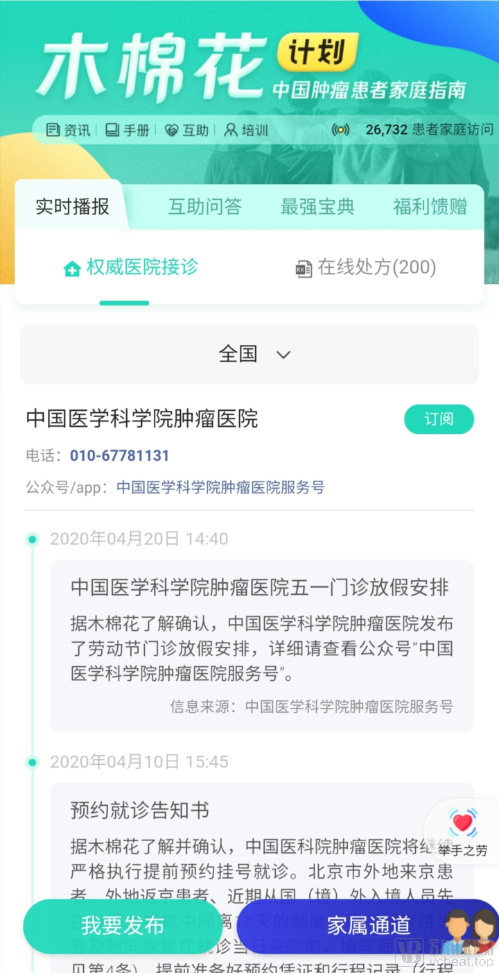
(Real-Time Broadcast Platform for Patient Intake Information at China’s Authoritative Oncology Hospitals)
In fact, prior to this, the Mumu Flower Project had already served tens of thousands of families affected by cancer, collaborating with pharmaceutical and insurance giants such as AstraZeneca, Roche, Pfizer, and Taikang Allianz to support these families.
QTC Care is a global one-stop platform for critical care services and a global medical insurance service provider. Founded in Silicon Valley, USA, in 2013, the company established its China headquarters in Shanghai in 2016 and received tens of millions in investment from Tencent in 2019. Leveraging resources from over 600 hospitals and thousands of top-tier physicians worldwide, QTC Care has independently developed a remote video consultation system that enables patients to access optimal treatment plans without leaving home. To date, its service team has provided tens of thousands of Chinese patients with medical services including remote consultations with domestic and international experts, overseas medical treatment, and overseas health check-ups.Its main products include the “Kapok Plan (anti-cancer digital therapeutic)” and the “Mitea Plan (digital therapeutic for healthy behavior management).”
In 2008, Lu Yi went to Stanford University in the United States to pursue an MBA. After graduation, she managed wealth for the Walton family, the richest family in the United States. During this period, Lu Yi had the opportunity to access high-end medical care in the United States. She found that the overall level of high-end medical care in the United States was very advanced, and there was a significant gap compared to China. "Many drugs and treatment methods were almost unavailable in China, so we decided to start a business in cross-border healthcare, initially targeting cancer patients to help them find the best doctors and treatment plans," Lu Yi introduced.
In fact, among the many countries serving as destinations for overseas medical care, the United States has long been the top choice for Chinese patients. Approximately 80% of new cancer drugs worldwide originate from the U.S., where innovation in pharmaceuticals consistently leads globally. Coupled with high healthcare expenditure and overall medical standards that are among the best in the world, an increasing number of people are choosing to travel to the United States for oncology treatment.
High-quality overseas medical resources provide patients with a wider range of treatment options and innovative drugs. Market forecasts suggest that the potential of China’s overseas medical market could exceed tens of billions of U.S. dollars in the next decade.
In 2013, QTC Care was founded in Silicon Valley. The founding team comprised a group of elite professionals from Silicon Valley, with technical expertise spanning engineering, biology, algorithms, and the internet. The team included engineers from Google as well as renowned oncology experts from China’s West China Hospital.
Three years later, Lu Yi returned to China with QTC Care. “In fact, we began making strategic adjustments as early as 2016. We recognized that, from the perspective of the disease itself, once a tumor has developed, treatment becomes an extremely costly and arduous process. Therefore, we aimed to achieve breakthroughs in prevention and health intervention. As a result, QTC Care established its Digital Therapeutics division,” said Lu Yi.
She explained that digital therapeutics are currently divided into two main segments. One is the Mita Project, which is primarily based on big data and employs proactive, forward-looking behavioral intervention programs to help participants achieve weight loss, overcome plateaus, manage sleep, enhance memory, regulate emotions, maintain healthy exercise habits, and manage gastrointestinal health, thereby reducing the risk of chronic and serious diseases. “This product is a solution designed mainly for weight management in healthy and sub-healthy populations. Its ultimate goal is to help ordinary people develop long-term healthy lifestyle habits. Weight loss occurs as part of this process, and such weight reduction can significantly lower the risk of many chronic diseases.”
The second is the "Kapok Project," which is currently being prioritized.The “Kapok” program, launched in April 2019, is a pioneering product based on evidence-based medicine that introduces the first “hexagonal” deep-balanced management model. It aims to maximize the quality of life for cancer patients and their families, reduce overall healthcare expenditures, and alleviate the burden on family caregivers.The product takes the form of a WeChat mini-program and includes: 27 days of intensive training, 60 minutes per day, joint classes for patients’ family members and children, on-site lectures by experts, and full-process guidance by teaching assistants. “Mumianhua primarily targets cancer patient families within our existing network, focusing on their children with a 21-day training program designed to improve long-term treatment adherence and satisfaction among these families,” said Lu Yi.
Why develop such a product? Lu Yi pointed out that cancer patients are predominantly middle-aged and elderly. In China, a cancer diagnosis affects not just the individual but the entire family. Many of these patients’ children are relatively young and more proficient in using mobile phones."By implementing cognitive and behavioral management for children, the overall quality of family life can be improved to a certain extent, thereby enhancing confidence in cancer treatment."
It is understood that this home-based electronic anticancer medication is the first of its kind in China. The product’s advantages are twofold: First, it offers an online training program for in-depth patient education and behavioral management tailored to family members of cancer patients, thereby improving patient adherence, boosting confidence in treatment, enhancing quality of life, and helping to prolong survival. Second, it helps strengthen interactions between insurance agents and the families of the insured, increases goodwill toward the insurance company among family members and relatives, and facilitates policy conversions by family members.
“The mission of the Kapok products is to guide family members from a state of ‘knowing nothing’ to being ‘fully prepared,’” said Lu Yi. She noted that currently, tens of thousands of families have joined the platform, with a 100% participation rate among family members, an average completion rate of 70%, and significant overall effectiveness.From the data, the average interaction rate of a cancer patient's family on the Mumianhua platform is 10 to 100 times that of similar products in the market.
Given these results, Mu Mian Hua is currently conducting clinical trials at two domestic Grade A tertiary hospitals in China, aiming to quantify and confirm the product’s changes and outstanding performance in terms of cure rate.
Regarding future plans, Lu Yi stated that the company will continue to intensify its efforts in product development and launch Class III digital therapeutics in the next phase. Furthermore, it will accelerate market commercialization, making product promotion the core business focus in 2020. Meanwhile, the company will strengthen clinical validation of its research; for instance, it will conduct clinical trials to gather evidence for its core methodology—the Hexagon Theory—thereby scientifically demonstrating the feasibility of this treatment approach.
“We aim to become China’s largest digital therapeutics company. We hope our digital therapeutic products will become the ‘standard-of-care’ offerings for these specific patient populations.”.” said Lu Yi.