

Tianjin Primary Digital Healthcare Consortium: A Post-Pandemic Evolution of China's Internet Hospitals
Are Internet hospitals merely an online migration of offline hospitals? Within the business framework of follow-up consultations and specialist consultations, what more can Internet hospitals do? With inclusion in medical insurance reimbursement, can Internet hospitals immediately claim a share of the market?
In 2020, internet hospitals demonstrated remarkable performance in the prevention and control of the COVID-19 pandemic, propelling this new business model forward by a significant leap. Both standalone and platform-based internet hospitals rapidly mobilized for epidemic response efforts, with medical insurance reimbursement channels quickly established in certain regions. Although this constitutes substantial progress—facilitating the migration of more offline medical services to online platforms and enabling patients with chronic diseases to conduct follow-up consultations, obtain prescriptions, and process insurance reimbursements via the internet—is this the full extent of the value offered by internet hospitals?
Where Are Internet Hospitals Headed in the Post-Pandemic Era? Neither Incumbents Nor New Entrants Driven by Pandemic Control Can Cease Debating the Questions Posed at the Beginning of This Article.
Recently, a practice in Tianjin has provided an answer. On April 29, the Tianjin Municipal Health Commission announced the citywide launch of the construction of grassroots digital health communities. As the only reform of its kind in China to cover an entire provincial-level administrative region, this initiative is led by Tianjin Weiyi Internet Hospital, which collaborates with 267 primary healthcare institutions across the city to establish a closely integrated grassroots medical and health consortium.
“Primary Care Digital Health Consortium” and “Internet Hospital” highlight two key themes of Tianjin’s current healthcare reform. The leading role played by Internet hospitals reveals their new positioning: an exploration aligned with the trends of healthcare reform, representing a model breakthrough that goes beyond merely prescribing and delivering medications for follow-up visits or simply migrating offline services online. Instead, Internet hospitals are spearheading primary care reform within the region. This may well provide answers to the questions raised at the outset.
On April 29, the Tianjin Primary Care Digital Health Consortium, spearheaded by the Tianjin Municipal Health Commission, commenced its construction. The initiative aims to leverage a digital platform, with chronic disease health management as the entry point, to accelerate the establishment of a citywide, health-centered, and efficient health maintenance system.
Tianjin’s grassroots digital health consortium covers 267 primary healthcare institutions across the city. Led by Tianjin WeDoctor Internet Hospital, it leverages a digital platform to coordinate with primary healthcare institutions, establishing a citywide closed-loop service system integrating medical care, pharmaceuticals, insurance, and testing.
Previously, the national government and various provinces and municipalities have successively promoted medical consortia and closely integrated medical communities to drive primary healthcare reform, with the aim of achieving the goal of tiered diagnosis and treatment.
In 2017, pilot programs for the construction of Medical Consortia were fully launched, encompassing four models: urban medical groups, county-level medical communities, cross-regional specialty alliances, and telemedicine collaboration networks. The leading entities are primarily tertiary public hospitals or other hospitals with strong clinical capabilities, while county-level hospitals serve as vital links between urban and rural areas and act as leaders within their respective counties. The primary significance of these diverse forms of Medical Consortia lies in promoting the flow of high-quality medical resources to grassroots levels and remote, impoverished regions.
The Close-Knit Medical Consortium is a model that further accelerates the enhancement of primary healthcare service capabilities, building upon the foundation of county-level medical consortia. The lead institutions are primarily secondary Grade A hospitals or higher, serving as local flagship hospitals, while primary healthcare institutions participate as member units. This model aims to improve primary care capacity, rationally control medical expenses, and enhance the utilization efficiency of medical insurance funds through unified operations in administrative management, clinical services, information systems, and centralized procurement of pharmaceuticals and medical consumables.
The grassroots digital health community shares the same lineage with medical alliances and closely integrated medical consortia in promoting the equitable distribution of high-quality medical resources and enhancing cost-efficiency in primary healthcare services.
Of greater significance to the industry is that, in the construction of Tianjin’s grassroots Digital Health Community, an internet hospital served for the first time as the lead entity in local healthcare reform. By acting as a digital platform, it pioneered the digital upgrading of primary healthcare at the provincial administrative level, empowering the existing medical service system. While revitalizing local medical resources, it further promoted the transition from “disease-centered” to “health-centered” care, representing an advanced exploration beyond traditional Medical Consortia and Close-knit Medical Communities.
The launch of Tianjin’s grassroots digital health community also demonstrates that internet hospitals have garnered significant attention from government authorities, extending well beyond their role during the COVID-19 pandemic. Internet hospitals have substantially become a key digital lever for government regulatory bodies to comprehensively reform healthcare service delivery processes and promote health maintenance.
"Of course, the high level of attention from government departments is only one aspect; we should also recognize its significance in the overall development process of the industry."
Why Can We See New Possibilities for Internet Hospitals in Tianjin’s Grassroots Digital Health Consortium? Let Us Begin with the Development History of Internet Hospitals.
Taking the establishment of China’s first internet hospital as the starting point, a review of the transformation of internet hospitals over the past five years reveals three main phases when examined from the perspectives of service model evolution and progress in driving policy formulation. (This classification is not based solely on chronological dimensions, so there is temporal overlap among the phases.)
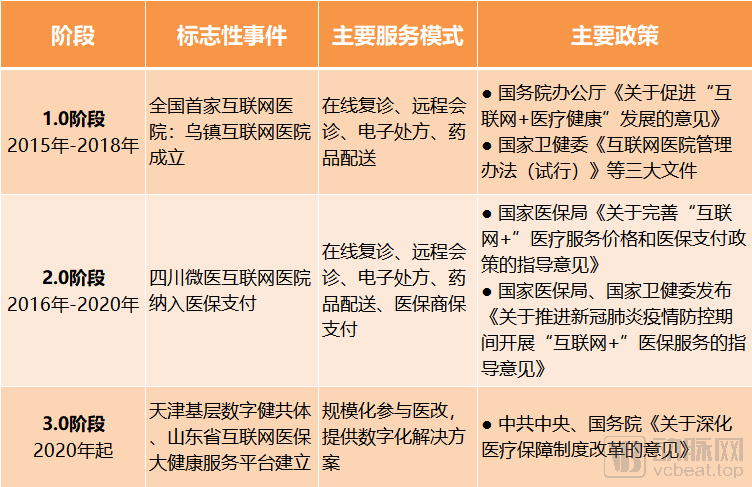
Three Stages of Internet Hospitals. Source: Public Reports; Graphic by VCBeat
Internet Hospital 1.0 Phase: Basic Form Established
On December 7, 2015, the Wuzhen Internet Hospital, co-established by WeDoctor and the Tongxiang Municipal People’s Government, officially opened, becoming China’s first internet hospital.
Three days later, Wuzhen Internet Hospital issued an electronic prescription via video consultation for a follow-up patient in Hangzhou, marking China’s first electronic prescription. The patient’s condition was stable, allowing continuation of the previous medication regimen.
After the prescription is issued, the patient completes the medication payment online, and the drugs are delivered by a distribution company to the patient's home.
At this point, the new model of internet hospitals has emerged, connecting hospitals, doctors, and patients via the internet and integrating online and offline service workflows. Its core service models include online follow-up consultations, remote multidisciplinary consultations, electronic prescriptions, and home delivery of medications.
Over the subsequent two-plus years, various regions began exploring internet hospitals, which mainly fall into the following categories: internet hospitals operated by physical hospitals, represented by the First Affiliated Hospital of Zhejiang University School of Medicine Internet Hospital; platform-based internet hospitals, represented by Wuzhen Internet Hospital; and co-constructed internet hospitals, represented by Sichuan WeDoctor Internet Hospital (jointly established by Wuzhen Internet Hospital and the Fourth People’s Hospital of Sichuan Province) and Shandong Provincial Third Hospital Internet Hospital.
During this period, internet hospitals primarily operated under the aforementioned core service models. These models were subsequently incorporated into the foundational policy framework for “Internet+ Healthcare.”
In April 2018, the General Office of the State Council, in its “Guiding Opinions on Promoting the Development of ‘Internet + Healthcare’,” explicitly defined the concept of internet hospitals for the first time and permitted online follow-up consultations and prescription issuance for certain common and chronic diseases.
In September 2018, the National Health Commission issued three major documents, including the Administrative Measures for Internet Hospitals (Trial), which clearly defined three forms of internet-based healthcare—internet hospitals, internet-based diagnosis and treatment, and telemedicine—with online follow-up consultations as the boundary, and established corresponding access standards and practice rules.
Therefore, the 1.0 phase of internet hospitals was primarily characterized by industry-led innovation and exploration, driving policy formulation and ultimately shaping the model of internet hospitals.
Internet Hospital 2.0 Phase: Seeking Payers
Offline medical services are primarily funded by basic medical insurance and out-of-pocket payments, with commercial health insurance playing a supplementary role. With the emergence of internet hospitals, identifying payers has likewise become essential.
In October 2016, the Sichuan Provincial Healthcare Security Administration designated Sichuan Weiyi Internet Hospital as a designated medical insurance provider, pioneering the integration of online payment systems in China. Pricing for internet-based diagnostic and treatment services, including remote consultations and online outpatient care, was explicitly established and included in medical insurance reimbursement coverage.
In March 2017, the Yinchuan Municipal People’s Government issued the “Interim Measures for the Administration of Medical Insurance Personal Accounts and Outpatient Pooling in Internet Hospitals in Yinchuan City.” Residents of Yinchuan can use funds from their personal medical insurance accounts to pay for various online consultation services provided by the Haodf Online Yinchuan Smart Internet Hospital. For services falling within the scope of the “Three Catalogs” of basic medical insurance, payments can be covered by the pooled fund.
In 2018, Wuzhen Internet Hospital applied to the Tongxiang municipal authorities for inclusion in the designated medical institutions covered by basic medical insurance. Several months later, the Tongxiang Social Insurance Bureau issued the “Notice on Adding Designated Medical Institutions for Basic Medical Insurance,” formally incorporating Wuzhen Internet Hospital into the city’s roster of designated providers under the basic medical insurance scheme. As a result, insured employees in Tongxiang City can now seek reimbursement for medical expenses incurred at Wuzhen Internet Hospital.
Internet hospitals are actively exploring integration with medical insurance payment systems, progressively connecting hospitals, physicians, and patients while streamlining service linkages across healthcare, pharmaceuticals, and insurance coverage, achieving significant breakthroughs each year.
In addition to advancing reimbursement through basic medical insurance, internet hospitals are also accelerating their integration with commercial health insurance. For example, in 2017, Wuzhen Internet Hospital partnered with ZhongAn Insurance to launch the first outpatient insurance product for internet hospitals, which uses the family as the unit of coverage and allows direct settlement by commercial insurers for online consultation fees and medication costs incurred by insured individuals.
The industry’s exploration and practice during this period also provided valuable experience to inform the formulation of national policies. In August 2019, the National Healthcare Security Administration issued the “Guiding Opinions on Improving Price and Medical Insurance Reimbursement Policies for ‘Internet Plus’ Medical Services,” establishing key principles for incorporating internet-based medical services into the medical insurance reimbursement system. Subsequently, provinces such as Shandong and Sichuan followed suit, releasing their own lists of internet-based medical service items and corresponding pricing standards.
Internet hospitals, represented by Sichuan WeDoctor Internet Hospital, have achieved breakthroughs in medical insurance payments. Wuzhen Internet Hospital has further integrated both public medical insurance and commercial health insurance. Coupled with the introduction of relevant policies, this signifies that although out-of-pocket payments remain the primary funding source for internet hospitals, a diversified range of payers is gradually being onboarded.
Overall, during the 1.0 and 2.0 phases, internet hospitals primarily focused on expanding the scope and closing the loop of healthcare services, broadening application scenarios, and improving payment mechanisms. However, the actual implementation of medical insurance payments remained limited to exploratory efforts in select regions and did not achieve scale.
Internet Hospital 2.0 Evolution: Accelerating the Formation of a Closed Loop
In 2020, following the outbreak of the COVID-19 pandemic, internet hospitals played a significant role in epidemic prevention and control. In the early stages of the outbreak, major internet hospitals launched online free consultation services. Under the coordinated deployment of the Tianjin Municipal Health Commission, the Tianjin Medical Insurance Bureau, and the Cyberspace Administration of the Tianjin Municipal Committee of the Communist Party of China, WeDoctor Internet Hospital in Tianjin rapidly launched a real-time assistance platform for COVID-19 on January 24, Chinese New Year’s Eve. After the platform demonstrated remarkable effectiveness, the National Health Commission issued a document to promote WeDoctor’s “Tianjin Model” nationwide.
Furthermore, on February 4 and February 7, the National Health Commission issued consecutive directives calling for the vigorous expansion of internet-based diagnosis and treatment services across China. During the epidemic prevention and control period, this spurred a new wave of construction boom for internet hospitals.
As the pandemic spread, to meet the urgent needs of patients with chronic diseases for follow-up visits and medication, medical insurance payment for internet hospitals was acceleratedly launched, fully demonstrating the connectivity capabilities of platform-based internet hospitals.
In Wuhan, the epicenter of the outbreak, the Wuhan Zone of WeDoctor Internet General Hospital enabled online follow-up consultations, prescription services, and medical insurance reimbursement for ten types of severe chronic diseases on February 26. This marked Wuhan’s first platform-based internet hospital to be included in the medical insurance payment system. On March 2, the National Medical Insurance Electronic Certificate was launched in the Wuhan Zone of WeDoctor Internet General Hospital, further improving the efficiency of online follow-up consultations and medical insurance settlements for local patients.
According to data from the official WeChat account “Wuhan Release” of the Wuhan Municipal People’s Government, the Wuhan Zone of WeDoctor Internet General Hospital provided online consultation services to more than 40,000 patients with chronic and severe diseases in less than a week, from February 26 to March 2.
Platform-based internet hospitals enabled health insurance payments during the epidemic prevention and control period, effectively meeting the substantial demand for medical consultations and medication among patients with chronic diseases, thereby providing a significant boost to the internet hospital industry.
Meanwhile, provinces and municipalities such as Jiangsu, Shanghai, and Tianjin have urgently introduced payment policies to include internet-based medical consultations in the national health insurance scheme, with multiple standalone internet hospitals led by physical medical institutions gradually integrating health insurance payment systems.
The effectiveness of platform-based internet hospitals, represented by WeDoctor Internet General Hospital, has become evident. Pilot payment policies in multiple regions have driven breakthroughs in top-level policy frameworks.
On March 2, the National Healthcare Security Administration and the National Health Commission issued the “Guiding Opinions on Promoting ‘Internet+’ Healthcare Services During the Prevention and Control of the COVID-19 Pandemic,” which brings eligible “Internet+” medical service fees into the scope of medical insurance reimbursement. Although the National Healthcare Security Administration had previously introduced policies for medical insurance coverage of internet-based healthcare services, this Guiding Opinion provides clearer implementation pathways and regulatory mechanisms, and is regarded by the industry as a genuine liberalization of medical insurance payment in the field of internet healthcare.
Following the release of the “Guidance,” more regions have formulated payment policies, and internet hospitals that have already gone live have accelerated the upgrading of their information systems. According to incomplete statistics, dozens of various types of internet hospitals across China have been connected to the medical insurance payment system to date, while some are still in the process of integration.
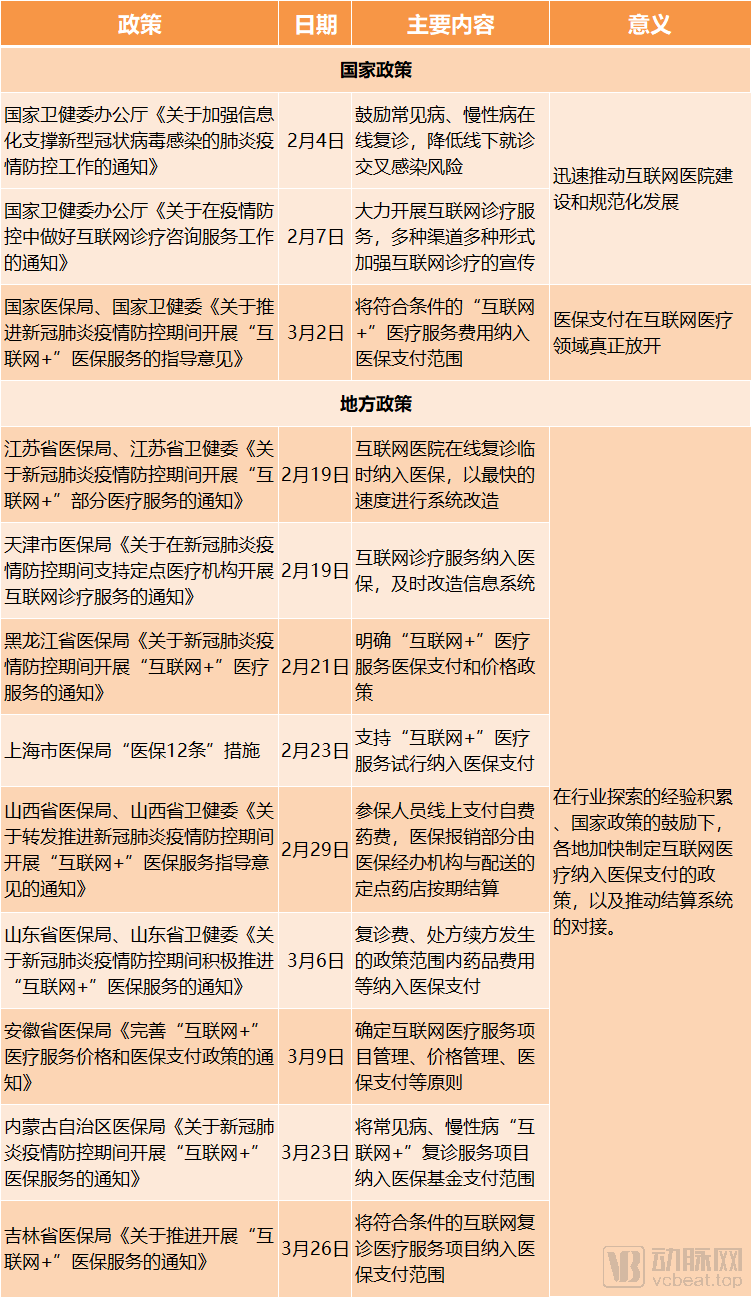
Selected Policies on Internet Hospitals During the COVID-19 Pandemic | Source: Official Websites of Local Health Commissions and Healthcare Security Administrations; Compiled by VCBeat
Overall, the payment process for internet hospitals was further refined during the 2.0 phase, a progression accelerated by the COVID-19 pandemic, underscoring the significant value of platform-based internet hospitals.
Internet Hospital 3.0 Phase: Large-Scale Participation in the Healthcare Reform Process
Benefiting from five years of continuous accumulation and the rapid acceleration during the pandemic, internet hospitals can now deliver a complete service loop.
The integration of industrial elements has opened up new possibilities for internet hospitals: it is not merely a migration of offline services to online platforms, but rather a deep, integrated solution that connects healthcare services, pharmaceuticals, and medical insurance—the “Three-Medical” linkage.
In Tianjin, a trend of innovation and transformation in the service model of internet hospitals is taking shape. Led by internet hospitals, the Tianjin Grassroots Digital Health Community leverages digital platforms to coordinate all primary healthcare institutions across the city, establishing a closed-loop service system covering medical care, pharmaceuticals, and insurance. We believe this may represent the next evolution of internet hospitals.
The Shandong Medical Insurance Big Health Platform, released not long ago, achieves a similar effect. The platform has established a complete closed loop for online medical insurance payment and settlement in internet hospitals—ranging from the establishment of internet hospitals and their inclusion as designated medical insurance providers, to patient identity verification and follow-up visit confirmation, and finally to online medical insurance settlement—thereby realizing the reengineering of healthcare processes based on the internet. This facilitates a rapid transition of internet hospitals from Stage 2.0 to Stage 3.0. In Stage 3.0, medical insurance begins to purchase internet hospital services at scale; leveraging digital platforms, internet hospitals efficiently achieve coordinated development among medical care, health insurance, and pharmaceuticals (the “Three-Medical Linkage”), participate in healthcare reform on a large scale, and play a significant role.
So, in Phase 3.0, how can internet hospitals participate in healthcare reform?
The key to healthcare reform lies in achieving coordinated action among medical services, pharmaceuticals, and health insurance; strengthening disease prevention and health promotion; and ultimately improving population health outcomes while reducing medical costs. The implementation pathways can be observed through Tianjin’s Grassroots Digital Health Consortium and the recently launched Shandong Provincial Internet Medical Insurance and Big Health Service Platform.
At its current stage, the Tianjin Primary-Level Digital Health Consortium employs digital applications centered on four major cloud platforms as the core “engine” to empower primary care, thereby effectively promoting tiered diagnosis and treatment and facilitating the rational allocation of medical resources.
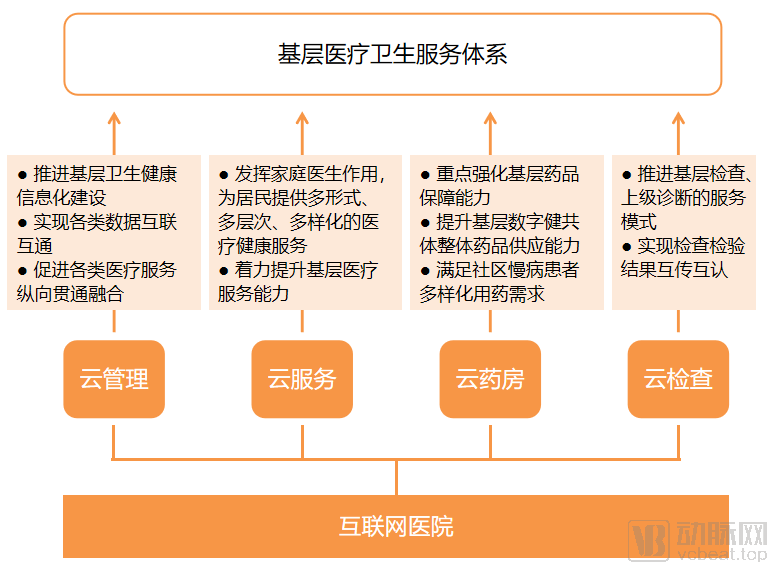
The Roles of the Four Major Cloud Platforms in Tianjin’s Primary-Level Digital Health Consortium at the Current Stage | Graphic by VCBeat
Building on this foundation, the Tianjin Grassroots Digital Health Community will further enhance the integration and operational efficiency of medical care, pharmaceuticals, and health insurance (“Three-Medical Linkage”) across the city in the next phase. It will innovate online-offline diagnosis and treatment models as well as family doctor contracting services, creating a convenient healthcare access and health management portal for Tianjin’s 16 million residents. This initiative aims to comprehensively improve primary care services and citizens’ health outcomes, facilitating a shift from a “disease-centered” to a “health-centered” approach.
Furthermore, the Shandong Internet Medical Insurance and Big Health Service Platform, also co-developed by WeDoctor, has established a complete closed-loop system that encompasses everything from launching internet hospitals and securing designated medical insurance provider status, to patient identity verification and follow-up consultation confirmation, culminating in online medical insurance settlement. The platform will continue to onboard various service providers, including internet hospitals, pharmacies, and elderly care institutions, thereby mobilizing industrial resources across all channels. This initiative aims to integrate healthcare, pharmaceuticals, and medical insurance, while reshaping the workflows for medical treatment, elderly care, insurance coverage, and health management, so as to meet the public’s diverse and multi-level service needs.
Although the Tianjin Primary Care Digital Health Consortium is led by the health authorities, while the Shandong Internet Medical Insurance and Big Health Service Platform is spearheaded by the medical insurance authorities, both represent significant innovations in the healthcare reform process. Internet hospitals have evolved beyond merely providing online follow-up consultations, prescribing, medical insurance payments, and medication delivery; they now integrate resources across medical care, pharmaceuticals, and insurance channels to deliver digital solutions that facilitate coordinated development among these three sectors. The ultimate goal is to enhance the quality of medical services, reduce healthcare costs, and promote public health maintenance, thereby serving as a key driver for the digital upgrading of healthcare reform.
What Role Will Internet Hospitals Play in the Future of Healthcare Reform and Medical Insurance System Reform?
In March 2020, the Central Committee of the Communist Party of China and the State Council mentioned “Internet + Healthcare” three times in the *Guiding Opinions on Deepening the Reform of the Medical Security System*, proposing to include eligible medical and pharmaceutical institutions within the scope of medical insurance agreement management, and to support and regulate the development of new service models such as “Internet + Healthcare.” This underscores the prominent position of internet healthcare in top-level design.
Currently, China has established a basic medical security system that covers the entire population, with its capacity for protection gradually improving. However, issues such as insufficient total medical resources and uneven distribution persist. Public perception regarding the difficulties and high costs of accessing medical care has seen little improvement, and the role of “health gatekeepers” remains absent. These are challenges that healthcare reform is addressing and will continue to tackle.
Following the establishment of the National Healthcare Security Administration, reforms to the medical insurance system have accelerated, thereby driving reforms in healthcare service supply. Leveraging internet hospitals and digital tools to optimize the allocation of high-quality medical resources and enhance their utilization efficiency represents a critical approach to addressing pain points on the supply side.
The “Key Tasks for Deepening the Reform of the Medical and Healthcare System in 2019” pointed out that policy documents on pricing for internet-based medical consultations and their coverage under medical insurance payment should be formulated; organize and carry out the construction of provincial-level demonstration zones for “Internet + Medical Health,” supporting pilot initiatives to accumulate experience. Continue to advance the development of the National Population Health Information Platform and provincial-level integrated regional platforms.
These initiatives were either completed by the National Healthcare Security Administration in 2019 or advanced by the National Health Commission. Although the key tasks for healthcare reform in 2020 have not yet been released, given the prominent role and rapid development of internet-based healthcare during the COVID-19 pandemic, it is likely that more related content will be included in the healthcare reform work plan.
Currently, healthcare reform has entered a critical phase, and the medical insurance system is poised for significant changes. Relying on existing offline healthcare service models, or merely migrating these offline models to online platforms, makes it difficult to efficiently achieve the coordinated development of medical care, health insurance, and pharmaceuticals (the “three-medical linkage”), nor does it facilitate the restructuring of healthcare service processes around a “health-centric” approach. In contrast, internet hospitals can leverage digital tools to integrate industrial service elements, thereby effectively achieving this objective.
Tianjin’s grassroots digital health consortium is exploring pathways in this field, reflecting the trend of digitalization driving reform. VCBeat will continue to monitor whether the experience accumulated from successfully implementing this new model can be rapidly replicated, which will further validate the value of the internet hospital industry.