

BGI Geno-Immune Secures China's First IND Approval for Neoantigen-Based Cell Therapy, Paving the Way for IPO
Tumor neoantigens have become a focal point in the development of oncology therapeutics over the past two years. As highly specific tumor targets, they have prompted numerous companies to rapidly enter the fields of neoantigen screening methodology development and drug discovery. Nevertheless, as this area remains in a relatively early stage of research, only a handful of candidates have advanced to registrational clinical trials.
On January 7, 2020, Wuhan Huada Jinuoyin Biotechnology Co., Ltd. announced that its Investigational New Drug (IND) application for the “Targeted Neoantigen Autologous Immune T-Cell Injection” had received implicit approval for clinical trials from the National Medical Products Administration (NMPA), making it the first tumor neoantigen cell therapy drug approved in China to conduct registration-enabling clinical trials.
Since 2012, Wuhan Huada Jinuoyin Biotechnology Co., Ltd. has been engaged in research on tumor neoantigens, positioning itself as a pioneer spanning the two hot fields of tumor neoantigens and cell therapy. The recent approval of its Investigational New Drug (IND) application signifies that the accumulation over the past eight years has propelled Jinuoyin into the first tier of these two niche sectors in China.
“BGI Group has a motto: ‘Genomic technology for the benefit of humanity,’ which also reflects our philosophy and starting point. At our company, we have further concretized this vision into ‘turning cancer into a chronic disease,’” said Dr. Li Bo, CEO of Jinuoyin.
Dr. Li Bo is a Distinguished Researcher, Visiting Professor, and Research Fellow at Xi’an Jiaotong University. He previously served as Director of the Institute for Precision Medicine at BGI Research. As a core member, he participated in the Giant Panda Genome Project. He has published 24 SCI-indexed papers, which have been cited more than 2,300 times in total.
Huada Jinuoyin was initially incubated within the BGI Group and began research on tumor neoantigens in 2012. After several years of research, it completed the preliminary product concept design and launched the world’s first clinical trial for tumor neoantigen T-cell therapy in 2016.
Dr. Li Bo is one of the members who have made the greatest contributions to the technological development of Jinuoyin. In the early stages of Jinuoyin’s development, in addition to Dr. Li Bo, other key members such as Dr. Yang Naibo and Dr. Zhao Zhengqi laid a solid technical foundation for Jinuoyin’s strategic layout in immune cell therapy.
Dr. Zhao Zhengqi joined Novartis’ cell therapy team as early as 1988, establishing himself as a pioneer in the global field of immune cell therapy. His early involvement laid a solid foundation for Jinuoyin’s cell technology capabilities.
Dr. Yang Naibo has been engaged in immunology-related research for over 20 years, led multiple monoclonal antibody drug development projects, and possesses extensive experience in the management and operation of pharmaceutical enterprises.
In 2018, Jinuoyin further brought on board Dr. Li Jingyu, who had previously served as a designer for Microsoft’s XiaoWei. As one of the world’s leading authorities in artificial intelligence, particularly in deep learning, Dr. Li’s addition enabled Jinuoyin to further refine its AI algorithms for tumor neoantigen prediction.
After several years of early exploration, Wuhan Huada Jinuoyin Biotechnology Co., Ltd. was officially registered and established in 2017. Leveraging the BGI platform, Jinuoyin has continuously increased its external collaborations and R&D investment while maintaining corporate independence. In 2019, the company completed a Series A financing round of RMB 120 million, led by GF Xinde.
More importantly, on September 30, 2019, the Center for Drug Evaluation (CDE) accepted the Investigational New Drug (IND) application submitted by Jinuoyin for its NEO-T product. By January 8, 2020—just three months after acceptance—the CDE had approved this IND application. This marked the first clinical trial approval in China for tumor neoantigen-based immune cell therapy.
Jinuoyin’s products were among the first to secure IND approval, a milestone closely tied to its substantial technical expertise. Since 2012, Jinuoyin has been conducting research on neoantigen technologies, progressively advancing from proof-of-concept studies through product prototype development, animal testing, and clinical trials, ultimately leading to the current IND approval.
“When we were conducting basic scientific research, we were contemplating what approaches could bring about a breakthrough impact on cancer treatment. We believed that neoantigens represented a highly promising direction. This is because neoantigens possess a unique advantage: they are present exclusively on tumor cells and not in normal tissues. As a result, our immune system recognizes them as foreign entities, facilitating their clearance,” Li Bo told VCBeat.
To date, the two globally approved immune cell therapy products have been indicated solely for hematologic malignancies. Neoantigen-based immune cell therapies, however, may break through the current bottlenecks of immune cell therapy in oncology, expanding its application into the broader field of solid tumors.
For personalized diagnosis and treatment, tumor neoantigens arising from mutations are undoubtedly ideal therapeutic targets. Compared with other cellular targets, tumor neoantigens exhibit superior specificity and immunogenicity. In the past two years, breakthroughs in detection technologies, coupled with their high specificity, have drawn widespread attention to tumor neoantigens across the entire industry.
To date, the greatest challenge in neoantigen detection lies in the imperfections of related algorithms and workflows. Since target sequences identified through genomic sequencing do not necessarily undergo transcription and translation to become neoantigens, it is necessary to employ artificial intelligence and mathematical models to simulate biological processes. These simulations span from transcription and translation, to peptide hydrolysis, antigen transport, and affinity assessment, ultimately identifying antigens that can be presented on the cell surface with high affinity.
To address this challenge, over the past eight years, Jinuoyin has developed two software tools for tumor neoantigen prediction: PSSMHCpan, which predicts tumor neoantigen affinity, and EPIP, which predicts tumor neoantigen presentation capacity. Meanwhile, Jinuoyin has established an immunopeptidomics platform spanning from mass spectrometry detection to identification, enabling the construction of a HLA-typed antigen database specific to the Chinese population, thereby significantly improving the accuracy of tumor neoantigen prediction in this population.
Building on these technologies, Jinuoyin can predict tumor neoantigens using deep learning models after obtaining patients’ tumor genetic information, and comprehensively rank them based on affinity, presentation capacity, and immunogenicity. Subsequently, the top-ranked neoantigens are synthesized into neoantigen peptides and co-cultured with dendritic cells (DCs) to induce DC maturation. Finally, the mature DCs are co-cultured with CD8+ T cells to directionally expand them into mature T cells capable of specifically recognizing the neoantigens. Ultimately, these T cells are infused back into the patient to eliminate tumor cells.
This comprehensive technical process constitutes NeoTT, the core technology of Jinuoyin’s cellular immunotherapy.
Compared with other current immunotherapies such as CAR-T and TCR-T, NeoTT, which targets neoantigens, offers higher specificity, a better safety profile, and indications covering solid tumors. However, due to the high demands on companies’ comprehensive capabilities, few enterprises have currently entered this field.
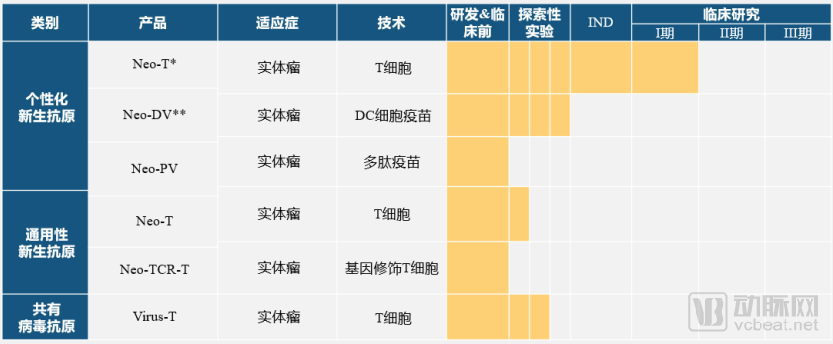
Building on its proprietary technological foundation, Wuhan Huada Jinuoyin Biotechnology Co., Ltd. (Jinuoyin) has established a robust product pipeline. Leveraging its tumor neoantigen screening technology, Jinuoyin has segmented its product portfolio into three categories: personalized neoantigen products tailored to individual patients; broadly applicable universal neoantigen products; and shared viral antigen products targeting viral antigens. Furthermore, based on differing therapeutic modalities, the company has selected various immune cell types, such as T cells and dendritic cells (DCs), as delivery vectors.
Jinuoyin’s product, which has just received Investigational New Drug (IND) approval, is the first neoantigen immune cell therapy in China to enter the registrational clinical trial phase. It is a personalized T-cell therapy leveraging its Neo-T technology and represents one of the few immune cell therapies in China approved for the treatment of solid tumors.
In previous relevant clinical trials, Neo-T has demonstrated remarkable therapeutic efficacy and an impressive safety profile. In trials conducted among patients with melanoma and colorectal cancer, disease progression was effectively controlled in over 60% of patients, and 25% achieved partial response (PR). More importantly, among all trial participants, only three cases experienced Grade 2 adverse events possibly related to the product, with no Grade 3 or higher serious adverse events reported.
The significant efficacy and favorable safety profile observed in solid tumors highlight the advantages of Jinuoyin’s Neo-T technology, which targets neoantigens. By focusing on neoantigens, Neo-T enables more precise recognition of tumor cells while avoiding excessive stimulation of immune cells to release pro-inflammatory cytokines, thereby perfectly preventing the occurrence of cytokine release syndrome (CRS).
It is precisely due to this dual advantage of efficacy and safety that China’s National Medical Products Administration approved Jinuoyin’s product for registration-based clinical trials just over three months after accepting its Investigational New Drug (IND) application.
Jinuoyin’s neoantigen cell therapy product, using dendritic cells (DCs) as carriers, has also demonstrated significant efficacy. A patient with advanced gastrointestinal malignancy showed marked symptomatic improvement within two weeks after receiving combination therapy with neoantigen-loaded DCs and a PD-1 monoclonal antibody. After six weeks of treatment, tumor shrinkage exceeded 90% in certain regions, and the patient was assessed as having achieved complete response (CR).
The low response rate of PD-1 monoclonal antibodies in "cold" tumors has long been a major concern. Neoantigen dendritic cell (DC) therapy primarily modulates the tumor microenvironment, converting "cold" tumors into "hot" ones and thereby clearing obstacles for PD-1 monoclonal antibodies. This approach holds significant promise as another excellent option for PD-1 combination therapy.
Ginuoyin is fully prepared for the upcoming registrational clinical trials. In 2018, its GMP cell manufacturing center in Wuhan Optics Valley, covering over 1,000 square meters, had already become operational, providing logistical support for the clinical trials. Meanwhile, several other product candidates are expected to complete preclinical development and submit Investigational New Drug (IND) applications in the coming years.
Following the receipt of its Investigational New Drug (IND) approval, Wuhan Huada Jinuoyin Biotechnology Co., Ltd. is also poised to launch a new round of financing. Li Bo expressed heightened confidence in the company’s future development: “Our next strategic focus will be to further expand our product portfolio across diverse vector platforms, indications, and drug combination modalities. We are confident that, leveraging our technological foundation, we have the capability to become an influential unicorn enterprise within this specialized niche.”