

Moshi Secures $12 Million Series B Funding to Expand Its Children's Sleep and Mindfulness Platform

Accel
Venture Capital Firms
Moshi
Developer and Operator of Children's Sleep Aid Applications
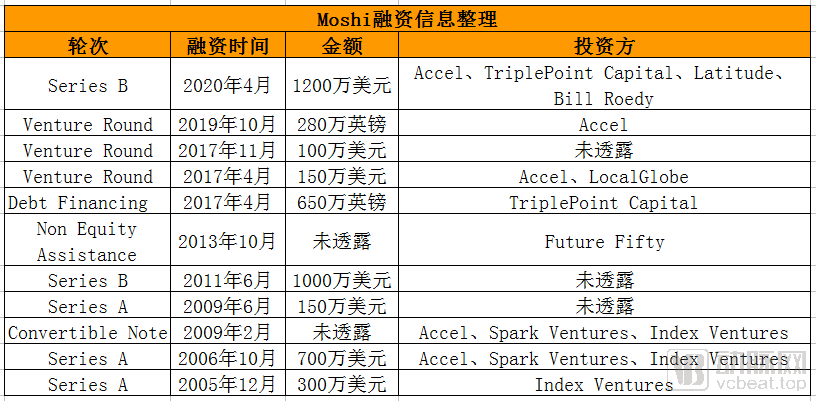
Moshi Announces $12 Million Series B Funding RoundRecently, Moshi announced the completion of a $12 million Series B financing round. The round was led by Accel, with participation from TriplePoint Capital, Latitude, and Bill Roedy. Additionally, Julia Hawkins from Latitude will join Moshi’s board of directors. This new capital will not only be used to develop new product features but also to formulate new advertising strategies and seek new partnerships. Lan Chambers, CEO of Moshi, stated, “The United States is currently Moshi’s largest market, and everything we are doing now is aimed at expanding our business in the U.S.”
Humans spend one-third of their lives sleeping. Insufficient sleep can adversely affect learning, memory, mood, and reaction time. Sleep duration varies with age; it is widely recognized that children require more sleep than adults. In recent years, growing awareness of the importance of sleep has led to a proliferation of sleep-aid products. While these products primarily target adults, some are specifically designed for children.
For children, sleep is a fundamental brain activity during early development. Longer sleep durations are required in the early stages of life, and high-quality sleep contributes to intellectual development, being closely linked to cognitive function, learning, and attention. For parents, getting children to fall asleep is no easy task, as many kids seem to have boundless energy before bedtime. To address the challenge of difficulty falling asleep in children, many companies are developing sleep-aid products for kids, with Moshi being one of them.
Moshi, formerly known as Mind Candy, was founded in 2004 and is headquartered in London, UK. It was established by Michael Acton Smith, who serves as its CEO. Michael Acton Smith has been dubbed the “Willy Wonka of the rock star world.” In 1998, he co-founded Firebox.com, a multi-channel retail website, with friends, engaging in retail, marketing, and the production of innovative products.
After establishing Moshi, Michael Acton Smith did not rest on his laurels. In 2012, he traveled to the United States to found Calm, a health and wellness brand. Calm now boasts an industry-leading sleep and meditation app that helps users alleviate symptoms such as anxiety and insomnia. To facilitate the management of Calm, he stepped down as CEO of Moshi in 2015 and currently serves as an active board member of the company.
Lan Chambers is the current CEO of Moshi. Prior to joining Moshi, he served as International General Manager at IGN, where he oversaw global business expansion and helped establish IGN as the world’s leading video game and entertainment media network. He also has professional experience at Ubisoft and Electronic Arts. In his personal life, Lan Chambers is a father of two. Motivated by his care for his family, he conceived the idea of helping children achieve better sleep—a vision that ultimately led him to join Moshi.
Chief Operating Officer Rich Keen has 20 years of experience in the music media and video game industries, and he successfully introduced meditation and mindfulness into mainstream culture at the 2000 Mind-Body-Spirit Festival. Chief Technology Officer Lan Trayler is responsible for building and innovating the technical team at Moshi, with over 20 years of experience in the online media industry, helping numerous companies resolve technical challenges.
From Brain-Training Games to Children’s Sleep Aid: Solving Pediatric Sleep Challenges
Moshi’s products have always been child-centric, with early offerings focused on educational games for children and later gradually shifting toward sleep aids for children.
Moshi’s first product was an entertainment game called Perplex City, which initially struggled to gain traction. To address this issue, Moshi organized a global alternate reality game (ARG) campaign, allowing participants to engage in treasure hunts through live events, websites, magazines, and other channels. The ultimate winner received a $200,000 prize. Through this campaign, Perplex City began to generate profits, and Moshi gradually gained public attention.
In April 2008, Moshi launched a children’s gaming website called Moshi Monsters. On the platform, players could adopt two pet monsters for free, while paying members could adopt up to six. The most common gameplay involved guiding pets through world exploration and puzzle-solving. Additionally, players could customize their rooms and interact with other users online.
When Moshi Monsters was launched, Moshi was on the verge of collapse. The product received widespread acclaim upon its release and achieved remarkable success between late 2008 and late 2009. The popularity of Moshi Monsters peaked in 2012, and by 2019, the website had accumulated over 100 million registered online users. While expanding its online operations, Moshi Monsters also gradually extended its brand into offline merchandise, including books, toys, magazines, and music. In December 2013, eight Moshi Monsters toys were included in Happy Meals offered by McDonald’s in the United States and Canada. However, in December 2019, Moshi Monsters announced its permanent closure due to the discontinuation of Flash Player support, which prevented the game from running.
Moshi’s latest survey report reveals that among 1,000 parents surveyed, over 50% reported that their children are struggling with stress and anxiety, leading to difficulty falling asleep at night, while 85% believed that telling bedtime stories is the most effective way to help children sleep.
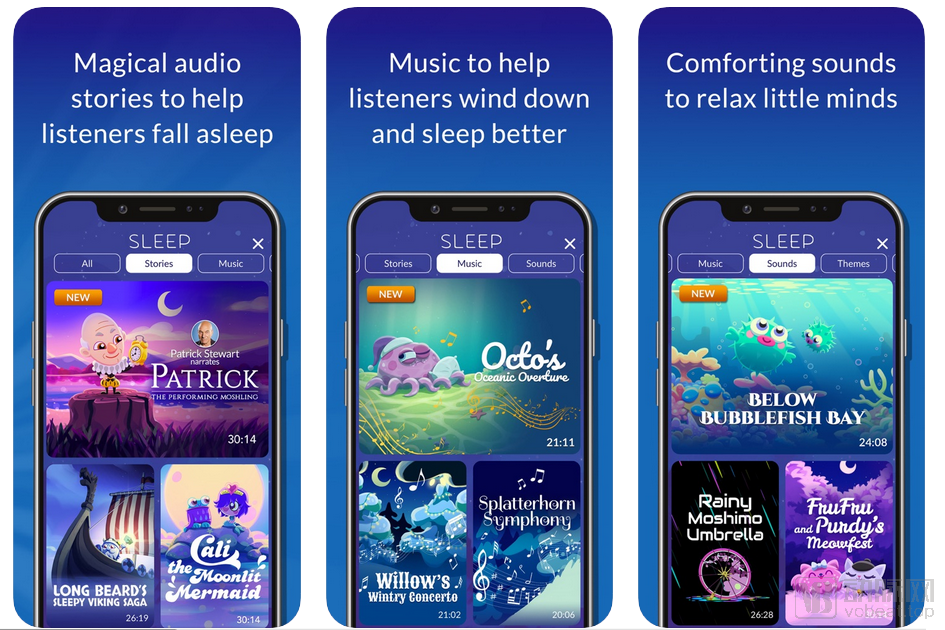
In response, Moshi launched a sleep aid app called “Moshi: Sleep and Mindfulness” in 2017. Currently, this app is the company’s flagship product, available for download and installation directly through the Apple App Store and Google Play Store. The bedtime stories and sleep-inducing music featured on the app are originally created by dedicated teams of writers and composers. New content is added weekly to meet children’s needs. Parents can create customized playlists for their children or choose from various themed playlists within the app.
This app charges users an annual fee of $40, but new users can enjoy a one-week free trial after registration. Upon expiration of the trial period, users may decide whether to subscribe based on their experience. Currently, Moshi: Sleep and Mindfulness has over 100,000 subscribers. Additionally, the app supports Family Sharing, which, once enabled in the settings, allows up to six family members to use the service.
Generally, to help children learn to fall asleep independently, parents should not stay in their child’s room for extended periods at bedtime. However, many young children require some external assistance before falling asleep. In this regard, Moshi: Sleep and Mindfulness helps children calm down quickly through soothing sleep-inducing audio content.
Moshi: The primary sleep-inducing audio offerings of Sleep and Mindfulness include bedtime stories, sleep sounds, and guided meditations. Most of the bedtime stories are accompanied by dreamy, gentle background music, which often incorporates white noise such as ocean waves and rainfall. As the story progresses, the narration pace gradually slows down, and the background music fades in volume. After the story concludes, the music does not stop immediately but continues to loop for a few minutes, with the volume gradually decreasing until it fades out completely.
To help children focus their attention, the protagonists of these stories are all adorable animal characters, including a sleepy koala, a little white rabbit capable of traversing dreams, and a knowledgeable Professor Owl. These characters spark children’s interest in the stories and allow their minds to wander through boundless imagination. Some of these bedtime stories are narrated by renowned actors such as Goldie Hawn and Sir Patrick Stewart.
It is worth noting that, based on user feedback, this app can also significantly alleviate anxiety and insomnia symptoms in adults. Although it is specifically designed for children, it is actually suitable for individuals across multiple age groups.
Acquisition of Tutpup and Origami Blue to Rapidly Expand Children's Educational Business
For any enterprise, acquisition is undoubtedly an effective strategy for business development. In February 2009, Moshi acquired Tutpup, an educational website offering brain-training games specifically designed for children aged 5 to 14. The platform enabled participating children to compete in math and spelling challenges with players from around the world. Through this acquisition, Moshi gained a substantial base of online users.
To provide more creative, child-centric products, Moshi acquired the game studio Origami Blue in July 2012. This acquisition injected new momentum into Moshi’s “Candy Labs” project, on the basis of which Moshi would subsequently establish a new R&D studio. Prior to the acquisition, Origami Blue had developed game applications for multiple enterprises and collaborated with numerous psychologists to create a touch-screen typing system suitable for children.
According to statistics, there are 200 million insomnia patients in China. The market also offers numerous sleep-aid and sleep-tracking apps, such as Tide, Little Sleep, Snail Sleep, and Dolphin Sleep. Most sleep-aid apps primarily induce drowsiness through soothing music and white noise, with a main focus on sleep-inducing music, while bedtime stories for children constitute only a small proportion. In contrast, sleep-tracking apps can monitor users’ deep sleep duration and snoring patterns, generating comprehensive sleep reports. However, these applications predominantly target adults, and there are very few sleep-aid apps in China specifically designed for children.
Currently, no dominant player has emerged in China’s sleep health sector. The smart sleep aid market is akin to the “Warring States Period,” with multiple companies vying for market share. Admittedly, while the market potential for smart sleep aid products is enormous, it is accompanied by two major challenges.
On the one hand, insomnia is merely a symptom; primary idiopathic insomnia accounts for only 15% of cases, while underlying emotional factors such as depression and anxiety are the root causes. Sleep aids should be used solely as a means to alleviate symptoms, and users should avoid becoming overly reliant on them.
On the other hand, solutions for sleep disorders are relatively complex and typically require a multidisciplinary approach. This implies that product development teams must possess not only expertise in electronics but also a certain level of medical knowledge, leading to a sharp increase in R&D costs.
After 2020, China’s sleep-aid market is poised for a period of growth, with an increasing number of players entering the space. To establish a firm foothold in this multi-million-user market, greater strategic thinking and innovation will be required. We await these developments with keen interest.