

Kintor Pharmaceutical Advances Diversified Pipeline in Oncology and Hair Loss, with Prostate Cancer Drug Filing for Approval Expected This Year

Kintor
Innovative Drug Developer
In 2008, as one of the earliest pioneers to return to China for the research and development of novel small-molecule anticancer drugs, Dr. Tong Youzhi noted that there were few companies engaged in new drug R&D in China at that time, and the innovative pharmaceutical industry was still in its early stages.
Prior to this, Dr. Tong Youzhi served as Vice President at Angion Biomedica Corp., a U.S.-based new drug R&D company, for six years, leading the team from its startup phase to maturity. This entrepreneurial experience was highly significant for Dr. Tong’s later establishment of Kintor. “This experience taught me how to build a successful new drug R&D enterprise from the ground up,” stated Dr. Tong.
In the 1980s, the popular saying “Master mathematics, physics, and chemistry, and you can go anywhere without fear” was widely circulated. Dr. Youzhi Tong chose to major in chemistry and remained at Peking University after completing his undergraduate and graduate studies there. During his time at Peking University, biology emerged as the most popular academic discipline. “When I went to the United States, I wanted to switch from chemistry to biology,” he said. In 1997, Dr. Tong earned his Ph.D. in Pharmacology from Cornell University/Sloan Kettering Cancer Center and subsequently conducted postdoctoral research. From 1999 to 2001, he served as an Assistant Professor at the Albert Einstein College of Medicine.
“All the changes began in 2007, when Dr. Tong Youzhi returned to China after his father was diagnosed with prostate cancer. ‘At that time, China had already achieved a relatively advanced level in hardware such as laboratory equipment, but there was still a certain gap between its new drug R&D capabilities and international standards. I felt this was a great opportunity to return home and contribute to the country,’ recalled Dr. Tong Youzhi.”
The incidence of prostate cancer has been rising year by year. From 2014 to 2018, it was the second fastest-growing cancer type in China and ranked first among the ten most common cancers worldwide, seriously affecting men’s health. “With changes in dietary habits and increased life expectancy, older men face a very high risk of developing prostate cancer. It is a ‘modern disease,’ and through this phenomenon, I see its strong market prospects,” Dr. Tong Youzhi told VCBeat.
Elevated androgen levels are one of the contributing factors to prostate cancer. Androgen deprivation therapy (ADT) serves as the initial treatment for metastatic prostate cancer, achieved through bilateral orchiectomy or medical castration combined with androgen blockade. Although the initial response rate is high, many patients eventually experience disease progression after ADT, a condition known as castration-resistant prostate cancer (CRPC).
Kintor’s first new drug development project was proxalutamide (GT0918) for the treatment of metastatic castration-resistant prostate cancer (mCRPC). As a Class 1 new drug in China, proxalutamide is a second-generation androgen receptor (AR) antagonist. The research project was included in the National “12th Five-Year Plan” Major New Drug Creation Special Project in 2011, making Kintor one of the smallest and youngest enterprises among those undertaking this special project at the time. Subsequently, in 2017, the project was again selected for the National “13th Five-Year Plan” Major New Drug Creation Special Project.
Pyrilutamide is a novel compound derived from the core structure of enzalutamide, an anti-prostate cancer drug marketed by Pfizer, through computer-aided design based on the crystal structure of the target protein and iterative optimization. Its chemical structure features multiple modifications compared to enzalutamide, thereby improving molecular solubility and pharmacokinetic properties, preventing excessive drug accumulation, and potentially eliminating the central nervous system and other side effects observed clinically with enzalutamide.
Furthermore, proktandil features a dual mechanism of action not found in currently available second-generation AR antagonists. Through its unique pharmacological effect of reducing AR protein expression, it holds promise as a potential best-in-class therapy for mCRPC by overcoming prostate cancer cell resistance to existing drug treatments.
It is reported that proxalutamide is conducting clinical trials simultaneously in China and the United States. In China, its second-line and first-line therapies for metastatic castration-resistant prostate cancer (mCRPC) are in Phase III clinical trials, with a single-agent marketing application expected to be submitted in 2020. In the United States, it is in Phase II clinical trials, with the study expected to be completed in 2020.
In addition to treating mCRPC, Kintor is actively exploring other indications for proctilutamide. For metastatic breast cancer, Kintor has completed Phase I/Ib clinical trials of proctilutamide in China and is currently conducting Phase Ic clinical trials of combination therapy with aromatase inhibitors and estrogen receptor antagonists—exemestane, letrozole, and fulvestrant. Proctilutamide is poised to become the first AR antagonist globally for the treatment of breast cancer.
Dr. Tong Youzhi expressed optimism about the prospects of proxalutamide, stating, “We will accelerate the clinical development and commercialization of proxalutamide, striving to provide better treatment options for a broad population of prostate cancer patients.”
Industry report data shows that in 2018, among males alone, over 92.8 million people aged 30 to 70 in China and over 31.1 million in the United States suffered from varying degrees of androgenetic alopecia (also known as "seborrheic alopecia"), with these numbers continuing to rise. The market for hair loss treatment drugs is substantial; so how did Kintor expand from oncology into the field of hair loss treatment?
“During the compound screening process for our company’s first project (proxalutamide), we unexpectedly discovered that the candidate compound fluridilone, due to its short half-life, is more suitable for development as a topical medication. Based on its mechanism of action, fluridilone is well-suited for the treatment of androgenetic alopecia,” said Dr. Tong Youzhi.
Currently, the two approved drugs for hair loss treatment are minoxidil and finasteride. The use of minoxidil is limited due to its unclear mechanism of action and potential adverse effects (propylene glycol allergy and orthostatic hypotension). Finasteride may cause decreased libido, sexual dysfunction, and impotence, which deters many men from using it.
Furterene exerts its pharmacological effects locally with low systemic drug exposure, thereby offering a potentially superior safety profile compared to existing therapies. As a potential first-in-class topical androgen receptor (AR) antagonist, Furterene holds promise for redefining the market landscape of androgenetic alopecia.
Currently, fluridil is undergoing Phase II clinical trials in China for the treatment of androgenetic alopecia, and its Phase Ib clinical trial in the United States will be completed this year. In March this year, Kintor entered into a strategic partnership with Sinopharm Holding Co., Ltd., to make full preparations for better patient services and market development for fluridil.
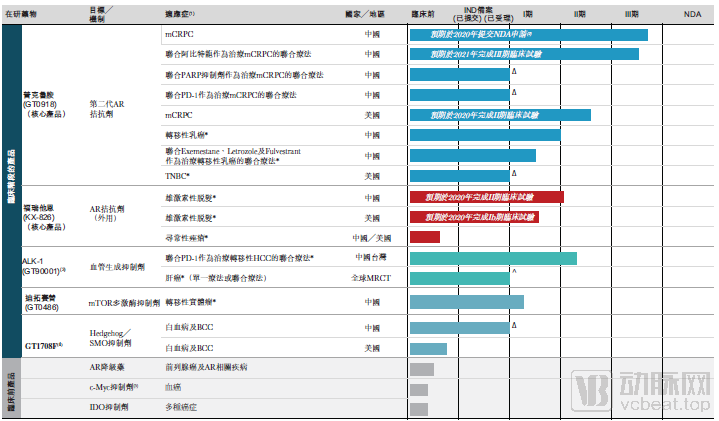
Kintor’s R&D Pipeline
An examination of Kintor’s R&D pipeline reveals that, in addition to proktalutamide and foritacitinib, other rapidly advancing projects include the ALK-1 monoclonal antibody. This biologic macromolecule project was licensed by Pfizer to Kintor for exclusive global development of a novel oncology antibody therapeutic and is currently undergoing a Phase II clinical trial in Taiwan evaluating its combination with PD-1 (nivolumab) for the treatment of metastatic liver cancer. The company’s portfolio also includes ditosertib (GT0486), a dual mTOR1/mTOR2 inhibitor, and GT1708F, a Hedgehog/SMO inhibitor, both in clinical development, as well as an AR degrader, a c-Myc inhibitor, and an IDO inhibitor, which are currently in preclinical studies.
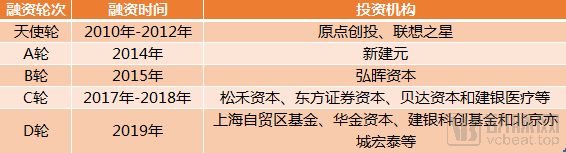
Kintor's Historical Financing
In terms of financing, Kintor has completed five rounds of funding. On December 31, 2019, Kintor submitted its listing application to the Hong Kong Stock Exchange, becoming another small-molecule targeted therapy company to list in Hong Kong this year after InnoCare Pharma.
Kintor has recently officially passed the Hong Kong Stock Exchange’s listing hearing and is actively preparing for its IPO in Hong Kong. We believe good news will follow soon.