

China's Evolving RWS Regulatory Framework: Key Considerations for Pharmaceutical Companies
On March 26, 2020, Allergan’s “XEN Glaucoma Treatment System” received marketing approval from the National Medical Products Administration (NMPA). The product utilized real-world evidence (RWE) in its registration to evaluate ethnic differences, making it the first medical product in China to obtain marketing approval based on real-world evidence. Mentioning real-world evidence inevitably brings to light the increasingly prominent “Real World Study” (RWS) in recent years.
Real-World Study (RWS) refers to a research process that addresses pre-specified clinical questions by collecting health-related data on study subjects in real-world settings (i.e., Real-World Data, RWD) or aggregated data derived from such data, and then analyzing them to generate clinical evidence regarding the utilization, potential benefits, or risks of medical products (i.e., Real-World Evidence, RWE). In other words, the purpose of RWS is to demonstrate the impact of a medical product on the health of study subjects and to evaluate its safety and effectiveness.
Some may certainly ask: Before the emergence of Real-World Studies (RWS), was the evaluation of medical product efficacy conducted through virtual world research? In fact, prior to the widespread discussion and attention on RWS, the traditional gold standard for evaluating the safety and efficacy of medical products was the Randomized Controlled Trial (RCT). An RCT is a comparative trial based on rigorous scientific design, striving to minimize the influence of confounding factors on treatment effects. Due to the relatively definitive causal relationships demonstrated in RCTs, their conclusions are highly reliable.
To summarize the application differences between RCTs and RWS in one sentence: an RCT design is required when determining whether a medical product intervention has a clear therapeutic effect, whereas an RWS design is necessary for further investigating the effectiveness and safety of that intervention in routine clinical practice.
Real-world studies (RWS) are generally conducted in actual healthcare settings, where participants have broad representativeness. By integrating trial evidence with individual patient characteristics to conduct meaningful assessments of therapeutic benefits and safety risks, the resulting evidence is most applicable to clinical practice. Well-designed RWS can serve as a supplement to randomized controlled trials (RCTs) to evaluate the effectiveness and safety of treatments already deemed effective in real-world medical practice. In practical research, conducting RWS can be very costly due to the need for large sample sizes and relatively long follow-up periods. The greatest advantage of RWS lies in its ability to provide evidence on the effectiveness and safety of interventions in routine real-world clinical settings; however, this may come at the risk of compromising internal validity.
With the advancement of medical informatics, artificial intelligence, and deep learning technologies, professionals can derive insights into the safety and efficacy evaluation of medical products through scientific analysis of various health data obtained in clinical practice. These real-world data (RWD)-based studies not only significantly accelerate the pace of traditional controlled trials but also attempt to address questions that such trials cannot answer. Through rigorous scientific design, real-world studies (RWS) have the potential to serve as a valuable complement to randomized controlled trials (RCTs), the traditional gold standard for evaluating medical products.
Following the establishment of the RWS methodology, it quickly garnered attention from various sectors of society. We have compiled a timeline of key milestones in the field of RWS in China:
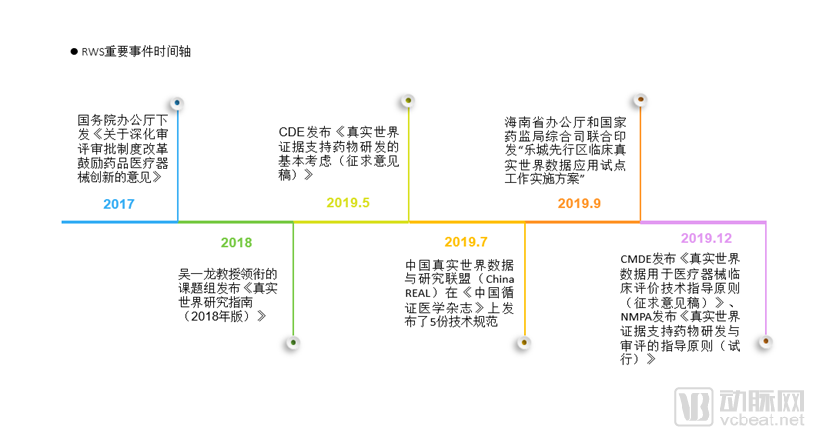
1. The “Opinions on Reforming the Review and Approval System for Drugs and Medical Devices” issued by the State Council in August 2015, and the “Opinions on Deepening the Reform of the Review and Approval System to Encourage Innovation in Drugs and Medical Devices” issued by the General Office of the State Council in October 2017, both strongly advocate research and development innovation in drugs and medical devices.
2. The research team led by Professor Wu Yilong released the Guidelines for Real-World Studies (2018 Edition) at the Chinese Oncology Clinical Trial Development Forum held in August 2018, marking the first systematic introduction of RWS in China. These guidelines introduce concepts related to RWS and provide systematic recommendations and guidance on RWS processes, design, data collection, and quality control.
3. In May 2019, the Center for Drug Evaluation (CDE) of the National Medical Products Administration released the “Basic Considerations for Supporting Drug Development with Real-World Evidence (Draft for Comment),” marking the first time that application scenarios and research requirements for real-world studies (RWS) entered the official regulatory purview.
4. The China Real-World Evidence Alliance (China REAL) has released five detailed technical specifications focusing on the establishment of research databases and the evaluation of treatment outcomes. (i) Technical Specification 1 primarily addresses the technical requirements for constructing research databases from typical existing healthcare data, while Technical Specification 2 provides a detailed discussion of the key technical requirements for establishing patient registries; these two specifications mainly answer the question, “How to establish research databases based on real-world studies (RWS).” (ii) Technical Specifications 3 and 4 primarily address epidemiological design and statistical analysis issues related to evaluating treatment outcomes (efficacy and safety) using research databases based on observational designs, whereas Technical Specification 5 focuses on the technical requirements for pragmatic clinical trials; these three specifications mainly address the question, “How to evaluate the efficacy and safety of treatments based on RWS.”
5. In September 2019, the General Office of Hainan Provincial People’s Government and the Comprehensive Department of the National Medical Products Administration jointly issued the “Implementation Plan for the Pilot Program on the Application of Real-World Data in Clinical Settings in the Boao Lecheng International Medical Tourism Pilot Zone,” deciding to conduct pilot real-world studies on urgently needed imported drugs and medical devices in the Boao Lecheng International Medical Tourism Pilot Zone.
6. On December 13, 2019, the Center for Medical Device Evaluation (CMDE) of the National Medical Products Administration publicly solicited comments on the “Guiding Principles for Using Real-World Data in Clinical Evaluation of Medical Devices (Draft for Comment)” (hereinafter referred to as the “RWS Guiding Principles for Medical Devices”).
7. On January 3, 2020, the NMPA issued the Guiding Principles for Using Real-World Evidence to Support Drug Development and Review (Trial) (“Guiding Principles on the Use of RWS in Drug Development”).
Among the aforementioned documents, the last two are particularly significant. The table below lists the RWS application scenarios that have been or are proposed to be recognized by national authorities:
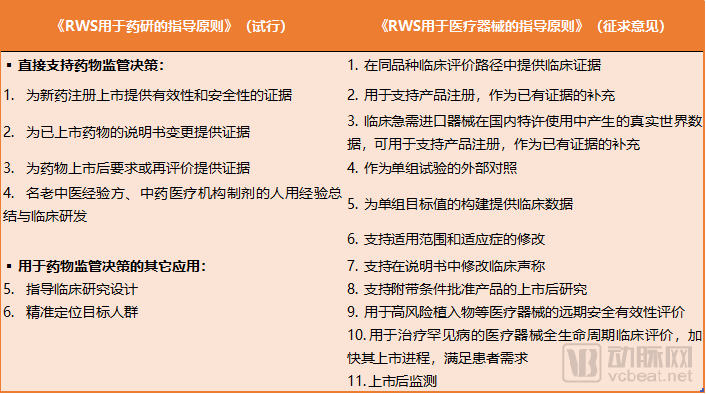
Table: RWS Application Scenarios
According to the aforementioned two guidelines, RWS can be categorized into two types: interventional studies and non-interventional studies:
(1)Interventional studies, also known as “Pragmatic Clinical Trials” (PCTs), aim to closely mirror real-world clinical settings. The design of specific intervention factors is relatively flexible, and data collection relies on medical practices within these clinical trials. Conducting PCTs must also comply with China’s regulatory requirements for clinical trials of medical products.
(2)Non-interventional studies include observational studies (retrospective or prospective) and external control studies conducted as single-arm trials (historical controls or parallel controls), among others, with data collection relying on routine medical practice. For non-interventional studies, participant cooperation may still be required during the study process.
On the other hand, Chinese laws and regulations do not use intervention as the criterion for defining clinical trials; all clinical research involving human subjects must comply with various regulatory requirements for clinical trials. Such regulatory requirements are in line with international practices. The Guideline for Good Clinical Practice (GCP) established by the International Council for Harmonisation of Technical Requirements for Pharmaceuticals for Human Use (ICH) serves as an important internationally recognized guiding principle for drug clinical trials. According to GCP provisions, clinical trials and clinical research are regarded as equivalent concepts. Real-World Studies (RWS) should likewise adhere to the regulatory requirements for clinical trials. The table below briefly outlines the key regulatory points that RWS must meet:
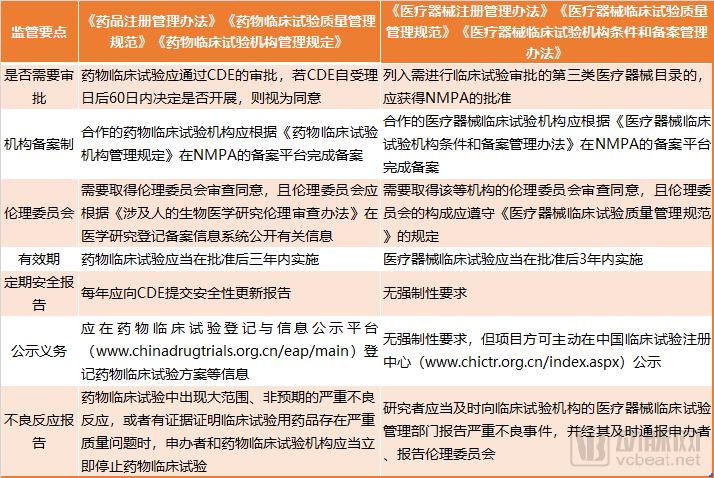
Among the aforementioned regulatory priorities, oversight by the ethics committee constitutes a critical component. The ethics committee comprises medical experts and independent members external to the clinical trial institution. Its review focuses on key documents, including the informed consent forms for subjects participating in clinical research.
For retrospective observational studies and historical control studies conducted using big data, obtaining informed consent from participants is often challenging because pre-existing data are utilized. According to the relevant provisions of the Measures for Ethical Review of Biomedical Research Involving Humans (the “Measures for Ethical Review of Medical Research”): (1) where identifiable samples previously used for diagnosis or treatment are employed in research, researchers must obtain signed informed consent forms from the participants; (2) where human biological materials or data containing identifiable information are used in research, if the participants cannot be located and the study does not involve personal privacy or commercial interests, the requirement for signed informed consent may be waived upon review and approval by the Ethics Committee. In light of this, it can be reasonably inferred that, after de-identification of data and under the premise of ensuring no infringement of personal privacy, the Ethics Committee has certain discretion to appropriately waive the requirement for participants to re-sign informed consent forms in specific real-world study (RWS) contexts (e.g., non-interventional studies utilizing only historical health data).
With the Cybersecurity Law as its cornerstone, China is vigorously advancing the formulation of numerous supporting regulations and related laws. These include the Regulations on Multi-Level Protection of Cybersecurity, the Information Security Technology—Personal Information Security Specification, the Data Security Law, and the Personal Information Protection Law, all of which have initiated their legislative processes. The Information Security Technology—Personal Information Security Specification was officially released in March 2020. As a recommended national standard, it provides significant demonstrative and guiding implications for personal information protection within the internet industry.
The regulatory framework for medical and health data in China primarily includes the Administrative Measures for Standards, Security, and Services of National Health and Medical Big Data (Trial), the Administrative Measures for Population Health Information (Trial), and the Regulations on the Management of Human Genetic Resources. These normative documents reflect the following regulatory principles: (1) Medical and health institutions, as well as enterprises and public institutions that collect and control data, are the responsible entities for data security protection and application. These responsible entities shall ensure effective cybersecurity protection and privacy protection for medical and health data, and guarantee that data is used within the scope authorized at the time of collection; (2) Population health information shall not be stored on servers located outside of China, nor shall it be hosted or leased on servers located outside of China; (3) For data utilization that may involve state secrets (such as human genetic resources), prior approval from the relevant competent authorities must be obtained.
According to public news reports, in the pilot areas of Hainan Province, the relevant competent authorities, in collaboration with experts, scholars, and the relevant review departments of the National Medical Products Administration (NMPA), have formulated the Preliminary Plan for the Collection of Clinical Use Data on Clinically Urgent Imported Medical Devices in the Hainan Boao Lecheng International Medical Tourism Pilot Zone. Regrettably, these plans have not been made public, so the specific details remain unknown to the general public.
Nevertheless, in light of current practices in the field of information security, sponsors, investigators, and corresponding clinical trial institutions involved in Real-World Studies (RWS), as well as providers of healthcare and medical data, should first execute written agreements authorizing data use. These agreements must ensure that data utilization or collection does not result in the leakage of personal information or infringement of personal privacy. However, beyond this, many issues remain to be addressed through detailed regulations issued by competent government authorities. Such issues include methodologies for data de-identification, whether patients retain the right to informed consent regarding RWS-related matters after data de-identification, how compensation should be obtained and its standards determined for patient data used beyond the authorized scope, and whether the National Medical Products Administration (NMPA) will jointly regulate data security with the National Health Commission.
Conclusion: The United States and China are engaged in intense competition, with innovation in the healthcare sector serving as one of its central themes. The COVID-19 pandemic has further underscored the decisive role that significant advances in medical research and innovation play in safeguarding overall societal security. We look forward to Real-World Studies (RWS) contributing to the advancement of global healthcare innovation, and we further hope that China’s medical legal framework will adopt an inclusive regulatory approach toward RWS, thereby accelerating the pace of healthcare innovation in China.
Author: The Healthcare & Life Sciences Team at AnJie Broadstone Law Firm

Contact QR Code
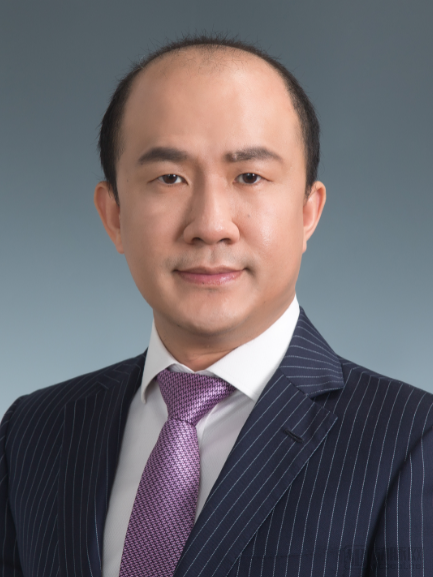
Introduction to Attorney Cai Hang: For over a decade, he has specialized in investment and financing services in the healthcare, TMT, and artificial intelligence sectors, wielding significant influence in China’s venture capital legal services landscape. *China Business Law Journal* named him one of the “Top 100 Legal Elite in China,” recognizing him as one of the country’s most outstanding commercial lawyers. He has also been repeatedly recommended by leading legal ranking agencies such as The Legal 500 and Legalband in the fields of TMT and venture capital. In addition to venture capital work, he is highly proficient in mergers and acquisitions and capital markets practices. Mr. Cai serves as the Managing Partner of AnJie Broader Law Firm’s Shanghai office.

Introduction to Lawyer Zhang Yin: She has represented renowned domestic and international funds in completing a substantial number of investment and M&A transactions, while also providing legal services for corporate clients’ financing and investment activities. The industries involved primarily include healthcare, biopharmaceuticals, artificial intelligence, entertainment and media, and tourism. In the field of big health compliance, Lawyer Zhang has assisted medical enterprises in deeply engaging with internet hospital compliance matters and has represented clients in completing acquisitions of multiple medical institutions and internet healthcare companies.