

SwipeSense Files IPO Prospectus to Advance IoT-Driven Healthcare Platform

SwipeSense
Software Developer
Hand hygiene is an umbrella term encompassing handwashing, hygienic hand antisepsis, and surgical hand antisepsis. It refers to measures taken to mitigate the risk of cross-infection among healthcare workers during clinical practice. In recent years, with technological advancements, IoT sensor-based hand hygiene management has gradually become a primary entry point for digital health enterprises in this domain. SwipeSense is a software developer that leverages Internet of Things (IoT) technology to help hospitals enhance their healthcare systems, aiming to improve patient outcomes and reduce care costs by lowering hospital management expenses.
On December 7, 2017, Chicago-based healthcare technology company SwipeSense announced that it had secured $10.6 million in Series B financing, led by Eclipse Ventures with participation from Sandbox Industries. The funds will be used to advance SwipeSense’s market-leading hand hygiene solutions and scale up product development for new applications, including Asset Tracking and Nursing Insights.
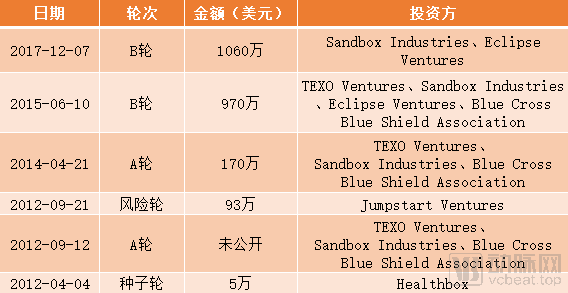
SwipeSense Funding History
SwipeSense, founded in 2012 and headquartered in Chicago, USA, is a software developer serving healthcare institutions. It aims to make healthcare systems secure, efficient, and predictable through location-aware technology, with the mission of improving patient outcomes and reducing care costs. To date, the company has secured approximately $23.3 million in total investment.
Mert Iseri, a Turkish designer and co-founder and CEO of SwipeSense, was born in Istanbul, Turkey. In 2008, he enrolled in the McCormick School of Engineering at Northwestern University to study entrepreneurial design. In spring 2011, driven by a passion for design and entrepreneurship, he co-founded “Design for America,” a nationwide initiative aimed at encouraging college students to engage in local social innovation. The program expanded to more than twenty top universities across the United States, mobilizing students to design products, services, and ventures to address various social and environmental challenges.
Yuri Malina, another co-founder of the “Design for America” initiative, is also the co-founder and Chief Product Officer of SwipeSense. He studied physics and mathematics in the Integrated Science Program (ISP) at Northwestern University from 2008 to 2011. A French-American designer and entrepreneur, he was named to the Forbes 30 Under 30 list in the Social Entrepreneurs category, and his work has been featured in The Wall Street Journal, Harvard Business Review, Fast Company, and the Chicago Tribune.

Co-founders Mert Iseri and Yuri Malina
(Image source: SwipeSense official website)
To further realize its product vision and support the industry’s growing demand for scalable, cost-effective IoT hospital platforms, the company recently appointed Michael Cruz as Vice President of Engineering, Katy De Leon as Vice President of Marketing, and Stephen Williamson as Vice President of Sales.
SwipeSense’s website features the statement, “We save lives by enabling hospitals to deliver the most efficient and safest care possible.” The company believes that exceptional healthcare professionals deserve exceptional tools to deliver higher-quality medical services.
Current hospitals face challenges that are difficult to manage directly, such as hospital-acquired infections and loss of medical equipment. These issues cause unnecessary harm to patients and healthcare workers and impose significant costs on the healthcare system. SwipeSense aims to eliminate these preventable medical errors. Its connected hospital platform is user-centric, creating a truly interconnected and collaborative data ecosystem for hospitals. By collecting millions of data points in real time, it provides robust evidence to support decision-making for hospital administrators and clinical staff.
SwipeSense’s IoT hospital platform serves as the foundational technological infrastructure for the company’s other products. By connecting to the system via a smart chip, it collects and organizes all core metrics required by users in real time. It supports the simultaneous operation of multiple applications, eliminating the need to log in to multiple systems repeatedly.
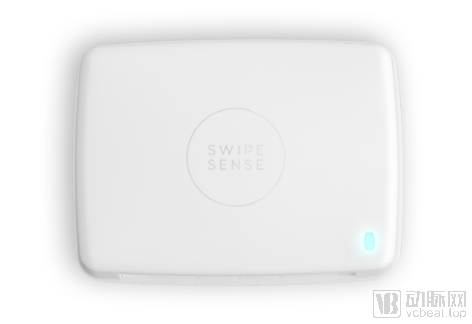
(Image source: SwipeSense official website)
In the United States, hospital-acquired infections are a leading cause of death, with up to 100,000 people dying each year from such infections.Hand hygiene compliance refers to the practice by healthcare workers of washing and disinfecting their hands in accordance with established protocols, representing one of the most critical patient safety measures in healthcare. The lack of reliable data on this issue significantly hinders hospitals’ ability to improve accountability and prevent the spread of infections.
The SwipeSense hand hygiene application enables devices to drive lasting behavioral change. Every hospital staff member is issued a smart chip, clipped to the back of their ID badge, with a battery life of up to two years. Meanwhile, both new and existing soap and sanitizer dispensers are equipped with corresponding receivers to capture individual usage data. Localization hubs are installed in each patient room or care area to continuously track healthcare workers’ access events. This ensures that every recorded hand hygiene event is accurately linked to the specific location where it occurred.
Hand hygiene data is transmitted from all devices to a communication hub located in centralized work areas, such as nursing stations. The data is then transmitted via the hospital’s existing Wi-Fi or Ethernet network to a secure server for analysis.
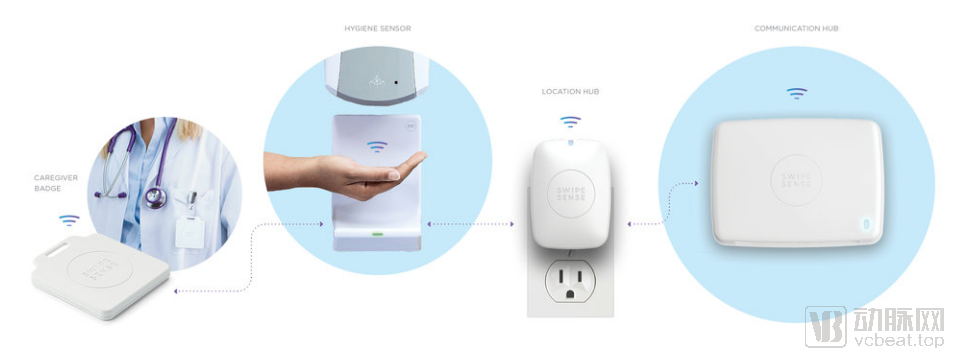
(Image source: SwipeSense official website)
Hand Hygiene does not disrupt clinicians’ workflows; it relies on proven behavior-change methods rather than short-term gimmicks such as alerts or reminders, thereby enabling widespread adoption in hospitals. Currently, SwipeSense has completed basic testing under ideal laboratory conditions and conducted clinical validation across dozens of scenarios to accurately reflect and improve hand hygiene compliance among all staff members.
On average, each hospital in the United States loses or has stolen medical equipment valued at over $1 million annually. These devices are critical to patient care and indispensable to the daily workflows of healthcare professionals.
Asset Tracking equips each medical device with a smart chip and utilizes a network of power-outlet-embedded location hubs to pinpoint these devices, rather than relying on hospital Wi-Fi infrastructure for localization, enabling clinical staff to immediately locate the storage position of the equipment they need.
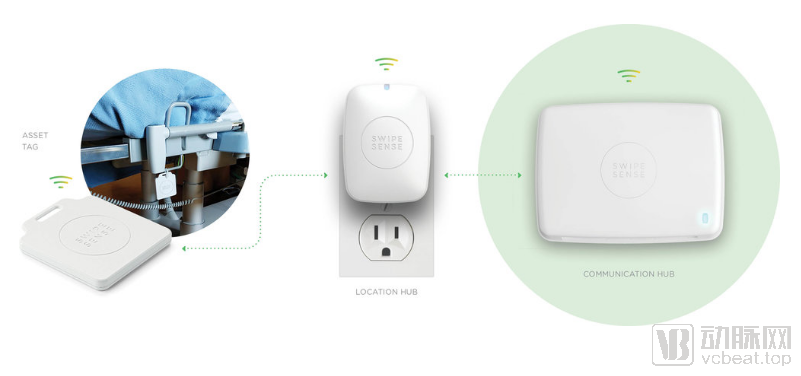
(Image source: SwipeSense official website)
Asset Tracking is priced one-third lower than other similar products on the market, helping hospitals with limited budgets or outdated IT infrastructure reduce unnecessary equipment purchases, improve asset utilization and staff productivity, and prevent the theft or loss of expensive medical devices.
Ward rounds and shift handover reports are the two most critical daily nursing tasks, essential for ensuring patient safety and clinical stability. However, with nearly 1 million patients hospitalized annually in U.S. hospitals, nine out of ten nurses admit to missing fundamental nursing care during each shift change, prompting hospitals across the nation to seek ways to enhance patient safety and experience.
By integrating the SwipeSense Connected Hospital Platform with smart badges worn by staff, the Nursing Insights application enables nurse managers to systematically collect and monitor hourly shift reports. This helps reduce preventable harms caused by delayed reporting of issues such as prolonged nurse absenteeism, sudden patient deterioration, or accidental falls, thereby optimizing the use of healthcare resources. Clinical practice has demonstrated that this product is a key driver in reducing adverse events and improving HCAHPS (Hospital Consumer Assessment of Healthcare Providers and Systems) scores.
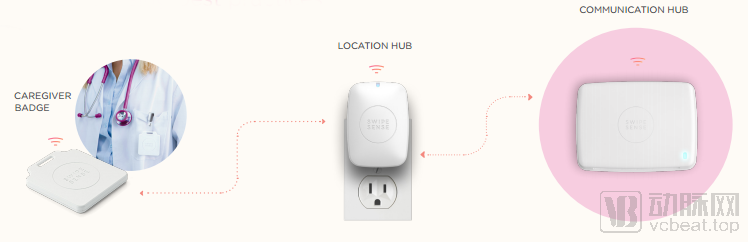
(Image source: SwipeSense official website)
Mert Iseri stated: “Today’s healthcare institutions lack reliable, data-driven information, leaving them unable to improve conditions that cannot be quantified.“SwipeSense empowers hospital administrators and healthcare professionals to monitor all core metrics on a single platform, enabling them to implement incremental changes, improve compliance, enhance patient health outcomes, and achieve significant cost savings.”
“Clinical monitoring is outdated and error-prone,” said Lior Susan, Founder and Partner at Eclipse Ventures. “By integrating devices, data, and analytics tools, SwipeSense is driving the development of the world’s first IoT hospital platform—a platform flexible enough to continuously deliver solutions based on cutting-edge technology.”