

JD Health Launches 'Healthy China Medicine Subsidy Program,' Offering RMB 1,000 Annual Medication Subsidy to All Nationally Registered Poor Households
Without universal health, there can be no comprehensive well-being. The year 2020 marked the final push toward China’s goal of building a moderately prosperous society in all respects, as well as the decisive stage in the nationwide campaign to alleviate poverty. In this context, health-focused poverty alleviation has served as a critical pathway for achieving targeted poverty reduction.
To effectively reduce the medication burden on impoverished populations, the China Social Poverty Alleviation Network, in collaboration with JD Health and JD Charity, jointly launched the “Healthy China • Pharmaceutical Subsidy Program” on May 9. This program will provide an annual pharmaceutical purchase subsidy of RMB 1,000 per person to registered poor households nationwide (including those who have been lifted out of poverty). The subsidy can be used when purchasing medicines listed in the designated catalog.
As of its launch, the project’s subsidized drug formulary included more than 350 medicines, covering hundreds of common and chronic conditions such as cardiovascular and cerebrovascular diseases, colds and fever, and gastrointestinal disorders. It is slated to rapidly expand in the future to include new specialty drugs and medications for rare diseases. The initiative is projected to reach over 30 million person-times within the next three to five years, effectively alleviating the pharmaceutical cost burden on impoverished populations and helping to curb poverty caused or exacerbated by illness. It is currently the health-focused poverty alleviation program in China with the broadest coverage, the largest number of beneficiaries, and the greatest amount of subsidy funding.
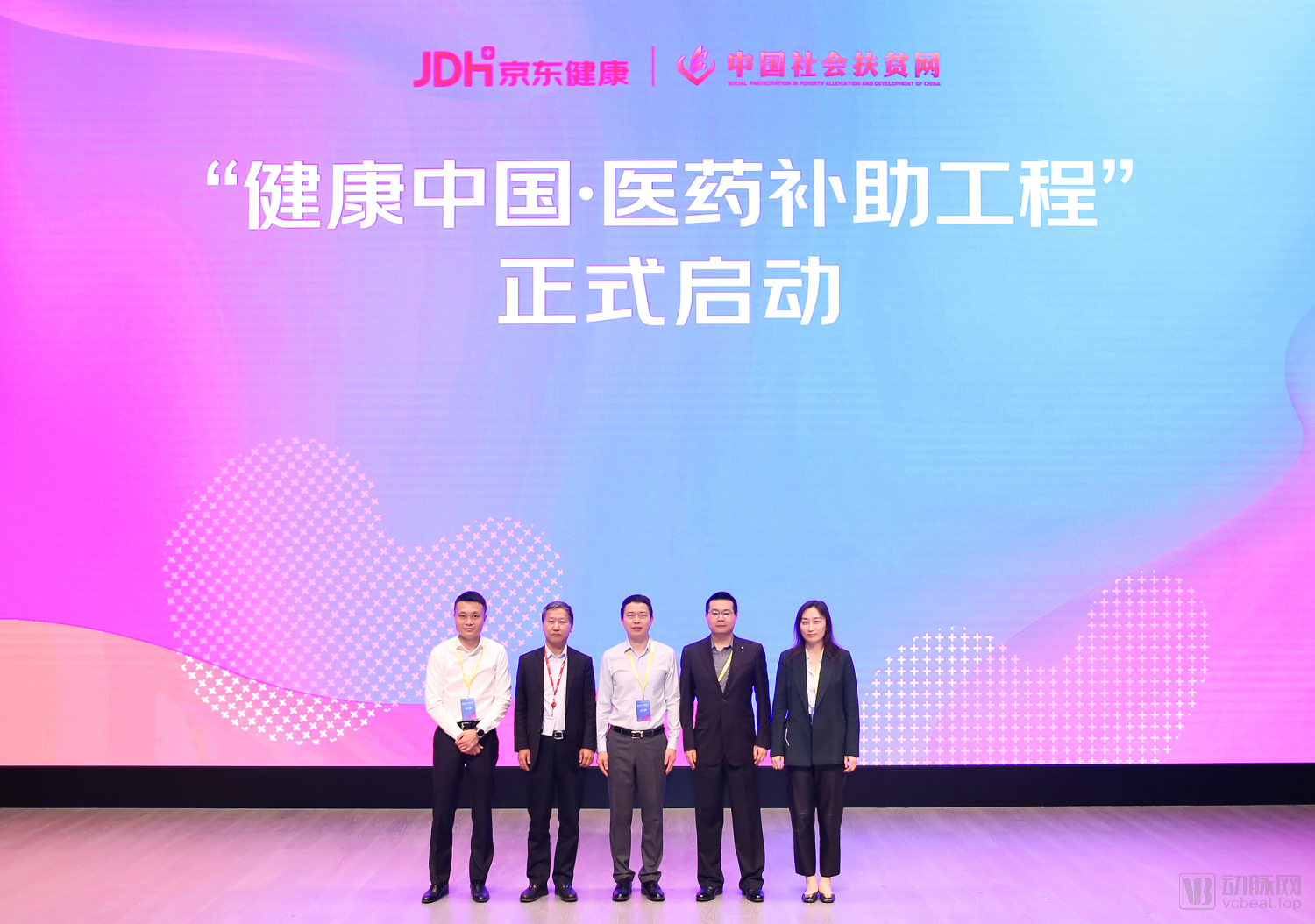
(“Healthy China • Pharmaceutical Subsidy Project” Launch Ceremony. From left to right: Jin Enlin, General Manager of the Pharmaceutical Division at JD Health; Long Baozheng, Vice President of JD Group; Xin Lijun, CEO of JD Health; Tian Chunyuan, Deputy General Manager of the China Social Poverty Alleviation Network; Zhang Jing, Director of the Public Welfare and Poverty Alleviation Department at the China Social Poverty Alleviation Network)
Benefiting from the national targeted poverty alleviation policy, China’s poverty incidence rate dropped significantly from 10.2% in 2012 to 0.6% by the end of 2019. In terms of health-focused poverty alleviation, by 2020, the number of major diseases covered under the special treatment program for the rural poor had increased to 30; the reimbursement rate for critical illness insurance was raised to 60%; and the reimbursement rate for hospitalization expenses among the rural poor reached 90%, substantially alleviating issues such as the high cost of medical care for impoverished households.
However, many outpatient medications and essential medicines are not covered by the medical insurance reimbursement schemes for the rural poor. Difficulty in accessing affordable medication remains a pressing issue for some impoverished populations. Data show that over 40% of China’s total impoverished population falls into poverty or returns to poverty due to illness. As impoverished individuals with labor capacity gradually escape poverty, this proportion is expected to rise. Achieving the goals of poverty alleviation on schedule and preventing people from falling back into poverty due to illness have become critical components in the decisive stage of the fight against poverty.
Under the guidance of the China Poverty Alleviation Volunteer Service Promotion Association and leveraging the China Social Poverty Alleviation Network, the “Healthy China • Pharmaceutical Subsidy Project” will precisely identify the identity information of impoverished individuals nationwide to determine eligible beneficiaries. JD Health will provide an annual pharmaceutical subsidy of RMB 1,000 per beneficiary, which can be used when purchasing medicines listed in the subsidy catalog through designated channels.
The designated online pharmacy channel for this project is JD Pharmacy, the self-operated retail pharmacy under JD Health. Medications purchased by users will be delivered by JD Logistics, with coverage extending to most regions across China. Offline designated partner pharmacies will be approved and selected by JD Health based on relevant criteria, with a principle of one pharmacy per township. The project will prioritize launching subsidies on the online platform, while the offline component will adopt a model of initial pilot programs in select regions, followed by gradual nationwide rollout.
JD Health has currently partnered with the first batch of 11 pharmaceutical companies, including Hangzhou Minsheng Health Pharmaceutical, Tasly Pharmaceutical Group, Suzhong Pharmaceutical Group, Enwei Pharmaceutical, Kuihua Pharmaceutical Group, Lunan Pharmaceutical Group, Shanghai Zhonghua Pharmaceutical, Yunnan Baiyao Group, Yangtze River Pharmaceutical Group, Xian Janssen Pharmaceutical, and Yabao Pharmaceutical Group. Over 350 drugs have been selected, with subsidy rates determined; the maximum subsidy rate for a single product reaches 68%. The list of participating pharmaceutical companies and subsidized drugs will continue to expand as the project rolls out.