

Vida Health Files for IPO: A Pioneer in Digital Chronic Care Management

Vida
Virtual Care Service Provider
Whenever diabetes management is discussed, terms such as “a market worth hundreds of billions” and “business models that are difficult to sustain” inevitably come up. According to VCBeat, companies in the diabetes management sector are currently exploring new business models in search of innovative operational frameworks and revenue streams.
Can the diabetes management industry break through its current impasse? To assist domestic diabetes management enterprises, VCBeat has researched and analyzed the development path, revenue sources, and consumer-facing strategies of the U.S. company Vida Health, hoping to offer insights for entrepreneurs in China’s diabetes management sector.
In this article, you will learn:
1. What are the key features of Vida's solution?
2. How have Vida's revenue sources changed?
3. How does Vida attract C-end users to pay?
Vida was founded in 2014 with the initial aim of managing diabetes, later expanding its scope to cover the management of most chronic diseases. The company’s founder, Stephanie Tilenius, made outstanding contributions to payment operations for companies such as Google and eBay. Previously, she co-founded the online pharmacy PlanetRX and helped take it public in 1999.
Regarding the original intention behind founding Vida, Stephanie Tilenius once stated: “First, the cost of treating chronic diseases is high, accounting for a significant proportion of all healthcare expenditures. Managing chronic diseases can reduce costs for payers, employers, and patients, achieving a win-win outcome. Second, while chronic diseases cannot be cured, they can be prevented through proactive daily management. Third, lifestyle is crucial for patients with chronic conditions, which is where digital therapeutics come into play.”
The founding of Vida in 2014 was perfectly timed. At that time, consumer healthcare was rapidly developing, mobile devices were becoming increasingly ubiquitous, and tech companies such as Google and Apple launched smartwatches capable of monitoring users’ vital signs, sparking the rise of wearable devices. With industry giants like Apple and Google entering the medical sector to explore healthcare solutions, greater attention was drawn to the field, particularly to chronic disease management for conditions such as diabetes, thereby reducing the cost of market education.
Additionally, according to a report by Rock Health, funding in the digital health sector reached $2.3 billion in the first half of 2014, surpassing the total funding for the entire year of 2013. Riding this wave of investment, Vida completed a $5 million Series A financing round on October 28, 2014, with investors including venture capital firms such as Khosla Ventures, Aspect Ventures, and Signia Venture Partners, as well as Yahoo co-founder Jerry Yang.
Vida initially offered consumers a mobile app, one-on-one coaching from its team of health coaches, various clinically reviewed personalized medical services (database), and remote care software.
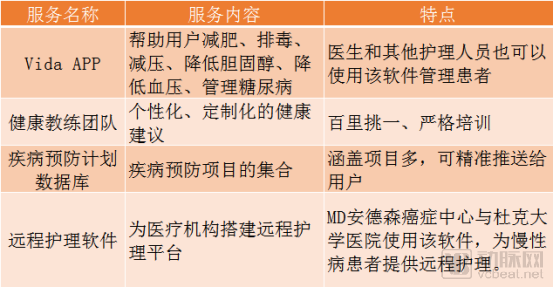
(Solutions Provided by Vida in 2014)
2014 Edition of the Vida APP
The mobile app is primarily designed to connect users with health coaches. The software extracts patients’ vital signs data from a variety of wearable devices and mobile medical equipment. Meanwhile, Vida stores the acquired data in the cloud and shares it with hospitals and physicians.
Users can contact health coaches at any time (24/7) via phone, text message, and video. Vida states that health coaches will respond to users within one minute. The “24/7 service” signifies real-time availability, while responding within one minute demonstrates timeliness. Promptly addressing users’ health needs and providing quick, professional answers to their inquiries helps enhance user satisfaction.
Additionally, the software enables users to communicate with various supporters, such as friends, family members, physicians, coaches, and fellow patients within the community. The creation of this “community” helps enhance user stickiness and can even drive new user acquisition for the platform.
Health Coaching Team
Vida’s health coaching team comprises nurses, medical assistants, dietitians, and physicians, primarily providing users with personalized health advice. Meanwhile, Vida collaborates with clinical care teams to ensure patients receive accurate, professional, and effective health guidance.
When users utilize the Vida software, Vida periodically collects and analyzes their vital signs data, then provides feedback on their health status. When signs of illness are detected, Vida prompts users to seek care at professional medical institutions. In this way, as a supplement to medical services, Vida delivers health services without competing with healthcare providers; instead, it can collaborate with them to expand its user base. Meanwhile, comprehensive services can also improve user retention rates.
Disease Prevention Plan Database
Vida’s disease prevention plan database, developed for users, enables rapid and precise selection of medical services. It also serves as a user acquisition channel for Vida, increasing the likelihood that users will choose its platform. Furthermore, once the user base reaches a critical mass, this product can even become a revenue stream.
Remote Care Software
Vida’s remote care software, provided to healthcare institutions, is currently still in use at MD Anderson Cancer Center and Duke University Hospital. In the early stages of a startup, stable business operations can ensure corporate “survival.” Meanwhile, partnerships with renowned medical institutions can facilitate brand promotion and foster trust among general users.
The same applies to collaborations with renowned medical enterprises. Thus, Vida partnered with AstraZeneca to launch the cardiac rehabilitation support software Day-By-Day in 2015, with health services provided by Vida. This strategy enabled Vida to generate revenue while enhancing its brand awareness, achieving a win-win outcome.
Vida App 2016 Edition
On December 8, 2016, Vida completed an $18 million Series B financing round, led by Canvas Ventures, with participation from Nokia Growth Partners (NGP) and existing investor Aspect Ventures.
Following this round of financing, Vida has expanded its scope of chronic disease management from the original focus on weight loss, detoxification, stress reduction, cholesterol, hypertension, and diabetes to include anxiety, asthma, chronic obstructive pulmonary disease (COPD), depression, prediabetes, hypertension, hyperlipidemia, and diabetes.
Reasons for Expanding the Scope of Chronic ConditionsThere are three primary reasons for expanding the scope of chronic conditions: First, Vida aims to broaden its user base and increase revenue. Second, the impact of personnel changes. After completing the financing round, a partner from Canvas Ventures joined Vida’s Board of Directors, tasked with optimizing products and expanding into the enterprise market.
Third, Vida was established based on experience in managing chronic diseases. Its founders have stated in publications: “Patients with diabetes are twice as likely to suffer from depression as the general population, and individuals with depression are also at a higher risk of developing type 2 diabetes. Patients with diabetes may also present with hypertension or other complications; therefore, the management of diabetes requires complex and specialized expertise.”
2018 Edition of the Vida APP
In 2018, Vida made significant changes to its software, offering two solutions for diabetes while retaining management services for hypertension, depression, and other conditions.
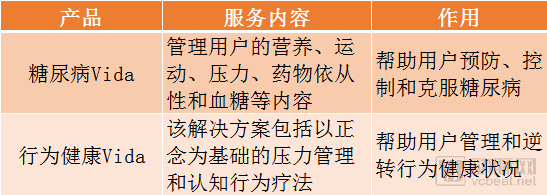
(2018, Vida's Upgraded Diabetes Solution)
Meanwhile, Vida has also upgraded its user services: previously limited to collecting vital sign data already available on users’ smartphones, the platform now supports integration with external devices such as smart scales, blood glucose meters, and blood pressure monitors. Upon subscribing to the software, Vida will ship the hardware devices directly to users.
Previously, users were required to manually enter or import relevant data, resulting in a poor user experience and hindering long-term sustainability. Following the upgrade, users can complete data entry with a single-click import, while also obtaining more accurate data. This not only enhances the product’s user experience but also improves patient adherence. Additionally, the price of Vida’s upgraded service remains unchanged, suggesting that it does not generate profit from device marketing (sales).
Vida has made significant changes to its original solution, considering the following reasons:
1. Impact of Personnel Changes. On December 12, 2017, Raymond Lee, former Vice President of Product and Design at Proteus Health, joined Vida as Vice President of Product. Upon assuming his role, Raymond Lee stated, “Integrating health behaviors into the model facilitates promotion to enterprise clients.”
2. Based on experience in diabetes management, there is a large population of patients with comorbidities (e.g., diabetes co-occurring with depression). Relying on a single diabetes management approach fails to meet patient needs, places an additional burden on health coaches, and results in high costs with low profit margins. However, effective management of these high-cost comorbid patients can significantly reduce expenses for payers, thereby unlocking market opportunities in both the enterprise and insurance sectors.
3. Vida has delved into deep learning technologies, aiming to apply them to diabetes management to enhance user experience and reduce the workload of health coaches.
4. Mindfulness-based therapy gained popularity in 2017. In early 2018, the American Association of Clinical Endocrinologists (AACE) and the American Endocrine Society released new diabetes management guidelines. The updated guidelines incorporated mindfulness-based therapy and other novel management strategies, which not only appeal to individuals interested in mindfulness interventions but also strengthen trust among patients with diabetes in Vida.
On June 18, 2019, Vida announced the appointment of Chris Mosunic as Vice President of Behavioral Health. Previously, Mr. Mosunic served as the Director of Behavioral Health at Yale New Haven Hospital, where he was responsible for addressing addiction and managing patients with chronic diseases through behavioral health interventions. This suggests that Vida will focus on the field of comorbidities, with its subsequent software offerings being better tailored to patients with comorbid conditions.
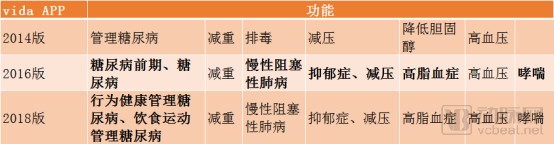
(Note: Bold text indicates newly added or optimized content.)
In summary, Vida’s optimization of its solutions follows a clear trajectory. The first optimization standardized and normalized the original service offerings according to user needs, while also expanding the scope of services, thereby enabling users to quickly and accurately locate the services they require. Meanwhile, Vida further segmented its diabetes management services and upgraded its care management capabilities.
Second Optimization: Diabetes is managed through two effective approaches. The second approach is currently gaining popularity, which helps attract new users. Implementing both management methods allows for comparative analysis, facilitating scientific research and future service upgrades.
According to Vida’s publicly released press release, we can see that: Prior to its Series B financing round, Vida’s payers were software users and healthcare institutions. After the Series B financing round, enterprises were added as payers, and the number of healthcare institution clients also increased.
At the time of completing its Series B financing on December 8, 2016, Vida stated: Since launching its software in October 2014, Vida has served over 30,000 users and accumulated more than 7 million data points. Given that the pricing was $45 per user per month from November 2014 to December 2016, Vida’s total revenue is estimated at $33.75 million (excluding its remote care software business).
Based on 30,000 users, 25 months, and 7 million data points, the frequency of interactions between Vida users and health coaches can be estimated at an average of 10 times per user per month. Although this interaction frequency is relatively low, it is ideal for Vida’s health coaching model. Meanwhile, Vida reports a user satisfaction score of 9.8 out of 10, indicating that users do not have a strong demand for “one-on-one coaching”; instead, they place greater emphasis on the timeliness of health coach responses and the availability of software assistance when needed. (Note: The satisfaction data is self-reported by Vida and does not utilize standardized metrics, so it may be disregarded.)
During its Series B funding round, Vida also presented its B2B market status: it has established partnerships with companies such as Steelcase, eBay, and FICO, providing services under a model where employers pay for the service as an employee benefit. Meanwhile, Vida also provides services to healthcare institutions such as UnitedHealthcare and Stanford Medicine.
VCBeat compiled statistics on Vida’s new customer acquisitions based on the press releases it has issued over the years:
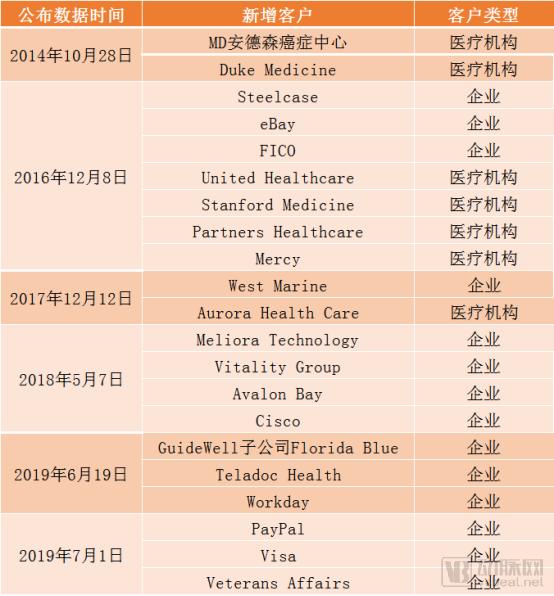
(Vida customers, statistics compiled by VCBeat based on its public disclosures)
As shown in the figure above, Vida acquired three corporate clients and four medical institutions as new customers in 2016, whereas all new customers added in 2018 and 2019 were corporations.
Among these, the new clients added in 2018 were a result of Vida’s strategic initiatives in 2017. In early 2017, Vida expanded its software capabilities to cover a broader range of chronic disease management, facilitating corporate clients in selecting appropriate services for their employees. Meanwhile, Vida invited a partner from Canvas Ventures and the CFO of Livongo, a chronic disease management service provider, to join the company to lead the expansion into the corporate market.
In April 2018, Vida made another strategic move by appointing Randy Forman, formerly Vice President of Sales and Director of Strategy at Livongo, as its Chief Business Officer. In this role, he was responsible for promoting enterprise-side business, sales operations, and partnership management (including cooperative channels and platforms). According to available information, Randy Forman had previously collaborated extensively with payers across the United States, including large enterprises, healthcare institutions, pharmacy benefit managers (PBMs), and health plans.
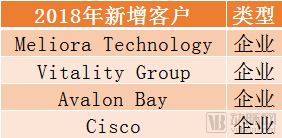
(Vida's New Customers Added in 2018)
Perhaps it was precisely due to the addition of several top sales executives that Vida acquired new clients in 2018, including Meliora Technology (partnership), Vitality Group (partnership), Avalon Bay, and Cisco.
Vida founder Stephanie Tilenius stated in a 2018 post, “At this stage, government willingness to pay is low. We are engaging with healthcare providers, enterprises, and insurance companies as payers to test different revenue streams. Additionally, we have observed rapid growth in consumer-driven healthcare, with an increasing number of consumers willing to pay for health services.” (This suggests that Vida has achieved strong development in the consumer market.)
In January 2019, Veeneta Lakhani, former Vice President of the health benefits company Anthem, joined Vida as Senior Vice President of Health Services. She was tasked with overseeing Vida’s employer-paid plans, healthcare provider partnerships, and pharmacy benefit management (PBM) operations. Additionally, high expectations were placed on her to integrate the Vida platform into healthcare system services.
In 2019, six new clients were added, a achievement to which Veeneta Lakhani undoubtedly contributed significantly. The reason is straightforward: Veeneta Lakhani was responsible for integrating Vida into healthcare system services, and among the newly acquired clients, one entered into a strategic partnership with Vida, incorporating its platform into their healthcare system.
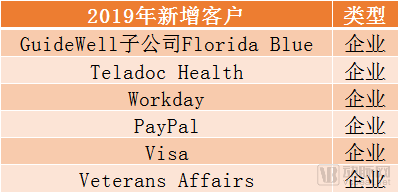
(New Vida customers added in 2019)
On June 18, 2019, Vida completed a $30 million Series C financing round, with investors including healthcare enterprise GuideWell Mutual Holding Corporation, telehealth giant Teladoc Health, and enterprise cloud software company Workday. Vida plans to use the funds for sales, marketing, recruiting coaches, and expanding its service network.
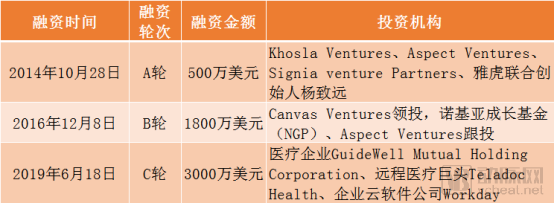
(Vida’s funding history, compiled by VCBeat based on public information)
In its press release, Vida announced that all investors in this round have entered into strategic partnerships with the company. Among them, Florida Blue, a health insurer under GuideWell, will become a Vida client, with Vida providing services to 100,000 of its members, particularly those with comorbidities (reflecting the impact of Vida’s 2018 software upgrade, which placed greater emphasis on patients with comorbid conditions). Workday has also become a Vida client, purchasing Vida’s solutions to help employees perform better at work, and will offer these solutions to its own customers as well.
As for Teladoc Health, it has partnered with Vida to offer customers bundled solutions that include a care platform and chronic disease management products. Meanwhile, physicians under Teladoc Health will recommend the Vida software to patients, thereby expanding Vida’s user base.
According to the press release, Vida carefully selected strategic partners as shareholders in this round of financing. The alignment of interests among shareholders, partners, and the company itself will undoubtedly facilitate Vida’s promotion.
In a press release, the founder of Vida stated: “Vida is seeking strategic partners who can add value to the company, drive business growth, enhance Vida’s healthcare expertise, and expand its services to more patients with chronic conditions.”
Thus, it is evident that Vida’s strategy is to partner with more enterprises and expand its managed user base, thereby driving revenue growth. Meanwhile, the emphasis on “enhancing healthcare expertise” underscores its commitment to delivering high-quality services. In fact, only high-quality services can foster high customer satisfaction and, in turn, attract a larger client base.
Vida’s publicly disclosed data does not include specific consumer-user metrics; therefore, VCBeat has inferred Vida’s consumer-facing strategy based on the information it has released.
To monetize consumer-end (C-end) users, two issues must first be addressed: First, acquire a sufficient number of C-end users. Second, retain these acquired users and convert them into paying customers.
Regarding the first point, Vida has established multiple user acquisition channels: brand promotion, disease prevention program databases, partnered medical institutions, user community management, corporate partners, clients of strategic partners, and portfolio companies of its investors. For example, Vida offers its software and services free of charge for the first month to attract more users.
Meanwhile, Vida has conducted extensive brand promotion across various media outlets to attract users. According to Vida’s press releases, its promotional efforts focus on highlighting the company’s services and their efficacy, while also showcasing its clients, such as MD Anderson Cancer Center, Duke University Hospital, eBay, and Cisco (all renowned medical institutions or corporations).
Regarding the second point, Vida builds trust with end-users by focusing on pricing (cost savings), brand communication, clinical outcomes, and high-quality service, thereby converting them into paying customers.
For instance, the cost of a diabetic patient’s consultation with a physician is $150 per hour, and 24/7 service would certainly be more expensive. In contrast, Vida offers services that meet user needs at a price of $45 per month. Compared with traditional medical services and pricing, Vida’s pricing strategy can attract numerous consumer-end users.
However, low pricing alone does not drive user payments; users also need to see that the services provided by Vida are genuinely effective. Therefore, Vida has collaborated with medical institutions and renowned healthcare companies, repeatedly presented trial data at major scientific conferences, and proactively engaged in brand promotion to demonstrate the value and efficacy of its services. Moreover, Vida publishes its management outcomes on its official website to enhance user confidence in the platform.
A crucial factor is that Vida provides rigorous training for its health coaches, ensuring high-quality and effective services. For instance, after Cisco became a client, Vida identified that many of its employees were of Indian origin and subsequently designed low-calorie Indian meal plans for them.
Vida has developed a comprehensive strategy to acquire users and earn their trust. As users undergo this integrated approach, the number of paying subscribers continues to grow.
In addition, Vida has skillfully leveraged relevant talent to make significant inroads into corporate and insurance markets, yielding substantial returns. (This success is also attributable to its well-prepared “combination strategy.”) The participation of an increasing number of renowned enterprises has broadened Vida’s brand reach and facilitated user acquisition. Meanwhile, selecting appropriate strategic investors has accelerated Vida’s growth; these investors have brought not only capital but also expanded customer bases, optimized services, and additional talent.
Finally, patient adherence remains a persistent challenge for healthcare managers. To address this, Vida provides personalized, high-quality services to enhance product efficacy and thereby improve user satisfaction. Additionally, Vida compares users’ baseline data with post-intervention data to bolster their confidence in diabetes management and increase adherence.
Vida’s success in the enterprise sector is closely tied to the U.S. health insurance system, making it difficult to replicate in China. However, its consumer-facing strategies and entrepreneurial journey can offer valuable insights for entrepreneurs in China.
First, Vida’s services are high-quality and effective. Patients will only pay for services that deliver results. Although the benefits may take some time to manifest, users will personally experience tangible outcomes such as improved overall health, reduced blood glucose levels, weight loss, and decreased stress.
Second, patients must be informed about what constitutes effectiveness. Since users often lack the knowledge to evaluate the efficacy of disease management, companies need to establish clear assessment criteria for them—for example, a 5% reduction in body weight or a 3% decrease in blood pressure.
Third, patients should be made aware that these outcomes are attributable to the company’s management practices. This point should be integrated with the second point and supported by extensive brand promotion efforts, such as publishing clinical trial data and comparative analyses, which can also strengthen user confidence in the enterprise.
Fourth, pricing should be reasonable, and the frequency of interactions should be limited. The services provided by the company must be of high quality, yet priced lower than offline alternatives. This requires the company to continuously optimize its software, enabling users to engage in self-directed learning and self-management, thereby reducing their interactions with health coaches and allowing each coach to serve a larger number of users.
Fifth, collaborate with universities, research institutions, medical facilities, and renowned healthcare enterprises to conduct scientific research, publish trial data, and promote the brand. Partnering with prestigious entities enhances brand visibility and helps bolster user confidence in the company. The same applies to the publication of trial data.
Sixth, select appropriate strategic investors and invite talented professionals to join. While suitable investment firms are hard to find and require one’s best efforts, recruiting the right talent allows for proactive outreach. Vida has repeatedly recruited top talent from Livongo, a chronic disease management service provider, yielding enviable returns.
Differences in Payers Determine Differences in Business Models. In the field of chronic disease management, directly copying foreign models will not succeed in China, but their successful experiences can serve as valuable references. VCBeat has analyzed the characteristics of Vida’s solutions and its consumer-facing strategies, hoping to provide some insights for entrepreneurs in China.
We hope that the business models explored by domestic entrepreneurs will take root and flourish in China at an early stage.