

Hesith Health Files IPO Prospectus: A B2B-Focused Chronic Disease Management Platform That Achieved Profitability Within One Year of Launch
Chronic diseases, characterized by high treatment costs and significant health benefits from intervention, have garnered substantial attention within China’s current healthcare landscape.
On one hand, China has a large population of patients with chronic diseases; diabetic and hypertensive patients alone account for 23% of the total population. On the other hand, chronic diseases are characterized by long disease courses, high incidence rates, and prolonged medication regimens, resulting in substantial medical costs. In 2016, expenditures on chronic diseases accounted for 70% of China’s total health expenditure.
In addition, the government has frequently issued relevant policies, demonstrating its emphasis on chronic disease management. In 2019, the State Council introduced the "Policy on Reimbursement of Outpatient Medications for Hypertension and Diabetes under the Basic Medical Insurance for Urban and Rural Residents," which included outpatient medications for over 300 million patients with hypertension and/or diabetes in the medical insurance coverage, with a reimbursement rate exceeding 50%.
In 2016, China’s expenditure on chronic disease management reached nearly RMB 320 billion. According to forecasts by Qianzhan Industry Research Institute, the market size was projected to reach RMB 550 billion by 2020. It has become widely recognized that this sector offers substantial commercial opportunities and growth potential, prompting numerous companies to eagerly position themselves to capture a share of the chronic disease management market.
The Hesit team, which was still responsible for Huawei’s smart healthcare projects, also noticed this industry trend. Although the market was right ahead, they did not immediately take action. This was because they identified a critical issue: the business model for chronic disease management was unclear, and blind entry would not secure a first-mover advantage.
Who Pays for Chronic Disease Management? The VCBeat team conducted an analysis from the following three perspectives:
Patients' willingness to pay is not high.Chronic diseases have a long latency period, and public awareness remains low. For healthy individuals, chronic disease management services are perceived as "non-essential," as they cannot tangibly appreciate the importance of such products, resulting in limited demand for purchase.
Few insurance companies are involved in chronic disease management, and the payment scale is limited.Insurance for individuals with pre-existing conditions in China is still at a very nascent stage, from product design to sales channels.
Low Trust in Third-Party Providers of Chronic Disease Management Services Among Patients Hinders Business DevelopmentCompared with the stable and favorable reputation of hospitals, third-party service providers are still a nascent entity. Coupled with the varying quality of market participants, they will require more time and greater industry self-discipline to earn broader recognition from patients and the market.
“Chronic disease management must ultimately return to hospitals; a B2B operational model is better suited to our own development.” Having identified their market entry strategy, the Hesun founding team turned down lucrative salaries and attractive benefits at Huawei, rallied a group of like-minded partners, and embarked on their entrepreneurial journey.
In 2019, Shanghai Hesi Health Technology Co., Ltd. (hereinafter referred to as “Hesi Health”), a company dedicated to building a chronic disease health management platform, was officially registered and established, and completed an angel round of financing amounting to several million yuan within a short period of time.
Founder Ouyang Mingguang holds a Ph.D. in Computer Science from Shanghai Jiao Tong University. He has served as the Technical Lead for Huawei’s 3G Wireless Product Line and as the Head of Product Design for Huawei’s Smart City Solutions, among other roles. With 11 years of leadership experience in product design at Huawei and extensive expertise in medical big data product design, he spearheaded the design of Huawei’s smart city and smart healthcare products, which have generated over RMB 20 billion in sales revenue.
Hesi Medical’s core team has a strong Huawei heritage. Of the five-member core team, four have more than ten years of work experience at Huawei. Internally, the team is primarily divided into three functions: R&D, marketing, and supply chain. In terms of external collaborations, Hesi Health has partnered with internationally renowned medical device manufacturers and authoritative institutions such as Bayer, ACON Laboratories, and the Guangzhou Institute of Biomedicine and Health, thereby strengthening its professional capabilities in the healthcare sector.
Although Hesi Health was officially registered and established in 2019, its origins date back to 2017.
In 2017, Hes Health completed the development of its first product, the DMS Integrated Diabetes Management System for In-hospital and Out-of-hospital Care, and successfully deployed it on a trial commercial basis in over 100 hospitals within that year. In 2018, as the DMS product was undergoing trial commercialization and its hospital deployments surpassed 200, Hes Health completed the development of its second product—the HMS Smart Hypertension Management Center Platform.
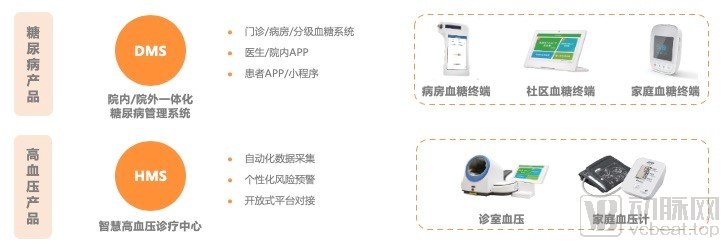
Hesi Health Product Line (Image from the company)
In terms of system functionality, both systems adopt an integrated hardware-software approach that connects patients with physicians, forming the foundation for a big data-driven intelligent chronic disease management system.
Currently, Hesing Health is developing a new product, AI-CDMS, which leverages machine learning and artificial intelligence to enable drug efficacy assessment, clinical medication support, and personalized follow-up plans. The system has already been piloted at Shandong Provincial Hospital and in more than 20 communities.
“Never fight a battle unprepared.” From day one of its founding, the Hesi team has been contemplating how to enable the company to “move fast” and “go far.” After in-depth market research, Hesi Health established a three-step development strategy:
1, Collaborate with pharmaceutical companies and medical device manufacturers to rapidly enter secondary and tertiary hospitals.
In 2018, the National Health Commission issued the Standards and Specifications for Hospital Information Construction in China (Trial), mandating that two-thirds of hospitals nationwide implement and upgrade information systems for blood glucose management. To rapidly provide hospitals with blood glucose monitoring and data analysis tools, HesHealth partnered with medical device manufacturers, generating revenue through SaaS software services and swiftly penetrating the secondary and tertiary healthcare systems.
Currently, Hesin Health has established partnerships with renowned multinational corporations such as Bayer, Acon, Terumo, Roche, and Essens. Its DMS product has covered 21 provinces and municipalities across China, been deployed in over 300 hospitals, and served more than 600,000 patients. The company aims to expand its reach to over 5,000 hospitals within the next three to five years.
2. Collaborate with primary care and community medical institutions to provide intelligent clinical decision support systems for medication, intelligent hypertension management systems, and other solutions.
For HMS market expansion, Hesi Health chose to start with primary care and community hospitals. The low awareness rate of hypertension among the general public determines their healthcare-seeking behavior, making primary care hospitals the first choice for hypertensive patients.
Hesi Health collaborates with hospitals to centrally collect and manage patient blood pressure monitoring data, providing customized management solutions for patients with hypertension. The HMS product has now been deployed in 85 hospitals (including community health centers) across 11 provinces, serving a total of 650,000 patients and encompassing 1.2 million blood pressure records, thereby maintaining a leading position in the industry.
3. By providing digital transformation services to hospitals, medical device manufacturers, and insurance companies, we ultimately reach end-users (C-side) to build a comprehensive chronic disease management platform.
With a clear business model, Hes Health, a latecomer in chronic disease management, has embarked on a stable development path. In 2019, Hes Health achieved revenues of RMB 12 million and began to turn a profit.
In 2020, Hesi Health will strive to obtain the Class R medical device license for its big data-based intelligent chronic disease management system, and plans to expand its market coverage to 800–1,000 institutions, reaching as many community hospitals as possible to provide intelligent services for primary-care patients with chronic diseases.
Furthermore, Hes Health is undertaking a new round of financing to strengthen research on AI-driven chronic disease pathways for facial recognition-enabled smart blood pressure kiosks, and to expand market reach for its Smart Hypertension Diagnosis and Treatment Center and Diabetes Management System.