

Subtle Medical Files IPO Prospectus Highlighting AI-Driven Medical Imaging Breakthroughs Inspired by 2019 Eric Topol–Andrew Ng Dialogue on Healthcare Transformation
Article Author: Deepwise Medical
We are living in an era of data explosion, particularly for the medical field, which is increasingly moving toward precision medicine. The massive volume of data makes the development of AI more necessary now than ever before.
Recently, at an online seminar hosted by deeplearning.ai, Dr. Eric Topol, a molecular medicine expert and founder of the Scripps Research Institute, an independent scientific research organization in North America, engaged in an in-depth dialogue with AI expert Dr. Andrew Ng, presenting to the audience the latest research findings and clinical applications in the field of AI-driven medicine.
Dr. Eric Topol, named “Physician of the Century” by Thomson Reuters, is a member of the National Academy of Medicine. He has published more than 1,100 highly cited articles, ranking among the top ten most-cited authors in the medical and pharmaceutical fields. He has authored over 30 medical textbooks and is the author of the bestseller *The Patient Will See You Now: The Future of Medicine Is in Your Hands* (Chinese title: *Disrupting Healthcare*).
Andrew Ng is one of the most authoritative scholars in the field of artificial intelligence, hailed as the “AI Master.” He is the founder of deeplearning.ai and a co-founder of the online education platform Coursera.
In the first part of this article, we will follow the dialogue between Dr. Eric Topol and Dr. Andrew Ng to review the latest advancements in AI within the healthcare sector over the past year, including NYU’s research on breast cancer screening, Subtle Medical’s medical imaging products, and intriguing applications such as smartphone-based ultrasound detectors and the smart toilet developed by Stanford University. In the second part, we will delve deeper into the challenges encountered in the clinical implementation of AI in healthcare and examine what types of AI applications are truly needed at present.
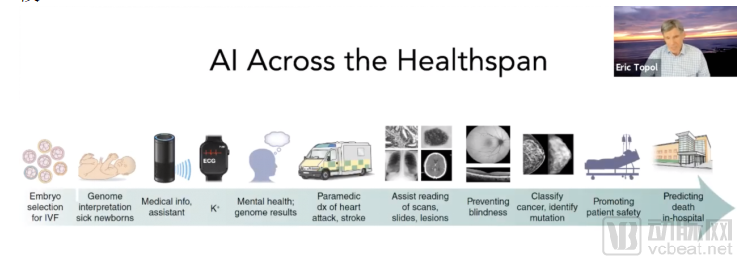
Why Does Our Medicine Need the New Path of AI? Current medical technologies still suffer from numerous issues, such as low accuracy in diagnostic tests, frequent missed diagnoses and misdiagnoses, high costs of testing and treatment, and significant waste of resources. Dr. Topol believes that AI has the potential to effectively address these problems, and that all of humanity can benefit from the development of AI in healthcare, with these benefits spanning every stage of life from birth to death.
Improve Accuracy
Google’s team once conducted an experiment in which ophthalmologists were shown an image of a retina and asked to determine whether it belonged to a male or a female. The ophthalmologists’ accuracy rate was 50%, whereas a trained AI neural network achieved an accuracy rate of 97% to 98%.
This example aims to illustrate that a major role of AI is to enhance diagnostic accuracy. Through deep learning, the accuracy of AI-based diagnoses can reach expert levels, or even far surpass them. Of course, this is merely a simplistic illustration; in reality, there are countless more effective methods for determining the sex of the individual to whom an organ belongs.
The severe consequences of low accuracy are misdiagnosis and missed diagnosis, which are relatively common in clinical practice. Taking breast cancer screening as an example, although breast cancer is one of the leading causes of cancer-related deaths among women worldwide, mammograms still suffer from a high rate of false negatives and false positives.
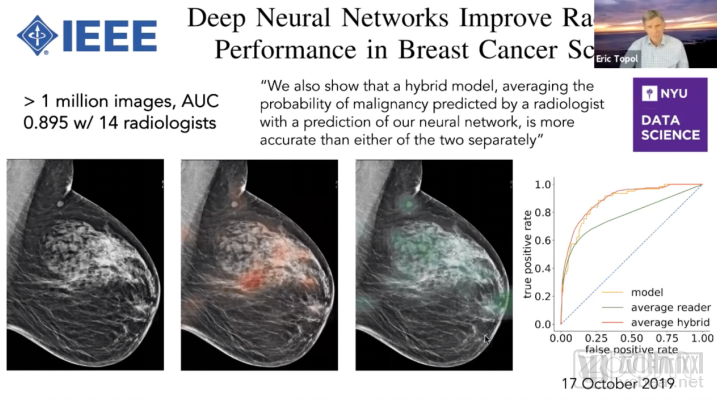
In October 2019, New York University published a paper in which researchers used deep convolutional neural networks to classify, train, and evaluate breast cancer screening on over one million images, marking the largest-scale breast cancer study to date. The study demonstrated that the neural network achieved expert-level performance in predicting the presence of cancer in the breast (AUC = 0.895). The researchers also compared their results with interpretations from 14 radiologists, each of whom reviewed 720 mammograms. The findings proved that the accuracy of AI judgments was comparable to that of the radiologists. Furthermore, a hybrid algorithm that averaged the predicted probability of malignancy from the radiologists with that of the neural network yielded even more accurate predictions. This study is highly valuable because hundreds of millions of women undergo breast screening annually, yet they often receive incorrect results.
Improve Detection Efficiency
Beyond accuracy, another major application of AI in real-world healthcare is improving efficiency. For instance, AI enables faster scanning and detection in medical imaging while achieving higher image quality in less time. Such applications deliver tangible value to hospitals, physicians, and patients alike.
Dr. Eric Topol cited Subtle Medical’s products during his live stream. Founded in 2017, the company is dedicated to leveraging AI to enhance medical imaging quality, streamline examination workflows, improve patient experience in radiology departments, and reduce contrast agent dosage during scans, thereby minimizing potential health risks to patients.
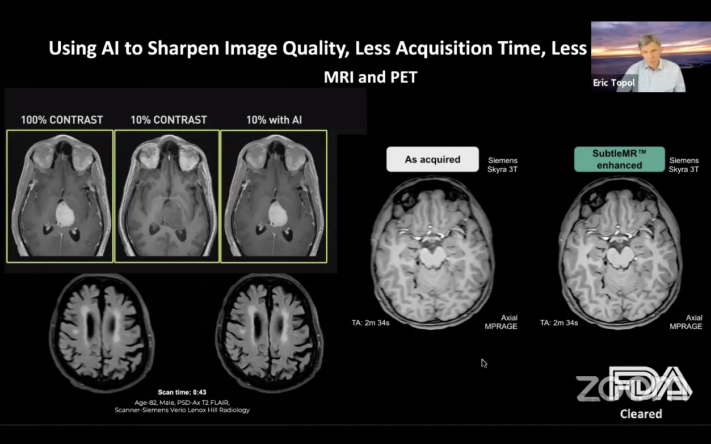
The image above shows a human brain scan, from which we can see that, through Deepwise Medical’s AI-enhanced technology, physicians can obtain MRI and PET images more quickly and with better quality.
In the past two years, Subtle Medical has obtained FDA approval and European CE marking for two of its products, SubtlePET and SubtleMR, which are currently deployed in multiple hospitals and imaging centers across the United States and Europe.
As is well known, magnetic resonance imaging (MRI) is widely used; however, conventional scanning processes are generally slow. Prolonged scan times can cause patient discomfort and may lead to artifacts and other image quality issues due to patient motion. SubtleMR leverages AI algorithms to accelerate MRI scans by a factor of 2 to 4. Clinical studies conducted by the Mayo Clinic in the United States and RadNet, an industry giant with over 300 imaging centers, have demonstrated that SubtleMR improves image quality and efficiency, delivering equivalent diagnostic quality at threefold acceleration.
Meanwhile, Subtle Medical is also researching how to leverage AI technology to reduce the use of contrast agents, thereby alleviating patients’ physical burden and potential risks. The company’s third product, SubtleGAD, utilizes AI to maintain or even enhance image quality while reducing the contrast agent dosage by a factor of ten. Reportedly, SubtleGAD received a $1.6 million research grant from the U.S. National Institutes of Health (NIH) in 2019 to support in-depth research and clinical adoption. It is currently collaborating with Stanford University Hospital, UCSF, and Beijing Tiantan Hospital in China to validate its efficacy.
Another direction for AI applications is to help patients monitor their own health conditions, reducing unnecessary medical consultations and thereby improving the operational efficiency of the entire healthcare system. Here, we mainly introduce two interesting applications.
One application is a smartphone-based ultrasound detector. By connecting the detector to your smartphone and placing it on your chest, you can view images of your heart on the phone within seconds, including chamber dimensions, myocardial thickness, and other parameters, as well as track blood flow.
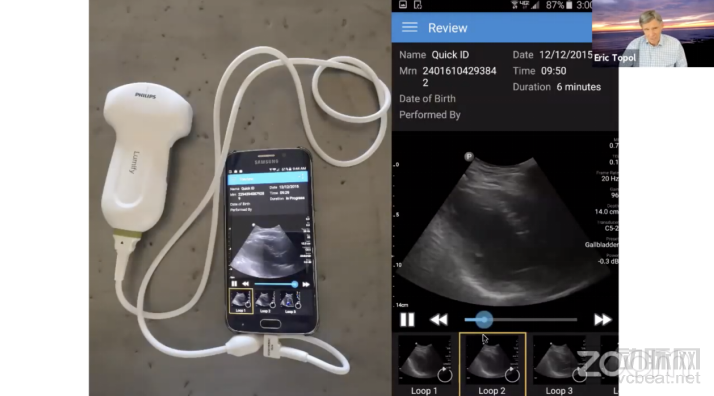
For patients, observing their own heart on a smartphone is a novel experience. Moreover, you can do this without any professional training; even elementary school students know how to operate it. Simply place the probe on your chest and rotate the AI detection device according to the prompts, and you will obtain an automatically captured video image.
The second application is relatively more novel. It is a smart toilet released by Stanford University in April 2020. Equipped with various cameras for fecal and urinary analysis, this toilet can, if you consent, examine your anus and excreta. If any health issues are detected, the smart toilet will alert you to seek medical attention.
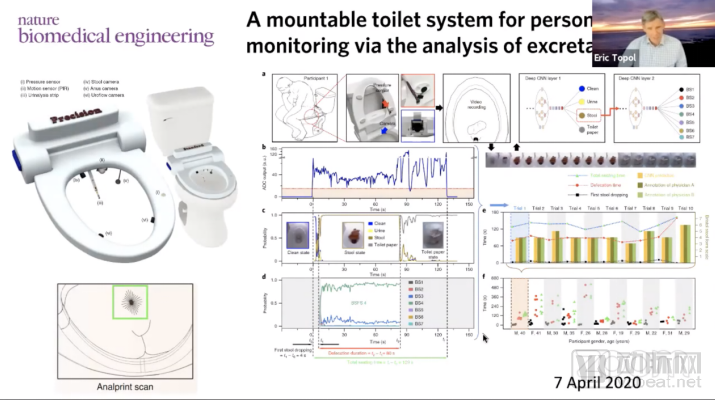
In short, directing AI healthcare toward consumer-facing applications is a significant avenue for development. In Africa, smartphones are currently being used to diagnose pneumonia and other diseases.
In the future, we may be able to use smartphones to capture images of any part of the body. Taking common skin diseases as an example, studies have shown that AI can preliminarily screen for potentially cancerous skin lesions through smartphone photos. Such applications could enable patients to quickly determine when they do not need to see a dermatologist and when they should go to the hospital for a biopsy. Although there are currently no consumer-available apps for diagnosing skin diseases, Dr. Eric Topol believes that such technology will emerge soon.
The preceding section outlined the latest research findings and products in AI-driven medicine from global technology companies and laboratories over the past year. In this section, we will further explore what types of AI can truly deliver value to clinical practice.
In fact, AI technologies that are overly advanced or detached from a hospital’s existing infrastructure may fail to benefit our current healthcare system in clinical practice.
The Bottlenecks of AI+Healthcare
Undoubtedly, researchers will be accompanied by AI for the long haul on the path of future medical development.
Dr. Antonio Di Ieva expressed a view in his article published in The Lancet: “Machines will not replace doctors, but doctors who use AI will quickly replace those who do not.”
In Dr. Eric Topol’s view, we are still in the early stages of AI medical research. Although research findings in AI healthcare are continuously emerging and gradually advancing toward clinical application, these achievements remain far from sufficient to meet human healthcare needs.
From a technical perspective, Dr. Topol believes that the current bottlenecks in AI-powered healthcare include: 1) a lack of large, diverse, and annotated datasets; 2) a lack of prospective trials; 3) insufficient deep collaboration between computers and physicians; 4) limited clinical implementation, with algorithms requiring greater oversight to prevent malicious interference, attacks, and other potential software failures; and 5) the need for new, hybrid models to handle multidimensional data.
AI pioneer Andrew Ng focuses more on the challenges encountered during the practical implementation of AI. He raises the question: Given that extensive research and news headlines suggest deep learning has reached, or even surpassed, the performance level of experts such as radiologists, why has it not been widely adopted in hospitals?
Andrew Ng believes that the widespread application of deep learning still faces three major bottlenecks. The first is data volume; deep learning often performs better with large datasets, whereas for diseases with only a small number of cases available for machine learning (such as hernia), AI often fails to reach the level of human experts.
Second, robustness and generalization: a model validated in published papers may still encounter issues in clinical practice. For instance, if the hospital you visit lacks advanced equipment or its medical staff are insufficiently trained, the AI’s performance may be unsatisfactory.
Third, the changes that AI brings to hospital management and workflows. AI must address the following issues: First, can staff members—including radiologists, nurses, health insurance companies, and hospital administrators—adapt to the new workflows introduced by AI? Second, patient safety is paramount; how can we ensure that AI algorithms do not compromise patients’ health?
Laboratory Achievements ≠ Clinical Implementation
As Andrew Ng has stated, in the real world, even with a solid theoretical foundation and promising experimental results, AI encounters numerous challenges during clinical implementation.
Recently, Google Health disclosed that the clinical outcomes of one of its flagship AI healthcare projects were suboptimal. The project focuses on detecting diabetic retinopathy (DR) to enable early screening for diabetes. As early as 2016, Google published research findings in the Journal of the American Medical Association (JAMA), demonstrating that its algorithm achieved an accuracy rate of 90%, comparable to the performance level of ophthalmology specialists. It is understood that during the algorithm training phase, Google researchers established a dataset comprising 128,000 images, with each image annotated based on evaluations from three to seven ophthalmologists. They further validated the algorithm’s performance using two independent clinical trial datasets containing a total of 12,000 images. Currently, this detection system has received FDA approval and has been confirmed to exhibit high accuracy.
However, when the project was implemented in Thailand, it encountered the dilemma described by the Chinese idiom: “Oranges grown south of the Huai River remain oranges, but those grown north of it become trifoliate oranges.” It is reported that Google collaborated with Thailand’s Department of Public Health to install this deep learning system in 11 clinics across Pathum Thani and Chiang Mai provinces. In theory, the system can provide professional diagnostic recommendations within seconds, enabling nurses to make preliminary assessments within one minute and advise patients on whether to seek referral or undergo further examination.
In clinical practice, however, several unexpected issues arose. First, the ocular photographs taken by nurses failed to meet the algorithm’s standards; the images were often blurry and of poor quality, leading to frequent automatic rejections by the system and complicating the workflow. This was primarily because high-quality pupillary images require capture in a dedicated darkroom to ensure pupil dilation under low-light conditions, yet only two of the 11 clinics were equipped with such facilities.
Secondly, internet connectivity in Thai clinics was far from seamless. Images that could be uploaded within seconds in Google Labs often took more than a minute to upload in the clinic setting. In one instance, a two-hour network outage during fundus screening led to a 50% drop-off among the 200 patients waiting for examination. Furthermore, many patients, perceiving the AI diagnostic process as overly cumbersome, preferred to seek direct consultation with physicians.
Google’s DR project in Thailand actually offers us a valuable lesson: current medical AI innovations should not disrupt existing hospital workflows; they must genuinely improve processes rather than making them more complex.
Paul Chang, Professor at the University of Chicago Medical Center and an expert in medical IT, has stated that while AI technology holds immense value and is poised to revolutionize the medical imaging industry, this transformation will take longer than anticipated. Therefore, current efforts should prioritize needs closely integrated with clinical practice, focusing on developing “must-have” applications rather than merely “nice-to-have” ones.
Paul Chang, a Professor at the University of Chicago Pritzker School of Medicine, an expert in the field of medical IT, and one of the scientific advisors to Subtle Medical, has stated that while AI technology holds immense value and is poised to bring transformative changes to the medical imaging industry, this process will take longer than anticipated. Therefore, current efforts should focus more on needs that are closely integrated with clinical practice, developing “must-have” applications rather than merely “nice-to-have” ones.
Continuously optimizing processes through AI technology to reduce unnecessary costs and waste of medical resources, thereby truly enhancing clinical efficiency—this may well be the most valuable and practical direction for AI development in the healthcare sector today.