

Qingrui Intelligence Files IPO Prospectus: AI-Powered Clinical Decision Support Platform Covers Over 2,000 Diseases to Empower Primary Healthcare
“Improving the level of social security and people’s livelihood, strengthening and innovating social governance” and “Implementing the ‘Healthy China’ strategy” were key points raised in the report to the 19th National Congress of the Communist Party of China. The report emphasized the need to strengthen the primary healthcare service system and the workforce of general practitioners. In recent years, models such as “minor illnesses treated at the township level, major illnesses managed within the county” and “initial consultation at the primary care level, two-way referral, separate management of acute and chronic conditions, and coordinated care between different levels of healthcare institutions” have been progressively advancing the reform toward a tiered diagnosis and treatment system, thereby realizing the “Healthy China” strategy.
Although the direction is clear, implementation faces significant challenges. While inadequate infrastructure at the primary care level can be improved through increased financial investment, the shortage of high-quality general practitioners (GPs) remains difficult to address. Due to the demanding and lengthy training process for GPs, coupled with generally harsh working conditions at the grassroots level, few GPs are willing to commit to long-term careers in primary care. This has resulted in an insufficient and unevenly distributed supply of high-quality medical resources, as well as increased healthcare costs. Furthermore, if the accuracy rate of initial diagnoses at the primary care level is low, more patients will opt to bypass designated facilities and seek care at higher-level hospitals, undermining the implementation of tiered diagnosis and treatment. In such cases, medical consortia, telemedicine, and specialist outreach programs cannot fundamentally resolve the underlying shortage of competent physicians.
In 2016, the emergence of AlphaGo brought the concept of “artificial intelligence” to the public and sparked a wave of enthusiasm. Given that human expertise often fails to reach grassroots levels, could artificial intelligence fill this gap? With this consideration in mind, Beijing Qingrui Intelligent Technology Co., Ltd. (hereinafter referred to as “Qingrui Intelligence”) adapted the Dynamic Uncertain Causality Graph (DUCG) AI technology, originally developed by its Chief Scientist, Professor Zhang Qin, for fault diagnosis in nuclear power plants, and applied it to clinical diagnosis.
Qingrui Intelligence, established in 2016, holds all intellectual property rights to DUCG. The company has been granted five Chinese invention patents and one U.S. invention patent, with two additional U.S. invention patents pending approval. It received the Gold Cup Award from the World Invention Association at the International Exhibition of Inventions in Nuremberg, Germany.
Professor Zhang Qin is an Academician of the International Nuclear Energy Academy (INEA), an Honorary Member of the China Association for Science and Technology, and a Jointly Appointed Professor at both the Institute of Nuclear and New Energy Technology and the Department of Computer Science and Technology at Tsinghua University. The core technical team he leads currently comprises approximately 15 members, primarily consisting of artificial intelligence specialists and software developers from Tsinghua University, Beihang University, and renowned overseas universities. Additionally, Qingrui Intelligence maintains long-term, in-depth collaborations with more than 30 clinical experts from prestigious Grade A tertiary hospitals, forming a research team that integrates medicine and engineering.
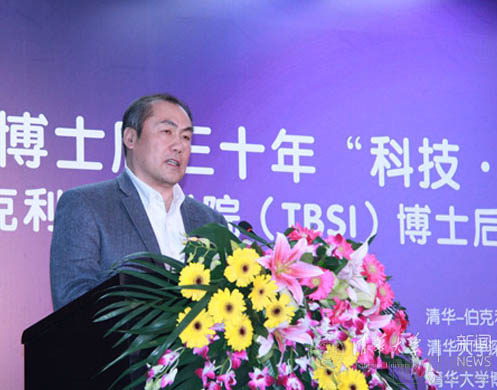
Professor Zhang Qin, Chief Scientist at Qingrui Intelligence
(Image source: Provided by Qingrui Intelligence)
DUCG employs a graphical approach to concisely represent uncertain causal relationships under various conditions. It expresses any uncertain causal relationship as a virtual random causal event, thereby integrating logical operations with probabilistic statistics. During inference, the knowledge base is first simplified and expanded based on evidence by removing irrelevant components and retaining only those pertinent to the current problem, which significantly reduces the scale and complexity of the problem. Combined with various efficient inference algorithms, this establishes a unique AI theoretical model that organically unifies knowledge representation, uncertainty, logical operations, and probabilistic calculations. By separating knowledge structure from parameter representation, it effectively addresses the interpretability and generalization capability of the model.
The establishment of this theory originated from the need to address online fault monitoring, prediction, diagnosis, progression forecasting, decision support, and risk assessment for large-scale complex industrial systems such as nuclear power plants. After more than 30 years of development, dozens of high-quality academic papers have been published, including 12 articles in SCI-indexed journals ranked in the Q1 quartile by JCR. To date, over one hundred applications and experimental validations have demonstrated a 100% accuracy rate.
While addressing fault diagnosis in large-scale complex industrial systems, the research team further adapted this methodology for clinical medical diagnosis. In collaboration with Professor Wang Ningyu’s team at Beijing Chaoyang Hospital and Academician Li Lanjuan’s team at Zhejiang University, they completed the construction and testing of two knowledge bases for vertigo and jaundice, preliminarily demonstrating the feasibility and superiority of this approach in the field of clinical diagnosis.
After years of accumulating knowledge and technological expertise, Qingrui Intelligence commenced its commercial operations in 2016.
Qingrui Intelligence’s core product—the DUCG Intelligent Clinical Decision Support Platform for Diagnosis—is a new-generation intelligent medical diagnostic assistance system based on DUCG technology.The platform is currently primarily accessible to primary care physicians, integrating with their clinical workflow systems. Using patients' chief complaints as the entry point, it guides physicians through history-taking, recommends diagnostic tests, and provides diagnostic conclusions along with evidence-based treatment recommendations. Furthermore, it employs a combination of graphics and text to explain diagnostic results, enabling primary care physicians to understand not only the conclusions but also the underlying rationale."In other words, while primary care physicians use the DUCG intelligent auxiliary diagnosis system, they are also learning from it."
Qingrui Intelligence believes that while artificial intelligence cannot replace physicians in clinical practice in the short term, it can empower primary care doctors, accelerating their development into clinical experts. This will encourage more patients to seek diagnosis and treatment at primary healthcare institutions, allowing highly skilled physicians to devote greater energy to tackling complex and refractory diseases.
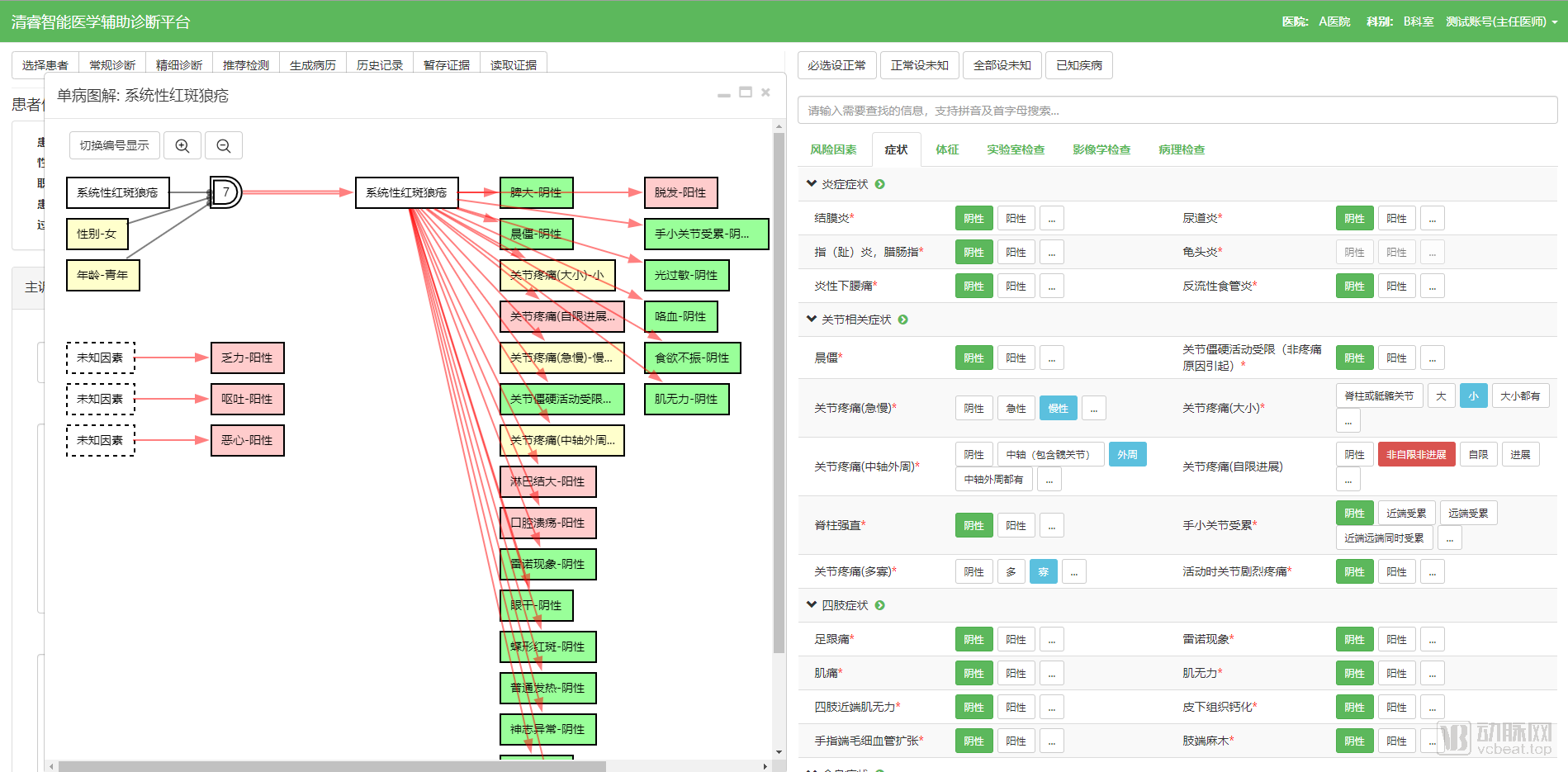
DUCG Intelligent Clinical Decision Support Platform
(Image source: Provided by Qingrui Intelligence)
The DUCG Intelligent Auxiliary Diagnosis Platform does not require clinical experts’ knowledge on how to initiate examinations based on chief complaints to diagnose diseases. It only requires knowledge expressing which factors influence each disease and what potential outcomes may arise (including possible results from specific diagnostic tests). In other words, it relies solely on forward causal knowledge (from cause to effect), rather than reverse causal knowledge (from effect to cause), the latter being a key differentiator of physicians’ clinical expertise.
To date, clinical medicine has essentially been an empirical science, requiring the accumulation of clinical practice over time to transform inexperienced physicians into clinical experts. However, the DUCG Intelligent Auxiliary Diagnosis System transforms experience-based clinical diagnosis into inverse computation based on forward knowledge, thereby converting it into a scientific problem of precise calculation and enabling computers to perform tasks originally carried out by human experts.
In addition to its high interpretability, the DUCG intelligent auxiliary diagnosis platform also possesses strong generalization capabilities.Currently, most deep learning models rely on medical record data from tertiary hospitals. These models may not be fully applicable to physicians and patients in primary care settings, as diagnostic conditions differ; many tests and evidentiary data available at large hospitals are lacking at the primary level, leading to reduced diagnostic accuracy. Therefore, diagnostic models must be adapted accordingly based on the specific application scenario—this is a key characteristic of the new generation of artificial intelligence.
Currently, Qingrui Intelligence is collaborating closely with more than 30 contracted clinical experts and has developed 43 knowledge bases based on chief complaint symptoms, covering over 2,000 diseases. Among these, 12 knowledge bases have completed third-party case validation, achieving diagnostic accuracy rates above 95%, and have been deployed in pilot applications.
Free public access during the pandemic
In early January this year, pneumonia caused by the novel coronavirus emerged in Wuhan, Hubei Province, and rapidly spread across China. As the outbreak coincided with the transition from winter to spring—a peak season for both allergies and influenza—many members of the general public experienced heightened anxiety due to symptoms such as fever, cough, or difficulty breathing. They were concerned not only about potentially contracting COVID-19 without receiving timely isolation and treatment, but also about the risk of cross-infection at crowded tertiary hospitals, fearing that a common cold could worsen into COVID-19 during medical visits.
Based on this, Qingrui Intelligence rapidly incorporated COVID-19 into the knowledge bases for the three primary chief complaints of cough, fever, and dyspnea. Each knowledge base covers dozens of diseases and was made freely available to the public in early March.Multiple township health centers in Jiaozhou City, Shandong Province, took the lead in piloting the DUCG Intelligent Auxiliary Diagnosis Platform for epidemic prevention and control, significantly alleviating outpatient pressure on tertiary hospitals and reducing the risk of cross-infection caused by patient overcrowding.
Regarding future development plans, Zhang Zhan, founder of Qingrui Intelligence, stated that the immediate short-term goal is to further refine and enhance its products and obtain third-party validation. The company expects to complete the development and validation of its general-practice knowledge base within this year and continue to expand the scale of product adoption. Currently, the DUCG Intelligent Auxiliary Diagnosis System has been deployed in clinical practice at hundreds of county-level hospitals, township health centers, and community clinics in Jiaozhou, Shandong Province, and Zhong County, Chongqing Municipality. In the future, clinical pilot programs will be expanded to more primary healthcare institutions across China.
In an interview with VCBeat, Zhang Zhan stated, “We believe that knowledge and data should be more effectively integrated. Only by dedicating ourselves to refining our products and continuously enhancing them through practical application can we truly demonstrate the capabilities of our products and team, thereby securing greater opportunities and access to broader markets. We welcome collaborations with more medical expert teams and invite additional investment to help us improve our products and expand our market presence more rapidly and effectively. From a long-term development perspective, we hope that Qingrui Intelligence will showcase to the world a successful operational model for tiered diagnosis and treatment and precision medicine, becoming another hallmark of Chinese original innovation going global.”