

Post-Pandemic Survival Strategies for Clinics: Adapting Through Innovation and Collaboration
In late May, the National Health Commission released data on national medical services from January to March 2020. Affected by the COVID-19 pandemic, the total number of patient visits at healthcare institutions across China decreased by 27% year-on-year. Among these, patient visits to clinics (infirmaries) dropped by 39% year-on-year during the January–March period, with a year-on-year decline of 47% recorded in March alone.
From February to March, clinics across China experienced a widespread suspension of services, with some clinics generating zero revenue.
After the overall stabilization of the epidemic, most clinics have resumed patient consultations. However, the resumption of clinical services does not equate to a recovery in cash flow. The impact of the epidemic extends beyond the temporary suspension of services; it also includes the short-term difficulty in restoring routine diagnostic and treatment operations. “Wave of clinic closures” and “wave of practice transfers” have become key terms sparking intense discussion recently.
Amid this landscape, some participants have exited the market, while a greater number have adapted by adjusting their service offerings and delivery models in response to shifting patient demands across different time periods, thereby mitigating adverse impacts from the external environment and proactively considering future trends.
We interviewed multiple clinic founders and managers, hoping to draw inspiration from their practices and perspectives.
During the epidemic prevention and control period, many regions required various types of outpatient departments and clinics to suspend patient consultations. On February 17, the National Health Commission stipulated that areas outside Hubei Province must closely align with the evolving epidemic situation, prioritizing both epidemic prevention and control and the provision of medical services. A one-size-fits-all approach is prohibited; it is not permissible to adopt a blanket suspension of consultations or to shut down routine medical services entirely.
On March 20, the National Health Commission once again required that medical services in low-risk areas be fully resumed as soon as possible. Outpatient and emergency care, hospitalization, surgeries, laboratory tests, and diagnostic examinations must be comprehensively provided to patients. Medical services shall not be suspended under the pretext of epidemic prevention and control.
Currently, most clinics across China have resumed patient consultations. However, the industry widely faces the challenge of low patient volumes post-reopening, with operations failing to quickly rebound to pre-pandemic levels.
“Due to people staying at home and rarely going out, the incidence of respiratory diseases has significantly decreased. Additionally, the inability to receive febrile patients has contributed to the persistent failure of outpatient visits to recover,” said Yang Zefang, Vice President of DXY and Head of DXY Clinic.
Among nationally notifiable infectious diseases, hand, foot, and mouth disease (HFMD) predominantly affects children under five years of age. According to data from the National Health Commission, the number of HFMD cases in the first three months of this year was significantly lower than that during the same period last year.
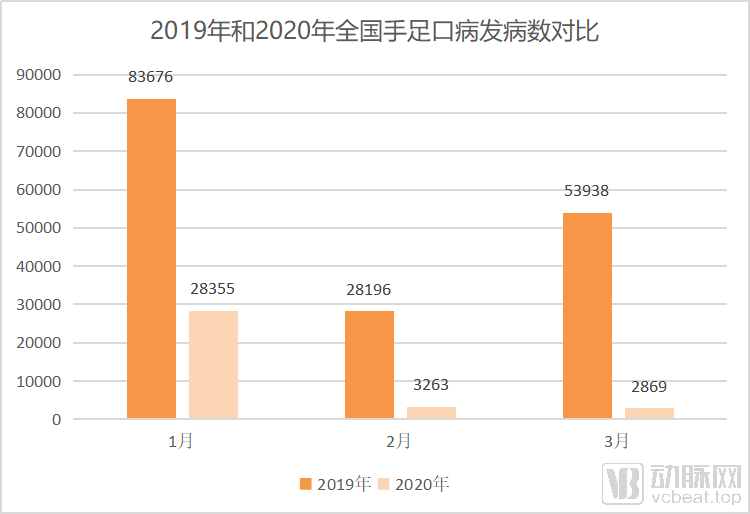
Comparison of National Hand, Foot and Mouth Disease Incidence in 2019 and 2020; Data Source: National Health Commission; Chart by VCBeat
As can be seen from the chart above, the number of hand, foot, and mouth disease (HFMD) cases in China reached 84,000, 28,000, and 54,000 in the first three months of 2019, respectively. This year, however, the number of cases was 28,000 in January, before plummeting to just 2,000–3,000 in February and March.
Not only typical pediatric diseases such as hand, foot and mouth disease, but also influenza, which affects people of all ages and genders, have shown a significant decline in incidence.
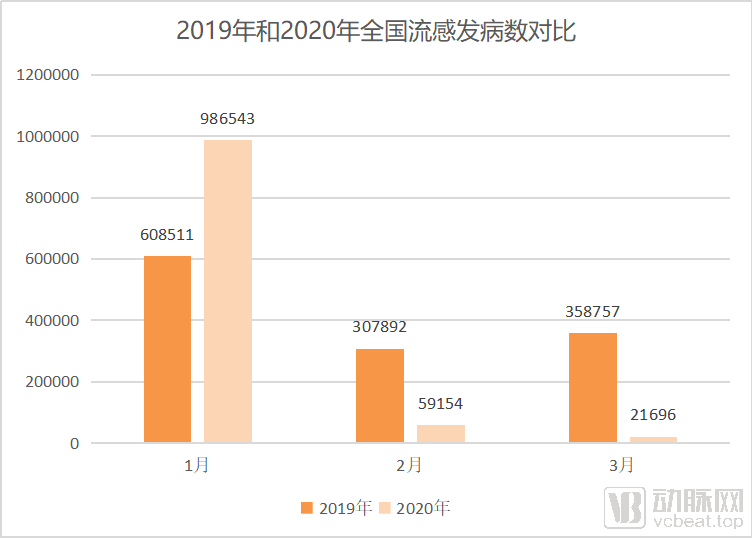
Comparison of National Influenza Incidence in 2019 and 2020; Data Source: National Health Commission; Chart by VCBeat
The figure above shows that in February and March 2019, the number of influenza cases was 308,000 and 359,000, respectively, whereas during the same period this year, the figures dropped by an order of magnitude to just 59,000 and 22,000.
Home isolation measures during the epidemic prevention and control period effectively blocked transmission routes. Although social life has gradually returned to normal in the post-pandemic era, mask-wearing remains mandatory in public spaces, reducing the risk of transmission for various common infectious diseases.
Therefore, the impact of the pandemic on clinics was not limited to the suspension of services itself, but also extended to the decline in the incidence of common diseases in the post-pandemic period. Under the influence of these factors, clinic cash flows were severely impacted, leading to a wave of closures.
According to data from Qichacha, a total of 1,356 enterprises with “clinic” in their business scope were deregistered or had their business licenses revoked between January and May 2020, including 570 from January to March and 786 from April to May. This indicates that clinic closures became more concentrated after clinics gradually resumed patient consultations.
“We observed that 90% of clinics were unable to resume operations until after mid-March. The two and a half months during the pandemic were extremely difficult to endure. But finally, most clinics have managed to weather the storm,” said Xu Kenan, head of the DXY Clinic Development Alliance.
Indeed, since most have endured the challenges and gained insight into the root causes of the issues, conducting joint reviews and sharing experiences will help clarify the path forward.
The clinics we interviewed are distributed across China. A summary of their measures to cope with the impact of the pandemic reveals three main strategies: shifting service spaces, transferring service processes, and seizing the opportunity to strengthen internal capabilities.
Relocate Service Spaces, Expand Online Services
“Preparing for a protracted battle, we have downsized part of the administrative office space in Hangzhou today. By reducing physical footprint, we aim to amplify team effectiveness.” On April 25, Zhang Qiang posted this message on his WeChat Moments, accompanied by a photo of the Hangzhou office area. To cut monthly fixed costs, Zhang also halved the floor space of the Shanghai headquarters and moved himself into a smaller office.
The Zhang Qiang Doctor Group has established Sijun Surgical Clinics and International Vein Centers in nine cities across China. After suspending consultations sequentially in February, the group recorded zero revenue in March, severely impacting its cash flow. To safeguard employee incomes, Zhang Qiang adopted measures to reduce administrative footprints and lower rental expenses. This approach not only cuts costs but also maintains daily operations such as patient consultations and surgeries, while retaining staff.
“Although the costs cut account for less than 10% of total costs, we need to send a strong signal—specifically, a signal of job security,” said Zhang Qiang. The group had initially considered reducing employee salaries but ultimately did not implement the plan.
The pandemic primarily affected interpersonal connections within physical spaces, and the demand for such interactions was quickly shifted to virtual spaces, namely the internet.
Previously, the cloud service platform of Dr. Zhang Qiang’s Doctor Group provided patients with auxiliary services beyond clinical diagnosis and treatment through customer service representatives. At the onset of the pandemic, an online consultation platform was built on this foundation, integrating physician-side access. Patients experiencing urgent venous complications, such as venous bleeding or venous thrombosis, can seek consultations via the cloud platform.
As April began, only four of the nine clinics operated by Dr. Zhang Qiang’s Medical Group across various cities had resumed operations, yet overall revenue had already reached 81% of the same period last year. “The comparison between recovered revenue and the number of reopened clinics is quite encouraging. Compared with other industries, particularly the film and entertainment sector, the healthcare industry is faring much better. The steady stream of patient appointments and visits since we resumed services clearly demonstrates their trust and recognition of our practice.”
Positioned within the community healthcare setting, Jiayou Health has established a chain of outpatient clinics across 26 residential developments in 14 provinces throughout China. Zhang Peng, founder of Jiayou Health, stated that in response to demands arising during the pandemic, its clinics implemented a series of online initiatives, including virtual consultations, online psychological counseling, sales of traditional Chinese medicine products, and management of online community groups.
In its previous services, Jiayou Health established deep connections with the property management companies at the locations of its clinics and with residents in the communities, enabling it to rapidly transfer these relationships online.
Shifting Services Upstream: From Diagnosis and Treatment to Health Maintenance
As previously mentioned, isolation and prevention measures have led to a reduction in the incidence of common diseases, meaning that clinics play a diminished role in diagnosis and treatment. It remains uncertain how long this impact will last. In the past, general practice clinics were primarily positioned to diagnose and treat common illnesses.
In response, DXY Clinic has intensified its health management services—such as infant and toddler growth and development assessments, adolescent development evaluations, dermatological aesthetic medicine, and adult health assessment and management—to offset losses resulting from the decline in outpatient visits.
Yang Zefang introduced that, in the past, infant and pediatric services accounted for 70% of Dingxiang Clinic’s overall business. As growth in health management services offset the decline in pediatrics, the clinic’s total revenue during the pandemic decreased slightly compared to previous periods but still exceeded expectations.
In community settings, Jiayou Health believes that illness is inherently a low-frequency event, with the majority of residents being healthy individuals. Therefore, Jiayou Health has adopted preventive medicine as its foundational approach and launched corresponding services in response to lifestyle changes brought about by the pandemic. “For instance, to address issues such as prolonged home confinement, lack of exercise, and irregular or unbalanced diets among residents, we organize online exercise programs, fitness and weight-loss initiatives, and Traditional Chinese Medicine (TCM) conditioning through community group operations,” introduced Zhang Peng.
Post-pandemic, residents have become more attentive to their health status. In response, Jiayou Health has timely launched health check-up packages, such as breast and cervical cancer screening during Mother’s Day. Zhang Peng stated that after the pandemic, clinics were no longer permitted to treat febrile patients, who had previously constituted a significant portion of their patient volume. Therefore, expanding preventive medicine services not only meets residents’ needs but also helps offset the loss in revenue from the decline in visits by febrile patients.
Zhang Peng also stated that this suite of services ensured his clinics did not lose all revenue during the suspension of operations. “Revenue dropped by 60% year-on-year, meaning we still retained at least a portion of our income.”
Conduct Academic Research and Training, Build Strength and Shape the Brand
During the pandemic, the enterprises we interviewed maintained a state of “suspending clinical services without halting operations.” Unable to provide face-to-face patient care, they devoted their efforts to self-improvement and brand building.
Zhang Qiang stated that during the suspension of clinical services, all physicians and physician assistants within the group were fully engaged in academic activities, summarizing past medical records to write research papers. Through his online live-streaming program, “Dr. Zhang Qiang’s Living Room,” he invited professionals from the medical field as well as experts from other industries to share their insights and perspectives. He jokingly referred to himself as a “newly minted homebody turned host.”
To date, “Dr. Zhang Qiang’s Living Room” has invited directors, lawyers, pianists, singers, and other guests to jointly discuss social and healthcare hot topics, enabling him to voice his perspectives across multiple fields and further build his personal brand.
“Branding is the key to navigating the pandemic; a strong brand ensures patient inflow as soon as consultations resume.” Zhang Qiang believes that the value of branding has become even more pronounced during these exceptional times.
Recently, Dingxiang Clinic has taken the opportunity to focus intensively on strengthening its internal capabilities. “Before the pandemic, we had to close the clinic for an entire day to organize specialized business discussions and training sessions. However, since the outbreak, we have had ample time to dedicate to these activities. We now hold pediatric service discussions twice a week, each session lasting two hours,” introduced Yang Zefang. He further emphasized that this is not fragmented or sporadic learning; six senior physicians specializing in pediatric diagnosis, treatment, and healthcare are conducting structured training for junior doctors, with the entire training program scheduled to last four to six months.
Yang Zefang believes that, under normal circumstances, excellent market operations can indeed drive traffic and acquire customers, but these offline channels became ineffective during the pandemic. “During special periods, prioritizing marketing over medical quality may lead to crises; quality and reputation are what matter most.”
Hao Xichun, founder of Keyou Clinic, has a deeper appreciation for the principle of enhancing influence through self-accumulation. He even believes that the pandemic has had a positive impact on Keyou Clinic.
Hao Xichun, a respiratory oncologist who resigned from a Grade 3A hospital, initially focused on online science communication and answering medical inquiries. In November 2019, he expanded his practice from online to offline by founding Keyou Clinic in Ningbo. The clinic’s services encompass two main areas: first, membership services that provide personalized health check-up plans, including customized screening protocols, interpretation of check-up reports, and second medical opinions; and second, medical science education courses.
After the opening of Keyou Clinic, membership services were rolled out in phases. However, the clinic encountered the pandemic just over two months later.
Hao Xichun stated, “We have a small team and relatively low labor costs. The most significant impact of the pandemic on us was the inability to hold our weekly in-person exchanges; we have now fully transitioned to online platforms. Meanwhile, we have strengthened our output of online science popularization content and online consultations, providing patients with high-quality, evidence-based medical recommendations. During the pandemic, my Weibo followers increased from 40,000 to nearly 110,000. This growth in personal influence also contributes to building the clinic’s brand.”
Hao Xichun introduced that during the pandemic, the focus was on enhancing influence, and no membership sales were launched. However, after the pandemic, they seized the opportunity to launch the fourth batch of memberships. “Currently, we have nearly 200 members and 15 live-streamed courses. At this early stage with a limited number of doctors, I believe these figures are quite satisfactory. Moreover, without pressure from investors, we can proceed with the next steps at our own pace.”
Jilin City Has Escalated Its Prevention and Control Measures Again, with Private Clinics Suspending Operations Once More, Sounding an Alarm for the Industry. Although all sectors of society are striving to prevent a resurgence of the epidemic, and we certainly do not wish to see it make a comeback, private clinics must take proactive measures and enhance their risk resilience as a matter of necessity.
So, what is the next strategic direction for clinics? What changes might arise? Several clinic founders and managers have also explored these questions.
Closer Industry Collaboration
Following the outbreak, Dr. Zhang Qiang’s Doctor Group transitioned to remote work. “We routinely hold many administrative and academic meetings online, so our team was already familiar with virtual workflows and quickly adapted. Three of our staff members have been working remotely on a long-term basis and no longer need to report to the office. In the future, our International Vein Institute will also launch an online education platform.”
Zhang Qiang believes that chain clinics should adopt an asset-light operating model. “Currently, we already operate with an asset-light structure, as pharmacies, laboratory testing, and medical imaging services are all provided by third parties. In the future, we will further advance our asset-light strategy through technological innovations, online services, and internet hospitals, thereby enhancing workforce utilization efficiency.”
In response to these challenges, Zhang Qiang has formulated a two-year plan and is considering adjusting the corresponding organizational structure accordingly.
Asset-light operations, at their core, involve focusing on a company’s core competencies across all business segments while leveraging external resources through partnerships for other functions. Meanwhile, we have also observed complementary approaches.
For example, according to Yang Zefang’s plan, Dingxiang Clinic will distill its accumulated experience in recent years in pediatric talent development and clinic management into a standardized system for external dissemination. “Once clinics undergo large-scale expansion, costs multiply. We hope to achieve win-win outcomes with the industry through this approach.”
Furthermore, Yongjia Community Medical, headquartered in Chongqing, is leveraging its network of more than 10 chain clinics and its cloud-based medical service platform to build a community chronic disease management platform and a centralized drug procurement platform for community medical institutions. It provides grassroots medical institutions with services such as laboratory testing, chronic disease management guidance, and telemedicine.
Meanwhile, we have also observed upstream players in the clinic industry chain extending support to downstream entities to help them weather the crisis. The DXY Clinic Development Alliance has shared case studies on pandemic response strategies among select clinics through community live-streaming sessions and new media content distribution, while also organizing group purchases of epidemic prevention supplies to reduce operational costs for clinics.
Songbai Investment’s dental distribution platform, Songbai Dental, has partnered with China Merchants Bank to launch a special loan program for the oral care industry. With interest subsidies provided by Songbai Dental, the initial phase of the loan program will allocate RMB 300 million to more than 100 dental distribution enterprises. Through these service networks, the initiative aims to help dental medical institutions resume operations as quickly as possible.
With inputs, outputs, and support in place, complementary advantages among stakeholders can facilitate a quicker exit from difficulties. In the future, closer collaboration between enterprises will be essential to enhance overall industry efficiency.
A Paradigm Shift Is Imminent
The pandemic has led to changes in public health habits. Zhang Peng believes that the operational philosophy of clinics should also evolve; primary care clinics should not focus solely on diagnosis and treatment, but must place greater emphasis on health factors.
“Many health management products can be derived from addressing the basic daily needs of the general public, such as eating, drinking, excretion, and sleep, but they must be effectively implemented in practice,” said Zhang Peng. He stated that the future value of clinics lies in leveraging these health management services to reduce mortality, disability rates, and the incidence of infectious diseases as disease prevalence declines.
In Hao Xichun’s view, the pandemic has also made clinics more focused on their core mission. To enhance risk resilience, it is essential to strengthen professional capabilities, develop distinctive characteristics, and deliver high-quality content. Pursuing value maximization is more important than pursuing profit maximization. “Relying solely on service is insufficient; healthcare is a slow process. By staying grounded and persisting over the long term, one will surely reap rewards.”
“Everything has two sides. While we witness clinic closures and transfers, we also see the emergence of new vitality within the industry. ‘The pandemic has served as a reset process; clinics lacking core competencies may face closure or transfer. However, they can make a comeback at any time once conditions improve,’ stated Zhang Qiang.”
In fact, more clinics are currently being established.
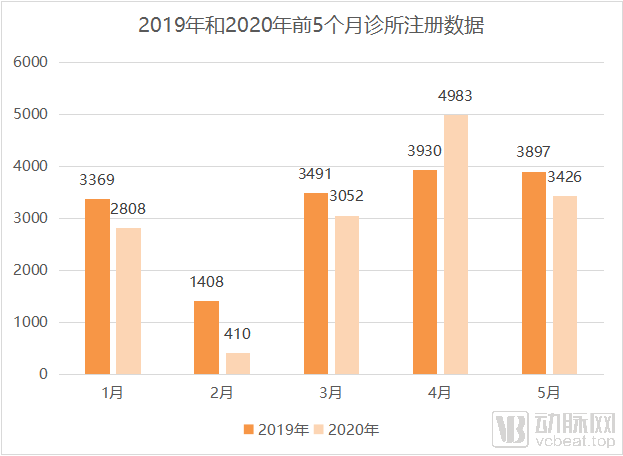
Clinic Registration Data for 2019 and the First Five Months of 2020; Source: Qichacha; Chart by VCBeat
A comparison of clinic registrations this year with those in 2019 shows that even in February, the month most severely affected by the epidemic, more than 400 clinics were registered across China. Registrations surged in March, exceeding the same period last year by April. Although there was a slight decline in May, the decrease was modest.
Shifting the focus from disease treatment to health promotion is a key task in deepening healthcare reform. This concept is frequently discussed within the industry, yet its practical implementation remains in the exploratory and initial stages. During the period when strict epidemic prevention and control measures were enforced and such protocols became the new normal, the general public indeed experienced improved health outcomes.
Will the incidence of common diseases rebound after future epidemic prevention and control measures are lifted? To what extent will they rebound? This remains unpredictable for now. However, one thing is certain: the pandemic has indeed served as a profound wake-up call to the industry, making it imperative that necessary changes be implemented.
We thank DXY Clinic, the DXY Clinic Development Alliance, Jiayou Health, Keyou Clinic, Songbo Investment, Yongjia Community Healthcare, and Dr. Zhang Qiang Medical Group for their support of this article.