

From One Clinic to Nearly 80: Sun Yan’s 20-Year Vision for IDSO Dental Alliance
How Many Twenty-Year Periods Are There in a Lifetime? Sun Yan Has Devoted His Entirely to the Field of Oral Health.
“I am in my forties and have at least 20 years to do a good job with IDSO,” said Sun Yan, founder of the IDSO Dental Alliance, in an interview with VCBeat.
Two decades ago, Sun Yan stepped into the dental industry, rising from an ordinary dentist to the head of a chain comprising nearly 80 dental clinics. He not only successfully propelled Happy Dentistry into the ranks of top-tier industry brands, but also established the IDSO Dental Alliance, which has become a focal point in the sector and is currently helping nearly 100 clinics achieve efficient operational management.
After navigating several key stages in the development of the dental industry, establishing the “IDSO Dental Alliance” represents a fresh challenge for Sun Yan. Through continuous understanding and exploration of the DSO model, as well as the innovative construction of the IDSO model, Sun Yan hopes that Chinese dental chain medical institutions will carve out their own unique space and forge a development path suited to their specific needs.
In 2001, Sun Yan, then a graduate student at the Fourth Military Medical University, co-founded the first dental clinic, “Ruibang,” with his classmate Ma Chunmin and others.
“At the time, my family was in difficult financial circumstances. Opening a clinic was simply a way to apply what I had learned and earn money to help support the household,” Sun Yan told VCBeat. A native of Xi’an, Shaanxi Province, Sun lived with his family in a cramped 15-square-meter room until he went to university. To avoid adding to his family’s financial burden, he applied to the Fourth Military Medical University—which charged no tuition—when filling out his college preferences in 1996, and subsequently became a dentist.
“Relying on one’s own hands” was the starting point for Sun Yan’s entrepreneurial journey. Like all young dreamers, he yearned to explore and make his mark in a major city. After several years of entrepreneurship, Sun Yan completed his doctoral studies. He then pursued postdoctoral research at Peking University School of Stomatology. During this period, he conducted extensive research on numerous joint-venture dental institutions, noting that their comprehensive management systems were lacking in domestic clinics. It was then that he conceived the idea of establishing a high-quality dental clinic in Beijing along similar lines.
Subsequently, he and four colleagues from Peking University School of Stomatology co-founded “Happy Dentistry.” Happy Dentistry represents an upgraded iteration built upon the first-generation “Ruibo” model. Established in 2007, it has grown to operate nearly 80 chain clinics, becoming a leading brand in China’s dental industry.
Since 2013, Happy Dentistry has consistently attracted investor interest, evolving from angel round to Series B within a few years and securing cumulative financing exceeding hundreds of millions of yuan. The company has expanded its business model from dental clinics to full-service dental hospitals, while also merging with Gurui Dental, which targets mid-to-high-end customer segments.
In 2017, Happy Dentistry marked its 10th anniversary. Through a decade of accumulation and iteration, the company had developed its own management experience and model. Against this backdrop, Sun Yan, who was visiting the United States at the time, learned about the Dental Support Organization (DSO) model—a specialized dental chain format that was experiencing rapid growth.
In the United States, the dental industry urgently needs a professional organization to help dental clinics develop and grow. DSO is the general term for operation management companies that provide non-clinical business support services to dentists and dental clinics.
Compared to the past, dentists today must not only keep pace with technological advancements but also contend with rising costs, government regulations, and legal issues. Dental Support Organizations (DSOs) can help dentists address these challenges. By providing clinics with cutting-edge technology and managing administrative affairs, DSOs significantly alleviate the burden of non-clinical tasks associated with running a dental practice, allowing dentists to focus on patient care.
The scale of a DSO can range from as small as two clinics to networks comprising hundreds or even thousands of clinics. The support provided by DSOs to their member organizations is equally diverse.
After gaining a deep understanding of DSOs, Sun Yan was thrilled. “DSOs have developed in the United States for 20 years and are now highly mature. Their success has shown me greater possibilities for the dental industry; introducing the DSO model will help drive the development of China’s dental sector,” said Sun Yan.
Sun Yan also stated, “It has been 20 years since I founded my first clinic in 2000. Throughout this period, I have been continuously exploring management models for dental clinics, learning from numerous missteps along the way. I hope to leverage our years of experience and established management systems, combined with the U.S. DSO (Dental Support Organization) model, to develop a management framework tailored to the development of local dental clinics in China. This framework will be shared with more entrepreneurial dentists to help their clinics grow.”
In the current dental care landscape, the market structure has evolved from one dominated solely by public hospitals to a dual system where for-profit private dental institutions coexist with public ones. Since 2000, a large number of private clinics have emerged. Coupled with recent policy initiatives such as “encouraging social capital to establish medical institutions” and “promoting multi-site practice for physicians,” private dental institutions have entered a period of rapid growth.
As of the end of 2018, there were approximately 99,000 private dental medical institutions in China, accounting for 78% of the country’s total dental care providers. However, these figures represent only a cross-sectional snapshot of the industry’s development. In reality, with growing consumer awareness, higher standards and expectations have been placed on the sector.
Sun Yan introduced to us that the oral care industry has roughly gone through three major phases. Chronologically, these are 1995–2005, 2005–2015, and 2015–2025.
Sun Yan believes that customer needs varied across these three eras. “From 1995 to 2005, customers sought solutions for clearly defined dental diseases—what we refer to as ‘chief complaint’ patients—aiming to meet immediate, basic needs for disease treatment. Between 2005 and 2015, demands escalated; customers were no longer satisfied with merely alleviating tooth pain, with increasing numbers focusing on aesthetics, such as whether their teeth were attractive, well-aligned, and white. From 2015 to 2025, the focus shifted to addressing full-cycle dental care needs. Customers during this period pursued the essence of healthcare: prevention, avoiding illness and dental problems, and requiring lifelong oral health management.”
Now that we are in the third phase as defined by Sun Yan, can dental clinics respond with a strong posture?
In fact, most dental clinics in China are founded by dentists. Apart from the leading dental chain organizations, a large number of dental clinics are self-operated by dentists who handle consultations and management themselves, and even live on the premises. Such workshop-style management makes it difficult to achieve standardization.
In particular, as capital has increasingly focused on and entered the dental industry in recent years, dental clinics in developed cities have begun to pursue improved management efficiency and standardization. However, the management pain points faced by dental clinics are equally prominent. During their development, many practices must simultaneously handle internal training, clinical care, marketing, supply chain management, personnel structure management, and financial analysis, among other tasks. Amidst these multifaceted management challenges, it is difficult for dentists to excel in all areas.
“From teams of 5–10, to 20–100, to 100–500 members… every stage requires real-time updates and follow-up in management,” Sun Yan cited as an example.
When the outpatient clinic team is small in scale, the clinic can be operated effectively as long as physicians manage their individual patient interactions well. However, when the team expands to 20–100 members, management challenges inevitably arise. At this stage, the substantial administrative workload cannot be handled by the founding physician alone, and patient care relies heavily on team collaboration. Therefore, establishing a robust organizational structure with clear division of labor and performance evaluation systems becomes critical to the clinic’s development. As the team grows to 100–500 members, the scope of management expands further. Managers must then step back from frontline roles to define the team’s mission, vision, and development goals, while engaging more extensively in strategic management.
How can these issues be effectively addressed? In his view, the first step is to resolve the conflict between the pursuit of short-term gains and long-term, steady development. Second, resources should be concentrated in a focused manner on customers. Finally, it is essential to provide physicians with a clear mission and vision, supported by a mature management structure.
Moreover, the core foundation of the healthcare industry lies in ensuring medical quality. To effectively achieve medical quality assurance and market oversight, it is necessary to enhance not only hardware equipment but also physician training.
It is difficult for small clinics to achieve the aforementioned objectives. “Drawing on the experience of U.S. Dental Support Organizations (DSOs), the future dental industry will transition from fragmented, individualized practices to a model in which 30%–50% of the market operates under the DSO structure. Under this model, dentists retain ownership of their clinic’s equity, while clinical operations are supported by the DSO through a chain-management approach.”
Sun Yan stated that the core contradiction in the current development of the private dental industry lies in the fact that the guiding philosophies and management practices for assessing future value have not fully kept pace. Management, in itself, is indeed an extremely complex undertaking.
The transition from individual dental clinics to chain operations requires managers to possess stronger business operational capabilities, which is an area where most dentists are not proficient. During its period of rapid growth, Happy Dental also encountered this issue: the founding team consisted of dentists, and as their footprint expanded, management became a “major challenge.”
“For more than a decade, my studies focused on medical practice, and even through my postdoctoral work, I was dedicated to the art of diagnosing and treating patients. In terms of management, we are still novices,” Sun Yan remarked in an exclusive interview.
From opening a few dental clinics to dozens, Sun Yan found it difficult to keep up with the pace in terms of management.
“Since 2012, I have become aware of this issue. During that period, we expanded our branch network at a rapid pace, but our lack of managerial experience led to numerous problems: many branches failed to achieve profitability, staff turnover was severe, and patient complaints increased,” said Sun Yan.
“This was his most anxiety-ridden period. To improve management, he pursued an EMBA and an MBA, and also studied at dental clinics in the United States. ‘Implementation was extremely arduous; it was entirely a process of groping in the dark. Initially, we believed that establishing a training system would suffice, but we later realized that this was not enough—data analysis and many other components were also required.’”
It was not until 2017, when Sun Yan traveled to the United States to attend an event and was introduced to the DSO model, that he discovered the issues he had encountered were already being effectively addressed in the U.S. through well-established and proven approaches.
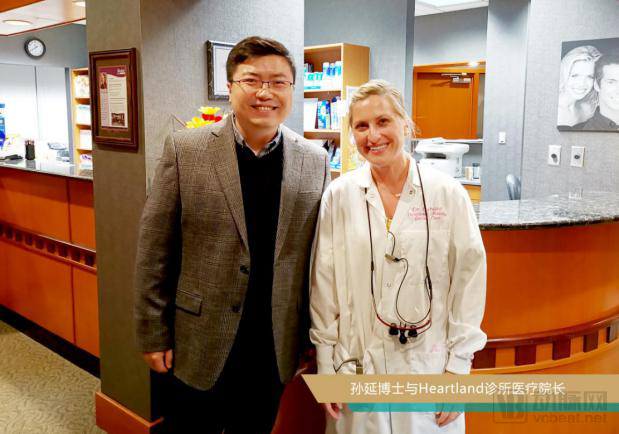
(Image: Sun Yan and the Medical Director of Heartland Clinic)
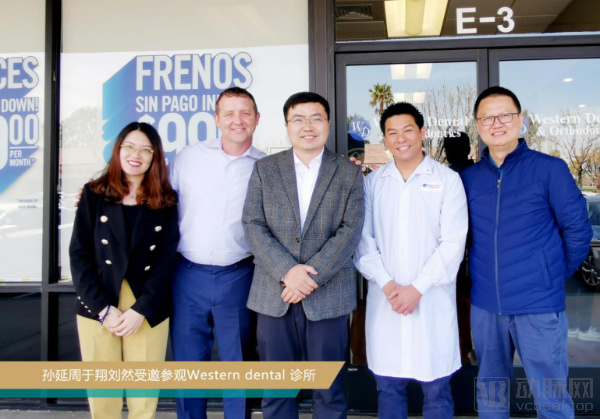
(Figure: Sun Yan leads the IDSO core team on a tour of Western Dental)
After returning to China, driven by the desire to address the management challenges facing Chinese dental clinics, Sun Yan and his team spent three years refining their approach before establishing the IDSO model, built upon the DSO framework. This model has been continuously refined within the Happy Dental system. Over the course of three years, by identifying customers’ core needs and establishing standardized clinical workflows, Happy Dental successfully developed and rolled out a standardized clinic model, while also transitioning certain locations to standardized online operations. These efforts have enabled Happy Dental to achieve steady growth in the Beijing region.
At Happy Dentistry, the IDSO pilot has achieved phased success. Currently, dental clinics in China are at a crossroads between traditional and emerging operational models. The IDSO model integrates the advanced concepts and frameworks of U.S.-based Dental Support Organizations (DSOs) with Happy Dentistry’s decade of proven local management expertise. This standardized set of processes, system platforms, and clinic management training programs will continue to empower small and medium-sized dental institutions in their operational and managerial capabilities.
According to Sun Yan, the philosophy of IDSO is rooted in “trust,” fostering a sense of “belonging” for every dental clinic. Committed to providing comprehensive management solutions for dental practices, IDSO offers services spanning new clinic preparation, training for both service and medical staff, group purchasing, store management and operations, marketing, information system development, human resources, and financial analysis, establishing itself as a rich and diversified oral healthcare service platform.
Sun Yan believes that dental clinics should adopt a business model akin to “automotive 4S dealerships.” Preventive care takes precedence over restorative treatment; modest investments in prevention can avert major complications. The focus should be on regular maintenance of oral health and the prevention of dental diseases, rather than seeking treatment only when normal chewing function is compromised. This approach represents the future development trend of China’s dental industry.
“After the IDSO service model entered the market, it sparked extensive discussion and gained recognition within the dental community. Soon, 50 clinic founders expressed interest in joining, from which IDSO selected 10 to provide precise, tailored services. Through this management system, these clinics achieved a performance increase of over 30%. One member clinic under IDSO’s guidance saw its revenue rise by 50% within just six months of joining the system,” said Sun Yan.
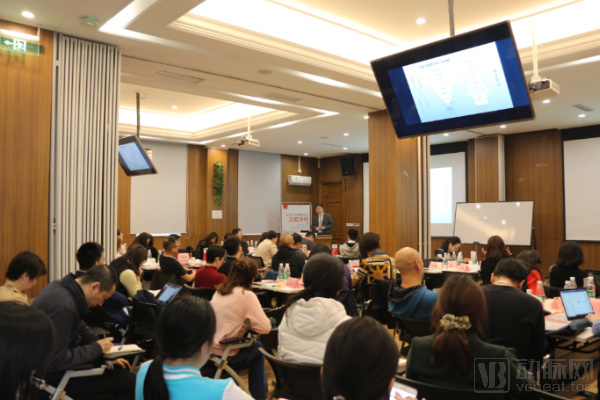
(Figure: Sun Yan provides instructional guidance to members of the IDSO Dental Alliance)
In his concluding remarks to VCBeat, Sun Yan stated that IDSO aims to create value on three levels. First, it seeks to establish efficient mutual trust between doctors and patients, enabling the monetization of physicians’ professional reputations, thereby effectively reducing transaction costs across the entire dental industry. Second, by implementing standardized, online management models and making them accessible to the broader industry, IDSO helps new clinic operators avoid common pitfalls and promotes industry development. Third, through the dissemination of its philosophy and operational model, IDSO hopes to influence the management practices of more dental clinics and guide more dentists in adopting this approach throughout their careers, ultimately delivering maximum value to patients and helping them achieve their aspirations for a better quality of life.
He stated that in the next phase, IDSO aims to provide high-quality services to the most influential and respected dental clinic brands in China’s second-, third-, fourth-, and fifth-tier cities. In the future, IDSO aspires to become the “Whampoa Military Academy” for dental practice management in China.
Currently, the “DSO” model in China is still in an exploratory phase, and most people have an unclear understanding of “DSO.” Some institutions that have entered the market under the banner of “DSO” have not genuinely addressed the challenges faced by dental clinics. Sun Yan believes that as the market continues to evolve, only DSOs with genuine capabilities to serve dental clinics will survive, and IDSOs will create value in this field.