

WeDoctor CFO Cai Qiang Unveils Three-Step Insurance Strategy to Accelerate Digital Health Maintenance Organization Implementation
On May 18, more than a month after joining WeDoctor, Cai Qiang made his first public appearance as Vice Chairman of the Board and CFO of WeDoctor, attending an online media briefing.
Previously, in late February, WeDoctor announced a personnel appointment, stating that Cai Qiang, the former Regional CEO of AIA Group, would join WeDoctor and officially assume his position on April 1.
During his tenure at AIA China, Cai Qiang spearheaded the reform of AIA China’s agent distribution system and drove rapid growth in regional life insurance value-based business, tripling AIA China’s new business value within five years. Prior to joining AIA Group, Cai Qiang served as Chief Executive Officer of AXA Hong Kong.
With 28 years of experience in the insurance industry, how will Cai Qiang integrate his insurance background with digital healthcare after entering the rapidly accelerating digital health sector? What are WeDoctor’s plans in the insurance domain? And what role does insurance play in WeDoctor’s core strategy for its Digital Health Community? At this media briefing, Cai Qiang addressed each of these questions.
After joining WeDoctor, Cai Qiang’s specific responsibilities included overseeing the group’s finance, investment and financing, and the WeDoctor Health business segment. Among these, WeDoctor Health primarily handles WeDoctor’s operations in the health and insurance sectors.

Cai Qiang, Vice Chairman of the Board and CFO of WeDoctor
Since the emergence of the internet healthcare industry, identifying suitable payers and establishing a complete service closed loop has been a long-term and arduous task. In the past, both public medical insurance and commercial insurance had only limited integration with internet healthcare, failing to achieve large-scale breakthroughs.
During the COVID-19 pandemic this year, internet-based diagnosis and treatment services, facilitated by internet hospitals, broke through spatial constraints and rapidly mobilized medical resources. These services effectively addressed issues such as follow-up visits for common and chronic diseases, medication delivery, and even health insurance reimbursement. Among these advancements, the breakthrough in health insurance reimbursement represents a significant milestone for internet hospitals in the payment sector. However, health insurance reimbursement is only one component of the payment ecosystem; commercial health insurance should also constitute an important part.
WeDoctor’s “Three-Step” Strategy in the Insurance Sector
At the meeting on May 18, Cai Qiang proposed a “three-step” strategy for WeDoctor’s initiatives in the insurance sector:
The first step is to integrate health insurance reimbursement. For example, during the epidemic response in Wuhan, WeDoctor launched its online hospital within just 36 hours, enabling integration with medical insurance payment systems, offline pharmacies, and logistics networks.
“There are 408,000 patients with severe chronic diseases in Wuhan, most of whom experienced interruptions in their medication supply due to the impact of the pandemic. The WeDoctor Internet General Hospital (Wuhan Zone) has established a full-process service integrating online follow-up consultations, prescription issuance, medical insurance settlement, and offline medication dispensing, thereby addressing the urgent needs of local patients,” introduced Cai Qiang.
The second step is to integrate with commercial insurance companies, which will cover the portions not reimbursed by basic medical insurance. Cai Qiang stated that supplementary medical insurance is the primary direction for WeDoctor’s future integration. “Once basic medical insurance has made its payment, the remaining costs will be covered by supplementary medical insurance, particularly for surgeries, cancer treatments, and new specialty drugs. This creates a seamless connection between basic medical insurance and commercial health insurance.”
According to Cai Qiang’s plan, once integration with both public medical insurance and commercial insurance is achieved, the third step will be to build a large-scale middle platform for the insurance industry, positioning the system as a TPA (Third-Party Administrator) service provider. Cai Qiang believes that when WeDoctor establishes deep collaborations with hospitals, public medical insurance authorities, and insurance companies, thereby creating a complete closed-loop payment ecosystem, users will enjoy an enhanced experience.
We can see that WeDoctor is advancing these “three major steps” in a phased manner.
In terms of integration with the national health insurance system, WeDoctor has taken the lead in the industry by being included in the scope of health insurance payments. For instance, in October 2016, the Sichuan Provincial Healthcare Security Administration designated Sichuan WeDoctor Internet Hospital as a designated provider for basic medical insurance. In 2018, Wuzhen Internet Hospital became a designated medical institution under Tongxiang City’s basic medical insurance scheme, enabling insured employees to seek reimbursement for their medical expenses.
During the pandemic this year, Weiyi enabled medical insurance payments in Wuhan and helped drive breakthroughs in top-level policies. On March 2, the National Healthcare Security Administration and the National Health Commission issued the “Guiding Opinions on Promoting ‘Internet+’ Medical Insurance Services During the Prevention and Control of the Novel Coronavirus Pneumonia Epidemic,” which included eligible fees for “Internet+” medical services within the scope of medical insurance reimbursement. This move was regarded by the industry as the true opening of medical insurance payment in the field of internet healthcare.
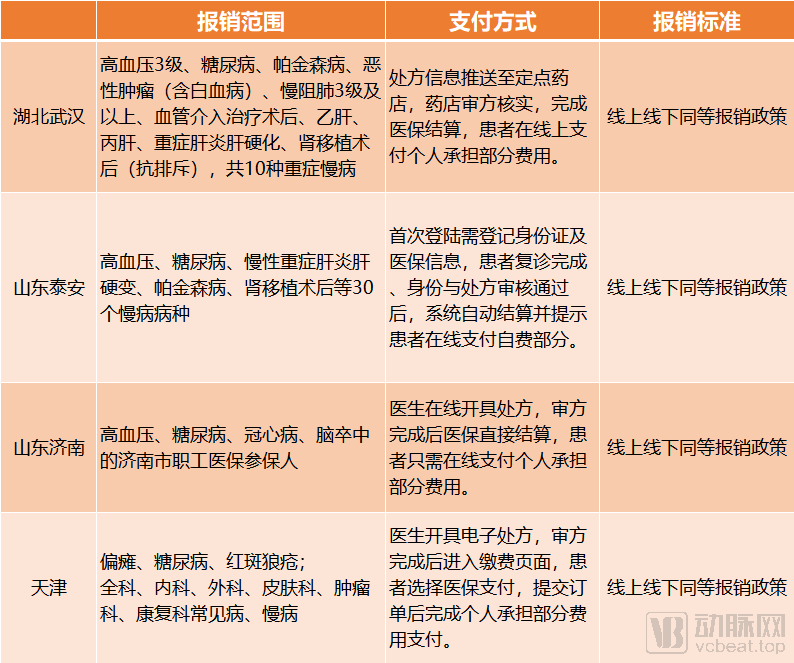
Since the beginning of this year, WeDoctor Internet Hospital has enabled online medical insurance settlement in multiple cities. Source: Public information; Graphic by VCBeat
Driven by epidemic prevention and control efforts, WeDoctor Internet Hospital has enabled medical insurance payments in Wuhan, Tai'an, Jinan, and Tianjin.
Recently, the Shandong Provincial Internet Medical Insurance and Health Service Platform, led and operated by WeDoctor, went online. The platform can retrieve patients’ medication history from the past three months in just 0.02 seconds, and Jinan WeDoctor Internet Hospital has issued China’s first electronic medical insurance settlement statement for a platform-based internet hospital through this system.
Furthermore, the platform has established a complete closed-loop process encompassing everything from launching an internet hospital and securing designated status for medical insurance reimbursement, to patient identity verification and confirmation of follow-up visits, culminating in online settlement via medical insurance. This represents not only a deep integration between WeDoctor and the medical insurance system but is also regarded as a significant breakthrough in China’s digital health industry in recent years.
In the realm of commercial health insurance, in June 2019, AIA Insurance, WeDoctor Group, and Medxcel Health (a subsidiary of Shanghai Pharmaceuticals) jointly launched China’s first single-disease insurance product targeting breast cancer, named “Guardian Beauty Medical Insurance.” The three parties integrated their respective industry-leading resources to connect the core links of medical care, pharmaceuticals, and insurance throughout the treatment process, providing customers with a comprehensive, closed-loop service for breast cancer that spans prevention, medical consultation, medication, and rehabilitation. The launch of this insurance product represents one of the hallmark examples of deep collaboration between WeDoctor and commercial insurance companies.
In terms of TPA services, WeDoctor is also deepening its engagement. It currently provides health services and product development support to insurers, and has established collaborations with more than 30 insurance companies.
In March this year, the "Opinions on Deepening the Reform of the Medical Security System" issued by the Central Committee of the Communist Party of China and the State Council clearly stated that a medical security system should be fully established, with basic medical insurance as the mainstay, medical assistance as the safety net, and supplementary medical insurance, commercial health insurance, charitable donations, and mutual medical aid developing in tandem. As a guiding document for the reform of the medical security system, the "Opinions" further clarified the positioning of basic medical insurance and commercial insurance, as well as the trend of their complementary development.
An overview of WeDoctor’s “three-step” strategic plan reveals its strong alignment with the direction of medical insurance system reform. It represents a clear pathway for leveraging digital tools to enhance reform efficiency and serves as an effective enhancement to the payer ecosystem in internet healthcare.
Payers Enhance Efforts to Drive the Realization of Larger-Scale Industry Closed-Loop Services
Currently, the internet healthcare industry features diverse revenue models, primarily including the sales of pharmaceuticals and health supplements, the sale of health management products, and medical informatics services. Does the maturation of payment mechanisms signify the emergence of new growth drivers?
“It is important to clarify that payment integration facilitates services, not profit models,” said Cai Qiang. He noted that once a closed loop among healthcare providers, pharmaceuticals, and insurance is established, it will naturally foster positive customer word-of-mouth, enhance customer stickiness and loyalty, and thereby generate revenue streams.
Cai Qiang revealed that revenue from medical insurance services is one of WeDoctor’s key income sources. “Of course, this also represents a service that fulfills our social responsibility. By integrating with the medical insurance system, we help reduce overtreatment, lower medical costs, and save on medical insurance expenditures; meanwhile, we enhance the quality of health services and improve hospital efficiency. This initiative primarily serves the broad user base.”
In addition, WeDoctor aims to serve more commercial insurance companies to create win-win outcomes and generate profits, while high-end medical aesthetics, overseas medical treatment, and new specialty drugs will also contribute to profitability.
“From a longer-term perspective, big data and intelligent applications can be deeply integrated with new drug R&D, pharmaceutical sales, market-oriented operations of insurance companies, and insurance product pricing. This represents our more long-term application,” said Cai Qiang.
Currently, WeDoctor has five business divisions: WeHospital, WePharma, WeLab, WeCare, and WeCloud, which correspond to internet hospital services, joint drug procurement, pharmaceutical care, diagnostic testing, health insurance, and big data, respectively. These five segments operate in a fully closed-loop synergy. By making significant strides in the insurance sector and deeply integrating insurance with healthcare, WeDoctor is rapidly advancing its overall strategy while achieving high-level coordination across its five major business segments.
Building a Digital Health Community to Optimize the Allocation of Medical Resources
In 2017, Cai Qiang proposed that “Insurance + Health” is a win-win model for the broader health industry.
“Abroad, the ‘insurance + health’ model rests on three pillars: the social security system, commercial health insurance, and personal consumer spending. These three pillars underpin the development of the entire healthcare industry,” introduced Cai Qiang.
In China, the public health insurance system serves as the primary pillar, while commercial insurance penetration remains low and out-of-pocket healthcare spending is relatively limited. Consequently, a significant proportion of households face poverty or fall back into poverty due to medical expenses. Cai Qiang believes that the future of the “insurance + health” model lies primarily in increasing the share of commercial insurance and enhancing individuals’ capacity for healthcare consumption, thereby achieving a balanced payment structure among all stakeholders.
“What WeDoctor can do is to build a digital health platform with its partners, namely implementing locally the ‘Health Community’ that is digitally driven and health-centered.” In Cai Qiang’s view, while there is immense demand for medical and healthcare services, the supply of resources remains limited. This contradiction will be difficult to fully resolve for a considerable period in the future, requiring joint participation from the government, hospitals, physicians, insurance companies, and even individuals to explore how resource optimization can be achieved.
WeDoctor’s Digital Health Communities are primarily delineated by administrative regions. Centered on public health, they integrate local governments, medical insurance agencies, healthcare institutions, elderly care service providers, commercial insurance companies, pharmaceutical manufacturers, and pharmacies. This integration establishes a digital healthcare service system that spans online and offline channels and facilitates the coordinated interaction of medical care, pharmaceuticals, medical insurance, and elderly care. The ultimate goals are to enhance regional medical standards, improve population health indices, and reduce the growth rate of medical insurance expenditures.
“The Digital Health Community can rationally optimize online and offline resources.” Cai Qiang proposed that the rational allocation of medical resources centered on the Digital Health Community is also a direction for cooperation between WeDoctor and insurance companies.
Shared Goals and Future Trends of the Digital Health Community
In 2019, WeDoctor officially launched its Digital Health Community strategy. Currently, the Health Community has been gradually implemented in multiple locations, including Tianjin, Longyan in Fujian Province, Tai’an and Dezhou in Shandong Province, Huanggang in Hubei Province, and Yinchuan in Ningxia Hui Autonomous Region.
In Tai’an, Shandong Province, the construction of health communities has focused on chronic disease management, integrating online and offline services to create an “Internet + Chronic Disease Management” model. Within 14 months, this initiative reduced medical insurance expenditures in Tai’an by a cumulative 10.2%.
In Tianjin, the local Health Commission has recently launched the construction of a grassroots digital health consortium, which is currently the only one in China covering an entire provincial-level administrative region.
The Tianjin Primary Digital Health Consortium, led by Tianjin Weiyi Internet Hospital, collaborates with 267 primary healthcare institutions across the city to establish a closely integrated primary healthcare consortium. Currently, the consortium leverages digital applications centered on cloud-based management, cloud services, cloud pharmacy, and cloud diagnostics as its core “engine” to empower primary care, promote tiered diagnosis and treatment, and facilitate the rational allocation of medical resources.
In the next phase, Tianjin’s grassroots digital health consortium will further enhance the integration and operational efficiency of medical care, pharmaceuticals, and health insurance (“Three-Medical Linkage”), innovate online and offline diagnosis and treatment as well as family doctor contracting service models, and create a convenient healthcare access and health management portal for Tianjin’s 16 million residents. This initiative aims to comprehensively improve primary care services and citizens’ health outcomes across the city, driving a shift from a “disease-centered” to a “health-centered” approach.
Although the specific implementation pathways of health communities vary slightly across different regions, their overarching goal is to help local governments enhance regional medical standards, improve population health indices, and reduce the growth rate of healthcare insurance expenditures.
Meanwhile, Cai Qiang believes that, driven by the Health Community, several changes will occur among the various stakeholders in the future healthcare industry:
First, it enables the integration of resources across all stakeholders. Historically, medical resources have been isolated and fragmented, representing one of the most significant challenges facing the healthcare industry. Through the Health Community, hospitals, physicians, pharmacies, and payers—both online and offline—can achieve interconnectivity and foster mutual collaboration.
Second, the hospital-centric model will gradually shift toward a patient-centric model, with digital innovation enhancing the efficiency of the healthcare system.
Third, the payment system dominated by basic medical insurance will shift toward a model in which medical costs are jointly borne by basic medical insurance, commercial health insurance, and individuals.
In recent years, the wave of digitalization has swept across all industries, and digital transformation has been incorporated into the national top-level design. Since 2018, multiple central-level meetings and documents have explicitly called for strengthening “New Infrastructure.” A key objective of “New Infrastructure” is to achieve digital transformation.
In the healthcare sector, we are currently in a phase of deepening healthcare reform, with accelerated development of information technology infrastructure across medical services, pharmaceuticals, and health insurance. However, IT initiatives undertaken by individual sub-sectors or single entities alone cannot effectively address the challenges of uneven distribution of medical resources, high out-of-pocket costs for patients, and significant financial pressure on health insurance funds.
Only digital solutions that integrate various industry stakeholders, break down information silos, and truly achieve coordinated development among pharmaceuticals, healthcare services, and medical insurance can reengineer healthcare service processes, thereby achieving the goals of rational allocation of medical resources, reducing individuals’ out-of-pocket medical expenses, and ensuring the sustainable operation of the medical insurance fund.
It can be said that digitalization is accelerating the improvement of new infrastructure in the healthcare field.
In October 2019, the World Health Organization released the draft of the Global Strategy on Digital Health (2020–2024), consolidating concepts such as health informatization, telemedicine, and digital medicine under the umbrella term “digital health.” The strategy establishes the priority status of digital health and affirms its potential to support the development of healthcare industries in all countries.
In Cai Qiang’s view, the development of digital health has gone through three stages. The first stage was internetization, beginning 10 years ago when Micro Medical Group established Guahaowang, as offline hospitals started to explore online presence.
From December 2015 to 2016, the emergence of internet hospitals, represented by Wuzhen Internet Hospital, marked the entry of digital health into its second phase, namely “Internet Plus.” “During this phase, hospitals did not merely establish an online presence; they also leveraged the internet to provide services such as online consultations and pharmaceutical sales,” said Cai Qiang. He noted that during this period, the “Internet Plus” model primarily combined e-commerce with light medical services. Although these digital health services were relatively superficial, they experienced rapid growth.
In 2019, the establishment of the Medical Community model marked the entry of digital health into its third phase. Cai Qiang stated that since the beginning of this year, the pandemic has accelerated the demand for building Medical Communities. Perspectives are rapidly changing across the board—from end-user experiences, behaviors, and mindsets to the viewpoints of government policymakers. Policy barriers in areas such as online prescription issuance and medical insurance payments are being dismantled.
“Therefore, we will devote substantial resources to building a digital healthcare community,” said Cai Qiang. He noted that the success of such communities would bring transformative change to the industry, and that only through concerted efforts among the government, medical institutions, and insurance companies can the longstanding challenges of difficult and costly access to medical care be resolved more rapidly.
Cai Qiang even directly describes the current state of digital health as “Big Health + Internet.” “The integration of online and offline participants in the Big Health sector creates enormous industrial potential, with future development expected to follow a double-digit growth trend.”
At the conference, Cai Qiang also discussed his career planning and its connection to WeDoctor and the digital health industry. He stated that after 28 years in the insurance sector, he was eager to take on new challenges. “Joining WeDoctor not only presents me with fresh challenges but also allows me to apply my accumulated experience and knowledge to a broader industry and a wider track—the digital health sector.”