

Baidu Smart Healthcare and Inspur Jointly Launch the 'Huaiyin Model' to Innovate Family Doctor Services
May 19 marks the 10th “World Family Doctor Day.”
In 2016, seven ministries and commissions, including the National Health Commission and the State Council’s Office of Healthcare Reform, jointly issued the “Guiding Opinions on Advancing Family Doctor Contract Services,” setting forth the goal of “basically achieving full coverage of the family doctor contract service system by 2020.” Unlike definitions in European and American countries, China’s family doctors are positioned to provide “basic medical care, public health services, and agreed-upon health management services.” They bear the critical responsibility of facilitating the transformation of healthcare delivery models and implementing the tiered diagnosis and treatment system, with a significant portion of their work dedicated to the follow-up management of patients with chronic diseases.
After years of implementing the family doctor contract system, the difficulty residents face in accessing medical care has been alleviated to some extent. However, in certain regions of China, problems such as a shortage of family doctors, “contracts without actual services,” and “difficulty in scheduling appointments despite being contracted” still persist. For many residents, their family doctor remains “the most familiar stranger.”
“In recent years, an increasing number of residents have signed up for family doctor services. I am currently responsible for nearly 2,000 residents, a significant proportion of whom suffer from chronic diseases. My workload has increased substantially compared to before, and I find it somewhat challenging to keep up,” said Li Tianjiao (pseudonym).
Li Tianjiao is a physician at a community hospital in Huaiyin District, Jinan City, Shandong Province. He stated, “Every morning, we see patients, collect their health information, explain test and examination results, discuss and analyze their health status together with them, provide health education, issue various electronic documents, and guide and advise them on daily life and medication precautions. The afternoons are even busier; we continue to see patients while also organizing the health records of all residents under our contracted care. Sometimes, when scheduled patients fail to arrive on time, our workflow is disrupted, necessitating follow-up calls to inquire about their specific situations. Meanwhile, we must schedule appointments for the next day’s patients to avoid overcrowding and long waiting times. Patients with more severe conditions require further follow-up to monitor their recent status. The most challenging aspect is that many patients lack the skills for record-keeping and self-management. For instance, we often need to access monitoring data such as blood pressure and blood glucose levels, but patients either have no records or only partial ones. Some elderly patients are forgetful; they frequently miss doses, repeatedly call to ask about medication administration and dosages, or forget to measure their blood pressure and blood glucose, making it difficult to track and manage their daily lives.”
The dilemma facing Li Tianjiao is also shared by hundreds of thousands of family doctors: with a large patient panel and heavy administrative burdens, it is difficult to provide comprehensive attention to every enrolled resident. Furthermore, the lack of monitoring data for patients with chronic diseases renders management efforts akin to “shooting arrows without a target.”
“Since late last year, the Jinan Municipal Health Commission has supported Huaiyin District in fully leveraging its health and medical big data platform to explore a new model of smart integration between medical care and disease prevention based on big data, focusing on chronic disease management by family doctors for patients. With joint development support from Inspur and Baidu, we have launched the Xiaodu Ai Jiankang (Xiaodu Love Health) innovative smart chronic disease family doctor service solution, which integrates the family doctor services of the Inspur Ai Jiankang App with the advantages of Baidu’s Xiaodu smart speakers. This system has been particularly helpful during the COVID-19 pandemic,” said Li Tianjiao.
According to reports, a patient call alert popped up on the computer at the service station where Li Tianjiao works, prompting him to initiate a video consultation with the patient. “Dr. Li, I measured my blood pressure this morning, and the system indicated that it was elevated. What should I do?” Li Tianjiao accessed the patient’s health information page, which included the patient’s medical examination reports, basic profile, and measurement data such as blood pressure and blood glucose levels. He then placed a video call to the patient, who was flagged as a key case on the interface, to provide face-to-face guidance.
“Previously, we had to conduct home visits one by one and manually enter each patient’s follow-up results into the system, which involved a great deal of repetitive work. Now, I can simply use the Huaiyin District Primary Healthcare Smart Service Platform to connect with patients’ Xiaodu Ai Jiankang (Xiaodu Health) devices for video consultations or voice-based follow-ups. Based on the follow-up outcomes, Xiaodu automatically guides patients in updating their health records. The data is synchronized directly into the backend public health system, and Xiaodu also provides personalized recommendations on diet, exercise, and medication based on patients’ measurement data. I can refer to these suggestions when communicating with patients, which greatly improves efficiency,” said Li Tianjiao.
In the afternoon, Li Tianjiao’s work primarily involved communicating via video with patients whose conditions were unstable through a service platform, addressing their concerns face-to-face, and reviewing information on patients scheduled for follow-up visits the next day—all tasks that required just a few clicks on the screen.
“Since using Xiaodu Ai Jiankang, tasks that previously took me two days to complete can now be finished in just one. This has allowed me to devote more energy to discussing patients’ conditions with them, while ensuring the quality and efficiency of my management responsibilities,” said Li Tianjiao.
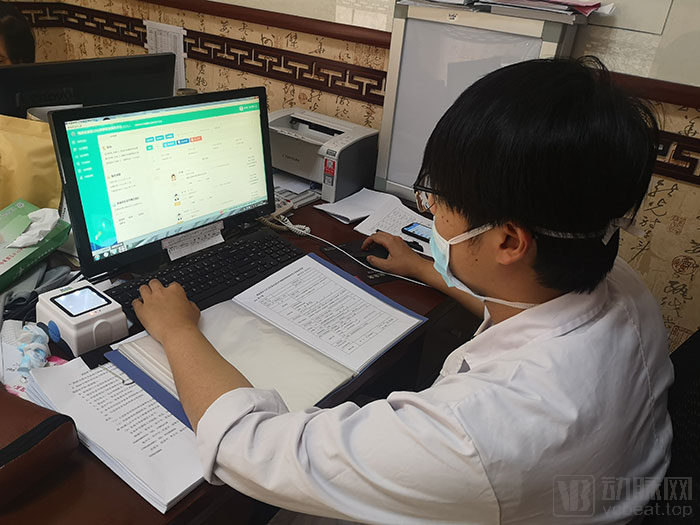
Li Tianjiao Reviews Health Records of Chronic Disease Patients at the Workstation
Li Tianjiao introduced that the dozens of diabetic and hypertensive patients under his care have become the first pioneers under the new model, connecting with him through Xiaodu Ai Jiankang.
According to reports, Ms. Liu is a diabetes patient. She said, “It reminds me to take my medication on time. In the past, when I was busy, I often forgot how much medication to take. When I was uncertain about whether I had taken other medications, I would consult Xiaodu Ai Jiankang (Baidu Health), and it would tell me the dosage, administration instructions, contraindications, and other relevant information. Previously, I frequently forgot to monitor my blood glucose levels when occupied with other tasks. Now, it reminds me when it is time to check my blood sugar. After testing, the data is automatically uploaded to the system via facial recognition. The system also synchronizes my test results from hospital visits, eliminating the need for me to read each item aloud from my notebook to Dr. Li—a task that was sometimes difficult for me to describe clearly. Due to my poor eyesight and limited proficiency in using smartphones, I find it hard to see the screen clearly. By communicating with Xiaodu Ai Jiankang directly through voice commands, I no longer need to burden my children with these concerns. I also use Xiaodu Ai Jiankang to stay in touch with them, as well as to control my TV and air conditioner. When I am bored, it even chats with me. This little device is truly quite interesting.”
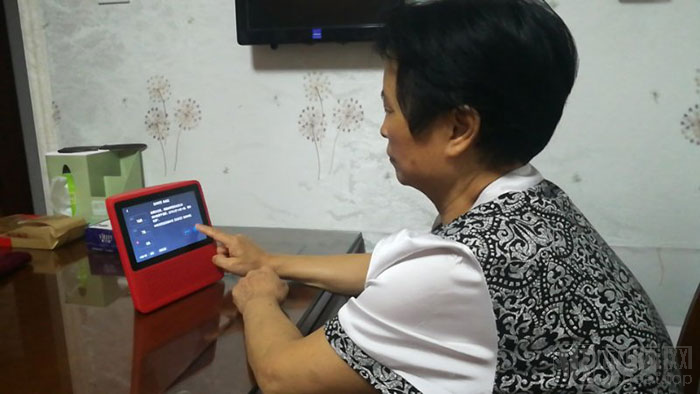
Ms. Liu uses Xiaodu Ai Jiankang at home
Li Tianjiao added, “For the elderly and patients with chronic diseases, the voice interaction and facial recognition features of Xiaodu Ai Jiankang are very user-friendly. During the pandemic, patients required assistance from family doctors for both medication management and psychological support. With Xiaodu Ai Jiankang at hand, neither I nor my patients needed to leave home; we could conduct medication guidance, disseminate epidemic prevention information, and provide psychological counseling, which was very convenient.”
It is reported that in November 2019, Baidu and Inspur signed a strategic cooperation agreement. Both parties announced that they would jointly promote the application and implementation of cutting-edge technologies such as artificial intelligence, cloud computing, big data, and the Internet of Things (IoT) in the healthcare sector, thereby driving industrial transformation and accelerating the process of intelligentization within the industry. The Huaiyin pilot project received strong support from the Jinan Municipal Health Commission. By integrating the Jinan Health and Medical Big Data Platform with Inspur’s “iHealth” Primary Healthcare Integration Service Platform and Xiaodu smart speakers, the two parties have jointly created the “Xiaodu iHealth” Chronic Disease Management Service Solution, marking a significant milestone in their collaboration.
Lingyi Zhihui, Baidu’s smart healthcare brand, leverages the authoritative knowledge of the People’s Medical Publishing House along with AI technologies such as medical natural language understanding and knowledge graphs to create a comprehensive solution. Meanwhile, Inspur capitalizes on its leadership in big data by integrating basic public health, primary care, and family doctor contracting business systems with its big data platform. This enables the fusion and sharing of grassroots health work data with clinical data from medical institutions within Jinan Municipality and self-monitoring data from residents’ smart devices. Monitoring data from patients using Xiaodu Ai Jiankang can be synchronized in real time, achieving the integration of public health, medical care, and health management, thereby effectively supporting the development of a new model for integrated medical and preventive care.
Huang Yan, General Manager of Baidu Smart Healthcare, stated that in the near future, the Xiaodu Ai Jiankang Chronic Disease Management Solution will incorporate additional features, including risk prediction, personalized recommendation plans, and in-depth diagnosis and treatment services for common diseases at the primary care level. Meanwhile, Baidu and Inspur are continuing to advance the implementation of various innovative medical service applications, such as Clinical Decision Support Systems (CDSS) and fundus image analysis systems. They are also exploring the development of an open platform service operation system based on big data and artificial intelligence, working together to create more compassionate and impactful healthcare and health service products.
Gao Chuangui, Chairman and CEO of Inspur Health, stated that the Huaiyin District of Jinan, designated as a national pilot zone for integrated medical and elderly care by Jinan City, places high importance on the high-quality development of primary public health services and the improvement of health outcomes for individuals with chronic diseases. The district is actively embracing advanced technologies and promoting the construction of new service models. By leveraging their combined strengths in integrated innovation, Inspur and Baidu have successfully launched the new "Xiaodu Ai Jiankang" (Xiaodu Love Health) home-based smart health service model, which empowers primary care family doctors and enhances residents' health. This year, the two companies will deepen their cooperation to provide more and better big data and AI-driven healthcare solutions, expanding service implementation across more scenarios and regions, thereby advancing the digitalization and intelligent transformation of primary healthcare services and resident health management.