

ByteDance Acquires Baikemy to Enter Digital Health: Ambitions and Strategic Moves
On May 15, 2020, data from Qichacha showed that ByteDance had completed a full acquisition of Baike Mingyi Wang, with the legal representative of Baike Mingyi Wang changed to Yan Shou, a senior executive at ByteDance.
It is hardly news that tech giants have entered the healthcare sector. JD Health secured over $1 billion in Series A financing shortly after its launch; Alibaba Health’s market capitalization on the Hong Kong Stock Exchange has exceeded HK$250 billion; Baidu and Tencent continue to intensify their efforts in internet healthcare; and Meituan has expanded into the broader health industry, starting with medical aesthetics.
Nevertheless, ByteDance’s quiet entry into the sector has come as somewhat of a surprise. At first glance, Baike Mingyi Wang appears to serve ByteDance by providing more authoritative medical content for Toutiao Baike.
Is it really that simple? By examining Baike Mingyi Network and ByteDance, VCBeat has uncovered more information. ByteDance’s layout in the healthcare sector seems to be gradually becoming clear...
ByteDance’s 2020 strategic layout saw its first move shortly after the Spring Festival.
In February 2020, the standalone Toutiao Search app was launched, bringing the web-based Toutiao Search, which had been available since 2019, to the familiar mobile platform in an effort to enter the search engine market. Subsequently, in late April 2020, the beta version of Toutiao Baike was launched, providing Toutiao Search with its own encyclopedia-style product.
So, why did ByteDance suddenly acquire Baike Mingyi Wang? The answer may lie in the medical content of encyclopedia-style products.
Encyclopedia-style products are science popularization platforms built by online communities. In most industries, there is no issue with scientific knowledge bases and entries being voluntarily created and maintained by internet users. However, the healthcare sector is an exception. Misinformation in the healthcare field may mislead users into making incorrect decisions, thereby posing risks to their health.
Therefore, major search engines have adopted authoritative sources for medical-related content. For instance, Sogou Search utilizes Baike Mingyi Wang; QQ and WeChat Search rely on Tencent Yidian; and Baidu launched Baidu Health Yidian in mid-2019 to establish an authoritative platform for medical and health science popularization.
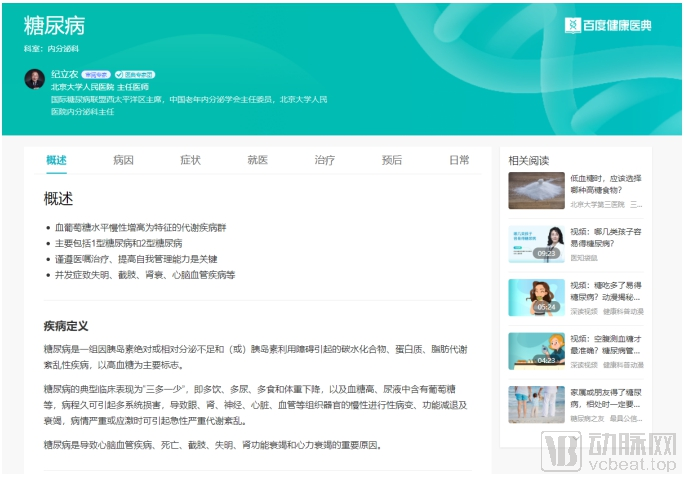
Baidu Health Medical Encyclopedia Page
Taking Baidu Search and Baidu Health Medical Encyclopedia as examples, when users search for medical and health-related terms on Baidu, the top result is the relevant content from the Baidu Health Medical Encyclopedia. All content undergoes editorial review by industry experts and includes comprehensive information ranging from overview, etiology, and diagnostic and treatment processes to prognosis.
Baidu Health Medical Encyclopedia has established a comprehensive healthcare ecosystem that connects with regulatory authorities at the top, collaborates with hospitals and physicians in the middle, and serves end-users at the grassroots level, with potential for further expansion into broader medical scenarios.
Search engines became a key focus for ByteDance in 2020, and the company naturally sought to capitalize on the high-demand sector of medical science popularization. Compared with building its own encyclopedia, acquisition would be a preferable strategy when suitable targets are available.
Baike Mingyi, acquired by ByteDance, was launched in 2012. By collaborating with major hospitals and top-tier experts and scholars, it provided professional medical science popularization content and served as the sole designated platform for the authoritative medical science popularization project of the former National Health and Family Planning Commission. In terms of industry positioning, Baike Mingyi’s ability to connect industry resources and its content quality align well with ByteDance’s needs.
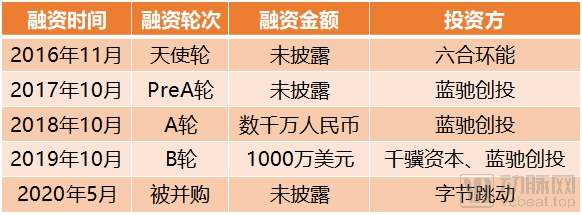
Baike Mingyi Network's Financing History
Just six months prior to the acquisition, Baike Mingyi Network had only just completed a $10 million Series B financing round in October 2019, invested by Qianji Capital and BlueRun Ventures. ByteDance’s decision to acquire it under these circumstances underscores its determination to enter the field of medical science popularization. Currently, the corporate entity of Baike Mingyi Network, “Beijing Pumeida Technology Development Co., Ltd.,” is wholly owned by ByteDance’s subsidiary “Beijing Hudong Jizhi Technology Co., Ltd.”
In the field of professional medical knowledge popularization, Baiko Mingyi Network, Baidu Health Medical Encyclopedia, and Tencent Medical Encyclopedia are the three major products. All three encyclopedia-type products collaborate with professional doctors and institutions to provide users with professional-grade medical content. However, through different choices in product details, it can be seen that there are subtle differences in the specific product logic among the three products.
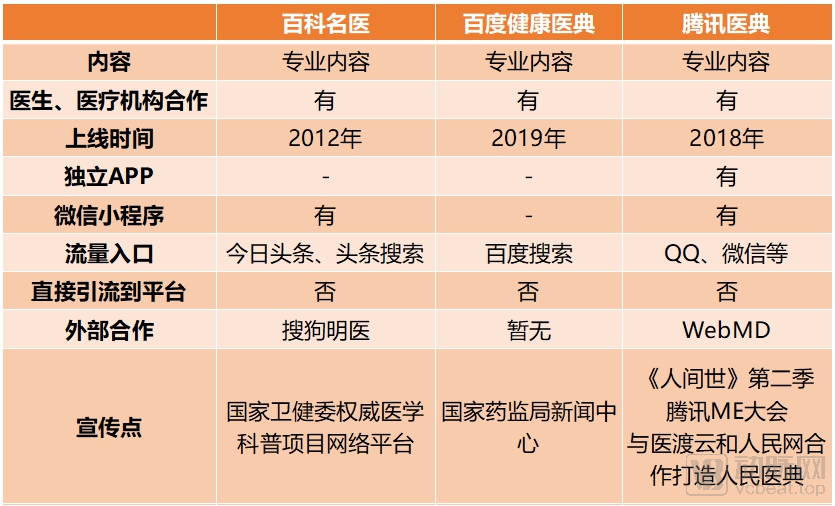
A Brief Comparison of Three Medical Science Popularization Products
Based on the characteristics of the three products, we conducted an analysis from the following dimensions:
Traffic Entry Point:Following ByteDance’s acquisition, the traffic acquisition models for the three products are largely consistent, with all relying on imports from their respective proprietary traffic platforms. Baike Mingyi Network draws traffic from Jinri Toutiao and Toutiao Search; Baidu Health Medical Encyclopedia primarily acquires traffic through Baidu Search; while Tencent Medical Dictionary obtains traffic via search entry points in WeChat or QQ. Furthermore, none of the three companies direct traffic straight to their medical encyclopedia platforms; instead, user engagement remains within the original platforms.
Product Positioning:It is evident from their traffic entry points that the functionalities of all three products resemble supplementary plugins for search engines, providing incremental information to these platforms. Neither Baike Mingyi Network nor Baidu Health Medical Encyclopedia has a standalone mobile app; notably, Baidu Health Medical Encyclopedia does not even have an independent WeChat mini-program. This aligns with their positioning as search engine plugins, as plugins are designed solely to deliver specific functionalities, whereas standalone apps could divert user traffic away from the core search experience. Among the three, Tencent Medical Encyclopedia maintains a relatively independent position. It launched its dedicated app in early 2019 and has adopted a more proactive approach in its promotional efforts.
Business Model:Baidu Health Medical Encyclopedia is an authoritative public welfare initiative for popularizing health knowledge launched by Baidu Health; therefore, revenue generation is not its core objective at this stage. Tencent Medical Dictionary also appears to be positioned as a public welfare project. Although Tencent has not explicitly stated this, no paid services or obvious advertisements have been found within its mini-program or app. The business model of Baike Mingyi Network following its acquisition will be discussed later in this article.
External Cooperation:Tencent Medical Encyclopedia has been the most proactive, partnering with WebMD in 2018 to secure exclusive licensing for its content and featuring a dedicated WebMD section within its app. In March 2019, it collaborated on the release of the “Medical Encyclopedia Insights” short-video series alongside the second season of the documentary “The Human World.” In November 2019, Tencent Medical Encyclopedia served as one of the organizers of the Tencent ME Conference. Additionally, in August 2019, it announced a tripartite collaboration with People’s Daily Online and Yidu Cloud to jointly develop the intelligent health product “People’s Medical Encyclopedia.”
Baike Mingyi Network has been in operation for eight years, the longest among the three companies, and offers more extensive information. In 2016, under the guidance of ministries including the former National Health and Family Planning Commission and the Ministry of Science and Technology, Baike Mingyi Network collaborated with Baidu and China Search to jointly establish an authoritative online platform for medical science popularization. Additionally, Baike Mingyi Network previously partnered with Sogou to provide content support for Sogou Mingyi.
Yang Minglu, General Manager of Baidu Health Business Division, stated earlier this year that Baidu Health Medical Encyclopedia would deepen its cooperation with the News Center of the National Medical Products Administration, replicate and innovate existing content production models, expand the reach of authoritative content, and improve the construction of its content ecosystem.
Past Achievements:Baidu Health Medical Encyclopedia and Tencent Medical Encyclopedia have both delivered impressive performance.
In early 2020, Baidu Health Medical Encyclopedia had already collaborated with over 400 experts and more than 60 authoritative institutions across China, meeting an average of 12 million daily searches for health-related information. Building on the Medical Encyclopedia product, Baidu launched the “Lingyun Initiative,” which integrates experts’ biographies, encyclopedia entries they have contributed to, and popular science articles to create personalized physician homepages. This initiative helps physicians build their personal brands while enhancing users’ experience in seeking medical advice and care.
Tencent Medical Encyclopedia is no less impressive. By June 2019,Tencent Medical Dictionary has established collaborations with over 100 renowned hospitals and more than 1,000 experts across China, including over 80 academicians of the Chinese Academy of Sciences and the Chinese Academy of Engineering, as well as disciplinary leaders. It provides authoritative medical and pharmaceutical information on more than 8,000 diseases, featuring over 1,500 videos alongside other multimedia content. The platform has constructed in-depth, structured medical knowledge graphs for various diseases, covering symptom identification, preliminary diagnosis, treatment options, and rehabilitation management.
Driven by the precedent set by Baidu Health Medical Encyclopedia and Tencent Medical Encyclopedia, ByteDance has also chosen to enter the healthcare sector through medical science popularization. This, however, appears to be merely the beginning of ByteDance’s strategic layout in the health and medical field.
Prior to the acquisition of Baike Mingyi, ByteDance’s footprint in the healthcare sector was lackluster. The acquisition of Baike Mingyi remains virtually its only capital move in the healthcare field to date. Although ByteDance’s platforms—including Douyin, Xigua Video, and Douyin Huoshan Ban—all feature health-related sections, Toutiao has been the most active player within its product matrix in the healthcare domain.
Toutiao has suffered setbacks in the healthcare sector.
According to the National Enterprise Credit Information Publicity System, ByteDance was fined RMB 3 million in 2018 for issues related to health supplement advertising. The very next day after the penalty was publicly disclosed, ByteDance launched its first support initiative in the health sector.
At the “2018 Suanming Health Conference,” Toutiao launched the “Qingfeng Initiative,” entering the specialized field of healthcare and medicine. The “Qingfeng Initiative” plans to invest RMB 15 million throughout the year to support and promote high-quality content, aiming to build a healthy science popularization ecosystem where content trends toward excellence, traffic returns to original works, and fans rally around outstanding creators. This also marks ByteDance’s formal push into the healthcare sector and its initial efforts to drive the production of high-quality content.
In 2019, Toutiao continued to strengthen its presence in the healthcare sector, focusing on hospital branding and the personal brands of doctors and experts. It launched initiatives and programs such as “Remarkable Hospitals,” “Renowned National Doctors on Toutiao,” the short-video series *Dear Doctor*, and the micro-interview series *Renowned Doctors on Toutiao*. These initiatives, developed in collaboration with three hospitals, consistently produced high-quality, medically professional content.
One year after the launch of the “Clear Breeze Initiative,” Toutiao released its 2019 Health Big Data report, marking its inaugural performance review in the healthcare and medical sector. Within one year, 63,000 health-related accounts produced 3.949 million pieces of content, with nearly 32,000 articles achieving over 100,000 views each. The total number of views for health-related information on Toutiao reached 54 billion, with approximately 35 million users browsing health content daily—a 60.7% increase from 2018. The number of saves exceeded 720 million, representing a 50% growth; likes surpassed 320 million, surging by 461%; and comments totaled 86 million, an increase of 139%. The “Remarkable Hospitals” project collaborated with 104 hospitals, onboarded more than 1,400 doctors, and generated over 140,000 pieces of content.
Maintaining the production of high-quality content is ByteDance’s core strategy for penetrating vertical sectors. As its daily active users (DAU) continue to rise, ByteDance is approaching its growth ceiling. Amid increasing difficulties in user acquisition, only high-quality content can ensure long-term user retention.
After solidifying its user base, ByteDance faces another question: how to establish a viable business model in the healthcare sector?
In internet-based medical popularization projects, entrepreneurs often look to WebMD as a benchmark. ByteDance’s acquisition of Baike Mingyi Wang is also viewed by some as the “Chinese version” of KKR’s acquisition of WebMD, aiming to integrate top-tier content and establish an ecosystem in the healthcare sector.
Is WebMD's business model applicable to Toutiao?
WebMD remains one of the world’s leading providers of professional medical content. Its two main divisions serve distinct audiences: WebMD targets consumers, while Medscape caters to healthcare professionals. Together, these businesses constitute the WebMD Health Network, forming a comprehensive medical information system that covers both patients and physicians.
In the final annual report released by WebMD prior to its privatization in 2017, it was disclosed that the company generated over $700 million in revenue and a net income of $90 million in 2016, representing a 42.6% year-over-year increase. Advertising and sponsorship revenues from pharmaceutical and medical device companies amounted to $560 million, serving as the primary source of income; additional revenue streams included health services (such as medical consultations) and a minor portion from information services. Operating costs and marketing expenses constituted the main components of its cost structure.
WebMD appears to have established a comprehensive commercial monetization pathway: high-quality content attracts readers, with revenue generated through pharmaceutical and medical device companies as well as medical consulting services. This model also aligns with Toutiao’s current strategic initiative to continuously promote the production of high-quality medical content.
But don’t forget that the regulatory environment in the United States differs from that in China, so WebMD’s path may not necessarily be applicable domestically. Toutiao can pursue this business, but its growth ceiling will be significantly lower than that of WebMD.
First, ByteDance’s business layout in healthcare differs from that of WebMD. Among WebMD’s two subsidiaries, Medscape is specifically targeted at healthcare professionals, resembling DXY and Xingshulin. In 2015 and 2016, 60% of WebMD’s advertising and sponsorship revenue came from this segment, an area that ByteDance has not yet been able to penetrate.
Secondly, in 2016, WebMD generated $428 million from prescription drugs and medical devices in its advertising and sponsorship revenue, accounting for 76.3%. This figure seems inconsistent with the previously mentioned 60%. It is not because WebMD made an error, but rather due to differences in advertising regulations. In the United States, prescription drugs can be advertised directly to the public, whereas in China, prescription drugs are only allowed to be marketed academically to healthcare professionals, with direct-to-consumer advertising being prohibited.
Of WebMD’s $700 million in revenue, ByteDance can only leverage the $280 million portion. This figure also excludes the portion of revenue from Medscape within the $132 million generated by over-the-counter drug advertising. Moreover, given that ByteDance has previously been penalized for health supplement advertising, it is bound to exercise greater caution when entering the pharmaceutical sector.
Therefore, the largest sector that ByteDance can enter at this stage is medical consultation.
Is ByteDance about to launch medical consultation services? No, they already have.
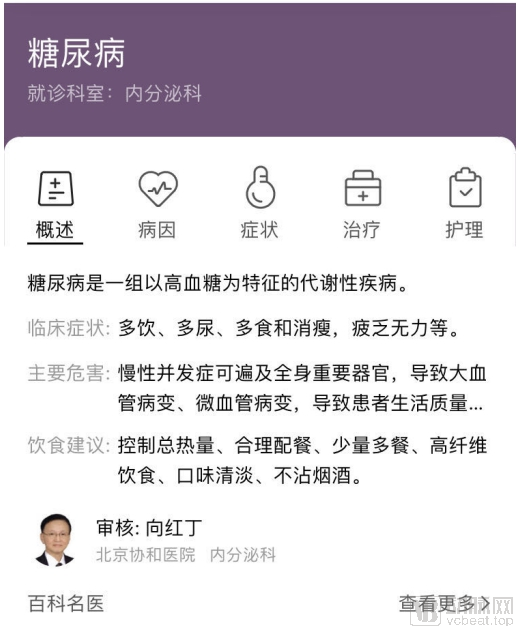
Content Provided by Baike Mingyi Network on the Toutiao App
On Toutiao, searches for medical and health-related terms now prioritize professional content provided by Baike Mingyi Wang. The overall content distribution is largely consistent with that of Baidu Health Medical Encyclopedia, and even includes more user-centric features such as diabetes self-assessment tools and expert Q&A sessions.
Near the end of the article, a section on paid consultations is featured. Users can pay to ask doctors questions directly through the Toutiao app by providing their mobile phone numbers, and doctors will respond to patients’ inquiries within 24 hours.
Subsequently, we searched the WeChat mini-program and website of Baike Mingyi Network but found no entry point for medical consultations. This indicates that this service is not an original offering of Baike Mingyi Network but was developed specifically for Toutiao.
The service's inquiry guidelines state, "This service is provided by DXY Doctor."
With its robust content output, DXY has amassed 8.55 million followers on Toutiao, making it the largest producer of medical and health-related content on the platform. Under these circumstances, the collaboration between DXY and ByteDance is a natural progression.
Currently, the project appears to be in a trial phase, with no large-scale promotion. From a functional perspective, there is still significant room for improvement.
The medical consultation services offered through this project are priced the same as those on the Dingxiang Doctor app. However, the Toutiao app only supports text input, lacking options for image uploads, prescription issuance, or access to patients’ medical histories. In other words, when consulting via the Toutiao app, physicians must provide medical advice based solely on patients’ basic information and textual descriptions of their conditions, and they are limited to offering such advice only. Compared with other online consultation platforms, the consultation experience on the Toutiao app leaves room for improvement.
Beyond this, there are more intriguing details.
Toutiao does not directly redirect users to the DXY platform; it merely utilizes DXY’s online consultation services. Does ByteDance intend to provide its own online consultation services in the future? This question arises because Baike Mingyi Network, which was acquired by ByteDance, has a subsidiary named Hainan Pugongying Internet Hospital Co., Ltd.
Hainan Pugongying Internet Hospital Co., Ltd. is a subsidiary established by Baike Mingyi Network in August 2019. Clearly, Baike Mingyi Network had already planned to enter the internet hospital sector at that time, which was also the reason for its Series B financing round.
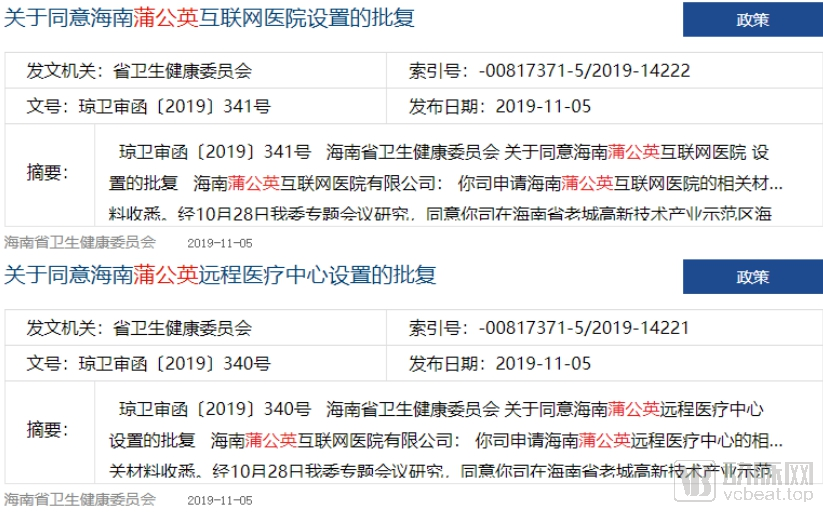
Public Notice on the Official Website of the Hainan Provincial Health Commission
According to the official website of the Hainan Provincial Health Commission, on November 5, 2019, the Commission approved the establishment of the Dandelion Internet Hospital and the Dandelion Telemedicine Center by a subsidiary of Baike Mingyi Network on the 2nd and 4th floors of Building B-13A, Hainan Ecological Software Park, in the Laocheng High-Tech Industrial Demonstration Zone, Hainan Province. In accordance with the six-month preparatory period stipulated in the approval, the project should currently have entered the acceptance phase.
Currently, the executive team displayed on the business registration page of Dandelion Internet Hospital remains the original team from Baike Mingyi Network. Given that the executive team of Baike Mingyi Network has already completed its industrial and commercial registration changes, we speculate that ByteDance’s team may lack professional healthcare management personnel. Consequently, the subsequent operations of Dandelion Internet Hospital continue to be managed by the original Baike Mingyi team, while ByteDance has temporarily taken over only the science popularization website pages.
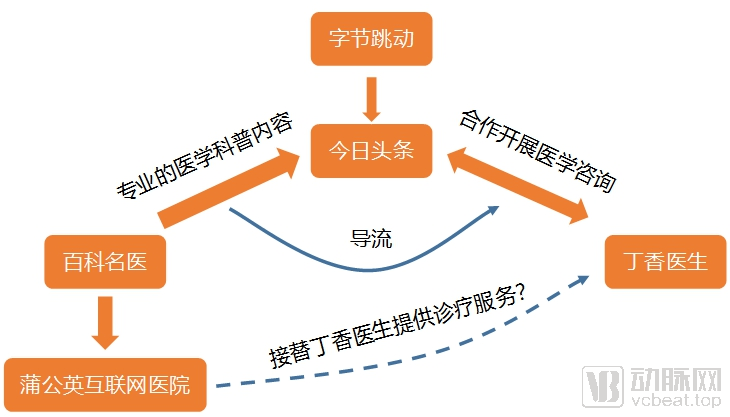
Speculation on ByteDance's Healthcare Layout
It is reasonable to speculate that Toutiao has partnered with DXY to launch an online consultation page, while also acquiring Baike Mingyi Network, thereby gaining access to an internet hospital on the verge of completion. Perhaps Puguangying Internet Hospital will take over this online consultation business in the future; however, we must await official announcements from ByteDance for further details.
In summary, the acquisition of Baike Mingyi represents a solid step forward for ByteDance in the healthcare sector. Although ByteDance has not yet officially announced its strategic layout in healthcare, its determination to penetrate this field is already evident. As internet tech giants continue to deepen their involvement in healthcare, we will maintain close attention on these developments.