

AI-Powered Transformation and Upgrade of Wuhan’s 'Hero Hospital'

SHUKUN
Provider of Intelligent Products and Innovative Solutions
“Inhale—hold your breath—exhale.” In the CT room, a physician at Union Wuhan Red Cross Hospital (Wuhan No. 11 Hospital) is performing a chest CT scan on a patient. The patient is a man in his early 60s.This was also the first patient to undergo a coronary CTA examination within the hospital. The introduction of this coronary imaging capability, from scratch to implementation, was made possible by the department’s adoption of a “new assistant”—cardiovascular AI.
As the closest Grade II Class A general hospital to the Huanan Seafood Market, it set an all-time high of 2,400 outpatient visits per day during the pandemic. One of the hospital’s aging CT scanners, overwhelmed by ultra-high-intensity operation, was retired. On March 25, after 63 days of suspending consultations for non-COVID-19 patients and undergoing a week of comprehensive disinfection, the hospital resumed full operations.
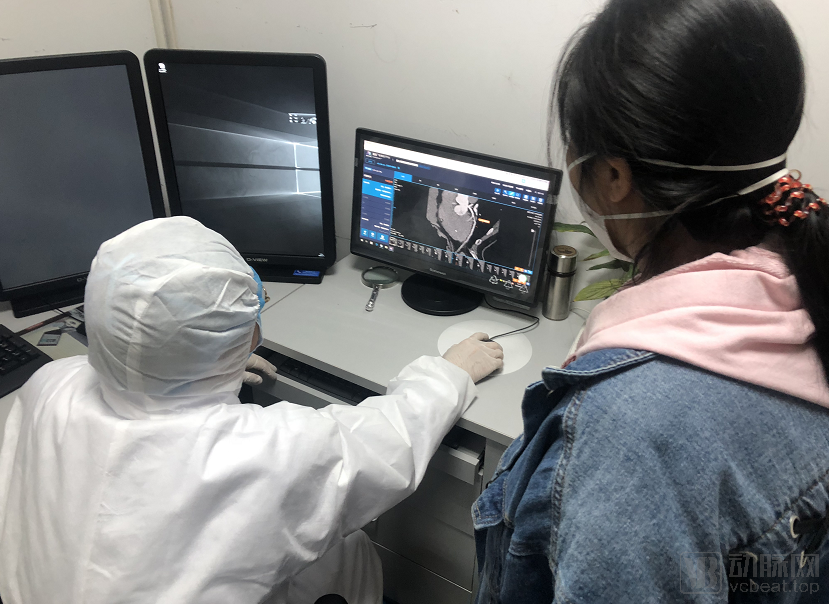
Wuhan Red Cross Hospital of Peking Union Medical College Uses Cardiovascular AI
Amid the severe global epidemic prevention situation, hospitals need to make more solid preparations. During the pandemic, AI technologies that “addressed urgent needs” brought about a significant improvement in efficiency, giving doctors a more intuitive understanding. The procurement of large-scale equipment such as CT scanners and their accompanying AI imaging systems has also come into the view of more hospital decision-makers. Under the threat of the epidemic, Wuhan Union Red Cross Hospital immediately initiated the emergency introduction of relevant equipment.
CT scanners with 64 slices or more are capable of performing cardiac imaging; however, compared to those with 128 slices or more, the former places higher demands on physicians’ expertise. For large tertiary hospitals, this difference is primarily reflected in efficiency. In contrast, for primary care institutions, factors such as equipment performance, operator proficiency, post-processing capabilities, and diagnostic accuracy directly determine whether routine cardiac CT examinations can be implemented.
How to make the choice is a problem faced by many hospitals.
Current cardiovascular AI is already capable of processing cardiac images obtained from 64-slice CT scans, automatically completing post-processing and diagnosis. Ultimately, the hospital chose to adopt the combination of 64-slice CT and SHUKUN AI.
In late March, Wuhan saw an orderly resumption of work and production; however, hospitals maintained a high level of protective measures, posing significant challenges for commercial delivery.
“Typically, we dispatch a professional delivery team, including deployment and operational training, to ensure that the AI system can be rapidly put into use once it arrives at the hospital,” said Ma Chun’e, CEO of SHUKUN. However, this delivery differed significantly from standard procedures; technical personnel were unable to visit the site in person, so the task was handed over to Wen Di, a sales representative based in Wuhan.
In mid-April, under the remote guidance of technical specialists, Wendi, a “technical layperson,” entered the hospital to perform the installation while wearing double protection—an N95 respirator plus a surgical mask. Training was conducted concurrently, and the department promptly accepted its first scheduled patient for coronary artery examination.
The relaunched “Hero Hospital” has also achieved a breakthrough by introducing coronary CTA examinations for the first time.
SHUKUN is no stranger to hospitals in Wuhan.
Previously, SHUKUN launched the industry’s first coronary AI system and initially collaborated with hospitals in the Wuhan region. According to reports, “(SHUKUN’s) coronary AI system … (helps physicians reduce) the processing time for a single case from approximately 40 minutes to just 3 minutes, earning it the nickname ‘Polaroid’ of coronary examinations.”
Within the national radiology community, the system has also garnered sustained attention. Director Hu has maintained ongoing exchanges with department heads at major hospitals in Wuhan, and the positive reputation of SHUKUN AI in practical applications has further reassured the hospital administration.
However, the direct and seamless implementation of AI in hospitals without prior experience in coronary CT angiography (CCTA) has put artificial intelligence to the test. The sole criterion for evaluating the value of AI is whether it can genuinely enable hospitals to establish CCTA services from scratch and achieve practical clinical adoption.
At Wuhan Red Cross Hospital of Peking Union Medical College, the initial coronary artery scan yielded suboptimal image acquisition due to the patient’s poor breath-hold cooperation, posing challenges for subsequent image reconstruction and diagnosis. Gratifyingly, the overall quality of images reconstructed by SHUKUN AI was satisfactory. “Technology has truly transformed the way radiologists work.”
Its excellent performance in generalization is attributable to SHUKUN’s accumulated AI technologies and clinical capabilities.
Zheng Chao, Head of Technology at SHUKUN, introduced that the coronary AI system employs a multi-dimensional woven neural network to automatically and precisely segment coronary vessels from coronary CT angiography images. “Through continuous learning and improvement during clinical use, we are highly confident in the product’s generalizability, whether applied to ultra-high-end equipment or standard CT scanners.”
In addition, to ensure that less experienced physicians can use the system smoothly, SHUKUN’s operations team conducts regular hospital visits, complementing its proprietary remote assistance tool, “SHUKUN Little Angel.” “We also maintain a dedicated online communication group with the hospitals. Whenever our physician users encounter any issues during clinical use, our team provides prompt responses,” said Wen Di.
During the pandemic, artificial intelligence became closely integrated with the healthcare industry, rapidly achieving practical implementation in areas such as drug screening, disease detection, and assisted diagnosis. The efficacy of AI has also left a deep impression on physicians. The introduction of coronary artery AI at Wuhan Red Cross Hospital affiliated with Peking Union Medical College enabled a breakthrough from zero to one in the hospital’s coronary examination capabilities. Perhaps medical technologies like AI will serve as a “breakthrough point” for primary care hospitals in building major disease prevention and control systems.
Primary healthcare institutions have long served as the cornerstone for implementing tiered diagnosis and treatment systems and for preventing and controlling major diseases. Under the Healthy China Initiative, chronic disease prevention and control—exemplified by initiatives targeting cardiovascular and cerebrovascular diseases—has emerged as a focal area. The Bureau of Disease Prevention and Control under the National Health Commission also emphasizes that screening and management of chronic diseases rely primarily on primary care facilities.
According to statistics, nearly half of China’s hospitals are district- and county-level hospitals, with their number reaching 15,400 in 2018, including 4,958 county-level city hospitals. In terms of outpatient volume, district- and county-level hospitals accounted for 33% of the national hospital outpatient visits, with county-level city hospitals handling 441 million patient visits.
Driven by the new healthcare reform policies, primary hospitals have also made significant strides in upgrading equipment and building specialized teams. In district- and county-level hospitals, large-scale medical devices such as 64-slice CT scanners are gradually becoming standard configurations.
However, equipment upgrades do not necessarily lead to improved diagnostic and treatment capabilities. The experience and competence of physicians have become the bottleneck constraining the diagnostic and treatment capabilities of primary care hospitals.
Professor Liu Shiyuan, President-Elect of the Chinese Society of Radiology under the Chinese Medical Association, stated in an interview, “Basic township health centers are equipped with imaging devices, but 70% of township health centers in China lack radiologists with diagnostic capabilities.”
A report from Fuwai Hospital of Cardiovascular Diseases, Chinese Academy of Medical Sciences indicates that among hospitals nationwide equipped with 64-slice CT scanners, 30% are unable to perform coronary artery examinations, and 76% of Tier II Grade A hospitals conduct fewer than 10 coronary examinations per month using their 64-slice CT scanners.
Strengthening the diagnostic and treatment capabilities of primary care physicians: One key aspect is transferring the expertise of senior specialists to primary care providers.
Built on algorithmic models guided by expert experience and augmented by deep learning across vast case datasets, AI effectively brings top-tier diagnostic and treatment capabilities to primary care settings without disparity.
Taking coronary CTA as an example, image post-processing is time-consuming, and tasks such as report writing and diagnosis are difficult for physicians without 3–5 years of experience to perform. However, with the aid of coronary AI, primary-care physicians can conduct coronary examinations after receiving minimal training.
Previously, SHUKUN conducted a multi-center AI validation study across 25 provinces and municipalities in China, involving 42 Grade A tertiary hospitals, with digital subtraction angiography (DSA)—the diagnostic “gold standard”—as the reference. The results also demonstrated that the sensitivity of the artificial intelligence system was comparable to that of senior physicians.
“Artificial intelligence plays a significant role in building China’s national disease prevention and control system for major diseases. For hospitals with no prior foundation in coronary artery diagnostics, AI has enabled a leap from scratch; for those with insufficient capabilities, it has enhanced their diagnostic and treatment capacities. AI’s ability to standardize care allows primary-level examinations to be recognized by large hospitals, significantly reducing the need for patients to travel long distances,” said Ma Chun’e, CEO of SHUKUN.
Previously, SHUKUN had collaborated with the Pinggu District Health Commission to promote relevant implementation demonstrations at Pinggu District Hospital.
In the first week of AI’s deployment at Union Wuhan Red Cross Hospital, the department was able to perform coronary CTA examinations for patients every day. It is reported that the hospital is gradually increasing the number of available appointments for coronary CTA scans, enabling more patients to undergo these examinations closer to home.
During the pandemic, Wuhan Union Red Cross Hospital admitted all patients in need, with doctors working at full capacity; this heroic team saved the lives of many patients. Numerous studies have shown that patients with underlying conditions experience more rapid disease progression. While the outbreak has been brought under control in Wuhan and across China, the global risk of continued spread remains severe.
“We are also continuously strengthening our capabilities to ensure more comprehensive preparedness for potential future risks, in order to safeguard the health of the people of Wuhan.”
Wuhan Red Cross Hospital Affiliated to Peking Union Medical College is undergoing renovation and upgrading.