

MagicNurse Files IPO Prospectus: World’s First Fully Automated Smart Blood Collection Robot Completes Five-Year R&D Journey to Close the Loop in Automated Blood Testing
In recent years, with technological advancements and improvements in healthcare coverage, the range of blood tests has continued to expand, making blood collection an increasingly critical step. Statistics show that over 95% of medical institutions perform phlebotomy services. The growing demands on hospital laboratory departments to enhance research and analytical capabilities and improve patient experience have raised expectations for phlebotomy operations, necessitating further improvements in blood collection efficiency and automated management processes.
China faces a shortage of nurses and severely inadequate staffing. The "Outline of the National Healthcare Service System Plan (2015-2020)" (Guo Ban Fa [2015] No. 14) explicitly points out that there is an imbalance in the allocation structure of resource elements, with a doctor-to-nurse ratio of only 1:1, indicating a severe shortage of nursing staff. By 2020, the number of registered nurses per 1,000 permanent residents should reach 3.14, the doctor-to-nurse ratio should reach 1:1.25, and the bed-to-nurse ratio in municipal-level and above hospitals should be no lower than 1:0.6.
To enhance sample quality and ensure the safety of medical staff, Beijing Mainashi Surgical Robot Technology Co., Ltd. (hereinafter referred to as “Mainashi”) has developed an intelligent robotic system for venipuncture and blood collection. This system enables standardized, automated, and digitalized blood specimen collection in clinical laboratories, eliminating the need for nurses to perform the “three checks and seven verifications” procedure. It effectively prevents medical testing errors caused by manual operational mistakes during and after sample collection.
Liu Zizhong, the founder of Mainashi, holds a Master's degree in Economics from Nankai University and previously worked at the Health Bureau for eight years.
Prior to founding Mainashi, he established Yantai Aidekang Biotechnology Co., Ltd. in 2006, where he spearheaded the research and development of China’s first fully automated enzyme-linked immunosorbent assay (ELISA) analyzer. This innovation was awarded the First Prize for Scientific and Technological Invention in Shandong Province and certified as a “National New High-Tech Product” by the Ministry of Science and Technology. With annual sales exceeding RMB 100 million, the product was widely adopted by major domestic hospitals such as Peking Union Medical College Hospital and Beijing Tiantan Hospital, and exported to countries including Germany and Turkey. In 2015, Aidekang was acquired by Beijing Lepu Medical Technology Co., Ltd.
Prior to Lepu Medical’s acquisition of Adicon, Liu Zizhong had already shifted his focus to the field of surgical robots.
He found that while the testing and analysis stages in both hospitals and laboratories have been fully automated, sample collection remains a manual process, which has led to numerous issues. Liu Zizhong told VCBeat, “Data shows that 70%–90% of current analytical errors are caused by mistakes occurring in the pre-analytical phase.”
He believes that automating blood collection and establishing a closed-loop automated process for blood testing is an urgent priority. Thus, in November 2014, Liu Zizhong and his friends invested in the research and development of blood-drawing robots and founded Beijing Mainashi Company.
MagicNurse is the English name for Mainashi. “Blood collection is a simple and highly repetitive task, so we believe it is entirely feasible to replace manual labor with machines. Nursing itself is a strenuous and high-risk profession; currently, over 20% of nurses suffer needlestick injuries during blood collection each year. Our stance is that even if this figure were as low as 1%, it would still be unacceptable,” Liu Zizhong stated firmly in an interview with VCBeat.
Since its establishment in 2014, Mainashi has grown to becomeThe company currently operates a modern, clean R&D workshop spanning nearly 1,000 square meters. Its R&D team is led by a Ph.D. holder from the Chinese Academy of Sciences and comprises a group of highly experienced professionals in mechanical automation, electronic hardware, software, and optical engineering. Furthermore, the company has established close collaborative partnerships with the Robotics Institute of Beihang University and Beijing Youan Hospital.
During the product R&D phase, Mainashi already secured multiple accolades and funding supports, including being named the “Most Promising Growth Project” at the 2016 China Sci-Tech Entrepreneurship Talent Investment and Financing Boot Camp hosted by the Ministry of Science and Technology of China; receiving startup project funding support from the Beijing Municipal Science & Technology Commission for technology-based SMEs in 2016; winning the championship at the 2016 MARS Innovation and Entrepreneurship Competition in Medical and Health Care; and securing third place overall and first place in the medical category at the 2017 HKUST Million Dollar Prize International Entrepreneurship Competition (Beijing Finals).
In 2014, the fully automated intelligent blood collection robot was a brand-new project, with both domestic and international markets being completely blank—there were no reference companies or products available. From establishing the blood collection workflow to developing algorithms and designing the appearance, all technical challenges had to be overcome independently.
To enable blood-drawing robots to accurately perform tasks such as venous identification, puncture site localization, and quantitative blood collection, relying solely on medical knowledge is far from sufficient. It is essential to integrate automation and artificial intelligence technologies to truly achieve standardization, automation, and informatization in the blood collection process.
To this end, Mainashi’s research and development team dedicated five years to collecting over 200,000 vascular imaging datasets, while rigorously advancing breakthroughs in biometric recognition, image-guided navigation control, automated puncture, and intelligent interaction technologies.
Image-guided navigation and control technology based on biometrics can intelligently plan puncture paths for vessels with varying anatomical courses across different users; multi-degree-of-freedom automated puncture technology enables precise venipuncture and blood collection from vessels at varying depths; and intelligent interaction technology ensures seamless communication between users and the blood-drawing robot.
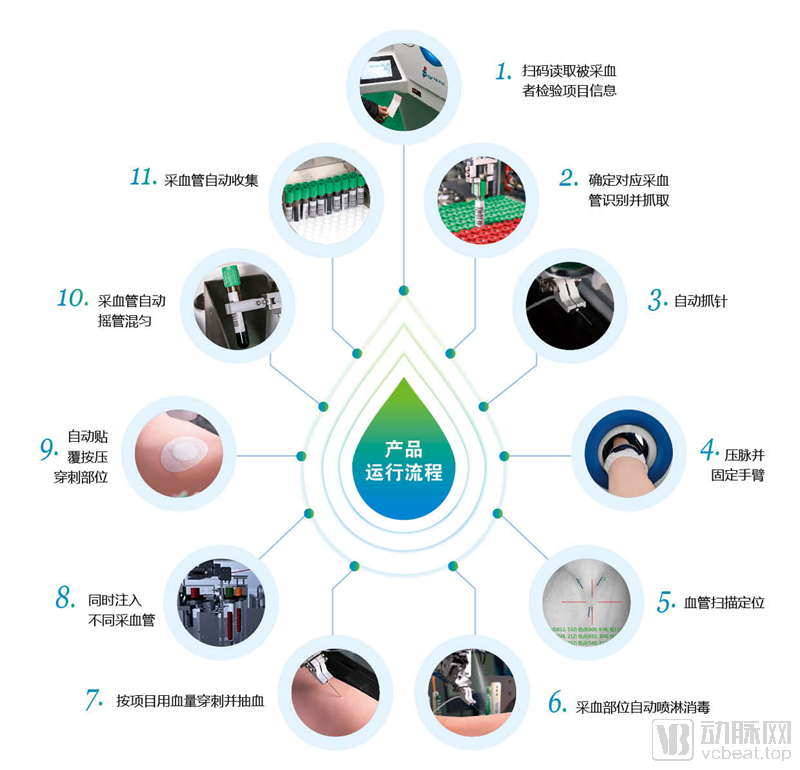
Mainashi Intelligent Puncture Blood Collection Robot: Blood Collection Procedure
(Image source: Provided by Mainashi)
The Mainashi intelligent puncture and blood sampling robot possesses fully independent intellectual property rights, holding 8 invention patents and 7 utility model patents.It is currently the only AI-powered medical robot in the world capable of achieving unmanned, standardized, and informatized processes across the entire blood collection chain., it can replace nurses to perform venous blood collection in a fully automated and unattended manner.
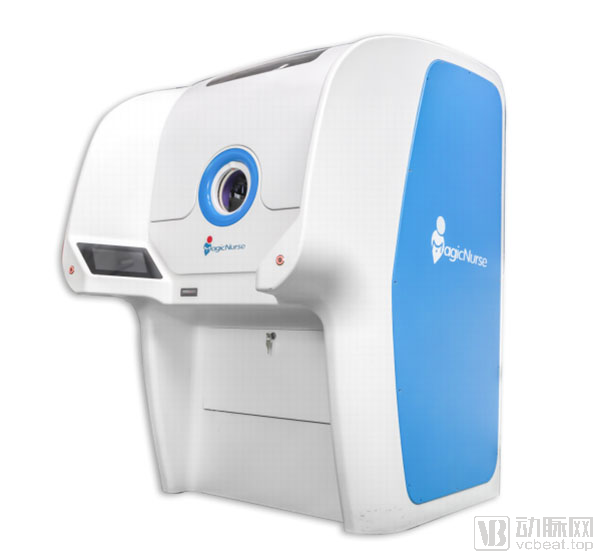
Mainashi Intelligent Puncture and Blood Sampling Robot
(Image source: Provided by Mainashi)
Once technical issues are resolved, the more critical challenge lies in addressing safety and efficacy. As a medical device intended for human use, intelligent blood-drawing robots are held to higher standards in these aspects than conventional devices. Furthermore, since artificial intelligence systems require large datasets for learning to enhance accuracy, it is necessary to recruit a sufficient number of volunteers for clinical trials.
By recruiting volunteers from the general public, as of January this year,The Mainashi intelligent blood collection robot has undergone over 3,000 live human venipuncture trials, achieving a first-attempt success rate of approximately 95%, which is nearly 20% higher than the average first-attempt success rate of nurses.Attain the level of a proficient nurse.
Currently, the Mainashi intelligent blood collection robot has passed the type testing by the CFDA and clinical trials at Beijing Jishuitan Hospital and Youan Hospital affiliated to Capital Medical University. In November 2019, it obtained the Class III medical device product registration certificate issued by the National Medical Products Administration (NMPA), and in January 2020, it received the production license for Class III medical devices, officially commencing production and sales.
Liu Zizhong told VCBeat, “The diagnosis of many diseases relies on blood test results, making blood collection a fundamental aspect of the healthcare industry. At present, Mainashi’s primary task is to continuously refine its products and quality management system, build brand awareness, and expand into the market. Frankly speaking, any newly developed product is bound to have some issues, but we should not abandon it because of these problems. Our very purpose is to solve them.”
Mainashi believes that the market potential for integrating artificial intelligence into the healthcare industry is substantial. Whether in diagnostics or therapeutics, AI-enabled devices can play a significant role in enhancing primary care capabilities and ensuring the safety of healthcare workers. Through its efforts, Mainashi aims to increase the nursing workforce supply by 5% over the next decade (equivalent to approximately 150,000 units in total), while also exploring overseas markets to become a leading enterprise in the field of phlebotomy robots.