

JuYun Smart Targets the Underserved $10B+ CSSD Market with Integrated Software and Hardware Solutions
“Only by specializing in and thoroughly mastering a specific industry, and continuously delivering innovative products, can one secure a place in the market.”
Yang Yong and his team, who were then employed at the Jiangsu Provincial Institute of Computer Science, discovered during a review of previous projects that the IT service awareness and automation level in the Sterile Supply Department were weak at the time, representing an untapped “black soil” market.
Central Sterile Supply Department (CSSD) is known as the heart of hospital infection control. It serves as a critical checkpoint for hospital infection prevention and control, disinfection and sterilization, and supply distribution. The CSSD primarily provides integrated disinfection and sterilization services to the healthcare system, offering end-to-end solutions—from collection, cleaning, and disinfection to sterilization and aseptic distribution—for reusable medical devices, diagnostic and treatment instruments, and medical textiles. Amid the severe global pandemic situation, the CSSD has garnered significant attention.
As the number of inpatients and surgical procedures increases, the sterilization load on existing hospital central sterile supply departments (CSSDs) has been rising steadily, failing to meet sterilization demands. Consequently, many hospitals need to build new or expand their CSSDs.
In 2003, the market for third-party sterile supply centers was a blank slate, with no prior experience to draw upon. Ten years later, the market size of third-party sterile supply centers in China had reached RMB 1.4 billion, growing to RMB 12 billion by 2017, representing a compound annual growth rate (CAGR) of 70%. The CAGR is projected to be 42% over the next five years. According to a Frost & Sullivan report, the market size is expected to reach RMB 76 billion by 2022.
The market is vast, and the government has frequently issued relevant policies to support the healthy development of CSSD.
On February 14, at the 12th meeting of the Central Committee for Comprehensively Deepening Reforms, national leaders repeatedly emphasized “15 systems, 9 mechanisms, and 4 institutions.” Many of these initiatives are closely related to the development of third-party sterile supply centers. The role of third-party sterile supply centers in reducing hospital infection control risks and improving the utilization efficiency of hospital personnel and facilities has been increasingly recognized by hospitals, making market demand self-evident.
A Vast Market with Few Participants. Currently, the market penetration rate of third-party sterile supply centers is less than 1%, indicating immense growth potential. Driven by the combined forces of high competitive barriers, policy support, market demand, and technological infrastructure, the third-party sterile supply industry has entered a period of significant growth opportunities.
In 2014, Yang Yong and a group of like-minded partners founded Nanjing Juyun Smart Information Technology Co., Ltd. (hereinafter referred to as “Juyun Smart”), focusing on providing comprehensive software and hardware solutions for sterile supply centers.
Juyun Wisdom strives to develop software and intelligent hardware products tailored for Super Central Sterile Supply Departments (Super CSSDs). It offers a comprehensive management solution that integrates smart software and hardware, which not only meets the operational management needs of CSSDs but also significantly enhances automated control over the cleaning, disinfection, and sterilization of medical devices, thereby enabling full lifecycle traceability of medical devices.
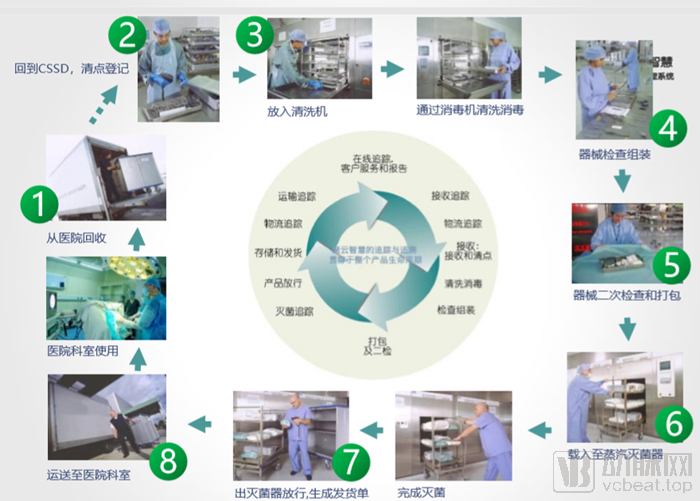
CSSD Management System Process
In terms of software management:
This solution comprises multiple integrated systems, including an intelligent traceability system, a quality management system, process control for the full lifecycle of sterilization supply services, a CSSD financial management system, and an equipment and energy consumption management system.
The operating systems of Juyun Smart’s various platforms integrate the concepts of industrial MES (Manufacturing Execution Systems), featuring user-friendly MES human-machine interfaces. All data acquisition is performed through visual QR code recognition or UHF RFID, eliminating the need for mouse and keyboard usage. This design minimizes manual operations by frontline staff in sterile supply departments to the greatest extent, significantly enhancing work efficiency.
Taking the quality management system as an example. If staff members identify quality issues, they can submit reports via PC or mobile terminals. Upon receiving automated system notifications, CSSD quality personnel conduct AI-driven analyses and investigations across all stages of the entire workflow. Guided by a historical quality sample database, they perform quality assurance tasks to identify the root causes affecting sterilization quality.
On hardware devices:
Each surgical instrument is engraved with a unique UDI code. Leveraging Juyun Smart’s proprietary UDI barcode reader, staff can rapidly scan the UDI DataMatrix code on each instrument. This enables the traceability management system to integrate into every stage of the sterilization and supply process, ensuring that each step in the handling of every instrument pack at the Sterile Supply Department is meticulously recorded and stored in the quality control system.
These data not only enable traceability in sterile supply management but also, leveraging a real-time database and data models with independent intellectual property rights, present control analysis reports and operational status in real time on PC and mobile dashboards, thereby providing data support for management personnel.
In the traditional CSSD processing workflow, staff members must manually verify the quantity of instruments in each surgical instrument pack to ensure there are no extra, missing, or damaged items, with particular emphasis on the accurate count of implantable devices such as screws and plates. This process is time-consuming and labor-intensive.
Juyun Wisdom leverages AI-based visual recognition algorithms by installing system terminals at operational workstations throughout the various processes of the Central Sterile Supply Department (CSSD), such as cleaning stations, inspection and assembly stations, and sterilizer loading stations. This enables AI-powered identification of CSSD instruments, automatic detection, and counting of instrument quantities, thereby reducing staff workload and labor intensity through "seamless" operation.
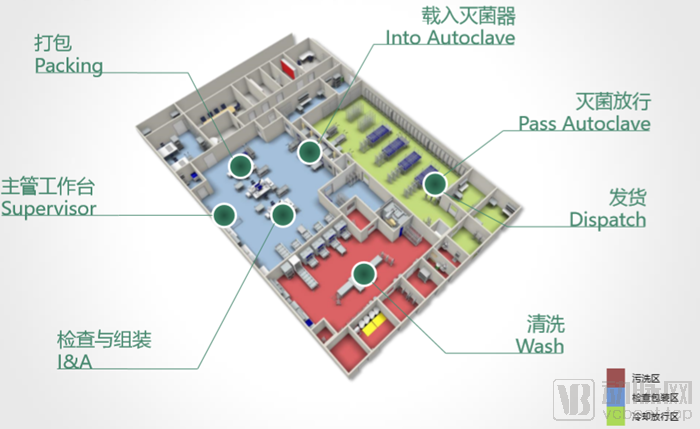
Juyun Smart CSSD Management System - Production Workbench
Notably, Juyun Wisdom has also made significant efforts in the field of soft medical devices.
Soft medical textiles refer to the collective term for fabrics used within operating rooms, such as surgical drapes, surgical gowns, and protective suits. By embedding RFID chips into these soft medical textiles, Juyun Smart enables rapid handover and location identification during their circulation. Leveraging Internet of Things (IoT) technology and edge computing, the company achieves full lifecycle traceability of soft surgical instruments.
Currently, after two rounds of updates and iterations, the Juyun Smart product has demonstrated stable performance and is being utilized at Nanjing First Hospital and Gulou Hospital. Yang Yong introduced that Juyun Smart has already begun developing a more AI-intelligent version 3.0.
Furthermore, based on differences in business models, domestic sterile supply centers (SSDs) can be categorized into hospital-owned SSDs, hospital-enterprise joint venture SSDs, and third-party SSDs. These models vary in terms of investment structure, leading party, hospital reputation, equipment sourcing, staffing strategies, and service pricing. Currently, Juyun Smart has proposed customized, comprehensive solutions for sterile supply management tailored to each type of sterile supply center.
Yang Yong, General Manager of Juyun Smart, introduced the company’s future plans: Juyun Smart will intensify its marketing efforts, focusing on Anhui and Jiangsu provinces while establishing a nationwide channel network to extend its market reach across China. Furthermore, the company will foster close collaborations with clients and conduct in-depth needs assessments to better integrate AI and robotic automation technologies into the Central Sterile Supply Department (CSSD) sector. To support these initiatives, Juyun Smart plans to launch a pre-A round of financing.