

Rapid Iteration of In-Hospital Service Demands and the Surge of Medical IT Firms into a Trillion-Yuan Market through Platform Model Upgrades

Mediinfo
AI-Native Smart Healthcare Solutions Provider
For hospitals, 2020 was undoubtedly a critical year for assessing their advancements in health information technology.
In August 2018, the Bureau of Medical Administration and Hospital Services of the National Health Commission (NHC) issued the "Notice on Further Promoting the Construction of Information Systems in Medical Institutions with Electronic Medical Records as the Core," stipulating that by 2020, tertiary hospitals must reach Level 4 in the Standardized Maturity Assessment for Interconnectivity of Hospital Information Systems. Furthermore, in December of the same year, the General Office of the NHC released the "Administrative Measures for Graded Evaluation of Electronic Medical Record System Application Levels (Trial)" and "Evaluation Standards (Trial)," requiring that by 2020, all tertiary hospitals achieve a graded evaluation level of 4 or higher, and secondary hospitals achieve a graded evaluation level of 3 or higher.
Although the penetration rate of Hospital Information System (HIS) business systems in China has reached a high level of over 90%, the level of integration and interoperability among various business systems remains low, and clinical business systems are still in a phase of continuous deepening.
According to the “Survey on Hospital Informatization in China (2018–2019)” released by the Information Professional Committee of the Chinese Hospital Association in September 2019, among the 1,135 hospitals that provided valid responses regarding the assessment of interoperability standardization maturity, 996 had not participated in the assessment, and only 5.81% achieved Level 4 Grade A certification; meanwhile, among the 1,136 hospitals that provided valid responses regarding the graded evaluation of electronic medical record system functional application levels, 618 had not participated in the evaluation.
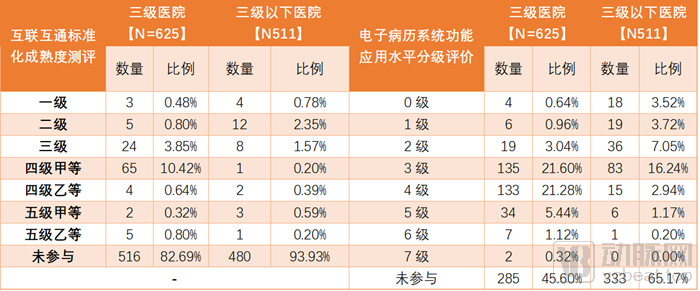
As policy and demand sides present increasingly diverse requirements for optimizing healthcare service processes, comprehensive, high-quality hospital informatization—driven by electronic medical record (EMR) grading assessments—is becoming a core component of hospital development. Upgrading and transforming existing information systems that suffer from pronounced “information silos” and “information chimneys” is undoubtedly an urgent priority for many hospitals.
According to industry research reports from Dongxing Securities and preliminary estimates by VCBeat, the exogenous demand for hospitals to meet the grading requirements for Electronic Medical Records (EMR) and the Standardization Maturity of Interconnectivity has alone spurred a market space nearing RMB 100 billion. To adapt to the increasingly lean and diversified trends in both exogenous and endogenous demands for hospital information construction, the intelligent integration platform model characterized by “underlying infrastructure + micro-service modules” has become a new growth point for medical IT product output in recent years. Consequently, the concept of the “middle platform” has rapidly emerged as a new competitive battleground contested by major medical IT enterprises.
In May 2019, Winning Health first proposed the “Smart Hospital 3.0” strategy, which aims to reconstruct digital businesses through a middle-platform architecture. It is understood that Winning Health’s Smart Hospital 3.0 will comprehensively upgrade its technical architecture based on three major middle platforms—technology, business, and data—and will build domain-driven business conceptual models, reorganize data models, and refactor business services. By catering to various healthcare roles, it provides personalized smart experiences, making services more proactive and intelligent.
In October 2019, ZHEJIANG MEDIINFO I.T.CO.,LTD’s microservices-based HIS 6.0 product was deployed at a hospital in Hangzhou, Zhejiang Province. According to the company, HIS 6.0 aims to restructure the hospital’s IT infrastructure by replacing the traditional model of cross-system interfaces with a unified underlying framework, standardized master data, and consistent interface protocols. This approach enables effective integration and information sharing across systems and platforms, while providing intelligent task-driven capabilities.
In January 2020, B-Soft released its development strategy for the new-generation Healthcare and Public Health product system (HIDA). As one of the core platforms of the Healthcare and Public Health middle office, the Data Middle Office is a representative implemented product within the HIDA framework. Serving as a bridge between the front-end and back-end systems, B-Soft’s Data Middle Office integrates data resources, provides data technology capabilities, standardizes data and service interfaces, and robustly supports various front-end businesses across the data industry chain.
Furthermore, MediInfo has strategically deployed its intelligent information integration platform based on the “platform + micro-applications” model. It is understood that MediInfo will focus on the intelligent information integration platform for core hospital systems and the open IoT platform for smart IoT infrastructure. This approach shifts system architecture from serial to parallel configurations, effectively enhancing data transmission efficiency. By consolidating data for unified management and analysis, the solution enables client hospitals to add or remove application modules as needed, leveraging the smart platform.
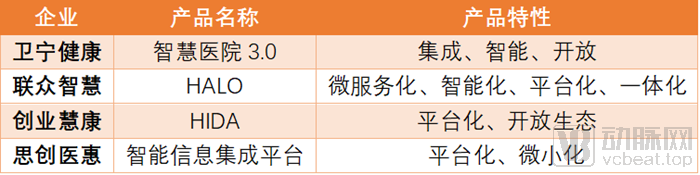
Nearly all medical IT vendors releasing new product strategies have mentioned the concept of a "platform." Unlike traditional integration platforms for clinical data systems, the current trend toward "platformization" mostly refers to intelligent middle platforms that encompass technology, data, and business operations.
The concept of the "middle platform," which first emerged in product design at gaming companies, is centered on the core philosophy of a "large middle platform and small front-end." Applying this new architecture to the entire in-hospital medical process can integrate the vast number of information silos formed by the successive layering of complex workflows and clinical business systems onto early-stage basic informatization systems that lacked top-level design. This approach fully leverages the routine accumulated diagnostic and treatment data that previously could not be effectively utilized due to isolation between disparate business systems.
Taking outpatient appointment registration as an example, assume the appointment process comprises four logical steps: patient information verification, retrieval of slot availability, slot allocation, and acquisition of complete appointment details. In the context of multi-channel appointments, this leads to a clearly structured product architecture. Integration between different systems is required to maintain data consistency (e.g., consistent patient information and medical staff schedules). As appointment channels continue to diversify, the integration logic among databases becomes increasingly complex.
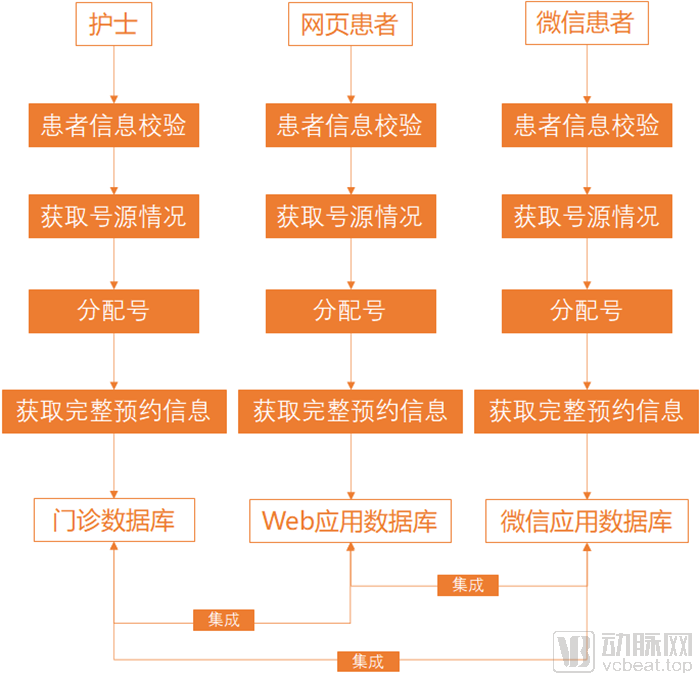
At this point, integration platforms emerged to maximize the relative independence among applications. Complex integration logic triggered requirements for connectivity, data transformation, filtering, routing, and dictionary mapping, which were subsequently deployed within these integration platforms.
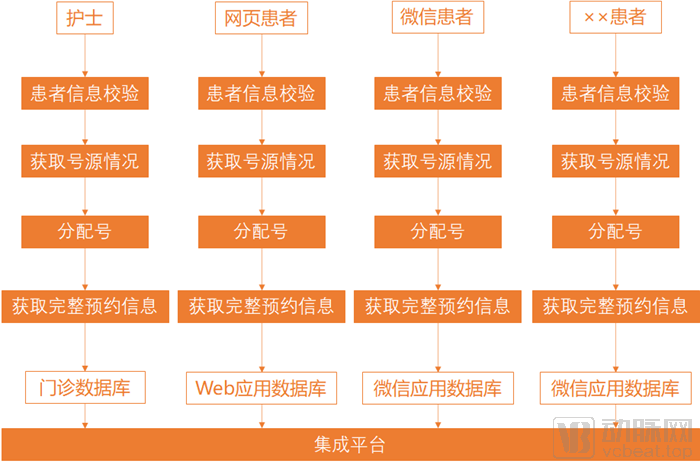
The system integration platform has effectively eliminated barriers to interoperability among business systems, but it has also introduced new challenges. Specifically, when information systems need to accommodate new diagnostic and treatment requirements, changes in business logic necessitate corresponding adjustments in the integration logic across systems, requiring the integration platform itself to be modified. For instance, hospital adoption of internet-based healthcare, tiered diagnosis and treatment models, regional health information platforms, and medical big data all require adjustments to complex databases involving patients, visits, physician orders, examinations, laboratory tests, medical staff, and equipment. In other words, hospital information systems based on an integration platform cannot effectively meet the upgrade demands driven by the iterative development of diagnostic and treatment services; therefore, the product architecture still requires adjustment.
The middle-platform architecture transforms all hospital data into independent, fine-grained resources and “exposes” them to the business logic layer via APIs. The business logic layer then assembles these data resources according to hospital requirements and ultimately delivers them to third-party applications in the form of services.
Taking the appointment service as an example, under this architecture, all third-party applications schedule appointments through a unified appointment service. When the hospital’s business logic needs to be modified, only the business logic layer requires changes, without altering the appointment service or the data access layer.
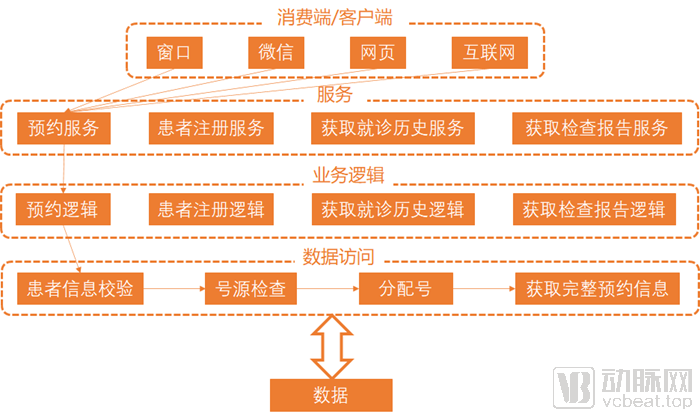
For example, if patient-level assessment is incorporated into appointment rules, it is only necessary to add the relevant nodes in the business logic layer. Once the operation is completed, the newly added business rules will take effect simultaneously across all application endpoints. In other words, introducing new requirements within a middle-platform architecture requires modifications, testing, and deployment solely at the business logic layer, while client-side changes are limited to handling the responses from the new business logic judgments on the interface. This significantly reduces the need for extensive backend business logic modifications. For hospitals, the implementation of new requirements follows a single-threaded management approach, eliminating the need for substantial repetitive work and integration coordination, thereby greatly reducing the risks associated with launching new requirements.
As indicated by the data cited at the beginning of the article, most hospitals have moved beyond the initial phase centered on basic Hospital Information Systems (HIS), yet the overall level of informatization in clinical business systems remains relatively low. Furthermore, integration levels are low across the vast majority of hospitals; only a small minority of institutions with leading healthcare informatization capabilities have completed the implementation of digital patient management and are gradually advancing intelligent transformation initiatives.
In this context, the emergence of a middle-platform architecture undoubtedly offers an excellent option for hospitals to upgrade their existing information systems or even rebuild new ones.
The strategic implementation of a middle-end platform imposes higher demands on the underlying technical capabilities of healthcare IT enterprises. ZHEJIANG MEDIINFO I.T.CO.,LTD’s profound understanding of clinical workflows, cultivated through long-term service to hospitals, along with its experience in logically addressing new scenario-based requirements, is crucial to the design of its middle-end platform products.
In early 2019, ZHEJIANG MEDIINFO I.T.CO.,LTD integrated its product lines and introduced foundational infrastructure such as a middle-end platform and cloud computing. Based on the Jingwei Middle-End Platform, it developed a new generation of integrated “HIS+EMR” products, codenamed “HALO”.
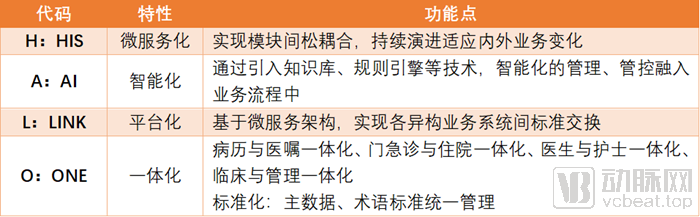
The most significant breakthrough of the HALO product is its adoption of the latest and most stable microservices architecture currently available in the healthcare industry. This architecture enables the decomposition of monolithic applications into multiple small, highly cohesive, and loosely coupled services based on business domains. Each microservice runs in an independent process, is maintained by a dedicated technical team, employs lightweight communication mechanisms for inter-service interaction, and supports independent automated deployment.
In October 2019, the HALO product was first launched in the outpatient department of the Affiliated Hospital of Hangzhou Normal University, completing the upgrade of the outpatient system version in over two months. During this process, HALO’s microservices architecture achieved integrated business and data consolidation, fully leveraging the features and advantages of canary releases and automated operations and maintenance. The upgrade and switchover were conducted by department and consulting room, advancing step by step to achieve comprehensive coverage of all business operations across more than 50 outpatient departments hospital-wide.
Furthermore, during the COVID-19 pandemic, HALO leveraged its elastic and infinitely scalable architecture to respond rapidly to epidemic control needs. It facilitated the swift transformation and optimization of the outpatient physician workstation system, enabling real-time integration with the City Brain’s Medical Brain module. This allowed for real-time access to Hangzhou Health Code data at the outpatient physician workstation, ensuring that high-risk patients were appropriately triaged and scheduled for consultation. Additionally, HALO added an epidemiological history reporting card to the fever clinic module of the outpatient physician workstation, enabling healthcare professionals to record clinical data in real time for high-risk patients during admission intake.
Kan Jiaping, Senior Vice President of Zhejiang Mediinfo I.T. Co., Ltd., told VCBeat that the company has undergone continuous technological innovation over more than two decades of development, evolving from its initial HIS 1.0 to the later HIS 5.0, and now to the current HIS 6.0 (HALO) product. “The launch of HALO represents a significant milestone,” said Kan. “In the future, Zhejiang Mediinfo will continue to explore cutting-edge technologies such as health data collection via smart terminals, real-time processing of dynamic big data and unstructured data, and deep integration of multi-source heterogeneous data, so as to provide healthcare institutions with more innovative health IT products.”