

GATT Technologies Targets $4 Billion Surgical Hemostasis Market with Innovative NHS-POx Platform

GATT Technologies
Medical Device R&D and Manufacturer

Johnson & Johnson Development Corporation
Healthcare-Focused Venture Capital Firm
VCBeat has learned that medical device company GATT Technologies (hereinafter referred to as “GATT”) recently completed a €10.5 million (approximately RMB 81.71 million) Series B financing round. The round was led by NGI, with participation from Johnson & Johnson Innovation-JJDC and OostNL. The funds will be used to support the launch of the next clinical trial phase in the second quarter, as well as to develop applications for its hemostasis technology platform.
GATT is a company founded in 2011, with its headquarters located within the European Union. As a medical device company, it possesses patented synthetic technologies. Its main products are hemostatic devices and sealants, designed to address bleeding and suturing challenges encountered during surgical procedures. Although these products are still in the clinical trial phase, GATT’s innovative technology paints a picture of a new era in surgery.
GATT’s pipeline products are all in clinical trial stages. Current products include GATT-Type, GATT-Spray, GATT-Patch, and GATT-Powder.GATT is also exploring potential application areas based on its proprietary technologies, such as bone regeneration, anti-adhesion, vascular surgery, and ophthalmology. Currently, the company is primarily focused on GATT-Patch, a rapid hemostatic patch designed for general surgical procedures. GATT-Patch is currently undergoing clinical trials in Europe and the United States.
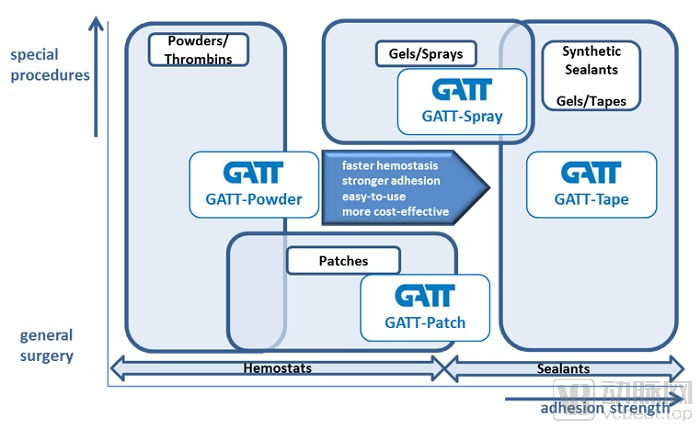
In general, various surgical procedures involving the lungs, dura mater, or intestines employ suturing for closure. However, this approach carries a high risk of postoperative tissue leakage, leading to complications that may prolong hospitalization or even become life-threatening. GATT-Type and GATT-Spray are primarily used for intraoperative sealing to prevent anastomotic leakage.GATT-SprayIt is an elastic, stretchable sealant with strong adhesion.
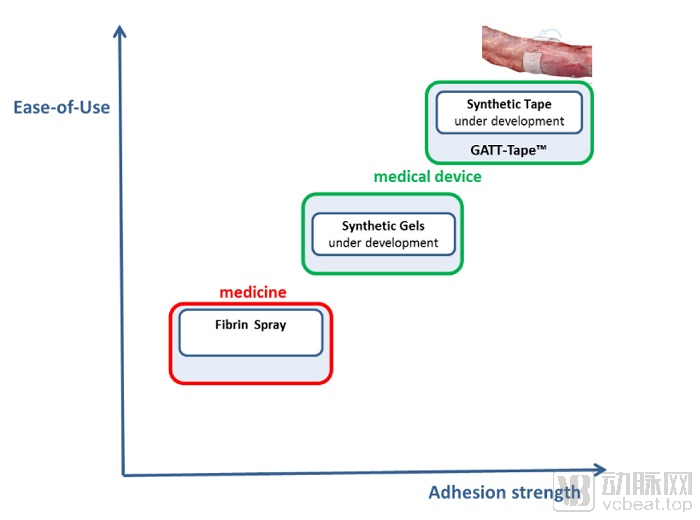
GATT-TypeIt is used to prevent intestinal anastomotic leakage. Its advantages are quite evident: it can be stored at room temperature, begins to adhere within 20–30 seconds of contact with moist tissue, and achieves extremely high adhesion strength within 1–2 minutes. For patients, it does not impede natural bowel movement and expansion. GATT-Type undergoes biodegradation within six weeks. Furthermore, the tape features uniform thickness, flexibility, and strength, ensuring consistent degradation. During surgery, there is no need to wait for curing, allowing the procedure to proceed immediately. Its use eliminates the risk of gel entering the anastomosis (which could impair healing) or dripping onto other tissues (which could cause unintended adhesion).GATT-Type offers superior ease of use and adhesion strength compared to fibrin spray sealants and synthetic gels.
GATT-Patch and GATT-Powder are primarily used for hemostasis during surgical procedures, particularly for patients with coagulation factor deficiencies who are prone to uncontrolled bleeding.GATT-PowderGATT-Powder is a rapid hemostatic powder suitable for general surgery, particularly effective when bleeding tissues are relatively smooth or when there are multiple bleeding points. Unlike other methods that attempt to achieve hemostasis by increasing coagulation factor concentration through physical penetration and blood dehydration, GATT-Powder acts more proactively: its gel binds with proteins in the blood and tissue, thereby accelerating hemostasis.
GATT-PatchIt is a hemostatic tablet that can be used to control severe bleeding and is also suitable for anticoagulation. Compared with existing hemostatic products, it has stronger hemostatic properties and better cost-effectiveness. What makes GATT’s approach novel and distinct is the improvement brought by its adopted technology.
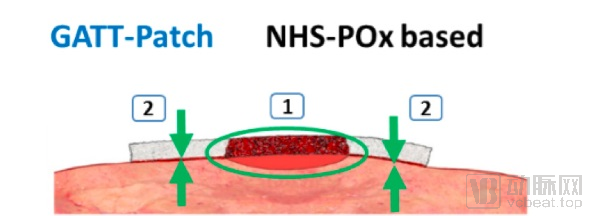
GATT possesses proprietary synthesis technology—specifically, NHS-POx synthesis technology. GATT’s platform is built upon this synthetic polymer, enabling the development of a diverse product portfolio. This polymer exhibits excellent hemostatic and sealing properties, achieved through the reaction of electrophilically activated polyoxazoline (NHS-POx) with nucleophilic crosslinkers. The resulting crosslinked polymer demonstrates tissue-adhesive properties due to the presence of NHS groups. These NHS groups have previously been utilized in PEG-based tissue adhesion technologies, and sealant products employing NHS-PEG technology are already approved and commercially available on the market.
What sets GATT Technologies apart is its development of fully synthetic polyoxazoline (POx) polymers with stable NHS side groups. Compared to the currently used NHS-PEG technology, NHS-POx technology enables conjugation with a broader range of polymers, thereby serving as a more robust adhesive. Users can tailor the polymer to meet specific requirements and accommodate the functional needs of different product formulations. This customization allows for precise control over the polymer’s adhesiveness and polymerization properties.
In the field of surgical procedures,Fibrin-based medical products remain in widespread use today. Advances in synthetic technology are effectively transforming this landscape.The entire market is also evolving toward medical consumables that enable faster hemostasis, stronger adhesion, and greater cost-effectiveness, such as sealant products utilizing NHS-PEG technology. Compared with NHS-PEG-based products, those based on NHS-POx technology offer distinct advantages.
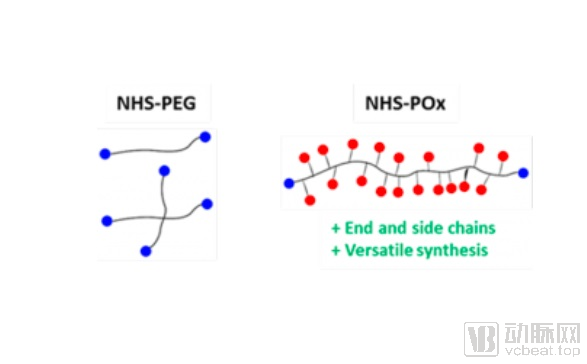
First, based on the conjugate itself, the NHS groups present in POx are essentially four times those in PEG, makingIt exhibits stronger and more rapid tissue adhesion., while simultaneously providing anticoagulation during cross-linking with blood, body fluids, and water. Secondly,Versatile features that can be tailored to specific clinical applications: It allows for fine-tuning of the number of tissue-adhesive groups and the biodegradation rate, and can even be rendered non-degradable upon request. Again,NHS esters of POx side-chain activation are highly stable, which differs from many other NHS ester polymers with side-chain activation. Finally,It allows for the incorporation of functional additives.. For example, antimicrobial agents, coagulation factors, and growth factors. As for the GATT-Type product, it allows other products to be attached to its surface.
The greatest concern likely remains safety.In fact, the technology adopted by the GATT platform is based on NHS-POx, which differs from the NHS-PEG technology currently employed in the pharmaceutical industry. However, their mechanisms of action are similar. Products based on NHS-POx technology are, in terms of safety, comparable to those sealant products based on NHS-PEG.
In addition to the aforementioned characteristics, sealant products based on NHS-POx technology are tunable across all levels, compared to those established using NHS-PEG technology. In terms of specific parameters, NHS-POx technology is similar to or even surpasses NHS-PEG technology. Perhaps more realistically,Its low cost enables highly cost-effective scaled production.At present, GATT has validated two products: GATT-Type and GATT-Patch.
In fact, the clinical development of GATT has progressed to the stage of in vivo validation in porcine models. The validation confirmed its rapid hemostatic efficacy and strong adhesiveness to wet tissues, among other properties. Based on these findings, it becomes easier to understand why GATT has attracted significant attention from investors.
On the official website of OostNL (its investor), there is an intriguing interview. The interview highlights that the birth of GATT was thanks to a flash of inspiration from its founder. At 3:30 p.m. on an ordinary day—December 21, 2009—an idea popped into the mind of founder John Bender. Such moments had occurred before, but they were usually not feasible. This time, however, was different. John Bender realized that the Type concept emerging in his mind was an actionable idea. This led him to briefly assume that such a device had already been invented. But that was not the case.
The idea that came to John Bender’s mind was to create a biodegradable tape using polyoxazoline. This tape can adhere inside the human body while allowing for a certain degree of flexibility. You might dismiss this as a mere whim; in fact, we prefer to believe it is closely tied to John Bender’s career and his observations of the healthcare industry.

GATT CTO John Bender
John Bender once served as Research Director at GLP Study, where one of his responsibilities was to provide compliance consulting in the medical field. This included offering documentation and validation consulting for biodegradable materials. In the course of his work, he also engaged with several sterile medical device companies. He recognized that in Europe, complications arising from intestinal anastomotic leaks result in up to 15,000 deaths annually. The direct economic losses caused by intestinal anastomotic leaks amount to billions of dollars each year. With this tape, physicians would only need to perform simple suturing followed by sealing with the tape, thereby saving significant time and costs. AndThe global market for surgical hemostasis and sealants is currently valued at $4 billion, with an annual growth rate of 5%-10%.The prospects are very broad.
However, turning ideas into reality entails other challenges. To develop a prototype product, John Bender collaborated with professors from Radboud University, Jan van Hest, a professor of chemistry at Eindhoven University of Technology in the Netherlands, and surgeon Harry Van Goor, forming their own team.
Alongside the announcement of a new round of financing, the company also officially announced personnel changes. Geert van Gansewinkel has taken over as CEO, replacing the former chief executive. Vlad Hogenhuis has joined the company as a new board member. Johan Bender, the company’s founder and former CEO, will continue to serve as CTO, primarily overseeing research and development.
In fact, the personnel changes took place earlier than the announcement. Geert van Gansewinkel assumed his position as early as March 2020, while Vlad Hogenhuis took office in May 2020. Given their professional backgrounds, they are likely to accelerate the commercialization of products.
Geert van Gansewinkel holds an International MBA from Maastricht University and an MBA from IESE Business School in Barcelona. As a senior executive, he has served as a technology and strategy consultant at Accenture and The Boston Consulting Group. He brings up to 20 years of experience in strategic consulting, entrepreneurship, and general management.
Vlad Hogenhuis holds an MBA from the Wharton School and a medical degree from Leiden University. As Chief Operating Officer of Ultragenyx, a rare disease pharmaceutical company, he is primarily responsible for global commercial operations, business development, and manufacturing. Previously, he held leadership positions at GSK and Merck & Co., where he oversaw operations and strategic leadership. He brings 25 years of experience in operational and strategic guidance.
John Bender, the former CEO and current CTO, stated, “The addition of Geert van Gansewinkel and Vlad Hogenhuis, along with the improvement in our financial position, marks a new milestone for our company.” John Bender firmly believes that the company is currently in a highly favorable position.“We can advance our first product, GATT-Patch, into clinical trials, further develop other products in our pipeline, and drive innovation.”
In China, we have also observed similar endeavors in the field of surgical hemostasis. For instance, Huanuo Biotech is currently developing an injectable hemostatic gel. This gel can automatically degrade into water and carbon dioxide and is primarily used for hemostasis in clinical surgeries. While achieving hemostasis, it can effectively adsorb and sustainably release active factors from wound exudate, thereby promoting tissue repair and regeneration and enhancing therapeutic efficacy. The product is on the verge of entering clinical trials. We will continue to monitor innovations in the field of surgical hemostasis.