

Sogou Launches World's First AI Nutritionist to Pioneer New Applications in the Trillion-Dollar Nutrition and Health Market
Driven by multiple favorable factors, including policy support, potential demand arising from population aging, and heightened health awareness among users, the big health industry is emerging as one of the most promising sectors. According to a report by China Business Industry Research Institute, the total output value of China’s big health industry reached approximately RMB 6 trillion in 2017 and exceeded RMB 7 trillion in 2018. Zhang Yuhui, Director of the Policy Research Office of the National Health Commission, previously stated that the big health industry was expected to surpass RMB 8 trillion by 2020. The report also highlighted that intelligent technologies, particularly artificial intelligence, are creating new opportunities for innovation and growth within the big health industry.
However, as a core segment of the broader health industry, the nutrition and wellness sector has yet to be effectively revitalized. Constrained by a shortage of registered dietitians in China and the proliferation of pseudoscientific information, the industry is plagued by disorder, with very low penetration of professional nutritional services that fail to meet user demand.
In response to this situation, during the 2020 National Nutrition Week, Sogou, a leading internet platform, leveraged its knowledge computing and natural language processing capabilities accumulated over more than 15 years to launch the “AI Nutritionist” under the guidance of the authoritative Chinese Nutrition Society. By simulating human interaction, the “AI Nutritionist” engages users in voice-based conversations, providing 24/7 online answers to questions regarding dietary health and building an authoritative knowledge base that covers all population groups, food ingredients, and diseases. Integrated with AI algorithms, it offers personalized dietary advice and nutrition guidance.
Sogou has previously made significant inroads into the medical and healthcare sector. Now, as it expands into the nutrition and wellness space and seeks to leverage AI to create new application scenarios, what is the strategic rationale behind this move? Can Sogou’s AI Nutritionist effectively address industry pain points and meet user needs? To explore these questions, VCBeat conducted an exclusive interview with Ms. Xu Jingfang, Vice President of Sogou and Chief Scientist of Sogou Search.
In recent years, nutrition-related health issues—including obesity, malnutrition, and micronutrient deficiencies—have drawn global attention. Ding Gangqiang, Director of the National Institute for Nutrition and Health at the Chinese Center for Disease Control and Prevention and Vice President of the Chinese Nutrition Society, stated: “In contemporary China, as living standards improve, public demand for knowledge about nutrition and health continues to rise. All sectors of society should collaborate, actively innovate, and engage in science popularization efforts related to nutrition and health, disseminating accurate information to the general public. This will help improve people’s lifestyle habits and dietary patterns, thereby further enhancing the nutritional and health status of all population groups in our country.”
Amid surging market demand, the scarcity of talent has become particularly pronounced. According to data released by People’s Daily Online, there are currently only slightly more than 5,000 Registered Dietitians in China who have passed the competency evaluation for Registered Dietitians. As early as 2016, the State Council issued an order to abolish the occupational licensing requirement for public nutritionists. Subsequently, the Chinese Nutrition Society introduced the Registered Dietitian certification examination, significantly raising the entry threshold for the profession.
Following the clarification of underlying principles, the policy will also inject fresh momentum. In July 2019, the State Council issued the Healthy China Action Plan (2019–2030), which stipulates that by 2030, there should be one nutrition instructor per 10,000 people. Currently, a significant gap remains. Moreover, due to the shortage of nutritionists, the plan faces considerable challenges in terms of concrete implementation and realization.
In July 2019, China launched the Special Action on Reasonable Diet as part of the "Healthy China 2030" initiative. This action explicitly called for the development and implementation of a registered dietitian system, requiring the deployment of dietitians in collective catering establishments such as kindergartens, schools, elderly care facilities, and hospitals, as well as the assignment of nutrition instructors in communities. It also emphasized leveraging the roles of medical institutions and physicians to further strengthen clinical nutrition services.
Meanwhile, the National Nutrition Plan (2017–2030), issued by the State Council, states that efforts should be made to “enhance the supply and dissemination of popular science information on nutrition and health,” and encourages “promoting the integrated development of Internet Plus, big data, and other cutting-edge technologies with nutrition and health, and developing personalized and differentiated digital products for nutrition and health.”
The launch of Sogou AI Nutritionist has positioned it as a pioneer in this trend.
Within Sogou’s product portfolio, the Sogou Search Engine should serve as the primary foundation for its “AI Nutritionist.” Although discussions of healthcare-related search have historically been associated with a “traffic-driven advertising” model, the core objective of Sogou’s AI Nutritionist is not to generate additional traffic.
Xu Jingfang, Vice President of Sogou and Chief Scientist of Sogou Search, pointed out that in the healthcare sector, where information asymmetry is particularly pronounced, search engines remain the primary port of call for users seeking health information and making medical decisions. Leveraging Sogou Search’s vast user base, the platform receives nearly 3.2 million daily searches and inquiries related to diet and disease. However, a large volume of personalized public queries centered on “what can be eaten” and “how it should be consumed” remain unanswered in a timely manner, indicating that dietary and nutritional management remains an essential yet under-prioritized need.
“Sogou’s search engine acts like a radar, capable of identifying numerous latent needs. On the Sogou Search and Sogou Input Method platforms, a large volume of users daily search for information related to dietary health. In particular, there is a high-frequency demand for knowledge on diet and nutrition among patients with chronic diseases, mothers and infants, the elderly, and individuals in a sub-health state; however, the market currently lacks effective product solutions,” said Xu Jingfang.
In response, Sogou Search has taken a path few can traverse: partnering with authoritative institutions to build knowledge bases, integrating AI algorithms to leverage the advantages of knowledge computing, and employing AI avatar technology to achieve seamless and natural human-computer interaction. This approach imposes higher requirements and greater challenges on data, technology, and operations than mere information aggregation.
Xu Jingfang stated, “In product design, many people choose to hire professionals to produce content after identifying user needs, in order to meet those needs. However, the vast number of users continuously generates personalized demands, making fragmented knowledge production inefficient and unable to resolve these challenges.”
By leveraging AI-driven knowledge computing to directly address the supply side of medical and health resources, cognitive intelligence is achieved. This approach provides users not merely with an aggregation of authoritative content, but with advice and guidance akin to that of a physician. This constitutes Sogou’s product logic.
The professional depth and volume of content mastered by the Sogou AI Nutritionist are comparable to those studied by top-tier nutrition professionals. Guided by the Chinese Nutrition Society and developed in collaboration with numerous domestic nutrition experts, the AI Nutritionist has curated a population database covering 18 distinct groups (including maternal and infant care, the elderly, and individuals with suboptimal health), an ingredient database detailing the nutritional profiles of over 1,800 food items, and a disease database providing dietary recommendations for more than 2,000 conditions. Leveraging these knowledge bases, it has constructed the most comprehensive and authoritative knowledge graph in the field of dietary nutrition currently available in China.
When addressing user needs, the “AI Nutritionist” mirrors the reasoning process of human nutritionists: it first engages in multi-turn interactive dialogues to accurately understand the user’s primary needs and gain a comprehensive grasp of their underlying medical conditions and overall health status. By analyzing key elements such as “population group, disease, primary need, and derived factors,” it constructs a holistic user profile. It then correlates the user’s colloquial expressions with professional terminology, leveraging knowledge from multiple databases through computational reasoning to deliver personalized dietary guidance tailored to the user’s specific nutritional requirements.
。
Leveraging Sogou’s proprietary AI avatar technology, the “AI Nutritionist” can now replicate facial expressions, vocal intonation, and even the logical coherence of question-and-answer exchanges with a fidelity indistinguishable from that of a real person. This lifelike representation, combined with natural language interaction, fosters a sense of approachability and trust.
Admittedly, “AI nutritionists” are still in their infancy and require multiple rounds of technological iteration. They cannot completely replace the humanistic care and warmth provided by human dietitians. However, they already hold a distinct advantage in terms of powerful learning capabilities and 24/7 service availability. In the future, with continuous technological advancements, AI nutritionists will cover a broader range of medical conditions, provide more precise recommendations, and leverage interactive and digital avatar technologies to establish professional credibility and authority, thereby expanding the accessibility of dietary and nutritional services.
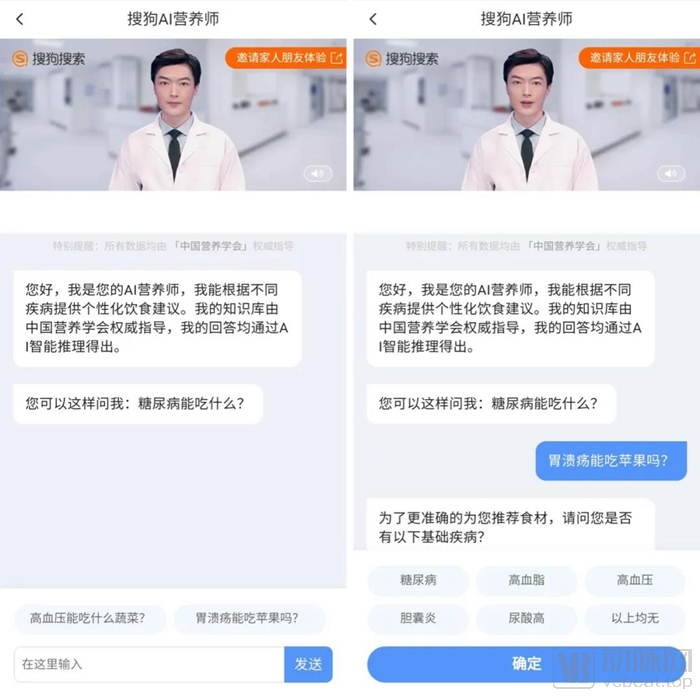
AI Nutritionist Interaction Interface
The AI Nutritionist took a year to develop and launch, demonstrating Sogou’s rigorous approach to healthcare products. Rather than pursuing rapid market expansion, the company aims to deeply empower the industry.
In the face of the vast health industry, leveraging Sogou Search's massive user base, AI Nutritionists can establish their own industrial ecosystem after addressing the essential needs of dietary and nutritional management for a wide range of specific demographic groups.
In the "Digital Innovation Report on the Nutrition Industry" released by VCBeat’s Eggshell Research Institute, nutritional health is categorized into four major demand scenarios: prevention/sub-health, adjuvant therapy (post-surgical rehabilitation, chronic disease management, metabolic disorders, etc.), life-stage-specific needs (infants and young children, adolescents, pregnant and postpartum women, middle-aged and elderly individuals, etc.), and special lifestyle groups (fitness enthusiasts, business professionals, etc.). Each of these segments represents a vast blue-ocean market.
The aging population has propelled the chronic disease management market to a scale worth hundreds of billions of yuan. To address the needs of patients with chronic conditions, Sogou’s AI Nutritionist can bridge in-hospital treatment and out-of-hospital rehabilitation services. Previously, internet-based chronic disease management platforms focused primarily on medical scenarios such as lightweight consultations, appointment registration, follow-up visits, prescription outflow, and health insurance payments. In contrast, the AI Nutritionist enables connectivity for home-based chronic disease management, thereby creating a more comprehensive ecosystem and exploring new frontiers in chronic care.
“There is a vast gap between patients’ natural language and medical knowledge.” Xu Jingfang believes that, in the face of diverse out-of-hospital scenarios, an intermediary bridge is needed to connect patient needs with medical services. “As companies specializing in input methods and search engines, we have the capability to bridge this gap and enable professional knowledge to play a more effective role.”To this end, Xu Jingfang emphasized that the application of professional expertise should be given particular attention when providing out-of-hospital services.。
Targeting the maternal and infant population, AI nutritionists can integrate multiple business formats—including infant and young child food, nutritional supplements, e-commerce platforms, and postpartum care—to provide personalized, precision nutrition management services.
AI nutritionists can also provide cross-functional empowerment to multiple stakeholders in the healthcare sector. By disseminating safe and reliable nutritional and dietary knowledge to users, they can accumulate user data through a model combining traffic aggregation with personalized nutritional and dietary management services. Furthermore, they can explore collaborations with more commercial health insurance institutions to customize personalized insurance products and services.
Moreover, AI nutritionists hold significant potential for innovation. By accurately identifying the dietary and nutritional needs of diverse population segments and integrating upstream and downstream resources, they can drive the intelligent, professional, and precise transformation of the nutritional health industry chain.
The trillion-yuan “Big Health” sector is undoubtedly the core future scenario for Sogou’s strategy. Leveraging AI to provide multi-dimensional support for the Healthy China initiative, and driving comprehensive improvements in the nation’s dietary structure and nutritional status, may well represent the ultimate vision for both Sogou and its AI Nutritionist.