

Lemonnc Technologies Files IPO Prospectus: Wearable-Powered One-Stop Personal Health Management Solutions
With the continuous increase in the sub-healthy population and the deepening aging trend in China, people's demand for daily health management is also growing rapidly.
According to survey data published by the Chinese Center for Disease Control and Prevention in 2019, 75.8% of China’s population aged 60 and older suffer from one or more chronic diseases. Moreover, chronic diseases are increasingly affecting younger populations, indicating a trend toward younger patients. The “China Family Health Big Data Report (2017)” released by the National Health and Family Planning Commission shows that, compared with 2013 data, the average age of hypertensive patients among white-collar workers in first-tier cities decreased by approximately 0.8 years in 2017.
In this context, growing health awareness has empowered individuals to shift from a passive role—where medical treatment decisions were solely dictated by physicians—to actively engaging in the maintenance of their own health. However, the current dilemma lies in the lack of systematic and real-time monitoring in personal health management, making it difficult to achieve effective control during the progression of diseases.
In the pre-disease stage, it is common for patients to fail to detect minor ailments in a timely manner and to overlook their significance. After disease onset, patients lack communication with professional physicians; clinicians can only diagnose based on the patient’s condition at the time of visit, without continuous data tracking and management. Following diagnosis, patients at home have no real-time monitoring for physical abnormalities or medication reminders, relying instead on their own adherence to medical advice. Furthermore, during rehabilitation therapy, patients must return to the hospital for evaluation. Elderly individuals in communities or nursing homes, lacking real-time vital signs monitoring and screening for potential underlying pathological changes, are heavily dependent on the assistance of caregivers.
Consequently, helping users manage their personal health in a scientifically grounded manner has emerged as a new entrepreneurial opportunity in the healthcare sector, attracting numerous players. These include Liangyi, which has launched TCM AI robots capable of performing the four diagnostic methods (inspection, auscultation and olfaction, inquiry, and palpation); Codoon Health, an internet service platform that leverages AI-driven big health data to provide scientific exercise and balanced dietary solutions; and Dongding Lizhi, a developer of wearable devices designed for real-time monitoring of physiological parameters such as electrocardiograms (ECG).
VCBeat recently engaged with Shenzhen Lingmeng Technology Co., Ltd. (hereinafter referred to as “Lingmeng Tech”), a high-quality player in this sector. Founded in 2012, the company operates on a business model that uses wearable smart hardware as its platform. By leveraging its proprietary biosensor algorithms, Lingmeng Tech accurately collects user health data, which then undergoes professional AI-driven cloud-based medical analysis to provide users with specialized health solutions.
“When people visit a doctor for diagnosis, they only reflect their physical condition at that specific moment. If we can track and understand a patient’s physical status continuously over approximately a week or even longer, and combine this with the physician’s diagnosis, we can obtain a more accurate assessment of the patient’s health,” Zhang Yong, founder of Lingmeng Technology, told VCBeat. “To this end, we have developed a personal health management system based on the model of continuous health monitoring.”
Specifically, the system continuously collects users' physiological data through wearable devices, transmits the data to the cloud for analysis, and then feeds the results back to both central management software and personal management software. This enables comprehensive real-time cloud-based monitoring of individuals' daily chronic disease status, facilitating efficient management by healthcare professionals and administrators on the backend.
Currently, Lingmeng Technology’s data collection devices include the PHOT health smartwatch, smart health kiosk, all-in-one detector, chest patch, and abdominal patch.
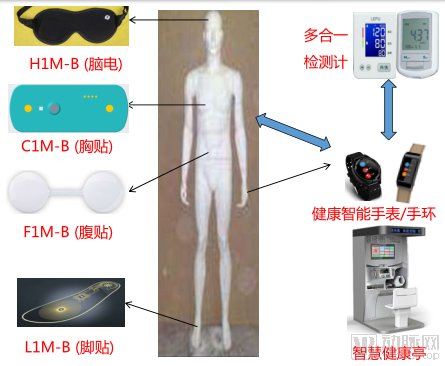
Among these features, the PHOT health watch offers safety and attendance functions including seven-mode positioning, motion trajectory playback, geo-fencing, and emergency SOS. Its health management capabilities monitor physiological indicators such as body temperature, heart rate, blood oxygen saturation, blood pressure, and blood glucose, while also providing Traditional Chinese Medicine (TCM) assessment reports covering sleep, mental state, emotions, cold/heat patterns, and circadian rhythms. For connectivity and battery efficiency, it supports cellular communication via 4G LTE Cat 1/GPRS/NB-IoT, as well as wireless transmission through Wi-Fi and Bluetooth.
Smart Health Kiosks support ID card information reading and can measure and monitor basic physical parameters such as height, weight, and body composition, as well as vital signs including blood pressure, heart rate, blood oxygen saturation, body temperature, and electrocardiogram (ECG). For specialized assessments, the device can measure lung function and bone mineral density, and perform Traditional Chinese Medicine (TCM) constitution identification. In terms of invasive testing, it can conduct measurements for blood glucose, blood lipids, cholesterol, hemoglobin, and routine urinalysis.
The chest patch (C1M-B) is primarily used for the acquisition of medical ECG, medical respiration, medical temperature and humidity, heart sounds, and lung sounds, while the abdominal patch (F1M-B) is mainly used for the acquisition of medical respiration, medical bowel sounds, medical temperature and humidity, and medical fetal heart sounds.
“With the assistance of these devices, users’ physiological data are comprehensively recorded, enabling real-time dynamic monitoring for chronic disease management. Particularly for the elderly, such systems can provide real-time predictions of chronic disease risks and psychological emotional states, thereby promoting better physical and mental health,” said Zhang Yong.
Great products also require suitable application scenarios. Lingmeng Technology provides users with one-stop service solutions through its product portfolio, which currently covers scenarios such as community-based elderly care, campuses, sanitation, and mining areas.
Taking the mining industry as an example, Lingmeng Technology’s solution addresses underground miner positioning and enables real-time monitoring of vital signs, thereby providing timely insights into miners’ physical conditions and ensuring their safety.
In campus settings, in addition to providing students with precise physical health monitoring and safety management, Lingmeng Technology is also attempting to identify the differentiating factors between high and low academic performance by observing changes in students’ physical and emotional states. This approach opens up richer possibilities for future expanded application scenarios.
As a company that values products and technology, the Lingmeng Technology team currently has more than 40 employees, with R&D personnel accounting for 90%.
In terms of channel promotion, Lingmeng Technology currently employs two primary strategies: first, collaborating directly with telecom operators or local governments to provide them with tailored solutions; and second, partnering with China Mobile, China Unicom, and China Telecom to promote products through their business halls. Moving forward, Lingmeng Technology plans to expand its presence on new media platforms such as Toutiao.
Regarding future development, Zhang Yong expressed strong optimism: “Despite the impact of the pandemic this year, our business volume has continued to grow against the trend. By the end of April, the company’s sales had already surpassed last year’s figures. We are striving to achieve annual revenue exceeding RMB 300 million this year.” From a short- to medium-term perspective, Lingmeng Technology will continue to focus on breakthroughs in product technology over the next two years, aiming to realize non-invasive complete blood count (CBC) testing, while expanding distribution channels and increasing its user base. “We project that our user base will reach tens of millions by 2022. At that point, with sufficient data volume, we will be able to conduct more extensive and precise data analytics. This will provide ample samples for health management tailored to the Chinese population, enabling the company to better safeguard the healthy and fulfilling lives of every family.”