

Smart Imaging+: AI Is Just the Beginning of Medical Imaging Intelligence — Imaging Decision Support Will Drive End-to-End Workflow Transformation

Smart imaging
An automated and intelligent service provider in the field of medical imaging services
Since 2016, the AI wave has swept across the globe, with many companies choosing to apply AI in radiology departments. Four years later, AI-powered medical imaging products have reached the pre-market approval stage, facing the phase of commercialization. However, the maturity of AI-based diagnostic imaging products does not mean that medical imaging has reached the end of its intelligent transformation; on the contrary, this is only the beginning of intelligence in medical imaging.
Yue Xin, CEO of Smart Imaging, told VCBeat that if the intelligent workflow of radiologists is divided into four major processes—clinical request, scanning, AI-based image post-processing, and diagnostic decision-making—AI-assisted diagnosis has only addressed one of these steps. To truly achieve intelligence and digitalization in radiology departments, physicians require support from a broader range of intelligent tools.
Founded in 2016, Smart Imaging aims to enhance the intelligence of radiologists’ diagnostic workflows by providing more intelligent tools. This approach addresses longstanding issues under traditional PACS and RIS systems, such as poor consistency in radiology reports, insufficient clinical reference value, and low data usability, thereby supporting physicians in delivering precise imaging diagnoses and reports from a clinical treatment perspective.
Smart Imaging’s products currently cover more than 60 disease types. The company has established collaborations with renowned Chinese hospitals, including West China Hospital, Peking University First Hospital, and Peking University Cancer Hospital. By leveraging the diagnostic logic from these institutions’ leading specialties as the foundation for its decision-support products, Smart Imaging has further refined the diagnostic logic for each disease type.
What Does Imaging Decision Support Mean for Physicians? How Does It Differ from AI-Assisted Diagnosis? VCBeat Conducts an Exclusive Interview with Yue Xin, Founder of Smart Imaging
Since graduating from the Department of Biomedical Engineering at Capital Medical University, Yue Xin has been deeply rooted in the field of medical imaging. As a veteran radiologist, he has witnessed the evolution of medical imaging from digitalization to intelligence over his 20-plus-year career.
He recalled that around the year 2000, upgrades in imaging equipment spurred significant advancements in digital imaging. CT scanners evolved from single-slice to dual-slice and four-slice configurations, leading to a substantial increase in imaging data volume. The emergence of this vast amount of data also facilitated numerous cutting-edge research initiatives, such as the development of RECIST criteria.
At that time, Yue Xin keenly recognized the need for standardized storage and management of large volumes of data. Twenty years ago, he founded a company specializing in radiology workflow management systems, with products covering PACS (Picture Archiving and Communication System) and RIS (Radiology Information System). The company has served over 1,000 clients across China and has earned widespread recognition from its customers.
Yue Xin stated, “In terms of process management, we are becoming increasingly detailed. However, the essence of process management is to record information generated during the process, with the expectation that someone will review it after recording. This constitutes a passive approach to information storage.”
Passive process management results in low data utilization within large hospitals. Although the hospital’s integrated platform stores data from multiple departments, each patient’s data is actually scattered across various business modules. This has a direct impact on physicians: they must spend considerable time making decisions based on clinical data.
As physicians face growing demands to access and process data more rapidly, traditional workflow systems have become unsustainable, ushering in a new wave of transformation in the medical imaging industry. Coinciding with the burgeoning rise of artificial intelligence (AI), the integration of AI with medical imaging has emerged as a prevailing trend, attracting significant attention.
Unlike many AI-based intelligent medical imaging diagnostic companies whose R&D personnel come from non-medical backgrounds, Yue Xin has long been a steadfast companion to the medical imaging industry. Early on, he recognized that physicians’ true need lies in decision support for image interpretation. In simple terms, imaging decision support uses data to substantiate a clinician’s hypothesis formed for diagnostic and therapeutic purposes; once such a hypothesis is established, multiple data dimensions are required to support the imaging-based diagnostic decision.
Yue Xin stated, “Hospitals are ostensibly sitting on a gold mine of big data, yet in reality, they are unable to extract any value from it. The more experienced and senior the physicians, the higher their demands for structured reporting and clinical decision support.”
With population aging, the widespread adoption of health screening, and improvements in the precision and speed of imaging equipment, the volume of imaging data faced by diagnostic physicians is growing at an annual rate of 20%–30%. On the other hand, the number of diagnostic physicians trained by medical schools can only meet a 3%–4% annual increase in the overall diagnostic workforce. For most healthcare institutions, it is becoming increasingly difficult to meet diagnostic demands through recruitment alone.
With the widespread adoption of information systems and the deepening of data analysis and mining, diagnostic knowledge in radiology is advancing rapidly. Its half-life has decreased from 10 years to 5 years, and even to 3 years. In other words, every 5 years, 50% of radiological diagnostic knowledge becomes obsolete. The dimensional complexity of data and the depth of reasoning involved in diagnosis have increased substantially, surpassing the memory limits of physicians. Existing learning modalities, such as advanced training programs, online courses, workshops, and academic conferences, each have their own merits. However, in terms of participant reach and coverage of diagnostic knowledge, these approaches fail to meet the urgent need for a systematic improvement in the overall competency of the diagnostic workforce.
On one hand, knowledge is rapidly updating and iterating; on the other, physicians face an unmanageable workload. This has directly led many radiologists to rely on copy-and-paste methods for generating reports. While this approach offers higher efficiency, its quality is questionable.
“We recognize that imaging decision support is the way forward to change the status quo. The trend toward intelligent medical imaging is unstoppable, but achieving true intelligence requires more than just AI-assisted diagnosis; physicians need comprehensive decision support. Only by integrating knowledge into daily diagnostic workflows can cutting-edge, sophisticated technologies be effectively utilized. Only by embedding tools into routine clinical processes can they be deployed at scale and with low cost.”
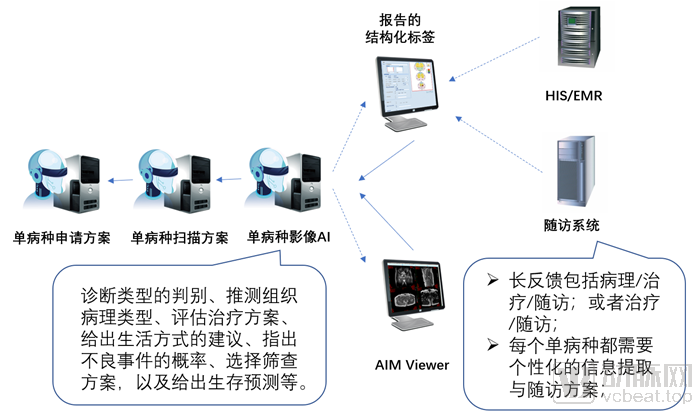
An increasing number of hospital clients in China are expressing demand for decision support solutions. During international exhibitions, Yue Xin observed that intelligent imaging decision-support products are gradually gaining traction abroad. Overseas imaging decision-support solutions typically encompass four key stages: clinical ordering, image acquisition, AI-based post-processing, and imaging decision-making.
Traditional workflow systems record various process-related information but still require medical technicians and nurses to manually search for data within the system. In contrast, clinical decision support systems automatically extract relevant data from peripheral information systems based on specific clinical scenarios. They then perform automated reasoning guided by expert consensus in the field of medical imaging, presenting preliminary results to medical technicians and nurses, thereby significantly improving their work efficiency and quality.
Imagine a scenario: Under the traditional model, a healthcare institution employs 30 staff members, pays salaries for 30 people, and completes the workload of 30 individuals. In the future, after implementing a clinical decision support system, the institution still employs 30 staff members but pays salaries equivalent to 40 people while accomplishing the workload of 50 individuals. This scenario highlights two essential characteristics of decision support services. First, the business scope of imaging decision support lies within the realm of human resources for radiological diagnosis. Second, on the premise of meeting the complexity and quality requirements of personalized medical care, the average diagnosis and treatment cost per patient is reduced.
Imaging decision support systems do not replace the roles of medical technicians and nurses; rather, they supplant their physical labor and simple reasoning tasks, elevating their work to a higher level of diagnostic and therapeutic analysis.
In general, intelligent decision-making in medical imaging constitutes a complete chain. Smart Imaging chose to enter the field of structured reporting at the final stage because it is the phase where the final results are presented.
“If a product performs exceptionally well during the application stage but fails to deliver tangible results, customers are unwilling to pay. In fact, medical imaging decision-making is a complete chain. To generate comprehensive structured reports, it essentially requires AI post-processing to provide sufficient information, technologists to design high-quality scanning protocols, and clear and accurate requisitions. Therefore, by taking responsibility for the outcomes, we are also taking responsibility for the entire workflow.”
After recognizing this new and untapped field, Yue Xin decided to launch a second venture, establishing Smart Imaging. Although Smart Imaging continues to serve radiology and imaging departments, its focus on imaging decision support and workflow management represents a fundamentally different approach.
Yue Xin stated that he first encountered challenges in three major areas.
First, the establishment of a knowledge graph.Intelligent decision support requires providing recommendations to physicians based on existing expert consensus. Although current expert consensuses are standardized in written form, transforming large volumes of textual data into knowledge graphs presents significant challenges. Furthermore, as expert consensuses require frequent updates, the professional rigor and completeness of the knowledge graphs must be continuously refined.
The second major challenge is integrating knowledge graphs from different perspectives.The organization of knowledge graphs must address the perspectives of clinical departments, radiology departments, and patients; therefore, the involvement of PhDs in medical imaging is required for all knowledge graph-related work.
The third major challenge is the integration of knowledge graphs with other information systems.As the final step in the intelligentization of medical imaging, structured reporting requires the extraction of key images from AI-assisted diagnoses in the vertical dimension, and cross-integration with other hospital systems—such as laboratory information systems, pathology systems, and patient historical data—in the horizontal dimension.
“This means that with over 60 single-disease categories, we need to integrate with more than 60 different systems. Therefore, developing imaging decision support is a labor-intensive endeavor, progressing at a particularly slow pace, and constitutes a ‘low-leverage’ demand. If we categorize needs along two dimensions—user adoption and willingness to pay—a need that has both users and paying customers is considered a ‘true’ demand. Among true demands, those that require minimal customization and are universally applicable qualify as ‘high-leverage’ demands. In the field of imaging decision support, while there is genuine demand, it remains a ‘low-leverage’ one. This is because product refinement requires collaborating with various clinical departments to tailor their knowledge graph requirements, as well as integrating with diverse information systems. These complex characteristics result in a relatively slow output process.”
Although adhering to the path of imaging decision support presents numerous challenges in the early stages, Yue Xin believes that products born out of urgent clinical needs will ultimately gain recognition.
“When we first entered this field in 2016, Smart Imaging spent more than nine months and revised the template over 300 times before completing its first reporting template for prostate cancer. But once we achieved that milestone, I knew we could break through in many other disease areas. No matter how complex the product, we can overcome the challenges.”
Over the past four years, Smart Imaging has earned recognition from radiologists at China’s top-tier hospitals by forging a path less traveled. In addition to its R&D efforts, Smart Imaging has established collaborations with numerous renowned hospitals across China. In December 2019, West China Hospital issued a tender for a structured reporting project, which Smart Imaging successfully won. This achievement not only underscores Smart Imaging’s technical prowess but also strongly demonstrates the commercial viability of its imaging decision support products.
The English name of 赛迈特锐 is Smart imaging+. The "+" signifies that there is still more room for imagination in the field of intelligent imaging decision-making in the future.