

TargetingOne Biotech Breaks Foreign Monopoly with Self-Developed Microdroplet Digital PCR Platform

TARGETING ONE
In Vitro Diagnostics Product Developer
With the advancement of modern medicine and the continuous elevation of testing requirements, fluorescent PCR technology has become the cornerstone of clinical molecular diagnostics. However, fluorescent PCR quantification relies on standard curves, and its analytical precision requires further improvement; thus, there is an urgent clinical need for novel detection technologies.
Over the past decade, digital PCR (dPCR), known as the “third-generation PCR technology,” has experienced rapid development. As a nucleic acid detection technique capable of absolute single-molecule quantification without reliance on standard curves, dPCR requires minimal sample volume and offers high analytical precision. Its nanoliter-scale droplet reaction system significantly enhances resistance to inhibitors, making it particularly adept at detecting rare target templates against a background of abundant non-target templates, thereby achieving a high signal-to-noise ratio. Consequently, dPCR boasts multiple advantages, including high detection sensitivity, more accurate quantitative results, and greater intuitiveness. It demonstrates significant clinical advantages in three key areas: infectious diseases, tumor genetic testing, and non-invasive prenatal screening.
Currently, China's digital PCR market is essentially monopolized by imported products, with costs remaining persistently high. However, it is encouraging thatAfter four years of arduous research and development, TargetingOne Corporation., Ltd. (hereinafter referred to as “TARGETING ONE”) pioneered the domestic development of the TD-1 microdroplet digital PCR platform, which possesses complete independent intellectual property rights, thereby breaking the monopoly held by imported products.
Five Key Requirements for Digital PCR Systems: SMART
Yang Wenjun, Vice President of TARGETING ONE, believes that a truly valuable digital PCR platform suited for the Chinese market must meet the following five criteria:
(Simple): Quick to master, stable performance;
Flexible (Multiple-choices): Flexible sample size selection and customizable software;
Accurate: Features anti-contamination performance, with strict control of systematic errors at each stage to ensure detection accuracy;
Rapid: Obtain test results within 3 hours;
Throughput: Capable of processing up to 96 samples in a single run.
In simple terms, achieving “SMART” is key, which will greatly facilitate the widespread adoption of digital PCR technology, benefiting more regions and populations.
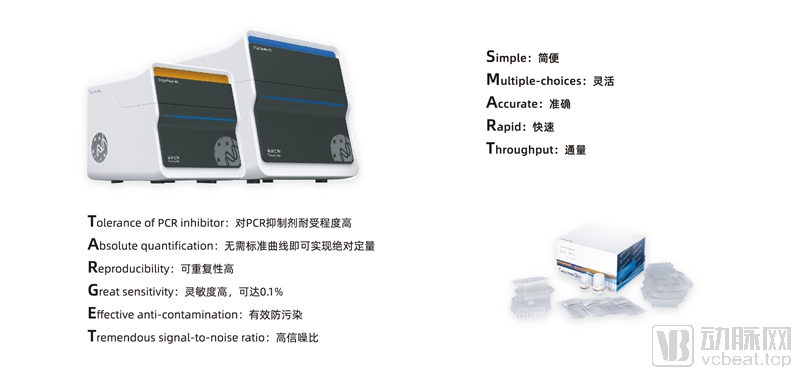
TARGETING ONE’s droplet digital PCR platform, the TD-1, was developed precisely to address these five requirements.
According to the introduction, using the TD-1 system, droplets are generated directly in 8-strip tubes. After generation, no manual pipetting is required; upon completion of PCR amplification, the tubes can be placed directly into a biochip analyzer for signal reading and analysis, making the operation extremely simple. This platform can perform droplet generation for 1–8 samples simultaneously and conduct PCR amplification for 1–96 samples in a single run, offering flexible adjustment of sample throughput. Furthermore, the sample analysis software can be customized within certain limits to meet diverse requirements.
Notably, the TD-1 employs a pioneering “quasi-confocal” fluorescence detection optical path to construct its microdroplet detection platform. Unlike traditional “confocal” optical paths, the excitation path operates in a defocused state, which not only maximizes the fluorescence signal from microdroplets but also significantly reduces fluorescence noise. This design achieves an excellent signal-to-noise ratio and markedly enhances the signal contrast between “positive microdroplets” and “negative microdroplets.”Data showsTD-1 achieves a wide dynamic range of detection from 0 to 300,000 copies/sample, with a relative error of less than 3% and linearity r² > 0.999.
Meanwhile, TARGETING ONE has designed a novel fully enclosed microdroplet chip structure, featuring its proprietary “seal-and-puncture” design that establishes an airtight connection between the chip and the reaction tube, thereby ingeniously enabling sample collection under sealed conditions. Strict containment is maintained throughout the entire process.Avoiding contamination from aerosols generated by nucleic acid amplification products in microdroplets significantly enhances the product's clinical adaptability.
In the result interpretation phase, TARGETING ONE utilizesAn absolute copy number estimation method based on probability distributions and confidence intervals, combined with a density-based clustering segmentation and merging algorithm, to achieve visualized, accurate, and adaptive automated interpretation of detection results.
Yang Wenjun stated, “Overall, the main advantages of TD-1 include a high number of droplets, flexible and adjustable sample volumes, flexible and adjustable sample throughput, ease of operation, capability for 96-sample amplification, contamination prevention through fully closed chip-based detection, and low cost.”
It is understood that TARGETING ONE's TD-1 Droplet Digital PCR is mainly used in three aspects,1. Early and rapid diagnosis of infectious diseases,To provide more accurate treatment recommendations for a variety of major infectious diseases, TD-1 offered critical support for the rapid and accurate detection of SARS-CoV-2 during the COVID-19 pandemic;Second, tumor genetic testing,"Due to the analytical sensitivity reaching a single copy, trace amounts of circulating tumor DNA in plasma can be efficiently detected,"To provide more reliable data for early warning, companion diagnosis, treatment efficacy monitoring, and prognosis assessment of diseases such as lung cancer, breast cancer, colorectal cancer, and chronic myeloid leukemia;Third is non-invasive prenatal screening,It enables highly sensitive detection of cell-free fetal nucleic acids in maternal peripheral blood, facilitating faster and more cost-effective screening for chromosomal disorders such as Down syndrome.
Currently, TD-1 has obtained national medical device marketing authorization and is in use at multiple hospitals, research institutions, and enterprises.Yang Wenjun stated, “Over the next three to five years, TARGETING ONE plans to focus closely on its digital PCR technology platform. Guided by R&D priorities addressing the urgent domestic clinical needs for early screening, early diagnosis, and precise diagnosis of major diseases, we aim to establish an efficient ‘R&D-driven commercialization’ operational mechanism, thereby providing the public with more high-quality medical products.”
Behind the Team: A Robust R&D Workforce and Extensive Clinical Application Experience
TARGETING ONE is dedicated to establishing a microdroplet digital PCR platform and developing its applications in clinical and other fields. Committed to independent innovation in core technologies, the company strives to be a pioneer in the domestic production of high-end medical devices—a goal made possible by its robust R&D team.
As a biotech high-tech company driven by core technologies, TARGETING ONE firmly believes that talent is the core competitiveness of the enterprise.Currently, 50% of the company’s employees are R&D personnel, with professional backgrounds spanning various fields including biology, medicine, chemistry, mechanical engineering, and electronics. Many core team members graduated from prestigious institutions such as Tsinghua University, Peking University, Peking Union Medical College, Hong Kong University of Science and Technology, Harvard University, UT Southwestern Medical Center, and the University of California. They possess extensive expertise in both research and industrialization, having achieved significant breakthroughs in molecular diagnostics scientific research and technological development.
Meanwhile, the team’s professional expertise spans all key aspects of corporate operations—including R&D, manufacturing, quality assurance, regulatory affairs, marketing, and sales—enabling rapid advancement of the company’s technological development and product commercialization.
Digital PCR Technology Will Become the Key Platform for Future Clinical Molecular Diagnostics
Currently, the domestic digital PCR market in China has entered a growth phase, attracting significant attention from investors and enterprises. In the international market, Bio-Rad and Thermo Fisher Scientific have emerged as the two leading players, while giants such as Roche and Qiagen are also actively expanding their presence in the digital PCR sector. As the first company in China to develop a microdroplet digital PCR platform with complete independent intellectual property rights, TargetingOne holds promising prospects for future development.
However, it is undeniable that the field of digital PCR in China still faces numerous challenges, such as the need to enhance clinical institutions’ awareness of digital PCR technology and the need to accelerate clinical registration. Yang Wenjun believes that,Digital PCR technology still needs to advance in high-throughput, automation, multi-target detection, and cost-effectiveness.
Addressing the current challenges in the field of digital PCR, Yang Wenjun aims to foster public awareness of the technology’s high sensitivity, absolute quantification, and accuracy through market education. By providing an open platform that enables users to develop diverse application-specific reagents, he seeks to expand the scope of digital PCR applications, cultivate a robust ecosystem, and grow the overall market.
Due to its quantitative precision and reliability, the advanced nature and significant value of digital PCR technology have become an industry consensus. It is foreseeable that, with continuously increasing testing requirements, digital PCR will inevitably become a key technological platform for clinical molecular diagnostics, ushering in a period of rapid growth.