

Xsens Launches Low-Cost Wearable Mobile App Development Platform to Empower Developers in Sports Health and Rehabilitation

Xsens
3D Motion Capture Technology and Product Developer
In March 2020, IDC’s Worldwide Quarterly Wearable Device Tracker released its latest data, showing that global wearable device shipments grew by 82.3% year-over-year in the fourth quarter of 2019 to reach 118.9 million units, with full-year 2019 shipments totaling 336.5 million units.
Wearable devices refer to portable devices that are worn directly on the body or integrated into users’ clothing or accessories, achieving powerful functionality through software support, data interaction, and cloud-based connectivity.Among these, wearable human motion capture devices are not constrained by venue limitations and are immune to optical occlusion. They can monitor users’ various indoor and outdoor activities at any time and in any weather condition, demonstrating broad application prospects in the fields of sports health and rehabilitative medicine.
In the field of sports and health, wearable human motion capture devices can be used for golf training, shooting posture training, table tennis posture training, taekwondo posture training, rowing monitoring, swimming technique analysis, and more. In the field of rehabilitation medicine, wearable devices can be used for gait analysis and lower limb rehabilitation training. Undoubtedly, the fields of sports health and rehabilitation medicine are becoming new growth points for wearable devices.
As the global wearable device market experiences rapid growth, many companies in the sports health and rehabilitation medical sectors are beginning to enter this field. However, for enterprises and teams lacking experience in wearable device development, successfully researching, developing, and manufacturing a wearable device is no easy task, requiring them to overcome numerous challenges.
First, companies need to address the challenges of sensor fusion algorithms. How can accurate attitude output from sensors be ensured across different motion modes? How can attitude accuracy be maintained in the presence of external interference, such as magnetic disturbances from treadmills, electronic devices, or metallic structures in gyms? How can Bluetooth transmission minimize data packet loss rates? What measures are required to achieve low-latency time synchronization to ensure authentic attitude reconstruction? To tackle these issues, companies must recruit multiple senior master’s and doctoral-level experts in sensor algorithms and conduct extensive research over a prolonged period to develop viable solutions.
Beyond investing heavily in building a professional sensor fusion algorithm team, is there a simple, low-cost solution that can help companies rapidly develop and manufacture wearable devices? In response to this question, Xsens, a leading Dutch enterprise in 3D motion tracking technology and product development, has already provided a satisfactory answer:In January 2020, Xsens officially launched the Xsens DOT wearable device mobile application development platform at CES 2020 in Las Vegas, enabling enterprises and developers in fields such as sports health and rehabilitation medicine to develop new wearable mobile applications more rapidly and at lower costs.
Pioneering Inertial Motion Capture Against the Backdrop of Medical-Engineering Integration
Xsens is headquartered in Enschede, in the eastern Netherlands, and is a globally recognized leader in inertial motion capture technology. Both founders graduated from the University of Twente, which ranks among the world’s forefront in the integration of medicine and engineering and hosts MIRA, a national-level research institute for Biomedical Technology and Technical Medicine. This underscores that the integration of medicine and engineering has been an intrinsic part of Xsens’ DNA since its inception.
Capitalizing on the convergence of medicine and engineering, Xsens rapidly launched its Inertial Measurement Unit (IMU) shortly after its establishment in 2000, applying it to rehabilitation research, sports science, and virtual reality. Within just four years of its founding, Xsens introduced a full-body motion capture suit based on inertial sensors.
It should be noted that,Previously, inertial sensors were primarily used in applications such as rocket and ship navigation, while the motion capture industry mainly relied on optical technologies for human motion capture. However, optical motion capture systems suffer from high costs and significant limitations regarding venue requirements.Xsens keenly recognized the application potential of inertial sensors in human motion capture and developed a full-body motion capture suit based on inertial sensors,Pioneered and led the field of inertial motion capture.
Since its launch, the full-body motion capture suit based on inertial sensors has gained widespread acclaim across various industries. To date, more than 500 animation and game studios, as well as over 500 universities and research institutions worldwide, are using Xsens’ inertial motion capture systems for game development, animation production, gait analysis, sports biomechanics research, and rehabilitation training system development.
According to a report released by IDC, China’s wearable device market saw shipments of 99.24 million units in 2019, representing a year-on-year increase of 37.1%. In April 2019, Xsens entered the Chinese market by establishing its regional headquarters, Movella Technologies (Shanghai) Co., Ltd., and began tapping into China’s wearable device market.
Currently, Xsens China’s headquarters has established a professional team dedicated to technical R&D and marketing. Its technical staff hail from Qualcomm, Huawei, National Instruments (NI), Volvo, and TSMC, bringing with them many years of extensive experience.
As wearable devices gain increasing traction in China, numerous pain points have also emerged. He Jiming, Business Development Manager for Xsens China, stated, “We have observed that many customers are seeking low-cost wearable solutions. Therefore, since 2019, Xsens has been developing Xsens DOT, a low-cost wearable sensor based on Bluetooth technology.”
Open Platform: Sharing 20 Years of Sensor Fusion Algorithm Expertise with Partners
In January 2020, Xsens officially launched the Xsens DOT at the Consumer Electronics Show in Las Vegas, attracting widespread attention from the medical, health, sports, and entertainment sectors.
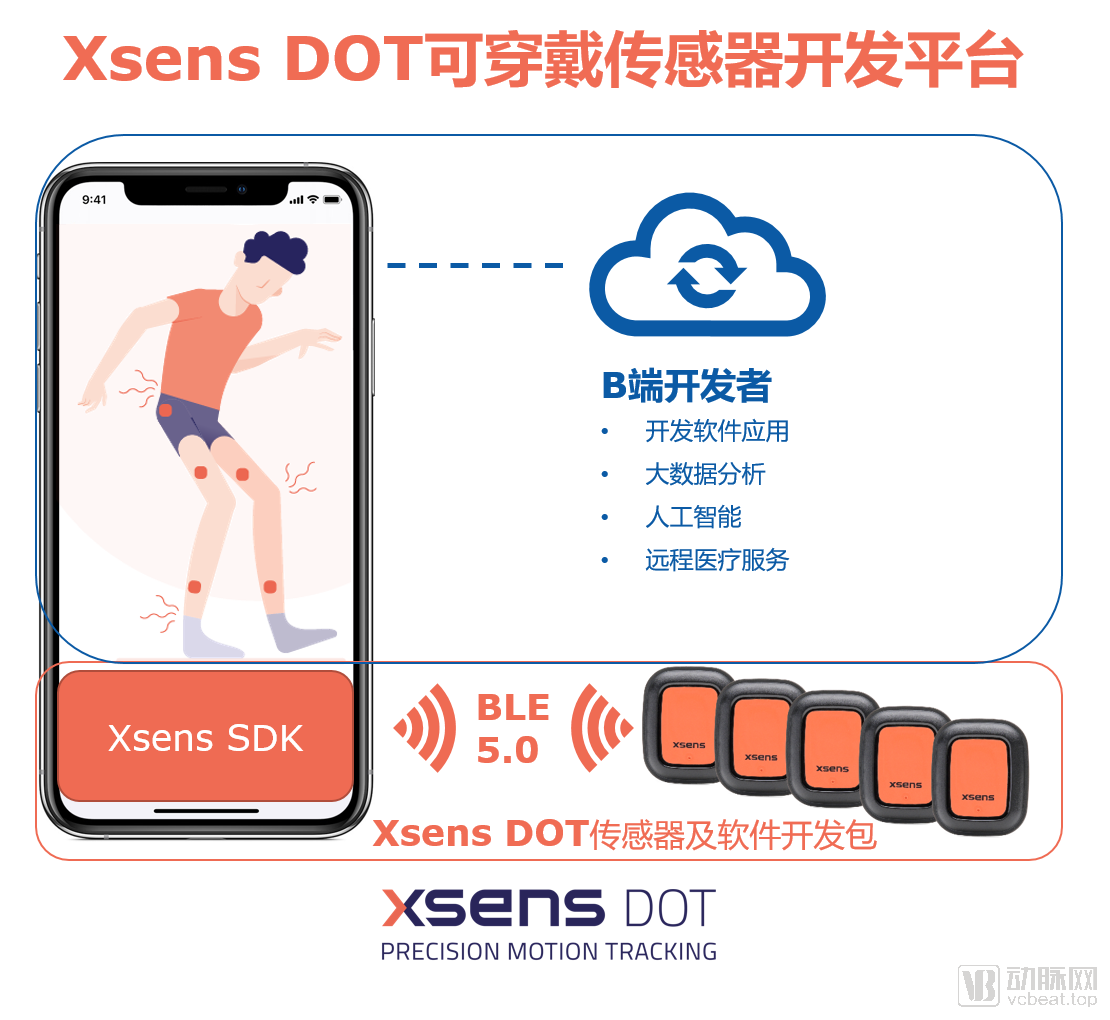
Xsens DOT consists of a set of 9-axis inertial sensors and a software development kit (SDK). It interacts with mobile devices via Bluetooth Low Energy, enabling developers to rapidly create new mobile applications, particularly those tailored for the sports health and rehabilitation medicine sectors.
According to He Jiming, the core competitive essence of Xsens DOT lies in two core algorithms:Strapdown Integration Algorithm(Strapdown Integration Algorithm) andSensor Fusion Algorithm(Sensor Fusion Algorithm)。
Due to the limitations of Bluetooth bandwidth and the requirements for real-time transmission, the update frequency of wearable mobile applications cannot be too high, and raw data must be downsampled to reduce data load. To address these issues, Xsens employs a strapdown integration algorithm, enabling the Xsens DOT to accurately reconstruct human motion posture even at low data update rates.
Sensor fusion algorithms ensure optimal output of posture angles across different human motion patterns or under external interference, enabling B2B clients to capture authentic data without environmental constraints in their application scenarios.
Xsens aims to share its 20 years of expertise in intelligent sensor fusion algorithms and manufacturing platforms with ecosystem partners through Xsens DOT and its accompanying software development kit (SDK), while providing expert support. This initiative is designed to empower hundreds to thousands of innovators, research institutions, and enterprises to develop diverse wearable application scenarios and business models on the Xsens DOT platform.
Since its release, Xsens DOT has acquired dozens of B-end users in China, including leading Chinese research institutions in intelligent medical devices, such as the National Research Center for Rehabilitation Technical Aids and the Institute of Intelligent Machines, Chinese Academy of Sciences.
Xsens DOT’s business model includes both OEM and ODM models. Additionally, the company can provide customized solutions delivered directly to end users based on customer requirements.
“Through the joint efforts of Xsens and its partners, we hope to see wearable devices become increasingly compact, more affordable, less obtrusive, and applicable to a wider range of scenarios,” said He Jiming.