

Only Intelligent Applications Can Rescue Internet Healthcare: Insights from Zuoshou Doctor's IPO Prospectus
By Zuoshou Doctor, published with authorization from VCBeat.
Internet healthcare has captured significant attention in today’s market. Propelled by the COVID-19 pandemic, it surged with the rise of internet hospitals, the integration of “internet healthcare + medical insurance,” and the introduction of “internet healthcare + initial consultations.” Coupled with the recent major shakeup among the first publicly listed internet healthcare companies, the sector now faces a critical question: will it succumb to the challenges of “low-frequency usage + business model” flaws, or will it soar to great heights?
Recently, the team at Zuoshou Yisheng (Left Hand Doctor) conducted intensive visits to major partners and engaged in in-depth discussions with numerous industry experts. We have come to firmly believe that only intelligent applications and tiered diagnosis and treatment can truly empower internet-based healthcare. Intelligent applications serve as a productivity engine, essentially enabling offline medical resources to serve patients more efficiently through online platforms. The mission of internet-based healthcare is not merely to make it more convenient for patients to seek medical care; rather, its ultimate aspiration lies in addressing the difficulties and high costs of accessing healthcare for people at the grassroots level.
Do current favorable policies, such as medical insurance reimbursement for various internet healthcare services, benefit both public hospital-affiliated internet hospitals and third-party platform-based internet hospitals?
The answer is obvious: it is beneficial for public hospitals, bearish for third-party platforms in the short to medium term, but bullish in the long run for those that survive.
Internet healthcare has undergone approximately seven to eight years of evolution, progressing from initial online consultations to follow-up visits and prescription renewals. Benefiting from the liberalization of internet healthcare policies, third-party platforms took the lead in establishing internet hospitals. Driven by the advancement of smart healthcare and the COVID-19 pandemic, public hospitals have also been vigorously developing their own internet hospital services. Leveraging medical resources associated with their physical institutions—such as physicians, brand reputation, and medical insurance coverage—public hospitals hold a comparative advantage in policy utilization. Under the constraints of localized medical insurance administration, it is difficult for third-party platforms to achieve significant breakthroughs in the short term by serving patients nationwide based on internet-centric models.
From the perspective of health insurance payers, their overall trust in public hospitals is higher than that in third-party platforms. What these payers truly care about is not whether services are delivered online or offline, but rather to whom payments can be made with greater confidence. If third-party platforms aim to achieve breakthrough progress in payment arrangements, they must provide concrete and effective evidence of cost savings to earn this trust. Such credible evidence must stem from the advancement of intelligent applications leveraging internet-based features, utilizing AI capabilities to reduce costs and improve efficiency, thereby achieving the goal of “cost savings.”
It is easy to predict that, in the near future, a substantial volume of internet-based medical services will be provided by public hospitals offering “high-quality, affordable care.” As more than 20,000 public hospitals across China establish their own internet hospitals, they are continuously injecting “high-quality, affordable” medical resources through promotional launch campaigns, while also generating certain revenues for the health IT vendors responsible for building these internet hospital platforms.
Third-party platforms striving to commercialize internet healthcare will not only face intense competition from public hospitals amid a harsh capital environment, but may also encounter “fundamental suppression” as public hospitals restrict their physicians from practicing on these third-party platforms. For internet healthcare itself, these shocks are merely the beginning.
In reality, after many public hospitals established their internet hospital platforms and transferred management to the Medical Affairs Department, these platforms failed to achieve effective operational performance, resulting in a stark disparity between online and offline services: while daily offline outpatient visits numbered 7,000–8,000, online consultations amounted to merely 70–80 cases.
The underlying reasons are threefold. First, existing internet healthcare services suffer from extremely low efficiency; online consultations require physicians to spend ten minutes or more on text-based communication, which constitutes a significant waste of medical resources. Second, there is a disconnect between intra-consultation and post-consultation services, failing to cultivate patients’ healthcare-seeking habits or foster user stickiness, with “use-and-leave” being typical patient behavior. Third, most physicians at public hospital-affiliated internet hospitals provide online consultations free of charge, resulting in insufficient motivation.
Are there any solutions to the aforementioned issues? We believe that the essence of internet-based healthcare must ultimately return to healthcare itself, with the internet serving merely as a connectivity mechanism. All stakeholders should leverage the strengths and mitigate the weaknesses of this approach, focusing on the core of healthcare and utilizing intelligent technologies to replicate high-quality medical resources. We have introduced new perspectives and solutions for positioning internet hospitals, which have resonated with many hospitals.
Taking the improvement of physicians’ online consultation efficiency as an example, face-to-face offline communication between physicians and patients is significantly more efficient than online text or video interactions. By adopting Zuoshou Yisheng’s intelligent pre-consultation system, physicians’ online consultation efficiency can be substantially enhanced. This intelligent application allows an AI physician to conduct the initial consultation before direct communication between the human physician and the patient. The AI physician collects the patient’s chief complaints and description of symptoms, guides the patient to upload historical medical records and reports via photos, and then compiles and analyzes this information for review by the human physician. This approach helps reduce physicians’ workload during online consultations by at least 60%. Moreover, the pre-consultation system responds immediately when patients submit their requests. While physicians are reviewing patient reports, the system intelligently recommends medical patient education content to waiting patients, thereby alleviating patient anxiety and improving patient satisfaction. During the COVID-19 pandemic, the intelligent pre-consultation system successfully assisted numerous hospitals, including Tongji Hospital in Wuhan, the 301 Hospital (PLA General Hospital), and Xi’an Children’s Hospital, significantly boosting physicians’ online consultation efficiency.
In terms of patient retention, national policies are continuously guiding hospitals to provide health promotion services to discharged patients. During out-of-hospital care, these interventions not only improve patient rehabilitation outcomes but also support clinical research by collecting Patient-Reported Outcomes (PROs). In this process, intelligent applications have emerged as one of the most successful solutions.
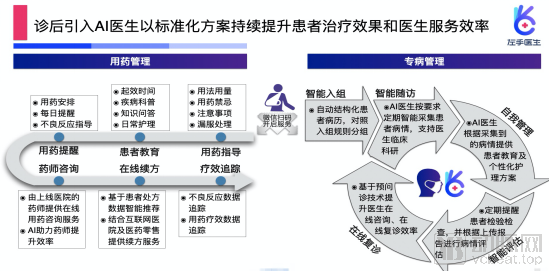
Internet hospitals must initially focus on service delivery, providing outpatients with continuous post-consultation services such as rehabilitation guidance, medication counseling, patient education, follow-up management, return visits, and re-examinations. This approach enhances patient experience while maximizing the utilization of internet hospital platforms.
By designing a closed-loop post-consultation health management system that integrates online consultations and online prescription renewals, internet hospitals complete the online usage cycle. This subtly guides patients, fostering habitual use of digital platforms. Consequently, through the continuity of post-consultation services, internet hospitals facilitate the migration of private-domain traffic (from offline outpatient visits) to online channels, thereby accumulating a substantial initial base of seed users.
Post-consultation management services cannot achieve ideal outcomes through manual processes alone, due to the substantial labor costs and training and management expenses involved.
We propose introducing AI capabilities to empower hospitals, enabling AI physicians to take on this responsibility. AI physicians can provide personalized post-consultation services—such as rehabilitation guidance and medication management—to multiple patients simultaneously, 24/7. This approach effectively enhances patient engagement and revitalizes internet hospitals.
However, under the current system, China’s basic medical insurance covers only medical treatment, not health management. Therefore, post-consultation patient management must deliver significant benefits to patients, thereby enhancing their willingness to pay and that of the insurance payer, and securing sustainable momentum for development.
Furthermore, boosting physicians’ engagement on internet hospital platforms is an unavoidable challenge for public hospitals, which also creates opportunities for third-party platforms.
We once discussed with a hospital president in charge of informatization, “What are the differences between collaborating with XXX Internet Hospital and operating your own internet hospital?” The respondent stated, “For physicians, they enjoy greater pricing autonomy and higher motivation on third-party platforms. In contrast, pricing on our hospital’s proprietary internet hospital must strictly comply with the requirements of the Price Bureau. For instance, during the COVID-19 pandemic, we received a notice requiring us to provide free consultation services to patients. However, the minimum consultation fee in our original system was RMB 0.01, so we had no choice but to upgrade the system to meet the regulatory requirements.”
Regarding the enhancement of physicians’ motivation, while introducing market-based pricing mechanisms is one approach, ZuoShou Doctor believes that, on the other hand, if intelligent applications can streamline the consultation process so that physicians merely need to tap their screens to verify the accuracy of AI-generated responses to patients, this would not undermine their clinical motivation, even under the demand for “high-quality, affordable care.”
Setting aside the classification of internet hospitals, we believe that their true future value lies in three key areas: first, helping physical hospitals better optimize offline diagnosis and treatment processes; second, supporting post-consultation health promotion services; and third, addressing the difficulties and high costs faced by grassroots populations in accessing medical care.
In every aspect, relying on traditional productive forces and production relations cannot ensure healthy progress; only by leveraging intelligent technologies can we reach the desired destination.
Help brick-and-mortar hospitals better optimize their offline diagnosis and treatment processes.
In Document No. 33 [2016] issued by the General Office of the State Council, it was explicitly stated to “make full use of Internet technologies to improve patients’ healthcare experience.” Furthermore, in Letter No. 236 [2019] from the Medical Administration Bureau of the National Health Commission, this directive was incorporated into policy through the framework of “smart service development.”
Left Hand Doctor believes that although currently popular services such as intelligent triage, online registration, payment and inquiry, information push for health education, and online consultation are the core of smart healthcare service construction, they essentially just replicate offline services to online platforms, and cannot truly enhance hospitals' service capabilities.
The Internet is characterized by temporal precedence and spatial concurrency. Within our partner hospitals, we have observed that integrating internet hospital services with intelligent applications has significantly enhanced operational efficiency.
For example, we help hospitals optimize their patient care workflows: After registering online, patients receive a preliminary consultation from an AI physician, which rapidly collects information on their condition. This data is transmitted to the hospital and assigned to the on-duty department physician, who collaborates with the AI to provide medical guidance and even order basic laboratory and imaging tests. Before the patient’s visit, a comprehensive care plan—including step-by-step instructions—is generated on their mobile device. Upon arriving at the hospital, the patient can choose to first use a self-service kiosk to pay by card, complete the basic tests, and then see the physician.
Statistical analysis indicates that the aforementioned optimized workflow not only enhances patient consultation efficiency but also saves more than one-third of physician resources. In traditional medical practice, physicians are unable to issue prescriptions prior to seeing patients due to a lack of information about their conditions. Leveraging the spatiotemporal advantages of the internet and intelligent technologies, physicians can access patient clinical data before the consultation. This capability significantly assists hospitals in optimizing the allocation of medical resources.
For example, Zuoshou Doctor is currently developing a project designed to help a specific region better optimize the allocation of medical resources. Although the region has already established a unified appointment registration platform that facilitates online booking for patients, the current first-come-first-served model for securing appointments fails to maximize resource value. In response, Zuoshou Doctor recommends that the platform allocate 10% of its medical resources based on need, prioritizing patients with genuine medical necessities. If patients are unable to secure their desired appointments through regular channels, they may apply for a “green channel.” By submitting their condition details and historical medical reports to an AI physician as required, the AI will analyze and evaluate the information against green channel criteria to allocate appointment slots accordingly.
Extending this logic further, we believe that the current model of “tiered diagnosis and treatment,” which relies on “upward referral” as its primary mechanism, cannot be effectively implemented. This is because healthcare typically follows a pyramid structure, making it difficult for primary care physicians to accurately refer patients to the appropriate higher-level providers. In Europe and the United States, there is no fundamental difference in treatment protocols for common and frequently occurring diseases, whether patients consult specialists or general practitioners. While China’s current healthcare environment still falls short in this regard, intelligent applications will make this feasible in the future. When patients need medical care, they can simply describe their condition to an AI doctor, which will provide precise recommendations for seeking care. This approach not only spares patients from the cumbersome, game-like process of navigating through multiple levels of care but also promotes the rational allocation of medical resources.
Supports post-consultation health promotion services.
Over the past decade, the health management sector has experienced significant fluctuations and setbacks, failing to achieve explosive growth. The reasons for this may include: First, there is no market for health management approaches that go against human nature when targeting healthy populations. Second, third-party health management organizations face challenges in customer acquisition, and it is even more difficult to earn patients’ trust. Third, current health management methods still rely primarily on supervision, consultation, and education, which fail to deliver substantial value. Fourth, at present, medical insurance covers only medical treatments and does not yet reimburse health-promotion activities.
With the rise of internet hospitals, this situation is likely to improve, particularly in terms of overall adherence to out-of-hospital guidance for post-consultation patients. Seamless connection to out-of-hospital management tasks immediately after discharge allows patients to receive medical advice and prescriptions, thereby enhancing their sense of gain. At the payment level, interactions between pharmaceuticals and insurance are creating new opportunities for the commercialization of digital healthcare. In this process, the aim of intelligent applications is to improve physician efficiency and increase patient stickiness.
In the post-consultation management phase, Zuoshou Yisheng (Left Hand Doctor), through its disease management product, has collaborated with key departments at leading Grade A tertiary hospitals, receiving positive feedback in scenarios such as post-gastrectomy management, gout management, asthma management, and joint replacement management.
In addition to bringing about a qualitative transformation in service content, intelligent technologies also play a facilitative role in service processes. Issues such as how to conveniently transition patients from offline to online settings and how to better integrate online and offline medical services warrant continued discussion.
Addressing the difficulties and high costs of healthcare access for grassroots populations,It has consistently remained a central concern across all healthcare policies.
When this topic is raised, many people immediately think of deploying intelligent applications at the primary care level, equipping primary care physicians with AI-enabled devices to enhance their capabilities, thereby alleviating the shortage of medical resources and addressing the challenges of difficult and expensive access to healthcare. However, based on our exploratory experience, this may not be the optimal pathway and might only be applicable in certain regions or scenarios.
From a numerical perspective, physicians in China’s tertiary hospitals have addressed more than 50% of outpatient demand through high-intensity clinical practice, indicating that overall medical resources are not scarce. For patients seeking care, the shortage is not of general medical resources, but of high-quality medical resources.
From a scientific perspective on medical care, it may not be the most rational approach for patients to seek referrals upward from primary care facilities whenever they feel unwell. Instead, they should first consult an experienced general practitioner to analyze their condition and rule out complex or rare diseases. If it is a common illness, they can then see the appropriate specialist. In media reports, we have seen too many patients who treat healthcare-seeking like “leveling up in a game,” progressing from township hospitals to county hospitals, then to city hospitals, provincial hospitals, and finally to top-tier hospitals in Beijing, Shanghai, and Guangzhou. At each stage, they receive “comprehensive treatment.” By the time they see leading specialists in major metropolitan areas, their conditions have often become more complicated, and their financial resources are nearly exhausted. Our current healthcare-seeking pattern is primarily based on the distribution of common diseases and, statistically speaking, represents a relatively optimal allocation of medical resources.
We believe that internet-based healthcare represents the future, as it can truly make high-quality medical resources readily accessible. Given the scarcity of premium medical resources, the only way to reach our ideal goal is to leverage intelligent applications to replicate expert experience and increase the supply of high-quality medical services. In this process, the first prerequisite is regulatory liberalization to make “internet-enabled initial consultations” a reality.
How to manage the risks associated with initial online medical consultations also requires the advancement of intelligent applications. For instance, regulations could be relaxed for certain conditions where medical risks can be brought infinitely close to those of offline consultations, and AI physicians could be involved in risk management. Zuoshou Doctor will further elaborate on how AI physicians can be leveraged to ensure that initial online consultations carry low or even zero risk.
As a medical AI startup, Left Hand Doctor has discovered in its exploration that the value of medical innovation lies not only in model innovation but more importantly in technological innovation. Through technological innovation, high-quality medical resources can be replicated to increase the supply of medical resources, thereby alleviating the difficulties and high costs associated with accessing healthcare. Internet hospitals serve as the ideal incubator for such technological innovations.