

Xiangyu Medical Files for STAR Market IPO with RMB 420 Million in Rehab Equipment Revenue
Recently, the Shanghai Stock Exchange accepted the STAR Market listing application from Henan Xiangyu Medical Equipment Co., Ltd. (hereinafter referred to as “Xiangyu Medical”), marking the company’s commencement of its STAR Market listing process, with a planned fundraising target of RMB 700 million.
Xiangyu Medical provides a series of rehabilitation products and comprehensive solutions to medical institutions at all levels across China, elderly care facilities, disability rehabilitation centers, welfare homes, educational systems, and households.
Among the tiers of domestically produced rehabilitation equipment manufacturers, listed companies include Pumen Technology, which went public on the STAR Market in 2019, and Chengyitong, which listed on the ChiNext Board in 2015. Notably, Pumen Technology’s core business encompasses not only rehabilitation devices but also an in vitro diagnostics (IVD) product line. Chengyitong entered the rehabilitation medical device sector after completing its acquisition of Longzhijie in 2017; prior to that, its primary business was as a manufacturer of biopharmaceutical automation equipment. In contrast, Xiangyu Medical pursued its initial public offering relying solely on its rehabilitation equipment business.
According to Xiangyu Medical’s 2019 financial results, the company reported a net profit of RMB 120 million and operating revenue of RMB 420 million, representing a year-on-year increase of approximately 19%. However, in terms of R&D investment, Xiangyu Medical’s expenditures from 2017 to 2019 were RMB 17.42 million, RMB 28.8167 million, and RMB 41.4931 million, respectively, accounting for 6.02%, 8.03%, and 9.71% of its operating revenue. The R&D investment ratio did not exceed 10%.
For a long time, the domestic rehabilitation equipment industry has been labeled by low value-added products, low industry concentration, and the absence of a leading enterprise. Xiangyu Medical’s push to list on the STAR Market relying solely on its rehabilitation equipment business signifies that the landscape of China’s rehabilitation equipment sector is no longer what it used to be. According to its prospectus, Xiangyu Medical’s core competitiveness lies in its 20 major series comprising over 400 types of rehabilitation devices, as well as its ability to provide various solutions based on this diverse product portfolio, including rehabilitation solutions for medical institutions and disease-specific rehabilitation solutions.

According to the prospectus, Xiangyu Medical was established in 2002. At that time, the development of rehabilitation medicine in China was sluggish, and manufacturers of rehabilitation equipment primarily focused on the research, development, and production of home-use rehabilitation devices and assistive aids, making limited progress in high-performance clinical rehabilitation therapy equipment. However, there were numerous workshop-style factories producing rehabilitation and physiotherapy equipment at the time, and Xiangyu Medical also started as such a workshop-style factory.
Before venturing into business, He Yongzheng, the founder of Xiangyu Medical, was a teacher. His father had previously sold physiotherapy equipment, which provided He Yongzheng with the opportunity to enter the sales of rehabilitation and physiotherapy devices. In 2002, after accumulating certain resources in medical device sales, He Yongzheng decided to establish a factory to manufacture rehabilitation medical devices. The first product produced by Xiangyu Medical was a traction bed, which was in short supply in the market at that time.
Although Xiangyu Medical did not start from a high base, it did not remain confined to small-scale workshop operations. With limited R&D capabilities at its inception, Xiangyu Medical proactively sought collaborations with universities and leading enterprises. The company has successively established cooperative relationships with renowned domestic higher education institutions such as Nankai University, Tianjin University of Science and Technology, and Zhengzhou University, as well as with medical institutions including the 309th Hospital of the Chinese People's Liberation Army, Henan Provincial Hospital of Traditional Chinese Medicine, the First Affiliated Hospital of Zhengzhou University, and the Second Affiliated Hospital of Zhengzhou University. Furthermore, Xiangyu Medical has engaged in exchanges and cooperation with numerous technologically robust companies, such as South Korea’s HANIL Co., Ltd., Belgium’s GymnaUniphy, and Taiwan’s Xinlin Company.
To differentiate itself from the multitude of homogeneous rehabilitation and physical therapy products, He Yongzheng maintained stringent quality standards, even personally smashing defective products worth 100,000 to 200,000 yuan in front of all employees. To earn long-term customer recognition, Xiangyu has also established a comprehensive and proactive after-sales maintenance system.
Over the past 18 years, Xiangyu Medical has evolved from a family-run workshop into a high-tech enterprise integrating R&D, manufacturing, sales, and international trade of rehabilitation physiotherapy equipment and trauma treatment devices. The company has progressed from developing single-function products to establishing comprehensive R&D and production capabilities for a full product portfolio.
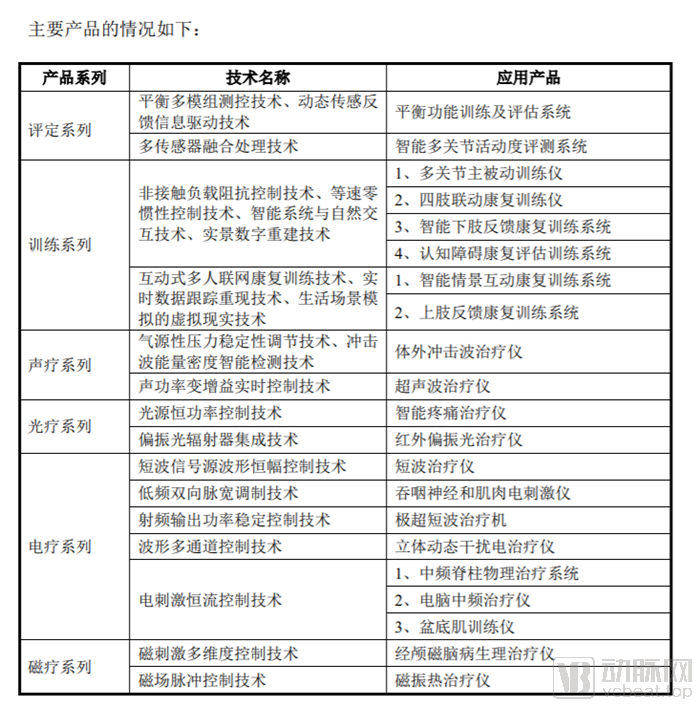
Xiangyu Medical’s core patents are primarily concentrated in rehabilitation training and rehabilitation treatment equipment. The company possesses proprietary core technologies protected by independent intellectual property rights across more than 30 technical fields, including shockwave therapy, phototherapy, electrotherapy, and magnetotherapy. To date, it has been granted 16 invention patents and 334 utility model patents, and has obtained 50 software copyrights.
Data Source: Xiangyu Medical Prospectus
Rehabilitation medicine is one of the four major branches of modern medicine, alongside preventive medicine, clinical medicine, and healthcare medicine. However, in China, the development of rehabilitation medicine has consistently lagged behind that of clinical medicine. Since 2011, driven by policy support, the domestic rehabilitation medicine market has begun to experience rapid growth.
In 2011, the former Ministry of Health issued the Guidelines for the Construction and Management of Rehabilitation Medicine Departments in General Hospitals, followed by the Basic Standards for Rehabilitation Medicine Departments in General Hospitals (Trial) in 2012. These documents require that general hospitals at Level II and above establish independent departments to provide rehabilitation medical services and equip them with standardized rehabilitation medical devices, including multifunctional assessment and testing equipment; therapeutic exercise equipment and occupational therapy equipment; physical agent therapy equipment; and speech, swallowing, and cognitive therapy equipment.
In 2011, the Chinese government began incorporating rehabilitation medical services into the national health insurance reimbursement system. From the perspective of health insurance coverage, the number of reimbursable rehabilitation services expanded from 9 items in 2010 to 29 items in 2016. The beneficiary population grew from primarily individuals with disabilities to include various patient groups such as the elderly and children. Reimbursable services extended beyond physical therapy to encompass a wide range of therapeutic interventions and rehabilitation assessments.
Overall, since 2012, the Chinese government has begun to introduce policies to explore the establishment of a three-tier rehabilitation medical service system in China. By 2019, relevant national authorities had gradually issued multiple standards, requiring departments of rehabilitation medicine in general hospitals, rehabilitation hospitals, rehabilitation medical centers, and institutions integrating medical care with elderly care to improve their standardized construction systems in accordance with their respective standards. Furthermore, regulations mandated that general hospitals at Level II and above establish departments of rehabilitation medicine, encouraged private capital investment in rehabilitation hospitals, and supported the transformation of Level II general hospitals into specialized rehabilitation hospitals. As China’s rehabilitation medical system continues to improve, market demand is expected to shift downward toward Level II general hospitals, rehabilitation hospitals, primary healthcare institutions, and home-based care.
However, based on the current state of the three-tier rehabilitation medical system, the development of rehabilitation hospitals still falls far short of the target requirements. According to the *2019 China Health and Health Statistical Yearbook* released by the National Health Commission, there were 637 rehabilitation hospitals nationwide in 2018, accounting for only 3% of the 19,693 general hospitals, indicating a substantial gap. Resources allocated to secondary general hospitals, rehabilitation hospitals, and primary healthcare institutions remain insufficient to meet demand. Challenges such as a shortage of rehabilitation facilities and personnel, unclear referral mechanisms, and limited health insurance coverage persist. There is still significant room for growth in China’s rehabilitation medical system.
As a vital component of the rehabilitation healthcare system, China’s rehabilitation medical device industry has achieved an average annual growth rate of approximately 20% in recent years. Since 2011, a substantial influx of advanced international rehabilitation medical equipment, accompanied by cutting-edge rehabilitation technologies, has entered the domestic market within just a few years. Notably, imported devices continue to hold a significant market share, particularly in the segment of rehabilitation and physiotherapy equipment.
Rehabilitation equipment encompasses a wide variety of products, which can be categorized into rehabilitation medical devices, rehabilitation education equipment, and rehabilitation assistive devices based on their application areas. Rehabilitation medical devices refer to medical equipment used in rehabilitation medicine for functional assessment, training, and treatment, effectively improving or restoring patient function. They constitute the primary component of rehabilitation equipment and are essential for diagnostic and therapeutic activities at rehabilitation medical institutions of all levels. Furthermore, based on their specific functions, rehabilitation medical devices can be subdivided into rehabilitation assessment equipment, rehabilitation training equipment, and rehabilitation physiotherapy equipment.
According to the data in Xiangyu Medical’s prospectus, the company’s primary revenue sources in 2019 were rehabilitation training equipment and rehabilitation physiotherapy equipment, which accounted for 31% and 55% of operating revenue, respectively, while assessment equipment contributed only 3.74% of operating revenue.
After 18 years of deep cultivation in the field of rehabilitation medical devices, Xiangyu Medical’s product portfolio has evolved from the R&D and manufacturing of individual devices → departmental solutions → solutions for rehabilitation hospitals & integrated clinical rehabilitation solutions for general hospitals → a comprehensive transformation and business enhancement towards integrated regional health and elderly care (covering city, county, and township levels).
It is evident that Xiangyu Medical’s current positioning extends beyond merely selling equipment and products; instead, it aims to provide comprehensive rehabilitation solutions to a wide range of institutions, including hospitals that have not yet established rehabilitation medicine departments, elderly care facilities, community centers, and various clinical departments within hospitals.
In terms of the rehabilitation departments covered, disease rehabilitation solutions include pain rehabilitation solutions, neurological rehabilitation solutions, orthopedic rehabilitation solutions, traditional Chinese medicine (TCM) rehabilitation solutions, postpartum rehabilitation solutions, enhanced recovery after surgery (ERAS) rehabilitation solutions, cardiopulmonary rehabilitation solutions, geriatric (medical-nursing combined) rehabilitation solutions, and pediatric rehabilitation solutions.
In terms of the types of hospitals served, medical institution rehabilitation solutions encompass: integrated regional health and wellness solutions for city-county-township areas; hospital-wide clinical-rehabilitation integration solutions for general hospitals; solutions for rehabilitation hospitals; specialized departmental solutions for medical institutions (solutions for specialty and disease-specific development); and capabilities in planning and designing individual devices and device combinations.
From the current state of rehabilitation medicine development in China, a shortage of rehabilitation professionals and human resources has prevented many rehabilitation hospitals from operating normally. For individual rehabilitation devices, hospital requirements are clear: safety, efficacy, and affordability. However, products that merely meet these three criteria are not what is most needed for establishing rehabilitation departments or hospitals. In short, at this stage, hospitals require rehabilitation equipment that can address a comprehensive set of rehabilitation needs, enabling rehabilitation departments to become operational quickly.
With the advent of the 5G, Internet of Things (IoT), and artificial intelligence (AI) era, the rehabilitation medical device industry is witnessing the emergence of new business models, with IoT-enabled solutions, intelligent systems, and rehabilitation robots garnering significant attention.
As a leading domestic manufacturer of rehabilitation and physiotherapy equipment, Xiangyu Medical has also made strategic investments in intelligent technologies. By leveraging IoT and big data technologies, Xiangyu Medical achieves interconnectivity among its devices, enabling the aggregation and analysis of clinical needs and experience feedback from end-user medical institutions. The company has also developed and manufactured a range of smart devices, including balance dysfunction training robots, lower-limb rehabilitation training robots, intelligent 3D comprehensive training platforms, hand function comprehensive rehabilitation training platforms, intelligent feedback rehabilitation training systems, and intelligent infrared moxibustion therapy instruments. These offerings include equipment capable of supporting simultaneous rehabilitation training for multiple patients as well as scenario-based interactive devices.
As the era of population aging arrives, rehabilitation medicine is receiving greater attention, and the rehabilitation market is poised for further growth in the future. To truly establish a comprehensive three-tier rehabilitation medical service system, the market needs more enterprises like Xiangyu Medical.