

Singular Genomics Completes Series C Financing of Several Hundred Million RMB for Self-Developed Next-Generation Gene Sequencer

Cygnus
Chinese High-Throughput Gene Sequencing Platform Manufacturer
VCBeat (WeChat ID: vcbeat) has learned that on June 11, 2020,Companies Focused on the Research and Development of Gene SequencersCygnus Biosciences Beijing Co. Ltd. (hereinafter referred to as: Cygnus) announced the completion of a Series C financing round amounting to hundreds of millions of yuan, led by Guangzhou High-Tech Industrial Development Zone Science and Technology Holding Group Co., Ltd. (hereinafter referred to as “GHTC”), the technology strategic shareholding platform of Guangzhou Development District Financial Holding Group Co., Ltd., with Jinhe Capital participating as a co-investor.Meanwhile, Cygnus announced a partnership with the Guangzhou Development District, bringing its gene sequencing technological achievements to the Guangzhou High-Tech Industrial Development Zone.
Lei Wu, Co-founder and CEO of Cygnus Biosciences, stated that following this round of financing,Cygnus will establish an industrialization base, R&D center, and sales headquarters in the Guangzhou Development District.
This marks the fourth round of financing completed by Cygnus. Its shareholders include state-backed investors such as General Capital and its managed funds, Oriental Yirui Venture Capital, Zhongguancun Development Group, Qiaojing Capital, and Gaoxin Ke Kong.This demonstrates the strong support for gene sequencing technology at the national level.
Cygnus Biosciences was established in 2015. Its core team is led by renowned international scientist Academician Xie Xiaoliang, with Dr. Wu Lei serving as CEO. The team includes Professor Huang Yanyi of Peking University, who previously served as the chief scientist for sequencer development under the National 863 Program; Dr. Chen Zitian, CTO; chemist Dr. Duan Haifeng; and Dr. Lao Kaiqin, a prominent Chinese-American scientist in the field of sequencing who recently joined the company. Cygnus Biosciences is dedicated to developing next-generation gene sequencers based on fluorogenic sequencing and error-correcting code (ECC) technologies, aiming to “upgrade” NGS sequencing technology with lower costs and higher accuracy.
Over the past decade, Illumina, leveraging its SBS (sequencing by synthesis) technology, has been at the forefront of the industry. Its flagship next-generation sequencing (NGS) technology, renowned for its low cost and high throughput, has revolutionized the gene sequencing sector.
“However, the drawbacks of traditional NGS sequencing technology are also quite apparent,” said Wu Lei. “While first-generation sequencing can achieve an accuracy of 99.999%, the accuracy of NGS sequencing technology is generally around 99%.” Therefore, when high-accuracy sequencing results are required as the gold standard, service providers typically still opt for first-generation sequencers.
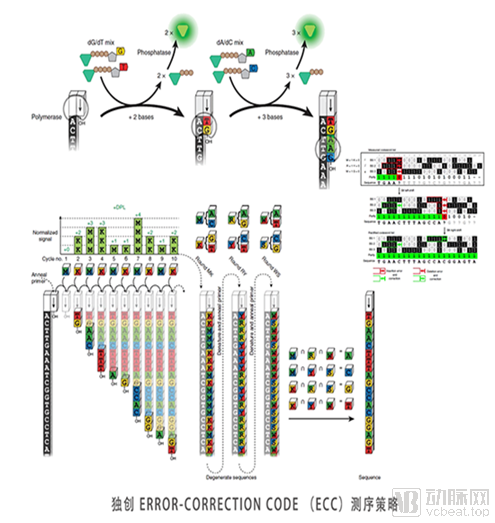
Cygnus has developed a new high-precision sequencing method based on the principles of NGS sequencing and the concept of “code verification” in the field of information and communications technology.It employs orthogonal combinatorial sequencing of the four ACGT bases to generate degenerate sequences, which possess self-verification capabilities. Upon completion of sequencing, a high-accuracy error-correction decoding algorithm is utilized to automatically detect and correct trace sequencing errors that occur during the process, thereby significantly enhancing accuracy while maintaining read length.
By leveraging this technology, the application cost of sequencing the same sample can be significantly reduced, while the error rate of gene sequencing can be lowered to one in ten thousand, on par with first-generation sequencers, thereby better meeting the high-standard sequencing demands of the clinical testing market.
According to data from Nature Reviews Drug Discovery, in 2012, research applications accounted for 67% of the global gene sequencing niche market, while clinical applications accounted for only 18%. By 2017, clinical applications had captured 39% of the global gene sequencing niche market, closely approaching the 43% held by research applications. The market began to shift from a research-dominated model to a parallel development pattern featuring both research and clinical scenarios.
“For hospital clinical laboratories, the demand leans more toward mid-to-low throughput instruments and lower sequencing costs, which are key to clinical medical applications,” said Wu Lei. Clinical testing is the key focus area that Cygnus Biosciences aims to breakthrough with its gene sequencers.
Regarding long-term market promotion and brand competition, Wu Lei stated, “The market requires a cultivation process; customers will not quickly form a singular judgment when selecting gene sequencers. Companies should focus on long-term customer accumulation and user development. Products with advanced technology and superior quality will survive in the fierce market competition.”
Currently, the gene sequencer independently developed by Cygnus has passed laboratory prototype testing. Wu Lei revealed that the product will enter the external testing (clinical trial) phase in 2021 and initiate the registration process for market approval.
“For the past decade, the state has consistently provided strong support for the development of precision medicine. The upstream gene sequencing platforms represent the segment with the highest technical barriers within the entire industry chain; mastering the core technologies in this area is conducive to maintaining a rapid pace of national development in precision medicine. The academician team led by Xie Xiaoliang possesses leading, independently innovated technological advantages. This collaboration will bring positive effects to the gene sequencing industry and even the broader biotechnology sector in our district,” said Wang Kaixiang, General Manager of Gaoxin KeKong.
Wang Zhifei, Executive Director of Jinhe Capital, also stated that in recent years, China’s gene testing industry chain has exhibited a typical oligopolistic competitive landscape. There is an urgent need for more advanced proprietary sequencing technologies to enter the market, break the monopoly, and accelerate application adoption. He expressed strong optimism about the future market potential of Cygnus’s products, noting that its core technologies are highly competitive.
For the Guangzhou Development District, the establishment of Cygnus Biosciences signifies a further optimization of its medical device industry cluster, generating a positive demonstration and driving effect. The principal official of the Guangzhou Development District stated, “The introduction of the Cygnus Biosciences project, led by Academician Xie Xiaoliang, will follow the model of high-end industrial projects such as GE, BeiGene, and InnoCare Pharma. This holds significant strategic importance for accelerating industrial transformation and upgrading to reach the international forefront.”