

Pharma-Insurance Collaboration for Marketing Breakthrough: Miaojiankang Empowers Service Platform Development
As the scale of China’s national centralized procurement continues to expand, the “soul-searching price negotiations” in the pharmaceutical sector are becoming increasingly common, driving a comprehensive transformation of (foreign) pharmaceutical companies’ market strategies in China. In response to this new landscape, pharmaceutical companies can no longer simply rest on the laurels of their brand equity; instead, they must carefully analyze policy trends and market demands, establish new business models, continuously break through existing boundaries, and identify new sources of growth.
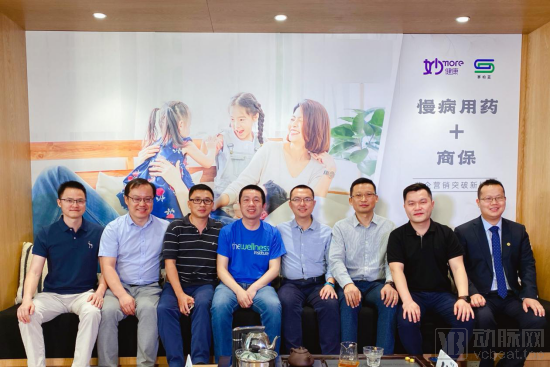
On June 6, 2020, the online salon titled “Chronic Disease Medication + Commercial Insurance: A New Model for Pharmaceutical Marketing Breakthrough,” co-hosted by Miao Health and Sai Bailan, was held in Beijing. The event invited numerous industry leaders from the pharmaceutical and insurance sectors to engage in a roundtable discussion, exploring how pharmaceutical companies can collaborate with insurance companies and health management organizations to jointly create future-oriented new business models in the evolving market landscape.
Amid healthcare cost containment measures, volume-based procurement (VBP), and intensified monitoring of key drugs, many pharmaceuticals—such as newly launched products and specialty drugs—are temporarily excluded from the National Reimbursement Drug List (NRDL), severely restricting their marketing opportunities. Huang Yi, Head of Retail for Prescription Drugs at GlaxoSmithKline (GSK), noted that nearly 90% of foreign pharmaceutical companies’ sales revenue in China comes from off-patent mature products. The “4+7” VBP policy has exerted considerable impact on the industry. For multinational pharmaceutical companies unable to access the hospital market, greater attention should be directed toward out-of-hospital channels, including integration with commercial health insurance, e-pharmacy platforms, and internet hospitals.
Since 2015, the commercial health insurance market has accelerated its expansion, with its scale continuously rising and becoming increasingly attractive to pharmaceutical companies. In Huang Yi’s view, connecting patients, hospitals, pharmacies, and commercial insurance payers through a “point-line-plane-system” framework, supported by robust data, will provide more reliable healthcare and pharmaceutical coverage, thereby unlocking significant market opportunities.
Sheng Yanci, Head of GlaxoSmithKline’s Internet Hospital, also pointed out that China’s accumulation of internet and data capabilities is unique and even world-leading, laying a solid foundation for the future development of multinational pharmaceutical companies. In the future, only through interactive engagement among healthcare providers, pharmaceutical companies, and insurers can business models be truly integrated, transforming the entire landscape of pharmaceutical sales and achieving mutual benefits and win-win outcomes for all parties involved.
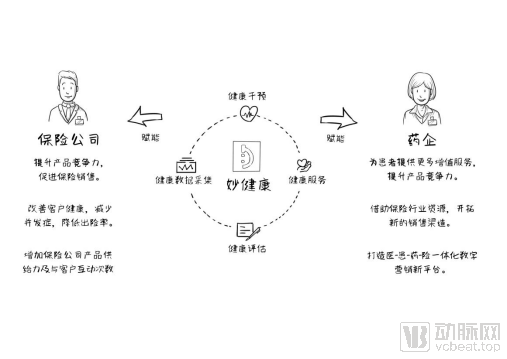
The integration of health insurance and health management has become an inevitable trend. Last December, the newly revised Measures for the Administration of Health Insurance, issued by the China Banking and Insurance Regulatory Commission (CBIRC), officially came into effect, featuring a dedicated chapter on health management. From an insurance perspective, leveraging high-frequency health management services can improve users’ health status, reduce the risk of complications among individuals with pre-existing conditions, achieve cost control, and lower the claim incidence rate.
In April 2019, Taikang Online, in collaboration with WeSure and Shanghai Pharmaceuticals Group, launched the “Medicine God Insurance · Special Anti-Cancer Drug Coverage Plan.” This plan covers all 12 high-cost specialized anti-cancer drugs excluded from the social insurance catalog, providing users with a two-year supply of these medications and related services following a cancer diagnosis. The company also introduced products such as the Taikang Online Mini Medicine Chest. These innovative initiatives combining pharmaceuticals and insurance garnered strong positive responses and acclaim within the industry and market. However, according to Gong Qiao, Deputy General Manager of the Health Insurance Division at Taikang Online, these efforts fall far short of meeting market demands.
Gong Qiao noted that Taikang Online has rapidly accumulated a user base from the internet; however, these users are predominantly young and healthy, meaning claims on their high-leverage insurance products may take a considerable amount of time to materialize. In contrast, China currently has a large population of individuals with pre-existing conditions who urgently need support from commercial insurance. Yet, significant pain points in risk control remain to be addressed, a challenge that health management is well-positioned to resolve.
Which drugs can be covered by commercial health insurance and leverage such coverage to drive sales? An industry insider noted that with over 400 million people suffering from chronic diseases in China, chronic disease medications not reimbursed by basic social medical insurance are likely to be included in commercial health insurance plans in the future. Unlike public insurance, commercial health insurance does not have a specific formulary. In China, the integration of pharmaceuticals and insurance is still in its early stages, and expansion efforts will inevitably encounter challenges. Compared with the Pharmacy Benefit Manager (PBM) model in the United States, there is an urgent need for third-party institutions to help manage prescription drug utilization, a role that domestic health management companies are well-positioned to fulfill.
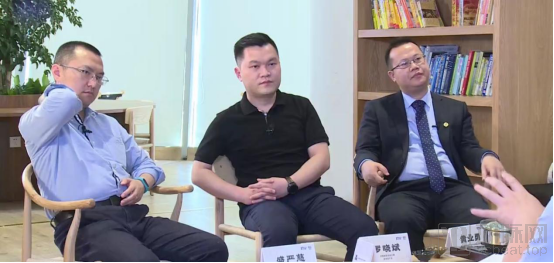
Dr. Luo Xiaobin, Senior Vice President and Chief Medical Officer of Miao Health, stated that while commercial insurance plays a significant role in decision-making within the foreign PBM (Pharmacy Benefit Manager) model, the pathway in China differs. Many insurers lack the capability to implement such models, hindering their practical application. The value of health management to commercial insurance lies in its ability to serve as a critical link, coordinating chronic disease medication management to enhance service quality for patients.
Luo Xiaobin stated that after nearly six years of development, Miao Health has not only mastered the core capabilities of precision health management through technological means such as artificial intelligence, the Internet of Things, and big data, but also introduced cutting-edge international lifestyle medicine to achieve comprehensive online-to-offline scenario-based management. Leveraging high-frequency interactive health management to foster integration between pharmaceutical companies and insurance providers is precisely within Miao Health’s area of expertise.
Regarding the practical integration of pharmaceutical companies with commercial insurance, Wang Jianhui, Vice President of Miao Health and General Manager of its Pharmaceutical Division, proposed two service solutions. The first leverages Miao Health’s health management capabilities, using data as a key driver to integrate pharmaceutical and insurance resources, thereby creating an integrated “medication + services + insurance” solution. This approach opens up new marketing channels for pharmaceutical companies while also boosting insurance product sales.
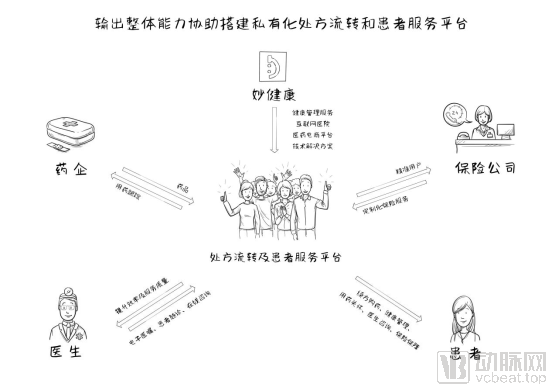
The second solution is more specific, leveraging the Miao Health platform to help pharmaceutical companies develop integrated solutions that connect patients, physicians, and insurance providers. Addressing the need for internal prescription circulation within hospitals, Miao Health delivers comprehensive service capabilities in health management, internet hospital services, pharmaceutical e-commerce, and health technology, thereby establishing a privatized prescription circulation and patient service platform.
“Water benefits all things without contention,” summarized Lin Junfeng, Vice President of More Health. He described More Health as a highly open platform for precision health management and expressed his expectation for in-depth exchanges with pharmaceutical companies, insurance firms, and other partners in the healthcare industry. By integrating advantageous resources across the upstream and downstream segments of the industrial chain, the aim is to provide consumers with the fastest and best services at minimal cost, fostering a progressively thriving ecosystem.