

Zhongyi Zhichuang: 26 Years in the Making, Three Surgical Robots to Pioneer the Chinese Market

ZHONGYI MEDICAL
Surgical Robot R&D and Manufacturer
With the rapid advancement of technology, the emergence of surgical robots has brought infinite possibilities to clinical practice. They not only address key challenges associated with traditional surgery, such as limited precision, prolonged operative times, and surgeon fatigue, but also enhance the patient experience by significantly alleviating surgical pain.
Industry insiders have pointed out that surgical robots are currently one of the hottest sectors in the medical device industry. According to data from PwC Consulting, the global market size for surgical robots was approximately USD 3.5–4 billion in 2016. Based on a comprehensive analysis of internal and external factors, the global surgical robot market is estimated to maintain a compound annual growth rate (CAGR) of around 11%. It is projected that by 2020, the global market size for surgical robots will exceed USD 5.8 billion.
Singapore’s Aimos Group, established in 2011, is an integrated enterprise specializing in the research and development, manufacturing, and sales of surgical robots. Zhongyi Zhichuang Medical Technology Co., Ltd. (“Zhongyi Zhichuang”), invested and established by Aimos Group, was founded in Nanjing in 2018 with plans to enter the Chinese market using three models of minimally invasive surgical robots.
Li Deli, the founder of Zhongyi Zhichuang, studied at the School of Aerospace Engineering of Xi’an Jiaotong University and later pursued a Ph.D. in Theoretical Physics – Quantum Mechanics at the University of Hong Kong.
In 1992, while attending a conference in Singapore, Li Deli learned that the country was beginning to attract global elites to build an Asia-Pacific hub for “smart healthcare.” Already highly optimistic about the prospects of this field, Li Deli immigrated to Singapore after obtaining his Ph.D. in 1993, forgoing opportunities for further study in the United States, and embarked on the research and development of surgical robots.
In 1999, after accumulating extensive experience in the research and development of smart healthcare technologies, Li Deli led members of his core team to establish Infobuz Pte Ltd, completing the R&D of more than 20 intelligent medical robots. In 2011, to achieve the industrialization of medical robots, Infobuz Group integrated multiple relevant teams in Singapore with AGT Group and founded AIMS.
EMUS has integrated over two decades of research achievements from renowned institutions in Singapore, Europe, and the United States in the fields of smart healthcare and surgical robotics, providing effective and safe medical solutions for hospitals, physicians, and patients. In 2018, to expand into the Chinese market and accelerate product commercialization, Li Deli, as the team leader, established Zhongyi Zhichuang in Nanjing.
Zhongyi Zhichuang’s core business spans multiple fields, including intelligent robotics, artificial intelligence, biomedicine, and medical image processing. In its early stages, leveraging the technical team from Emus, Zhongyi Zhichuang has completed the industrial development of several medical robots. The company is preparing to launch four products in the Chinese market: a smart healthcare robotics technology middle platform, a minimally invasive prostate surgery robot, an intelligent labor analgesia robot, and a microwave ablation robot.
Surgical robots are classified as high-end medical devices, characterized by significant challenges in acquiring core technologies, lengthy product development cycles, and stringent requirements for performance and safety.
Its development relies on the integration of core technologies and practical experience from multiple fields, including robotics, computer network control technology, digital image processing technology, virtual reality technology, and medical surgical techniques. It also emphasizes the interdisciplinary convergence of ergonomics, mechanical design, software control, and dynamics. Any single link in this chain can impact its safety, applicability, therapeutic efficacy, or treatment costs. Furthermore, stringent equipment safety monitoring, healthcare industry regulations, and market access oversight contribute to prolonged commercialization cycles and persistently high R&D costs for surgical robots.
Currently, the development process for most surgical robots on the market is driven by defining technical solutions and system functionalities based on specific surgical objectives. However, realizing these system functionalities relies on technologies and practical expertise from multiple disciplines, requiring prolonged research and substantial financial investment to achieve results. Any error in any stage of this process can lead to significant delays in the development cycle or even complete failure of the R&D effort.
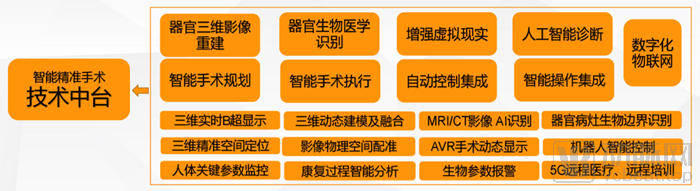
Leveraging over 30 years of technological expertise and drawing on R&D experience from more than 20 medical robots, Zhongyi Zhichuang has developed an “Intelligent Medical Robot Technology Middle Platform.”
(Image provided by Zhongyi Zhichuang)
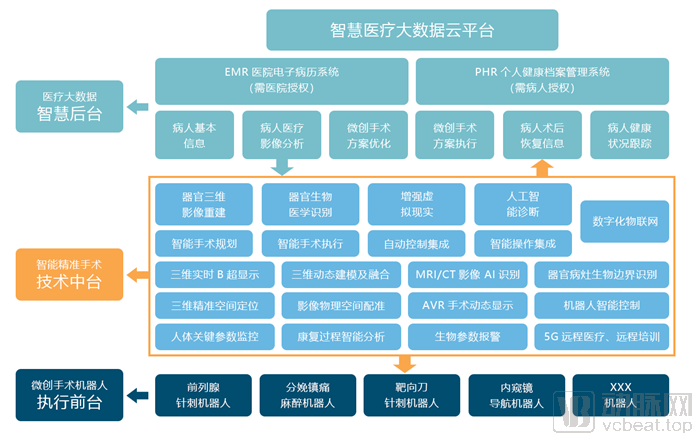
Leveraging the comprehensive empowerment of Emus’s intelligent backend, the Technology Middle Platform integrates widely adopted smart medical technologies into a unified platform. Its built-in capabilities, including biomedical recognition, 3D organ reconstruction, and AI-assisted diagnosis, significantly reduce R&D time and costs, establishing a pivotal bridging platform for the development of traditional medical robots.
(Image provided by Zhongyi Zhichuang)
Dr. Li Deli explained to VCBeat, “Much like most smartphones today, which run on universal operating systems, manufacturers can directly adopt off-the-shelf systems once they have finalized the optimal hardware design, thereby eliminating the need to undertake the majority of software-related R&D efforts. In the development of medical robots, the technical middle platform plays the role of this ‘operating system.’”
The technology middle platform has fundamentally transformed the R&D process for smart healthcare products. By designing functional modules that clearly specify the required technologies based on surgical objectives, developers can complete the research and development of a surgical robot. This approach significantly shortens the R&D cycle, reduces costs, and addresses the scarcity of multidisciplinary talent.
Prostate Minimally Invasive Surgical Robot
Prostate cancer is the second fastest-growing cancer type in China and one of the most common cancers among men worldwide, posing a serious threat to male health. However, another fact stands in contrast: if detected and treated early, the 5-year relative survival rate for patients with localized prostate cancer (tumor confined to the prostate) or regionally advanced prostate cancer can reach 100%.
The prostate minimally invasive surgical robot developed and manufactured by Zhongyi Zhichuang assists physicians in performing precise diagnosis, minimally invasive local therapy, and postoperative dynamic monitoring.
The prostate minimally invasive surgical robot precisely registers patient lesion information obtained through modern medical imaging technologies with the robot’s built-in real-time 3D ultrasound navigation system. Combined with results from routine tests and blood PSA assays, this approach not only increases the single-session diagnostic confirmation rate to over 90%, but also accurately identifies the location and boundaries of lesions, thereby achieving precise diagnosis. This fully digitalized precision diagnostic process addresses a critical limitation in current local minimally invasive therapies—namely, the inability to perform multi-point precise localization of lesion areas, which compromises treatment efficacy—and lays a solid foundation for promoting local minimally invasive treatments and reducing patient trauma.
When using Zhongyi Zhichuang’s minimally invasive prostate surgical robot, physicians can tailor the procedure to the patient’s specific condition by operating the robot to deliver localized minimally invasive therapy through various modalities, such as laser hyperthermia, microwave ablation, or radioactive seed implantation.
Compared with traditional open prostatectomy for prostate cancer, treatment using a minimally invasive robotic surgical system confines tissue trauma to the cancerous lesion and a few pinhole incisions, significantly reducing patient pain. Furthermore, the treatment cost is only 10%–50% of that associated with conventional surgery. More importantly, the integration and digitalization of precise diagnosis with localized minimally invasive therapy provide an effective platform for dynamic monitoring of therapeutic outcomes, enabling timely interventions to improve patient health and extend life expectancy.
Microwave Ablation Robot
Microwave ablation is a localized minimally invasive therapeutic procedure. Its principle involves inserting a needle into the lesion site, delivering microwave energy to the needle tip, and generating high temperatures at that location to destroy the pathological tissue, thereby achieving therapeutic objectives. The clinical applications of microwave ablation technology are extensive, such as radiofrequency ablation for arrhythmia in cardiology and microwave ablation for liver cancer in oncology.
Due to the advantages of local minimally invasive treatment methods, such as significantly reducing patient trauma, lowering the risk of postoperative cancer cell dissemination, and saving medical costs, they will gradually replace current organ resection therapies in the future.
However, current local minimally invasive treatment technologies have three major pain points:
1. Even the most experienced physicians are unable to precisely target multiple sites for treatment or accurately assess therapeutic efficacy;
2. Inability to determine the boundaries of the lesion and ensure complete treatment, posing a risk of postoperative cancer cell dissemination;
3. Current local minimally invasive treatment procedures are not digitized, making it impossible to dynamically monitor outcomes post-procedure to ensure therapeutic efficacy.
These three major pain points cannot be thoroughly resolved by relying solely on physicians’ clinical experience; technological interventions are required to achieve superior therapeutic outcomes.
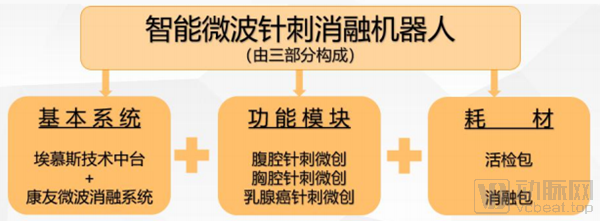
Zhongyi Zhichuang’s microwave ablation robot leverages the aforementioned technology platform, in conjunction with minimally invasive treatment technologies such as the Kangyou Microwave Ablation System, to perform localized minimally invasive therapy.
(Image provided by Zhongyi Zhichuang)
This robot enables precise multi-point localization of lesions through robotic manipulation, addressing the challenge of inaccurate multi-point targeted therapy. By leveraging AI-based 3D imaging technology to identify lesion boundaries and combining it with precise robotic operation, it reduces the risk of postoperative cancer cell dissemination, thereby overcoming the limitation of uncertain therapeutic efficacy. Zhongyi Zhichuang’s microwave ablation robot digitizes the entire diagnostic and treatment process, allowing physicians to access complete records of diagnosis and minimally invasive procedures at any time. These records can be compared with the patient’s current condition and medical information to assess treatment and recovery outcomes, enabling dynamic monitoring and achieving favorable therapeutic results.
Intelligent Labor Analgesia Robot
In the "Notice on Launching Pilot Programs for Labor Analgesia," the National Health Commission proposed enhancing the technical proficiency in labor analgesia and improving the scientific basis for maternal choices regarding delivery methods. By implementing labor analgesia, the proportion of cesarean sections performed due to intolerance of labor pain should be reduced, thereby promoting a gradual decline in the cesarean section rate, increasing the rate of vaginal deliveries, and further improving the health outcomes for both mothers and newborns.
In recent years, the prevalence of labor analgesia in developed countries has exceeded 85%, whereas it remains below 8% in China. Furthermore, survey results indicate that China’s cesarean section rate is as high as 46.5%, ranking first globally and far exceeding the 15% upper limit recommended by the World Health Organization.
One of the main reasons for the difficulty in promoting labor analgesia in China is the shortage of anesthesiologists. It is understood that to achieve the goal of nationwide promotion of labor analgesia, a gap of 300,000 anesthesiologists needs to be addressed.
(Image provided by Zhongyi Zhichuang)
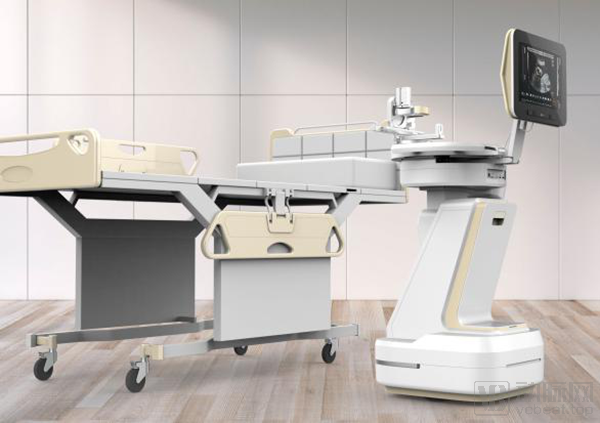
The intelligent labor analgesia robot, developed and manufactured by Zhongyi Zhichuang, digitizes and informatizes the entire anesthesia process for painless childbirth. It automatically performs tasks such as precise anesthetic infusion, continuous monitoring of key maternal indicators, and alerting for abnormal readings. This reduces the technical demands on anesthesiologists and enables a single anesthesiologist to monitor multiple pregnant women simultaneously, effectively addressing the critical shortage of anesthesiologists.
Zhongyi Zhichuang’s establishment in Nanjing has received strong support from the Nanjing Pukou High-Tech Zone. In addition to collaborating with the National University of Singapore (Suzhou Research Institute) to establish the “NUS-Emos Smart Healthcare Research Center,” it jointly founded the “Nanjing Emos Smart Medical Robotics Research Institute” with the Pukou Science and Technology Innovation Investment Group, and partnered with Nanjing University to set up the “Academician Wu Peiheng Workstation,” thereby creating an integrated industry-academia-research base for smart healthcare.
As the epidemic struck, Zhongyi Zhichuang rapidly repurposed Ems’s hospital logistics robots into intelligent disinfection robots, with plans to launch them on the market by July 2020.
Zhongyi Zhichuang believes that with the advent of the 5G era, smart healthcare will be an inevitable trend in the future development of the medical industry. The recent pandemic has highlighted the advantages and potential of robotics in the healthcare sector. Furthermore, as most domestic surgical robot companies are still in their early stages, Zhongyi Zhichuang’s years of R&D experience give it a distinct competitive edge in the industry.
Dr. Li Deli told VCBeat in an interview, “Given the relatively high barriers to entry in the industry, we believe that surgical robots will remain a blue-ocean market for a considerable period of time. Our technology middleware platform can help many startups still engaged in product R&D reduce both development time and costs. We hope to leverage this approach to accelerate the industry’s growth.”