

Preclinic Medical Files IPO Prospectus: Pioneering High-Fidelity Simulation Models for Minimally Invasive Interventional Procedures
In the United States, University Health San Antonio collaborated with a technology team to develop a portable ventilator designed for emergency situations such as power outages. The study utilized high-fidelity patient simulators with adjustable lung compliance features for product testing.
It is reported that this high-fidelity patient simulator closely resembles a real human, capable of simulating various symptoms of COVID-19 and other diseases. The lung compliance of the simulator can be adjusted to test the functionality and calibration of new ventilators. With the assistance of this high-fidelity simulator, the research has progressed smoothly and has entered the final approval stage.
Advanced simulators, also known as virtual patients, virtual clients, or high-fidelity models, refer to models that replicate the anatomical and pathological characteristics of specific target populations. These models are developed by healthcare professionals using acquired population-specific data, computer programs, and 3D printing technologies, and are primarily used for medical device product testing, surgical training, and other applications.
High-fidelity simulators play a pivotal role in the research and development of medical devices and in the training of specialist physicians.During the research and development process, medical device manufacturers need to utilize high-fidelity models to test their products, in order to reduce R&D costs, shorten development timelines, and ensure that the products can address actual clinical needs upon market launch.Even after the product is launched, models are still required for surgical rehearsal and physician training.
Medical simulation models have a long history in China, with companies entering this field as early as the 1990s. Currently, there are approximately 40 enterprises engaged in the research and development of medical simulation models.
However, the simulation models currently available on the market are all developed for traditional surgeries, lacking simulation models specifically designed for minimally invasive interventional procedures. Additionally,Minimally invasive interventional procedures demand extremely high fidelity from simulation models, requiring human-like anatomical structures, realistic haptic feedback, texture, and lubricity. Current commercially available simulation models lack sufficient precision and fall far short in terms of realism.
In 2017, Preclinic Medtech (Shanghai) Co., Ltd. (hereinafter referred to as "Preclinic Medical") was established, dedicated to developing high-fidelity models and simulation devices for minimally invasive interventional surgical instruments, used for R&D testing, demonstration, and educational training of surgical instruments.Currently, the company has successfully developed a series of high-fidelity models for the cardiovascular, respiratory, digestive, and urinary systems, and has provided these models along with bench testing apparatuses to numerous hospitals in China and well-known medical device manufacturers both domestically and internationally.
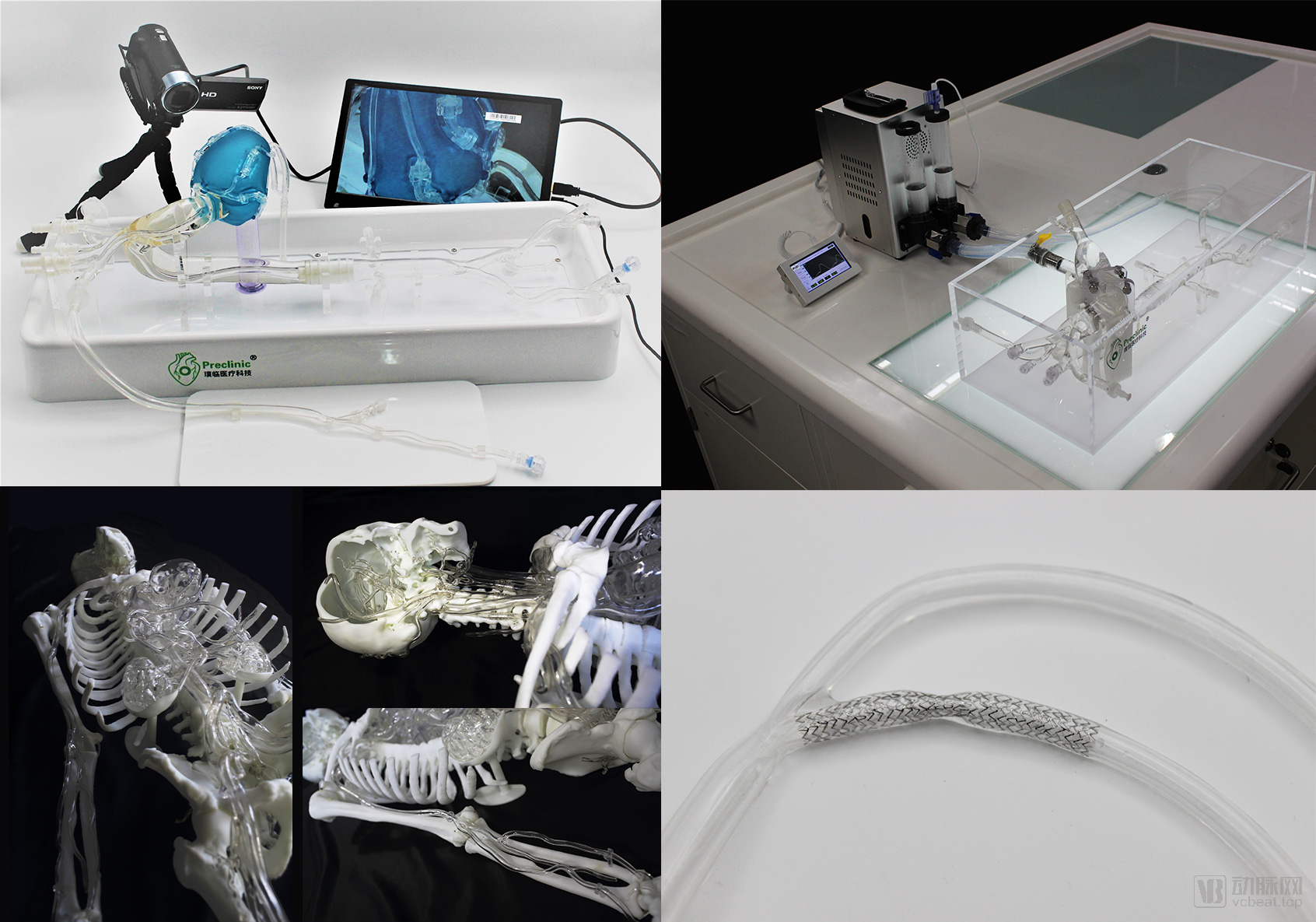
Silicone Vascular Model
The founding team has delivered numerous landmark cases in the medical 3D printing industry.
Preclinic Medtech’s core team comprises engineers specializing in medical image processing, structural design, material development, material forming, and software development. The company has accumulated years of technical expertise in clinical data, design solutions, biomimetic tissue materials, and the fabrication of complex anatomical structures.
The company’s founding team possesses extensive experience in developing projects that integrate medicine and engineering, and has been dedicated to the technological development and external service provision of 3D-printed surgical models for medical applications.Previously, they primarily developed surgical models for traditional open surgeries and completed numerous classic cases in the medical 3D printing industry.
For example, the company’s founding team customized a surgical model for a patient requiring hepatic resection. This model accurately replicated the patient’s specific anatomy, enabling surgeons to perform the liver resection precisely according to the preoperative rehearsal conducted on the model. This approach shortened operative time and ensured patient safety.
Compared with traditional open surgery, minimally invasive interventional procedures aim to achieve optimal therapeutic outcomes through specific techniques that cause minimal trauma to patients. In recent years, minimally invasive interventional surgery has become a new trend. The number of such procedures performed annually in China has been steadily increasing, the number of manufacturers developing related devices has grown, and demand for high-fidelity minimally invasive interventional surgical models has risen accordingly.
With the rise of minimally invasive interventional procedures, physicians have increasingly asked the founding team of Preclinic Medtech whether it could develop high-fidelity models for minimally invasive interventional surgery to support hospital-based surgical training and simulation.
The high demand among physicians for minimally invasive interventional procedure models has enabled the founding team of Preclinic Medtech to identify significant market opportunities in this niche sector.In 2014, the company’s founding team began research and development of high-fidelity 3D-printed human organ models, providing clinicians with a variety of 3D-printed models through project-based collaborations.
Material Modification Technology + Real Clinical Cases, Highly Restoring Human Tissue Anatomical Structures and Physical Texture
Compared with traditional open surgical models, the development of minimally invasive interventional surgical models is more challenging, with stringent requirements for model precision, fidelity, and transparency. Taking cardiovascular models as an example, minimally invasive interventional surgical models need to replicate anatomical dimensions, compliance, and other characteristics of human blood vessels as closely as possible, which poses significant challenges for developers.
To develop highly realistic surgical models that closely replicate human tissues, Preclinic Medtech has achieved numerous technological breakthroughs.Based on medical imaging and 3D printing technologies, the company has developed high-fidelity human organ materials and fabrication processes with independent intellectual property rights. These innovations accurately simulate the histological anatomy and performance of human organs, providing a highly realistic tactile experience during procedures.
Preclinic Medtech also collaborates with clinical experts,With a library of nearly 10,000 3D models from clinical cases, it enables customers to select appropriate case models for the convenient development of customized models and devices.
To date, the company has developed model series for the cardiovascular, respiratory, digestive, and urinary systems.

Preclinic Medical Products and Services Cover the Full Lifecycle of Medical Devices
According to Peng Changhao, Channel Director at Preclinic Medtech, the cardiovascular series models are made from modified high-transparency silicone. Featuring high transparency and realism, they accurately simulate vascular hemodynamics and anatomical morphology, serving as the company’s flagship products.Preclinic Medtech has partnered with dozens of hospitals and nearly 100 domestic and international medical device companies to provide long-term services featuring high-fidelity minimally invasive interventional surgical models.
High-fidelity models are widely used in the field of minimally invasive interventional surgery. The application scenarios of Preclinic Medtech’s minimally invasive interventional surgical models primarily include medical device R&D, medical device demonstration and promotion, surgical demonstrations, and clinical surgical training.
In the field of medical device R&D, Preclinic Medtech provides comprehensive services for the design and fabrication of human-simulated organs, supporting medical devices from proof-of-concept and functional verification to pre-clinical trial validation, while also integrating with relevant testing equipment.To facilitate the transition of medical devices from concept to clinical application, helping R&D institutions shorten time-to-market and reduce development costs.
In medical device demonstrations and surgical demonstrations, Preclinic Medtech can leverage real human CT and MRI data. Through in-depth collaboration between its engineers—who possess extensive experience in medical-engineering integrated projects—and device manufacturers as well as clinicians, the company designs and fabricates high-fidelity models and devices that fully showcase the features and advantages of the medical instruments.Help device manufacturers better demonstrate the usage process of their devices through intuitive models, while enabling physicians to better appreciate the advantages of new devices and thereby improve surgical outcomes.Furthermore, this class of models can also assist physicians in clinical surgical instruction.
In the field of clinical surgical training, the company develops high-fidelity models and training devices based on clinical case data. These tools assist clinicians in surgical training by capturing specific cases encountered by physicians in the form of high-fidelity simulations, thereby enabling their dissemination and application across other institutions.To help more physicians become proficient in the surgical diagnosis and treatment of such cases, thereby enhancing the surgical capabilities of doctors in underdeveloped regions.
Peng Changhao stated that the market for minimally invasive interventional surgical models in China is currently dominated by imported products. These imports are prohibitively expensive, with a single customized model costing anywhere from over 100,000 to several hundred thousand yuan, and they involve lengthy production lead times, typically requiring a wait of up to three months.Compared with imported products, Preclinic Medtech’s minimally invasive interventional surgery models are not only more affordable but also have a shorter production lead time of just one month or even less.
Domestication of Medical Devices Drives the Development of China’s High-Fidelity Simulation Model Industry
Peng Changhao noted that minimally invasive interventional procedures in China are still in their nascent stage, with only a limited number of hospitals capable of performing such procedures; consequently, the market size for minimally invasive interventional procedure models in China remains relatively small.
However, Peng Changhao also believes that minimally invasive interventional surgery is an emerging trend, with its volume certain to increase year by year. Among the driving forces, the localization of medical devices is a key factor propelling the development of the high-fidelity simulation model industry."Surgical models are an indispensable component of the healthcare ecosystem. It is believed that with the growing prevalence of minimally invasive interventional procedures and the increasing localization of medical devices, demand for high-fidelity models will experience a surge."
Peng Changhao is highly optimistic about the development prospects of minimally invasive interventional surgery models. In the future, Preclinic Medtech will continue to deepen its roots in the field of minimally invasive interventional surgery, optimizing and improving its products by enhancing material texture and anatomical precision, and integrating sensory equipment, thereby achieving a comprehensive improvement in the simulation fidelity of surgical models. “We aim to increase the prevalence and technical proficiency of minimally invasive interventional procedures through these surgical models, indirectly alleviating patient suffering, while also promoting the completion of the domestic R&D and manufacturing supply chain for minimally invasive interventional devices, thus contributing to the advancement of minimally invasive interventional surgery.”