

NovoRegen Medical Files IPO Prospectus: Pioneering Clinical-Oriented Bioprinting Platform for Tissue and Organ Repair
Biological 3D printing technology aims to create three-dimensional images of artificial tissues and biological organs, then use computer-aided design to develop 3D models, which are layered and numerically controlled for programming. This process processes active materials, including biomaterials, growth factors, and cells, as the main components, ultimately manufacturing artificial tissues or organs with biological functions.
Owing to its speed, accuracy, and proficiency in fabricating complex structures, bioprinting has emerged as the most promising technology in regenerative medicine, attracting numerous companies to enter the field, including Novaprint Therapeutics.
Novaprint Therapeutics, established in 2016, is a high-tech enterprise specializing in bioprinting. It focuses on leveraging bioprinting technology to develop clinically accessible products for tissue and organ repair.Currently, the company has independently developed the OPUS (Organ Printing United System) printing platform suitable for clinical applications. This platform is capable of printing viable soft tissue products and hard tissue implants, compatible with various biological cells, and creates a microenvironment conducive to long-term cell survival.
Regenerative Medicine Reaches a Technological Transition Point, with the Potential of Bioprinting Coming to the Fore
The application prospects for regenerative tissue engineering products fabricated using bio-3D printing technology are highly promising, with Novaprint Therapeutics targeting the field of tissue and organ repair.
Due to aging, accidents, trauma, chronic diseases, and other factors, China has a substantial annual demand for tissue repair and organ transplantation.Relevant data show that there are approximately 3 million patients with bone defects and injuries, 4 million patients with skin defects, and 1.5 million patients awaiting organ transplantation in China each year.
Autologous and allogeneic transplantation are commonly used methods in the field of tissue and organ repair. However, autologous transplantation is significantly limited by donor site availability, while allogeneic transplantation carries the risk of immune rejection. Furthermore, China faces a severe imbalance between the supply and demand for donors, with only 1 in 150 patients receiving the transplanted organs they need.
In this context, regenerative tissue engineering products have emerged as a breakthrough in addressing the supply-demand imbalance in the field of tissue and organ repair. Yang Xi, Co-founder and CEO of Novaprint Therapeutics, believes thatThe field of tissue and organ repair has reached a critical tipping point for technological transition, where bio-3D printing technology holds significant promise.It was based on this judgment that the company’s founding team established Novaprint Therapeutics in 2016.
Everyone is a specialist in their niche and, even more so, a generalist across interdisciplinary fields.
Bio-3D printing is an interdisciplinary field encompassing regenerative medicine, materials science, mechanical engineering, and digital medicine. Currently, Novaprint Therapeutics has assembled a team of experienced and diverse professionals.The team includes leading authorities in regenerative medicine with over 20 years of experience in skin regeneration, seasoned professionals with decades of expertise in materials science, mechanical engineering, and medical devices, as well as industry veterans with more than 10 years of experience in innovative product commercialization.
“The core team at Novaprint Therapeutics possesses the professional expertise to address some of the key technical challenges in current bioprinting, while also translating cutting-edge technologies into commercial products.”
Meanwhile, Yang Xi emphasized:“Everyone in the company is not only a specialist in their niche field but also a generalist across interdisciplinary domains.”Novaprint Therapeutics has always been committed to clinical needs-oriented R&D. In the product initiation and development stages, researchers study medical knowledge and visit hospitals to observe surgical procedures firsthand, ensuring that their products better serve doctors and patients.
"Launching a Bio-3D Printing System Tailored to Clinical Needs"
Currently, Novaprint Therapeutics has independently developed a comprehensive bioprinting solution based on the OPUS multi-process integrated printing platform, including the OPUS printing platform, an efficient bioink development system, and clinically applicable printing processes.
According to Yang Xi, the core competitive advantages of the OPUS platform are reflected in two aspects:
Simultaneous printing of bioprinting materials (cells, natural macromolecules, synthetic polymers, etc.).The products to be printed include both soft and hard tissues, exhibiting heterogeneity. In simple terms, different materials require different printing processes and printers. The OPUS platform enables simultaneous zoned printing of materials with varying viscosities (high and low), temperatures (high and low), and multiple cross-linking and curing methods.
The OPUS platform breaks through the limitations of standard printing sizes and meets the environmental control requirements for clinical product development.Traditional bio-3D printers are limited to printing small-sized constructs, failing to meet the clinical demand for large-scale products such as bones. In contrast, OPUS can accommodate human-scale dimensions, enabling single-step fabrication of full-size implants.
Novaprint Therapeutics has developed a variety of bioinks for cell printing, capable of printing skin, cartilage, and mesenchymal stem cells.Create a microenvironment conducive to long-term cell survival, and it is easy to print, widely supporting clinical applications.
The key to the printing process lies in constructing intricate three-dimensional structures that mimic the microenvironment of the extracellular matrix, thereby promoting functionalization and vascularization of transplanted tissues or organs. Meanwhile, Novaprint places significant emphasis on clinical practicality, balancing mechanical strength, biocompatibility, surgical procedures, and ease of use.
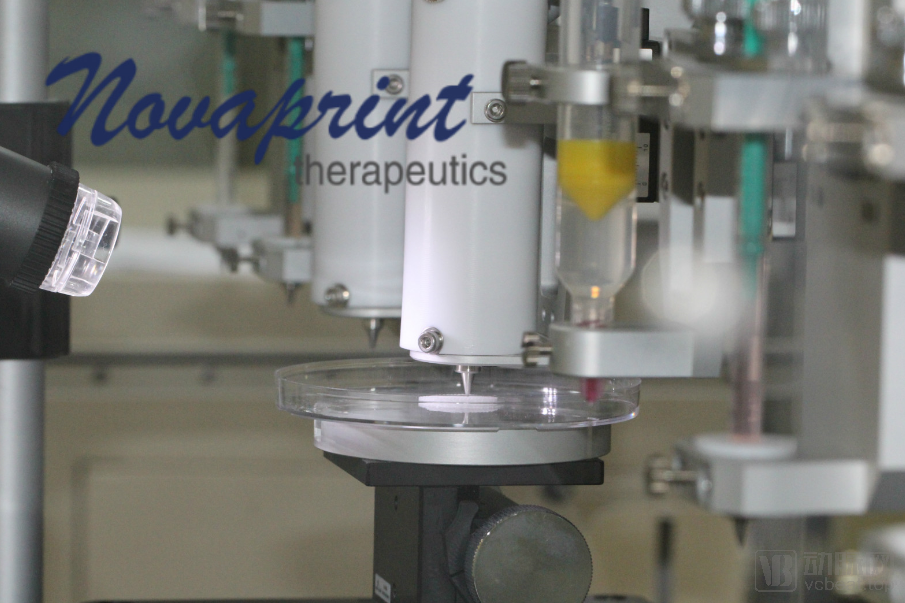
The OPUS Printing Platform Is a Truly Versatile, Clinically Practical Solution for Multiple Scenarios
Based on the OPUS printing platform, Novaprint Therapeutics is developing a series of products for hard and soft tissue repair. Yang Xi stated, “The company is currently engaged in small-batch production and is actively advancing clinical trials. We expect to obtain regulatory approval within three years.”
Meanwhile, during its development, Novaprint Therapeutics’ OPUS bio-3D printing platform has garnered high recognition from multiple hospitals and research institutions.In 2019, Novaprint Therapeutics officially launched the OPEN-LAB initiative, leveraging the OPUS platform to introduce 3D bioprinting services and provide novel solutions based on bio-3D printing for leading medical institutions and industrial clients.
It is understood that, to date, Novaprint Therapeutics has established collaborations with dozens of medical institutions in areas such as medical-engineering interdisciplinary integration and scientific research services, covering more than 100 service projects.

Bioprinting is the most cutting-edge field in 3D printing research.
Data shows that the global 3D printing industry had a total output value of $9.68 billion in 2018, and is projected to reach $35.6 billion by 2024. Among this, medical 3D printing accounts for 28% to 37% of the total industry output. In 2018, the global market size for medical 3D printing reached $3.42 billion, and it is expected to grow to $9.639 billion by 2024.
As the most cutting-edge field in medical 3D printing research, the bioprinting market is also poised for rapid growth and is expected to become a key area for the large-scale adoption of 3D printing technology.
Yang Xi has clearly observed that, compared with previous years, the field of biological 3D printing has been unprecedentedly active in the past two years, with a growing body of scientific research and a continuous emergence of new enterprises. “In summary, this industry has made significant progress and breakthroughs compared to earlier years. In the future, Novaprint Therapeutics will collaborate with industry partners to jointly drive the development of the sector.”
However, Yang Xi also pointed out that China’s bio-3D printing market still has a weak industrial foundation and an incomplete supply chain. Many raw materials used in bio-3D printing remain dependent on imports. In addition, there is a shortage of talent with R&D experience in bio-3D printing in China.
“These objective factors dictate that the overall development pathway for bio-3D printed products is exceptionally long, with high barriers to entry. However, once established, products enjoy a very long lifecycle, characterized by the coexistence of high entry barriers and substantial returns.”“Novaprint Therapeutics is actively collaborating with upstream and downstream partners across the industry chain and training interdisciplinary teams of medical and engineering professionals, aiming to accelerate product commercialization and secure a foothold in the field of bioprinting.”